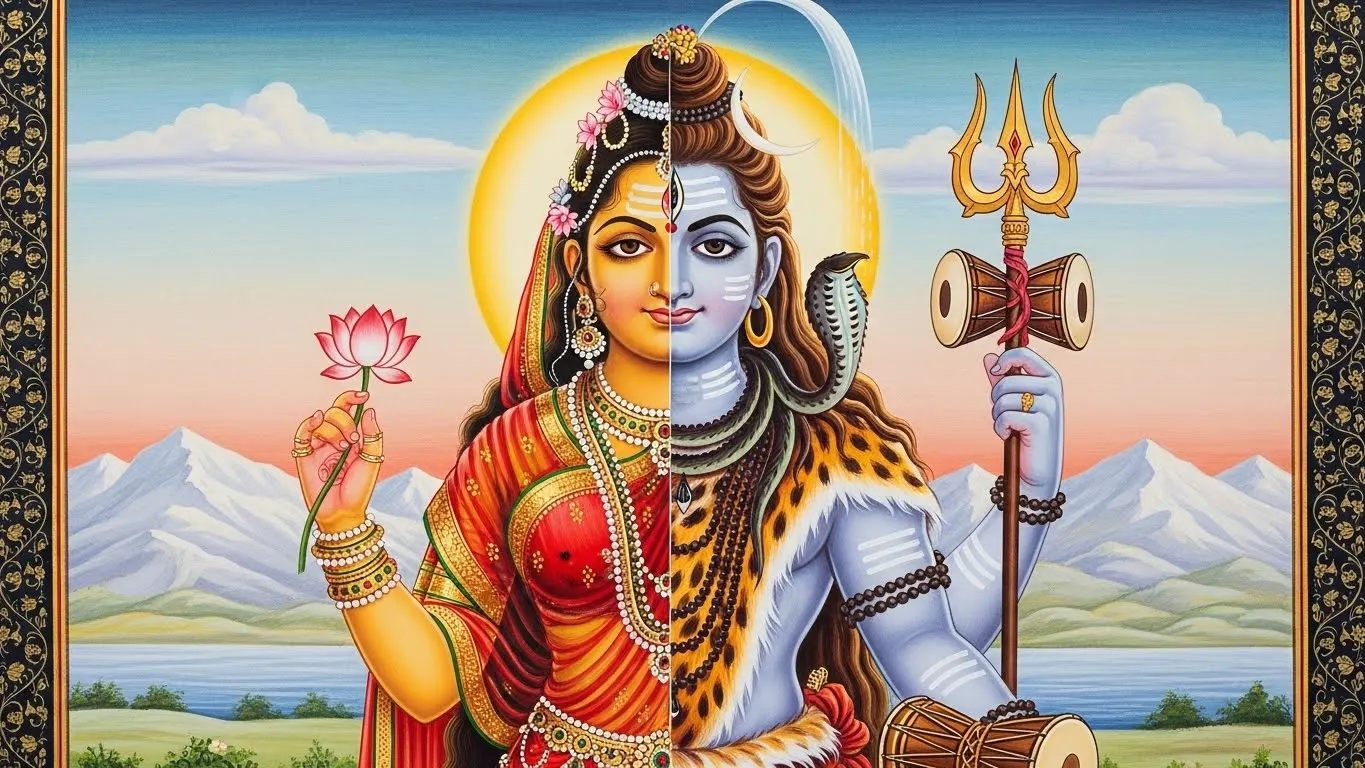
Half-Shiva Half-Parvati In Hindu theology’s profound symbolic vocabulary expressing metaphysical truths through embodied divine forms, Ardhanarishvara—literally “the Lord who is half-woman” from Sanskrit “ardha” (half), “nari” (woman), and “ishvara” (lord/god)—represents one of the most philosophically significant manifestations: a composite androgynous deity whose right half is male Shiva and left half is female Parvati (Shakti), merged into a single body split precisely down the middle, visually communicating the fundamental non-dual teaching that masculine and feminine, consciousness and energy, spirit and matter, transcendence and immanence, asceticism and worldly engagement are not opposing forces requiring reconciliation but inseparable complementary principles that have never been separate—together constituting the root and womb of all creation.
The iconography meticulously distinguishes the two halves: the right male Shiva side displays matted hair (jata) piled high and adorned with crescent moon, Ganga river, skull, serpent around neck, third eye on forehead, holding trident (trishula), drum (damaru), or rosary (rudraksha mala) representing asceticism and spiritual discipline, wearing tiger or elephant skin garment, rugged angular masculine physique, while the left female Parvati side shows elaborately styled hair decorated with flowers, pearls, and jeweled crown, ornate jewelry including distinctive patra-kundala (leaf-shaped) earring, rounded breast, curved feminine hip, narrow waist, holding mirror (darpa
na) representing material world and self-reflection or lotus (padma) symbolizing purity, wearing silken colorful sari, delicate graceful feminine form](https://www.dollsofindia.com/library/ardhanarishvara-symbolism/)—yet both halves share a single body, common waist, and often a composite face symbolizing unified consciousness behind apparent duality. This form represents the synthesis of Purusha (consciousness, the unchanging witnessing awareness, masculine principle) and Prakriti (energy, dynamic creative nature, feminine principle) from Samkhya philosophy, teaching that without Shakti, Shiva becomes “shava” (corpse)—inert, lifeless consciousness unable to manifest or create; without Shiva, Shakti lacks direction and purpose becoming chaotic undirected energy—making their union not merely symbolic marriage but ontological necessity for existence itself, like fire and its heat which conceptually differ but cannot exist separately in reality.
According to Shiva Purana’s creation narrative, when Brahma the creator god had produced only male beings (the Prajapatis) through mind-born creation and commanded them to regenerate and continue creation, they proved completely unable to procreate, creating a crisis as the pace of creation declined dramatically; confronted with this existential problem and perplexed by his failure, Brahma meditated intensely on Lord Shiva seeking guidance and help; to enlighten Brahma of his fundamental folly in attempting creation through masculine principle alone, Shiva appeared before him in the magnificent Ardhanarishvara form—half-male, half-female—revealing that creation requires both male and female principles working together in complementary union, demonstrating that generative power flows from gender complementarity rather than masculine sufficiency.
The Skanda Purana offers an alternative intimate origin where Parvati lovingly requests Shiva to allow her to reside with him embracing “limb-to-limb” in perpetual inseparable union, resulting in the Ardhanarishvara formation where she literally merges with half his body; this same text narrates how when the lustful demon Andhaka desired to seize and possess Parvati, she strategically revealed her Ardhanarishvara form to him—the unexpected half-male, half-female composite appearance confused and disturbed the demon’s desire, causing him to lose all interest and depart, demonstrating the form’s protective power transcending conventional gender-based attraction.
Philosophically, Ardhanarishvara reconciles apparently conflicting life paths: Shiva’s ascetic matted hair, third eye, meditation posture, and rosary associate him with renunciation, withdrawal from material world, and pure spiritual pursuit, while Parvati’s elaborate jewelry, mirror, beautification, and household activities connect her to material illusory world (maya) and worldly engagement, yet their fusion in one body teaches that material and spiritual dimensions must coexist in complete human life rather than requiring rejection of one for the other—the ideal householder (grihastha) integrating family responsibilities with spiritual practice embodies this sacred balance demonstrated by Ardhanarishvara.
In contemporary discourse, Ardhanarishvara has become a powerful symbol for gender non-binary, transgender, and LGBTQ+ spiritual seekers recognizing that ancient Hindu theology honored gender fluidity and the transcendence of binary categories thousands of years before modern Western gender theory, though traditional Hindu interpretations emphasize complementarity of distinct masculine-feminine principles rather than gender ambiguity or androgyny as sexual orientation, creating complex contemporary negotiations between devotional tradition and progressive reinterpretation.
Famous Ardhanarishvara sculptures include the magnificent 6-meter panel in Elephanta Caves near Mumbai carved during the Rashtrakuta dynasty (6th-8th century CE) showing intricate detail distinguishing the male and female halves with son Kartikeya and Brahma accompanying the central figure, the iconic bronze Chola sculpture from 10th-11th century Tamil Nadu displaying exquisite craftsmanship now housed in various museums, and temple carvings at Ellora, Badami, and Khajuraho demonstrating the form’s pan-Indian popularity and theological significance.
Understanding Ardhanarishvara reveals fundamental Hindu teachings about non-duality underlying apparent duality, the necessity of balancing rather than choosing between competing life values, the equal sacredness and cosmic necessity of both masculine and feminine principles, the integration of transcendence with immanence as complete spirituality, and the theological assertion that ultimate reality transcends all categories including gender while honoring multiplicity at manifestation level—making this half-male half-female divine form far more than artistic curiosity but rather a profound philosophical statement about the nature of existence itself.
This comprehensive exploration examines Ardhanarishvara’s meaning and etymology, detailed iconographic analysis distinguishing male and female halves, origin myths from Shiva Purana and Skanda Purana, the Purusha-Prakriti philosophical synthesis, symbolic meanings balancing opposites, famous temples and sculptures, worship practices and mantras, contemporary gender interpretations, and spiritual lessons for modern seekers.
Meaning and Etymology
The term “Ardhanarishvara” combines three Sanskrit components revealing its essential nature.
Breaking Down the Name
Ardha (अर्ध): Half, partial, one of two equal parts
Nari (नारी): Woman, female, feminine
Ishvara (ईश्वर): Lord, god, supreme being, controller
Combined, Ardhanarishvara means “the Lord who is half-woman” or “the god who is half-female”, directly describing the visual appearance where the deity’s body is divided equally between male and female characteristics.
Half-Shiva Half-Parvati Alternative Names
The form is also known by several alternative names reflecting regional and textual variations:
- Ardhanaranari: Half-man-half-woman
- Ardhanarinateshvara: The Lord of Dance who is half-woman
- Ammaiyappan: Tamil name meaning “Mother-Father”
- Naranari: Man-Woman
- Parangada: One who has a woman’s side
Detailed Iconography: Distinguishing the Two Halves
The Shiva (Right) Side
The right half displays distinctly masculine Shiva iconography:
Ear: Longer earlobe stretched from years wearing heavy earrings, often with simple kundala ornament
Demeanor: Austere, meditative, detached expression reflecting transcendent consciousness
The Parvati (Left) Side
The left half displays distinctly feminine Shakti iconography:
Forehead: Decorative tilaka mark, arched eyebrow shaped carefully, serene eye with full feminine expression
Demeanor: Gentle, compassionate, engaged expression reflecting immanent nurturing energy
Unified Elements
Despite clear differentiation, certain elements remain unified emphasizing inseparability:
Common Torso/Waist: The two halves merge at the vertical midline sharing single spine, common waist, unified torso demonstrating one body
Composite Face: Some sculptures show a single face serving both halves; others show composite face with Shiva’s features on right and Parvati’s on left
Shared Third Eye: Both halves share the third eye on forehead symbolizing unified spiritual consciousness
Common Vehicle: Often depicted standing or seated on Nandi the bull (Shiva’s vehicle), though some show one leg on Nandi and other on lotus
Origin Myths and Sacred Narratives
Shiva Purana: Enlightening Brahma
The Problem: After the cosmic dissolution (pralaya), Brahma was enjoined to recreate the worlds and all beings. He created male beings—the Prajapatis (progenitors)—through his mind-born powers (manasa-putra) and commanded them to procreate and continue creation.
The Crisis: The male Prajapatis proved completely unable to reproduce without female counterparts. No offspring were produced, and creation stalled, declining in pace and vitality. Brahma fell into great sorrow and perplexity, unable to understand why his creation had failed.
The Divine Voice: As Brahma contemplated his failure, he heard a voice from the heavens declaring: “Create through the union of Man and Woman”. But Brahma lacked the power to create Woman independently.
Seeking Shiva’s Grace: Recognizing that only through Shiva’s grace would he succeed, Brahma resolved to gain Mahadeva’s favor through strenuous tapas (austerities). He meditated intensely on Lord Shiva, contemplating the supreme deity and seeking guidance.
The Revelation: To enlighten Brahma of his fundamental error—attempting creation through masculine principle alone—Shiva appeared before him as Ardhanarishvara, the magnificent half-male half-female form. This visual demonstration immediately revealed that creation requires both male and female principles working in complementary union.
The Solution: Brahma immediately realized his folly and prayed specifically to the female half of Ardhanarishvara. He requested that the goddess provide him with female beings to serve as counterparts to the male Prajapatis. The compassionate goddess agreed and created various female powers (Shaktis, Devis) from her own divine body. These female beings united with the male Prajapatis, enabling sexual reproduction and allowing the stalled creation to progress successfully.
Philosophical Lesson: This narrative teaches that creation—and by extension, any generative or creative endeavor—requires the balanced cooperation of masculine and feminine principles. Masculine alone is sterile and unproductive; only through complementary union does fertility and manifestation occur.
Linga Purana: Emerging from Brahma’s Fury
The Linga Purana offers a more dramatic variant emphasizing the transformative power of divine fury.
In this version, Rudra (identified with Shiva) appears as Ardhanarishvara, emerging from Brahma’s head, forehead, mouth, or soul as the embodiment of Brahma’s accumulated fury and frustration at the slow pace of creation. The Ardhanarishvara Rudra is described as so intensely hot with creative-destructive energy that in the process of appearing from Brahma’s forehead, he actually burns Brahma himself.
Ardhanarishvara Shiva then enjoys his own female half—the Great Goddess—through “the path of yoga” (yogic union), and from her body creates Brahma and Vishnu themselves, establishing that even the creator Brahma emerges from the union of masculine-feminine principles embodied in Ardhanarishvara.
The text ordains that in the repetitive cycle of cosmic aeons (yugas), Ardhanarishvara is destined to reappear at the beginning of every creation just as in the past, making this form the eternal prototype of creative power.
Skanda Purana: Parvati’s Loving Request
The Skanda Purana offers a more intimate devotional narrative emphasizing marital love.
In this version, Parvati lovingly requests Lord Shiva to allow her to reside with him in perpetual inseparable union, embracing “limb-to-limb” so that she never needs to be apart from her beloved. Shiva, moved by her devotion and recognizing her as his eternal complementary half, grants her wish by manifesting the Ardhanarishvara form where she literally merges with half his divine body.
Demon Andhaka Episode: This same Purana narrates that when the lustful demon Andhaka desired to seize and possess the beautiful Parvati for himself, she cleverly revealed her Ardhanarishvara form to him. The unexpected composite half-male, half-female appearance confused the demon’s conventional desire and attraction, causing him to lose all interest and depart. This demonstrates the form’s protective power—transcending conventional gender-based attraction and confusing those whose lust depends on binary gender categories.
Other Puranic Variants
Similar Ardhanarishvara narratives appear in the Vayu Purana, Vishnu Purana, Kurma Purana, and Markandeya Purana, with variations in details but consistent theological message about the necessity of masculine-feminine complementarity for cosmic functions.
Purusha-Prakriti: Philosophical Synthesis
Samkhya Dualism and Its Resolution
Purusha (पुरुष): Pure consciousness, the unchanging witnessing awareness, eternal spirit, the masculine principle that observes but does not act
Prakriti (प्रकृति): Primordial nature, dynamic creative energy, constantly changing matter, the feminine principle that acts but lacks consciousness on its own
According to Samkhya, neither Purusha nor Prakriti can function independently: Purusha without Prakriti remains inert, unable to manifest or create—consciousness without energy becomes like a corpse (shava). Prakriti without Purusha becomes chaotic, directionless energy lacking purpose or awareness—power without wisdom destroys rather than creates.
Ardhanarishvara as Embodied Unity
Right Shiva Side = Purusha: Represents consciousness, awareness, transcendence, the witnessing principle, static unchanging spirit, masculine polarity
Left Parvati Side = Prakriti: Represents energy, nature, immanence, creative power, dynamic changing matter, feminine polarity
Single Body = Unified Reality: Despite conceptual distinction, they share one body, demonstrating that consciousness and energy are two aspects of singular ultimate reality
This teaches that the distinction between spirit and matter, consciousness and energy, masculine and feminine exists only at the level of manifestation and conceptual analysis. At the ultimate level, they are inseparable—like fire and its heat, or sun and its light—different in conception but unified in existence.
The “Shiva as Shava” Teaching
A famous Tantric maxim states: “Shivah Shakti-vihinah Shavah” (Shiva without Shakti is a corpse).
This teaching emphasizes that pure consciousness (Purusha/Shiva) without dynamic energy (Prakriti/Shakti) remains lifeless potential unable to manifest as creation. Conversely, energy without consciousness becomes blind chaotic force lacking direction.
Ardhanarishvara demonstrates their mutual necessity—neither half can exist or function without the other. Together they form the complete divine being capable of all cosmic functions: creation, preservation, destruction, concealment, and grace.
Symbolic Meanings: Balancing Opposites
Transcendence and Immanence
Shiva’s ascetic attributes (matted hair, ash, meditation) represent transcendence—withdrawal from material world toward pure spirit. Parvati’s worldly attributes (jewelry, mirror, household engagement) represent immanence—divine presence within material creation.
Their union teaches that complete spirituality requires both transcendent realization and engaged worldly life. The ideal is not to escape the world but to recognize divinity within it—the householder who integrates family responsibilities with spiritual practice embodies Ardhanarishvara’s balance.
Renunciation and Enjoyment
Shiva’s rosary represents renunciation (tyaga), meditation, and ascetic discipline. Parvati’s mirror represents enjoyment (bhoga), beauty, self-adornment, and sensory pleasure.
Ardhanarishvara teaches that spiritual life need not reject pleasure and beauty, nor should worldly life abandon discipline and awareness. The integration of tyaga and bhoga creates balanced fulfillment.
Knowledge and Action
Shiva represents jnana (knowledge, wisdom, contemplation)—the philosophical approach to liberation through understanding. Parvati represents karma (action, engagement, service)—the practical approach to spirituality through righteous deeds.
The unified form demonstrates that knowledge without action remains theoretical and incomplete, while action without wisdom becomes blind and potentially harmful. Effective spirituality integrates both paths.
Stillness and Movement
Shiva embodies stillness (sthira)—the unchanging eternal center, like the axis around which the universe revolves. Parvati embodies movement (chala)—the dynamic dancing energy that creates the universe’s rhythms and cycles.
Severity and Compassion
Shiva’s destructive third eye and austere demeanor represent severity (ugra)—the strict justice that destroys evil and tests devotees. Parvati’s gentle smile and blessing gestures represent compassion (karuna)—the maternal love that forgives and nurtures.
Famous Temples and Sculptures
Elephanta Caves, Mumbai
Description: The panel stands approximately 6 meters tall on the southern wall of the main cave temple. Parvati’s head is elaborately decorated with a jeweled crown, while Shiva’s side shows matted locks. The torso and waist distinctly show masculine and feminine characteristics on either side.
Attendant Figures: Son Kartikeya (Kumara), considered the Lord of War, stands at the lower left of the panel. Above Kartikeya, sitting on a lotus, is Lord Brahma, the four-headed Lord of Creation.
Condition: Unfortunately, the lower portion of the Ardhanarishvara image is destroyed, but the remaining upper portions show exquisite detail. Particularly notable is Shiva’s longer earlobe stretched from the weight of heavy ear ornaments worn over many years.
Chola Bronzes
Characteristics: These bronzes show incredible detail in jewelry, hair ornamentation, and body proportions. The naturalistic modeling of the body with clear differentiation between male and female halves demonstrates advanced sculptural mastery.
Museum Collections: Outstanding Chola Ardhanarishvara bronzes are housed in museums including the National Museum New Delhi, Government Museum Chennai, British Museum London, and Metropolitan Museum New York.
Other Significant Temples
Ellora Caves: Multiple Ardhanarishvara sculptures in the Kailasa temple (Cave 16) and other Ellora caves
Badami Caves: Rock-cut Ardhanarishvara in Karnataka’s Badami cave temples
Khajuraho: Temple sculptures showing Ardhanarishvara among the detailed carvings
Tiruvannamalai: South Indian temple with Ardhanarishvara worship tradition
Kedarnath: Himalayan shrine associated with Ardhanarishvara mythology
Worship, Mantras, and Spiritual Practices
Ardhanarishvara Mantra
The primary mantra for Ardhanarishvara worship is:
Sanskrit: ॐ ह्रीं श्रीं अर्धनारीश्वराय नमः॥
Transliteration: Om Hreem Shreem Ardhanarishvaraya Namaha
Components:
- Om (ॐ): The universal primordial sound representing ultimate reality
- Hreem (ह्रीं): Bija mantra of the divine feminine energy, symbolizing creativity and nurturing
- Shreem (श्रीं): Bija mantra related to Lakshmi, representing wealth, abundance, prosperity
- Ardhanarishvaraya (अर्धनारीश्वराय): To Lord Ardhanarishvara, the half-woman form of Shiva
- Namaha (नमः): Salutation expressing surrender, devotion, and respect
Benefits of Chanting
Traditional texts and practitioners attribute numerous benefits to Ardhanarishvara mantra recitation:
Balance of Energies: Brings harmonious balance of masculine and feminine energies within oneself, integrating active and receptive qualities
Divine Union: Invokes blessings of the united Shiva and Parvati, promoting internal and external harmony
Creativity and Abundance: The inclusion of “Hreem” and “Shreem” attracts creative energy and material prosperity
Spiritual Transformation: Regular chanting leads to spiritual transformation, fostering completeness and oneness with the divine
Relationship Harmony: Helps balance and harmonize relationships, especially between partners, by honoring both masculine and feminine principles
Ardhanarishwara Stotra
The Ardhanarishwara Stotram is a devotional hymn praising the composite form.
Benefits of Recitation:
Spiritual Awakening: Contemplating the unity of masculine and feminine energies facilitates spiritual awakening, inner transformation, and stronger connection with the divine
Inner Balance: Develops understanding of the divine union and its reflection in oneself and the world
Worship Practices
Timing: Monday (Shiva’s day) or Friday (Shakti’s day) are considered auspicious for Ardhanarishvara worship
Meditation: Visualizing the half-male half-female form while contemplating the unity of opposites within oneself
Ritual: Abhisheka (sacred bathing) of Ardhanarishvara images or Shiva lingams while chanting mantras
Contemporary Gender Interpretations
In modern discourse, Ardhanarishvara has gained significance beyond traditional interpretations.
LGBTQ+ Spiritual Symbol
This interpretation sees Ardhanarishvara as validating:
- Non-binary gender identities
- Transgender experiences of embodying multiple genders
- Gender fluidity and movement between masculine and feminine expressions
- The principle that ultimate divinity transcends human gender categories
Traditional Complementarity View
- The two halves remain clearly distinct (Shiva and Parvati don’t blur into androgyny)
- The form teaches that both masculine and feminine are necessary and sacred
- It represents metaphysical principles (Purusha-Prakriti) rather than individual human gender identity
- The union occurs at cosmic level rather than individual bodily level
Navigating Interpretations
Modern devotees navigate between traditional and progressive readings, with some seeing compatibility (ancient wisdom anticipating modern understanding) and others maintaining distinction (metaphysical principles differ from individual gender identity).
Both interpretations agree on key points:
- Gender categories are not absolute or ultimate
- Both masculine and feminine possess equal divinity and cosmic necessity
- Ultimate reality transcends all categories including gender
- Balance and integration represent spiritual maturity
Psychological and Spiritual Lessons
Ardhanarishvara offers profound teachings for contemporary spiritual seekers.
Internal Integration
Psychologically, every person contains both masculine (animus) and feminine (anima) aspects regardless of biological sex or gender identity. Ardhanarishvara teaches the necessity of integrating both rather than suppressing one:
For All Genders:
- Develop both assertive (masculine) and receptive (feminine) capabilities
- Balance logic and intuition, action and reflection, giving and receiving
- Integrate strength with gentleness, courage with compassion
- Honor both the warrior and the nurturer within
Relationship Harmony
In partnerships, Ardhanarishvara models equality and complementarity:
- Both partners possess equal divinity and necessity
- Differences complement rather than compete
- Unity doesn’t require uniformity—distinct halves form unified whole
- Healthy relationship integrates independence (two halves) with intimacy (one body)
Spiritual Completeness
- Transcendence integrated with immanence
- Spiritual practice integrated with worldly responsibilities
- Knowledge integrated with action
- Inner stillness integrated with outer engagement
Beyond Either-Or Thinking
The form challenges dualistic either-or thinking requiring choice between opposites:
- Not masculine OR feminine, but both-and
- Not spirit OR matter, but their inseparable unity
- Not renunciation OR enjoyment, but their integration
- Not transcendent OR immanent, but simultaneously both
Frequently Asked Questions
What is Ardhanarishvara?
Ardhanarishvara—literally “the Lord who is half-woman”—is a composite androgynous deity in Hindu theology whose right half is male Shiva and left half is female Parvati (Shakti), merged into a single body divided precisely down the middle. The iconography meticulously distinguishes the two halves: the right Shiva side displays matted hair with crescent moon, third eye, serpent ornaments, holding trident or rosary, wearing tiger skin, with angular masculine physique, while the left Parvati side shows elaborately styled hair with flowers and jewels, ornate jewelry including leaf-shaped earring, rounded breast and curved hip, holding mirror or lotus, wearing silken sari, with graceful feminine form.
This form visually communicates the fundamental teaching that masculine and feminine, consciousness and energy, spirit and matter are not opposing forces but inseparable complementary principles together constituting ultimate reality and the source of all creation.
What is the origin story of Ardhanarishvara?
According to Shiva Purana, when Brahma created only male beings (Prajapatis) and commanded them to regenerate, they proved unable to procreate without female counterparts, stalling creation. Perplexed by this failure, Brahma meditated intensely on Shiva seeking guidance. To enlighten Brahma that creation requires both male and female principles, Shiva appeared as Ardhanarishvara—half-male, half-female—revealing the necessity of gender complementarity.
Brahma immediately recognized his error and prayed to the female half, who graciously created various female powers from her body, enabling sexual reproduction and allowing creation to progress. An alternative origin from Skanda Purana describes Parvati requesting Shiva to allow her to reside with him in perpetual “limb-to-limb” union, resulting in the Ardhanarishvara formation where she literally merges with half his body, demonstrating their inseparable love.
What does Ardhanarishvara symbolize philosophically?
Ardhanarishvara represents the synthesis of Purusha (consciousness, masculine principle, unchanging spirit) and Prakriti (energy, feminine principle, dynamic nature) from Samkhya philosophy. It teaches that neither can function independently: without Shakti, Shiva becomes “shava” (corpse)—inert consciousness unable to manifest; without Shiva, Shakti becomes chaotic directionless energy.
Their union demonstrates that consciousness and energy, though conceptually distinct, are never actually separate—like fire and its heat. Beyond gender, Ardhanarishvara symbolizes integration of opposites: transcendence and immanence, renunciation and enjoyment, knowledge and action, stillness and movement, severity and compassion. It teaches that complete spirituality requires balancing rather than choosing between competing principles, and that ultimate reality transcends all dualistic categories while honoring both poles at the manifestation level.
Where are famous Ardhanarishvara sculptures located?
The most famous Ardhanarishvara sculpture appears in the Elephanta Caves near Mumbai, carved during the Rashtrakuta dynasty (6th-8th century CE)—a magnificent 6-meter panel on the southern wall showing exquisite detail distinguishing male and female halves, with son Kartikeya and Brahma as attendant figures, though the lower portion is unfortunately destroyed.
Outstanding Chola bronze Ardhanarishvara sculptures (9th-13th centuries) from Tamil Nadu are housed in museums including National Museum Delhi, Government Museum Chennai, British Museum London, and Metropolitan Museum New York, displaying incredible detail in jewelry and body proportions using lost-wax casting. Other significant sculptures appear in Ellora Caves’ Kailasa temple, Badami caves in Karnataka, Khajuraho temples, and various South Indian temples including Tiruvannamalai, demonstrating the form’s pan-Indian popularity.
What is the Ardhanarishvara mantra?
The primary Ardhanarishvara mantra is: “Om Hreem Shreem Ardhanarishvaraya Namaha” (ॐ ह्रीं श्रीं अर्धनारीश्वराय नमः॥). “Om” represents ultimate reality; “Hreem” is the bija mantra of divine feminine creative energy; “Shreem” relates to abundance and prosperity; “Ardhanarishvaraya” means “to Lord Ardhanarishvara”; “Namaha” expresses salutation and surrender. The mantra invokes the divine androgynous form combining Shiva and Shakti.
Chanting benefits include: harmonious balance of masculine and feminine energies within oneself, divine union blessings promoting internal and external harmony, creative energy and material prosperity, spiritual transformation fostering completeness with the divine, and relationship harmony by honoring both masculine and feminine principles. Regular recitation (traditionally 108 times) is believed to bring inner balance, spiritual alignment, and integrated consciousness.
How does Ardhanarishvara relate to gender and LGBTQ+ spirituality?
Ardhanarishvara has become a powerful symbol for gender non-binary, transgender, and LGBTQ+ spiritual seekers who see it as ancient Hindu validation that divinity transcends binary gender categories. This interpretation views Ardhanarishvara as affirming non-binary identities, transgender experiences of embodying multiple genders, gender fluidity, and the principle that ultimate reality transcends human gender constructs.
Traditional Hindu interpretations emphasize complementarity of distinct masculine-feminine principles (Purusha-Prakriti) rather than gender ambiguity, seeing the form as metaphysical teaching about cosmic forces rather than individual gender identity. Both perspectives agree that: gender categories are not absolute or ultimate, both masculine and feminine possess equal divinity and cosmic necessity, ultimate reality transcends all categories including gender, and balance represents spiritual maturity. Modern devotees navigate between these interpretations, finding value in both traditional metaphysics and contemporary gender inclusivity.
What spiritual lessons does Ardhanarishvara teach for modern life?
Ardhanarishvara teaches internal integration—every person contains both masculine (assertive, logical, active) and feminine (receptive, intuitive, reflective) aspects regardless of biological sex, requiring development of both for wholeness rather than suppressing one. For relationships, it models equality and complementarity where both partners possess equal necessity, differences complement rather than compete, and unity doesn’t require uniformity.
It challenges dualistic either-or thinking by teaching both-and integration: not masculine OR feminine but both; not spirit OR matter but their unity; not renunciation OR enjoyment but their balance; not transcendent OR immanent but simultaneously both. It represents spiritual completeness as the goal of yoga—union of all apparent dualities into non-dual awareness, integrating transcendence with immanence, spiritual practice with worldly responsibilities, knowledge with action, inner stillness with outer engagement—creating balanced fulfillment rather than lopsided development.
Is Ardhanarishvara worshipped in temples today?
While less commonly worshipped than other forms of Shiva or Parvati, Ardhanarishvara has specific devotional traditions in select temples. Famous Ardhanarishvara shrines exist at Tiruvannamalai (Tamil Nadu), certain Kerala temples, and various Shaiva temples throughout India where the form is honored during special occasions.
Worship practices include: chanting the Ardhanarishvara mantra “Om Hreem Shreem Ardhanarishvaraya Namaha,” reciting the Ardhanarishwara Stotra hymn, offering items representing both Shiva (bilva leaves, rudraksha) and Parvati (flowers, turmeric), performing abhisheka (sacred bathing) of Ardhanarishvara images or Shiva lingams, and meditating on the half-male half-female form while contemplating unity of opposites within oneself. Monday (Shiva’s day) or Friday (Shakti’s day) are considered auspicious for Ardhanarishvara worship. The form is particularly invoked for balancing energies, harmonizing relationships, and spiritual integration practices.
About the Author
Arvind Mehta – PhD in Vedic Studies and Ancient Indian History
Arvind Mehta is a distinguished scholar specializing in ancient Indian history, Vedic traditions, and Hindu cultural practices. With over 15 years of research experience focused on decolonizing historical narratives, he has published extensively on Hindu iconography, Shiva-Shakti theology, Ardhanarishvara symbolism, Samkhya philosophy, Purusha-Prakriti synthesis, gender complementarity in Hindu thought, sacred art interpretation, and the integration of apparent opposites within non-dual consciousness. His work bridges academic rigor with devotional accessibility, making complex philosophical concepts about consciousness-energy unity, masculine-feminine balance, and transcendence-immanence integration understandable to contemporary audiences seeking authentic knowledge about Hindu wisdom traditions and their transformative potential for creating integrated, balanced, and complete spiritual lives.