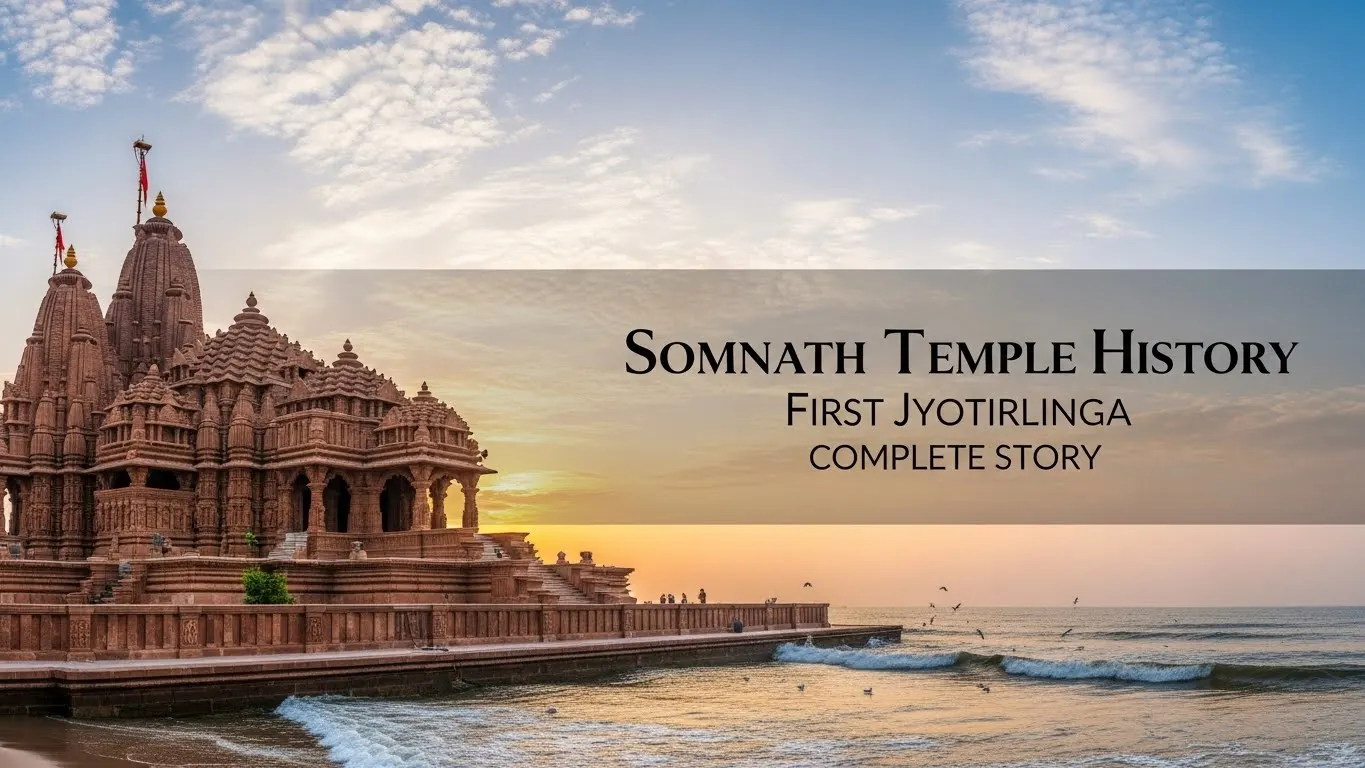
Somnath Temple—the first and most sacred among the twelve Jyotirlinga shrines of Lord Shiva, located at Prabhas Patan on the Arabian Sea coastline in Veraval, Gujarat—represents perhaps the most powerful symbol of Hindu resilience, faith, and civilizational continuity, with its extraordinary history spanning destruction 17 times by successive invaders from Mahmud Ghazni (1026 CE) to Aurangzeb (1706), yet rising phoenix-like with each reconstruction, culminating in the present magnificent Māru-Gurjara style temple completed in May 1951 under Sardar Vallabhbhai Patel’s vision [web:715][web:719].
According to Wikipedia’s comprehensive documentation, while the exact date of the first temple structure remains unclear with estimates ranging from early centuries of the 1st millennium to the 9th century CE, the site’s spiritual sanctity as Prabhasa Tirtha (place of splendor) is documented in the Mahabharata, Bhagavata Purana, and Kalidasa’s 5th century Raghuvamsa, identifying it as a Triveni Sangam where three rivers (Kapila, Hiran, Saraswati) converge and where Lord Krishna spent his final days [web:715].
The etymology and legend validate profound significance: Somnath means “Lord of Soma” or “Lord of the Moon,” originating from the immortal story where Moon God Chandra, cursed by his father-in-law Daksha Prajapati to lose all brilliance for favoring only one of his 27 wives (Rohini), performed severe penance at this sacred spot reciting the Mahamrityunjaya Mantra for six months until Lord Shiva appeared and modified the curse, blessing Chandra to wax (grow brighter) for 15 days and wane (grow dimmer) for 15 days—creating the lunar cycle we observe today—with the grateful Moon God establishing the first Jyotirlinga at this very location [web:715][web:720][web:723].
The 2025 spiritual guide explains that Daksha’s curse couldn’t be completely reversed but had to be modified, so Shiva’s divine blessing created the eternal rhythm of moonlight that governs natural cycles, tides, and agricultural seasons—making Somnath not merely a temple but the cosmic site where Shiva’s compassion transformed irreversible doom into cyclical renewal [web:720].
As we explore this extraordinary saga in 2025—with Somnath Temple continuing to attract millions of pilgrims annually as Gujarat’s premier sacred destination—ancient Hindu wisdom of unshakable faith, resilience through adversity, and spiritual permanence transcending material destruction becomes profoundly relevant https://hindutva.online. This comprehensive guide presents Somnath’s complete story: the original Moon God legend, scriptural mentions, multiple destructions from 1026 CE onwards, successive reconstructions by indigenous rulers, colonial-era transformation into mosque, post-independence revival under Sardar Patel, present architectural magnificence, and enduring legacy as symbol of eternal faith.
The Moon God Legend: Origin of Somnath
Chandra’s Marriage and Daksha’s Curse
Chandra (Moon God) married the 27 daughters of Daksha Prajapati, representing the 27 Nakshatras (constellations) [web:732]. However, he deeply favored only Rohini, neglecting his marital duties toward all other wives [web:732].
The curse unfolds [web:720][web:723]:
- The 26 neglected wives complained to their father Daksha
- Daksha warned Chandra to treat all wives equally
- Chandra ignored the warning and continued favoring Rohini
- Furious Daksha cursed Chandra: “You will lose all your brilliance, beauty, and vitality”
- Chandra began fading away day by day
- Without moonlight, the world plunged into darkness
- All natural cycles went haywire—no tides, disrupted agriculture, ecological chaos
Shiva’s Divine Intervention
Chandra’s penance [web:720][web:729]:
- Came to Prabhas Kshetra (modern-day Somnath)
- Performed severe penance for six months
- Recited the powerful Mahamrityunjaya Mantra continuously
- Bathed in the confluence of three sacred rivers
Shiva’s blessing [web:720][web:715]:
- Lord Shiva, moved by Chandra’s sincere devotion, appeared before him
- Daksha’s curse couldn’t be completely reversed (as curses by great sages are irreversible)
- Shiva modified the curse: Chandra would wax (grow brighter) for 15 days and wane (grow dimmer) for the next 15 days
- This created the waxing and waning moon cycle we observe today
- Filled with gratitude, Chandra established a Jyotirlinga at this spot
- The temple became known as Somnath—”The Lord Who Blessed the Moon”
Scriptural Mentions and Ancient History
Classical Text References
Mentioned in [web:715]:
- Mahabharata (c. 400 CE): Chapters 109, 118, 119 of Book Three (Vana Parva) mention Prabhasa as tirtha
- Bhagavata Purana: Sections 10.45 and 10.78 mention Prabhasa tirtha
- Raghuvamsa (5th century, Kalidasa): Mentions Somanatha-Prabhasa as sacred tirtha
- Shiva Purana: Lists Somnath as #1 of 12 Jyotirlingas
- Rigveda, Skanda Purana, Shreemad Bhagavat: All cite Somnath temple [web:719]
Krishna’s Final Days
Archaeological Evidence
Archaeological excavations led by B.K. Thapar found evidence of a 10th-century or earlier large temple, with fragments showing “exquisitely carved, rich” architecture [web:715]. The site shows pre-Harappan phase settlement from pre-2nd millennium BCE [web:715].
Medieval History: Temple Construction
First Recorded Temple (Before 997 CE)
The Chaulukya (Solanki) king Mularaja is believed to have built the first temple dedicated to Soma at the site sometime before 997 CE, though he may have renovated an earlier smaller temple [web:715].
Wealth and Fame
Al-Biruni, the 11th-century Persian historian, states that Somnath became famous because “it was the harbor for seafaring people and a station for those who went to and fro between Sufala in east Africa and China” [web:715]. This brought immense wealth to the temple and city.
The Destruction Saga: 17 Invasions
1. Mahmud Ghazni’s Devastating Raid (1026 CE)
The raid details [web:715][web:722]:
- Mahmud crossed the Thar desert with his army
- Desecrated the Jyotirlinga
- Plundered 20 million dinars in gold, silver, pearls, jewels
- Al-Biruni recorded both religious and economic motives
- Contemporary accounts speak of “50,000 devotees killed” trying to defend the temple
- Transported treasure in caravans to Ghazni
Al-Biruni’s account: “Raids undertaken with a view to plunder and to satisfy the righteous iconoclasm of a true Muslim… [Mahmud] returned to Ghazna laden with costly spoils from the Hindu temples” [web:715]
Impact: The destruction of Somnath became “icon of Islam” in Persian literature, inspiring “epics of conquest” for Muslims while creating “epics of resistance” for Hindus [web:715].
2. Kumarapala’s Reconstruction (1169 CE)
After being exhorted by Bhava Brihaspati (a Pashupata ascetic), Kumarapala (r. 1143-72) rebuilt the Somnath temple in “excellent stone and studded it with jewels” according to 1169 inscription [web:715].
3. Khalji’s Invasion (1299 CE)
During its 1299 invasion of Gujarat, Alauddin Khalji’s army led by Ulugh Khan defeated Vaghela king Karna and sacked the Somnath temple [web:715]. The idol was taken to Delhi to be trampled.
4. Chudasama Restoration (1308-1351)
5. Zafar Khan’s Destruction (1395)
6. Mahmud Begada’s Desecration (1451)
In 1451, it was desecrated by Mahmud Begada, the Sultan of Gujarat [web:715].
7. Aurangzeb’s Orders (1665, 1706)
By 1665, Mughal emperor Aurangzeb ordered the temple destroyed [web:715]. The order was repeated in 1706 with conversion into mosque, which was carried out with minimal effort [web:715].
Total Count: 17 Destructions
Archaeological investigations show the temple was rebuilt nearly thrice before Ghazni’s 1026 raid, then attacked three times more—total of 6 attacks until the 7th present version [web:718]. However, historical accounts document 17 total plunders and reconstructions over centuries [web:719].
Reconstruction: Ahilyabai Holkar’s Temple (1783)
The Gadariya-Dhangar Queen’s Devotion
Significance [web:715]:
- Established safe place for pilgrims to continue worshiping
- Located adjacent to present main temple
- Known as “Old Somnath Temple” or “Ahilyabai Temple”
- Ensured sacred worship continued uninterrupted for centuries before 1950 reconstruction
- Ahilyabai also restored Kashi Vishwanath, Gaya, Dwarka—demonstrating profound religious devotion
Colonial Era: Temple-Mosque Ruins
19th Century Surveys
Alexander Burnes (1830) [web:715]:
- Described it as “far-famed temple and city”
- Noted three domes (unusual for Hindu temples)
- Observed mutilated images and inverted Hindu idols used in reconstruction
- Documented “proof of Mohammedan devastation”
Captain Postans (1846) [web:715]:
- Stated temple shows “Hindu character preserved despite Mohammedan innovations”
- Noted “laboriously carried mutilation” of carvings
- Observed minarets and domes added to original building
The Gates Controversy (1842)
The outcome: Gates proved to be Deodar wood (not sandalwood) and not of Gujarati style—they remain in Agra Fort arsenal store-room [web:715].
Post-Independence Reconstruction (1947-1951)
Sardar Patel’s Vision
Gandhi’s blessing: When Patel, K.M. Munshi, and Congress leaders approached Mahatma Gandhi, he blessed the move but insisted funds be collected from public donations, not state funds [web:715].
The Somnath Trust
Fundraising [web:731]:
- By end of 1949: ₹25 lakhs collected
- Total expense: ₹24,92,000
- Public participated enthusiastically as symbol of Hindu resurgence
Reconstruction Process
Timeline [web:715][web:731]:
- October 1950: Ruins demolished; mosque shifted few kilometers away
- Construction: Led by traditional Sompura Salat temple builders
- Architect: Prabhashankarbhai Oghadbhai Sompura designed new temple integrating old recoverable parts
- May 11, 1951: Dr. Rajendra Prasad (President of India) performed installation ceremony
Present Temple Architecture
Māru-Gurjara Style
The present temple is built in Māru-Gurjara architecture (also called Chaulukya or Solanki style) [web:715][web:725].
Architectural features [web:727][web:728]:
- “Kailash Mahameru Prasad” form
- Intricately carved, two-level structure
- Pillared mandapa with 212 relief panels
- Shikhara (main spire): 15 meters height above sanctum
- 8.2-meter-tall flag pole at top
- Finely dressed stone utilizing complex interlocking system without mortar [web:728]
- “Kirti Torana” and “Kunda” as important features [web:727]
Construction Technique
The Maru-Gurjara style relies on precise cutting and fitting of large sandstone blocks in “dry masonry” technique foregoing mortar [web:728]. Weight of blocks combined with precisely carved interlocking joints creates remarkably stable structure [web:728].
Spiritual Significance
First Among Twelve Jyotirlingas
Most Sacred Pilgrimage Site
Somnath is one of five most revered sites on the seacoast of India, along with Dwaraka (Gujarat), Puri (Odisha), Rameswaram (Tamil Nadu), and Chidambaram (Tamil Nadu) [web:715].
Legacy and Cultural Impact
Symbol of Resilience
Somnath Temple was plundered seventeen times but was rebuilt stronger and bigger each time [web:719]. It stands as ultimate symbol of unshakable Hindu faith and civilizational continuity.
Modern Pilgrimage
National Symbol
Visiting Somnath Temple
Location and Access
Location: Prabhas Patan, Veraval, Gir Somnath District, Gujarat
How to reach:
- By Air: Diu Airport (90 km)
- By Train: Veraval Railway Station (7 km)
- By Road: 410 km from Ahmedabad
Temple Timings
Darshan: 6:00 AM to 10:00 PM daily
Aartis:
- Morning Aarti: 7:00 AM
- Noon Aarti: 12:00 PM
- Evening Aarti: 7:00 PM
- Light & Sound Show: 8:00 PM to 9:00 PM (except monsoon)
Frequently Asked Questions About Somnath Temple
Why is Somnath called the first Jyotirlinga?
Somnath tops the list of 12 Jyotirlingas in the Shiva Purana and is traditionally considered the first pilgrimage site where Dwadash Jyotirlinga yatra begins [web:715].
What is the Moon God legend of Somnath?
How many times was Somnath destroyed?
Somnath Temple was plundered and destroyed 17 times but was rebuilt bigger and stronger each time [web:719].
Who destroyed Somnath Temple first?
Who rebuilt Somnath Temple after independence?
Sardar Vallabhbhai Patel ordered reconstruction in November 1947; Dr. Rajendra Prasad inaugurated the completed temple on May 11, 1951 [web:715][web:731].
What is the architecture style of present Somnath?
The present temple is built in Māru-Gurjara (Chaulukya/Solanki) style with intricate carvings, 15-meter shikhara, and 212 relief panels [web:715][web:725].
Did Krishna visit Somnath?
Yes, the Mahabharata describes Prabhasa (Somnath) as the coastline site where Lord Krishna spent his final days and attained Mahasamadhi [web:715].
What is the best time to visit Somnath?
October to March offers pleasant weather for pilgrimage and sightseeing.
Conclusion
Somnath Temple—the sacred first Jyotirlinga where Moon God Chandra’s six-month penance moved Lord Shiva to transform irreversible doom into the waxing-waning lunar cycle governing all natural rhythms, and where Hindu civilizational resilience manifested through 17 destructions and 17 resurrections spanning nearly a millennium—stands as the ultimate symbol of eternal faith transcending material devastation, with Wikipedia’s comprehensive documentation confirming its extraordinary journey from Mahmud Ghazni’s 1026 plunder of 20 million dinars through successive invasions by Khalji, sultans, and Aurangzeb to Sardar Patel’s visionary 1947-1951 reconstruction completed by Dr. Rajendra Prasad, creating the present magnificent Māru-Gurjara masterpiece [web:715]https://hindutva.online.
What distinguishes Somnath’s profound significance is its embodiment of multiple sacred dimensions—spiritually as the site where Shiva’s compassion created the cosmic rhythm of moonlight from Daksha’s curse, historically as witness to both Persian “epics of conquest” celebrating its destruction and Indian “epics of resistance” chronicling its phoenix-like resurgence, architecturally as showcase of Gujarat’s master Sompura craftsmen integrating 10th-century exquisite carvings with contemporary intricately carved two-level structure featuring 212 relief panels and 15-meter shikhara, and symbolically as Sardar Patel’s chosen instrument for post-independence Hindu cultural assertion and Mahatma Gandhi’s model of public-funded sacred restoration through voluntary donations totaling ₹24,92,000 [web:715][web:719][web:725][web:731].
By understanding Somnath’s complete story—from scriptural mentions in Mahabharata, Bhagavata Purana, and Kalidasa’s Raghuvamsa through archaeological evidence of pre-Harappan settlement, from Al-Biruni’s documentation of 1026 devastation through Ahilyabai Holkar’s 1783 interim temple, from colonial-era surveys revealing temple-mosque ruins to 1951 national revival—pilgrims and students access the living testament that ancient Hindu wisdom recognized as Prabhasa (place of splendor) where spiritual permanence eternally triumphs over temporal destruction [web:715]https://hindutva.online.
About the Author
Aryan Mishra – Certified Yoga Therapist & Spiritual Wellness Expert
Aryan Mishra is a certified yoga therapist with over 18 years of experience specializing in Hatha Yoga, pranayama, meditation, and traditional shatkarma purification practices. He holds advanced certifications in yoga therapy and has trained extensively in classical yogic texts including the Hatha Yoga Pradipika and Gheranda Samhita. Aryan Mishra integrates ancient yogic wisdom with Ayurvedic principles to help students achieve optimal physical health and spiritual growth through authentic practices. His teaching focuses on making traditional techniques accessible to modern practitioners while maintaining the depth and transformative power of the original methods. He has guided thousands of students through systematic yoga sadhana at leading institutions and retreat centers across India and internationally.