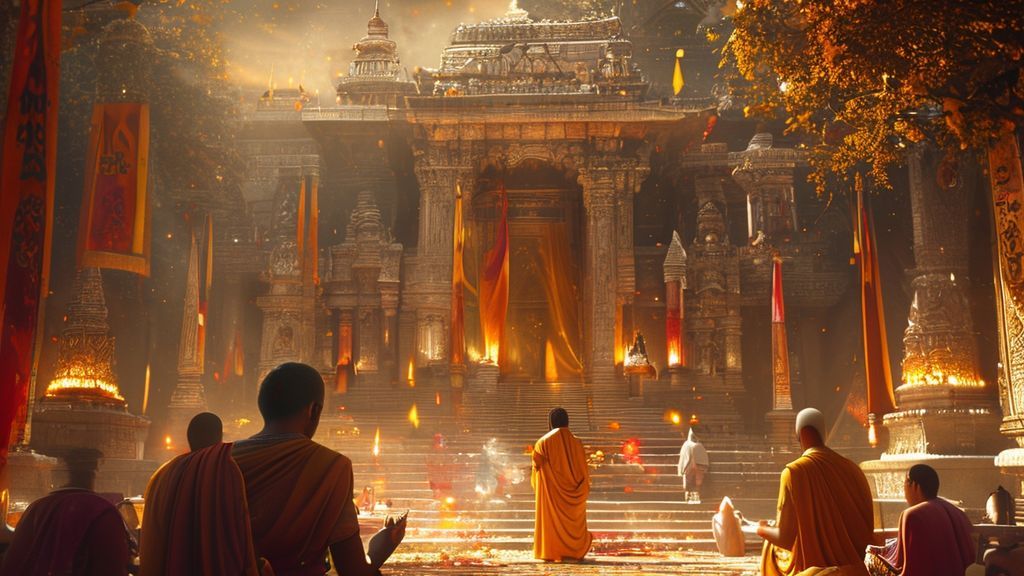
The Vedas are the foundational, divinely revealed sacred texts of Hinduism, considered *Shruti* or “that which is heard,” embodying eternal knowledge (*Apaurusheya* – not of human origin). Comprising four principal texts—Rigveda, Yajurveda, Samaveda, and Atharvaveda—they illuminate the path to *Dharma*, *Artha*, *Kama*, and *Moksha*, guiding humanity towards spiritual liberation and cosmic harmony.
| Attribute | Details |
|---|---|
| **Origin/Nature** | Apaurusheya (not man-made), Shruti (divinely revealed), Anadi (beginningless) |
| **Meaning** | “Knowledge,” “Wisdom,” from the root *vid* (to know) |
| **Language** | Vedic Sanskrit |
| **Core Divisions** | Samhitas (mantras), Brahmanas (rituals), Aranyakas (forest treatises), Upanishads (philosophy) |
| **Key Focus** | Dharma, Karma, Yajnas, Jnana (knowledge of Brahman and Atman), Bhakti (devotion) |
| **Number of Vedas** | Four: Rigveda, Yajurveda, Samaveda, Atharvaveda |
| **Preservation Method** | Oral tradition (*Guru-Shishya Parampara*) for millennia, later codified in written form |
The Eternal Wellspring of Sanatan Dharma
The Vedas stand as the undisputed foundation of Sanatan Dharma, the eternal way of life. Far from being mere religious texts, they are considered *pramana* – the ultimate authority – providing the bedrock for Hindu philosophy, ritual, and spiritual practice. The term “Veda” itself, derived from the Sanskrit root *vid*, signifies “knowledge” or “wisdom.” This knowledge is not a product of human intellect but is understood to be *Shruti* (that which is heard), divinely revealed to ancient seers, known as *Rishis*, in states of profound meditation. Thus, the Vedas are *Apaurusheya* – authorless, beginningless, and eternal, mirroring the timeless truths of the cosmos itself. They are the cosmic vibrations, the sacred sound (*Shabda Brahman*) that structured creation, and their wisdom guides every aspect of righteous living, spiritual inquiry, and ultimately, liberation.
The Divine Revelation and Preservation
According to the Vedic tradition, as expounded in texts like the *Vishnu Purana* (Book III, Chapter 4) and the *Bhagavata Purana*, the Vedas were initially a single, vast body of knowledge, spontaneously revealed at the dawn of creation. This unitary Veda was too immense for the limited human intellect of the Kali Yuga to grasp. Therefore, in a pivotal moment of cosmic ordering, **Maharishi Krishna Dwaipayana**, later known as **Veda Vyasa**, undertook the colossal task of organizing and dividing this eternal knowledge. He systematically arranged the Veda into four distinct parts, each with specific purposes and applications, to make it accessible to humanity. He then taught these divisions to his four principal disciples:
- **Paila** for the Rigveda
- **Vaishampayana** for the Yajurveda
- **Jaimini** for the Samaveda
- **Sumantu** for the Atharvaveda
This act of classification earned him the epithet “Vyasa” (divider or arranger). The rigorous oral tradition, known as *Guru-Shishya Parampara*, ensured the impeccable preservation of the Vedas for millennia. The elaborate system of *Pathas* (recitational styles) like *Samhita Patha*, *Pada Patha*, *Krama Patha*, *Jata Patha*, and *Ghana Patha* were developed with such meticulous precision that even a single syllable or its intonation (*Svara*) would not be altered, demonstrating an unparalleled commitment to textual integrity long before the advent of writing. This commitment to perfect transmission is a testament to the reverence held for these sacred sounds, believed to embody the very fabric of reality.
The Structural Architecture of Vedic Knowledge
Each of the four Vedas is further subdivided into four main categories, forming a comprehensive literary and philosophical structure:
- Samhitas: The core collection of hymns, prayers, benedictions, and sacrificial formulas. These are the earliest and most direct expressions of Vedic thought.
- Brahmanas: Prose texts detailing the correct performance of rituals and sacrifices (*Yajnas*). They elaborate on the meaning, symbolism, and efficacy of the Samhita mantras in the context of ritual action.
- Aranyakas: “Forest treatises” or “wilderness texts,” often seen as appendices to the Brahmanas. They explore the mystical and allegorical meanings of the rituals, meant for hermits and those who had renounced worldly life, bridging the gap between ritual and philosophy.
- Upanishads: The philosophical and spiritual essence of the Vedas, often called *Vedanta* (the end or culmination of the Vedas). They delve into the nature of Brahman (Ultimate Reality), Atman (the individual soul), the relationship between them, and the path to liberation (*Moksha*) through knowledge (*Jnana*).
The Four Pillars of Vedic Wisdom:
1. **Rigveda (ऋग्वेद):**
The oldest and most revered of the Vedas, the Rigveda is a collection of 1,028 hymns (*Suktas*) arranged into ten books (*Mandalas*). It primarily consists of invocations to various Devas such as Indra, Agni, Surya, Varuna, and Ushas, celebrating their cosmic powers and requesting blessings. It is a profound poetic expression of devotion and philosophical inquiry, containing seminal concepts like *Rita* (cosmic order) and the famous *Purusha Sukta* (RV 10.90) describing the cosmic man, and the *Nasadiya Sukta* (RV 10.129), a hymn of creation that explores philosophical skepticism.
2. **Yajurveda (यजुर्वेद):**
Meaning “knowledge of sacrifice,” the Yajurveda is primarily a ritual Veda, providing the prose mantras and sacrificial formulas necessary for performing various *Yajnas*. It has two main recensions: the **Shukla Yajurveda** (White Yajurveda), which contains only the mantras, and the **Krishna Yajurveda** (Black Yajurveda), which intersperses mantras with explanatory prose of the Brahmanas. It is indispensable for the *Adhvaryu* priests who perform the physical acts of the sacrifice.
3. **Samaveda (सामवेद):**
Often called the “Veda of Chants,” the Samaveda is a collection of 1,875 verses, nearly all of which are derived from the Rigveda. Its unique contribution lies in its melodic structure. These verses are arranged into specific tunes (*Samans*) meant to be sung by the *Udgatri* priests during the Soma sacrifice. The Samaveda emphasizes the power of sound and music in spiritual realization, embodying the mantra: “यो वेत्थ साम स वेद तत्वम्” (He who knows the Sama, knows the essence).
4. **Atharvaveda (अथर्ववेद):**
Distinct from the other three, the Atharvaveda focuses more on practical life, containing hymns for protection against evil, healing, charms, spells, and philosophical speculations. It has about 730 hymns in 20 books. It provides insights into ancient Indian society, medicine (*Ayurveda*), statecraft, and magic. Though traditionally considered the fourth Veda, its inclusion was debated in ancient times due to its different focus, but it ultimately became an integral part of the Vedic canon, recognized for its comprehensive address of human existence, both mundane and spiritual.
Vedic Adhyayana and Ritual Application
The study and application of the Vedas are central to Sanatan Dharma. The traditional method of Vedic study, *adhyayana*, involves intense memorization and comprehension under the guidance of a qualified *Guru* within *Pathashalas* or *Gurukulas*. This *Guru-Shishya parampara* ensures not only the preservation of the texts but also the correct understanding of their profound meanings and the precise pronunciation (*Svara*) and intonation of the mantras, which are crucial for their efficacy. The very act of reciting Vedic mantras with correct *Svara* is considered a powerful spiritual practice, connecting the chanter to the cosmic vibrations.
The practical application of the Vedas is most evident in the performance of *Yajnas* (fire sacrifices) and *Homas*. These elaborate rituals, described extensively in the Brahmanas, are performed for various purposes: propitiating Devas, maintaining cosmic balance (*Rta*), invoking blessings, and purifying the environment. Each mantra from the Samhitas is a precise instruction or invocation meant to be uttered at a specific point in the ritual, accompanied by specific offerings, thereby activating the spiritual energy it represents.
Mantras and Chants for Devotion
Vedic mantras are not mere words but vibrational forms of the Divine. Chanting them with devotion and understanding purifies the mind and connects the individual with higher consciousness. Some of the most potent and widely chanted Vedic mantras include:
- **Om (ॐ):** The *Pranava*, the primordial sound, the essence of all Vedas, representing Brahman itself. Chanting Om is a direct path to meditation and union with the Ultimate Reality.
- **Gayatri Mantra (गायत्री मन्त्र):**
ॐ भूर् भुवः स्वः ।
तत् सवितुर्वरेण्यं भर्गो देवस्य धीमहि ।
धियो यो नः प्रचोदयात् ॥*Om Bhur Bhuvah Svah, Tat Savitur Varenyam Bhargo Devasya Dhimahi, Dhiyo Yo Nah Prachodayat.*
(Rigveda 3.62.10) This supreme mantra invokes the brilliant light of Savitri (the sun deity) to illuminate our intellect and guide us towards righteousness and wisdom. - **Mahamrityunjaya Mantra (महामृत्युञ्जय मन्त्र):**
ॐ त्र्यम्बकं यजामहे सुगन्धिं पुष्टिवर्धनम् ।
उर्वारुकमिव बन्धनान् मृत्योर्मुक्षीय मामृतात् ॥*Om Tryambakam Yajamahe Sugandhim Pushtivardhanam, Urvarukamiva Bandhanan Mrityor Mukshiya Maamritat.*
(Rigveda 7.59.12 / Yajurveda 3.60) This mantra dedicated to Lord Shiva, the three-eyed one, is chanted for longevity, protection from untimely death, healing, and spiritual liberation. Its profound meaning evokes a longing for immortality and freedom from the cycle of birth and death, like a ripe cucumber easily detaching from its stalk.
These mantras, when recited with proper *bhava* (feeling) and *shraddha* (faith), resonate deep within, transforming the practitioner.
Dos and Don’ts for Engaging with Vedic Texts
Approaching the Vedas requires reverence and purity, reflecting their sacred nature.
- **Do:**
- Handle Vedic texts with utmost respect, ensuring cleanliness and proper storage.
- Study under the guidance of a qualified Guru or traditional scholar to grasp the nuances of pronunciation and meaning.
- Approach with a sincere desire for knowledge and spiritual growth.
- Maintain physical and mental purity when engaging with Vedic study or recitation.
- Understand that the true essence of the Vedas lies in their practice and realization, not just intellectual accumulation.
- **Don’t:**
- Treat Vedic texts casually or as ordinary literature.
- Recite mantras without understanding their meaning or proper intonation, as this diminishes their efficacy.
- Use Vedic mantras or knowledge for selfish, trivial, or harmful purposes.
- Place Vedic texts in impure locations or disregard their sanctity.
- Engage in debates or discussions about Vedic truths without adequate knowledge and humility.
Frequently Asked Questions About the Vedas
Who composed the Vedas?
The Vedas are considered *Apaurusheya*, meaning “not of human origin.” They were not composed by any individual but are believed to be eternal truths revealed to ancient seers (*Rishis*) in profound states of meditation. These Rishis were merely the channels through which the cosmic sounds and wisdom were perceived and transmitted.
Are the Vedas relevant in modern times?
Absolutely. The Vedas contain eternal principles of *Dharma*, ethics, cosmic order (*Rta*), philosophy, and spiritual realization that are timeless and universally applicable. Their insights into the nature of reality, consciousness, and righteous living provide guidance for all ages, offering solutions to contemporary challenges through their profound wisdom.
Can non-Hindus study the Vedas?
Yes, anyone with a sincere desire for knowledge and an open mind can study the Vedas. Many scholars and spiritual seekers globally, irrespective of their background, engage with Vedic texts for philosophical inquiry, historical understanding, and spiritual inspiration. However, traditional Vedic *adhyayana* (study) in *Gurukulas* often involves specific initiation rites and a commitment to the Sanatana Dharma way of life for deeper experiential understanding.
What is a “Vedic Rishi”?
A Vedic Rishi is a seer or sage who, through intense austerity (*Tapas*) and spiritual discipline, attained the state of realizing or “seeing” the Vedic mantras. They did not invent the mantras but were able to perceive the eternal sounds and truths of the cosmos and transmit them to humanity. They are revered as the intermediaries of divine knowledge.
The Eternal Resonance for Sanatan Dharma
The Vedas are not just historical documents; they are living scriptures that continually inspire and guide billions of Hindus worldwide. They represent the very breath of creation, the eternal sound that sustains the cosmos, and the ultimate source of spiritual wisdom. From the profound philosophical insights of the Upanishads that declare “Tat Tvam Asi” (That Thou Art) to the elaborate rituals detailed in the Brahmanas, the Vedas provide a complete framework for human existence. They uphold the principles of *Dharma*, guide the pursuit of *Artha* and *Kama* in a righteous manner, and ultimately illuminate the path to *Moksha*—liberation. By preserving and studying the Vedas, we connect with our profound spiritual heritage and ensure that the timeless wisdom of Sanatan Dharma continues to enlighten future generations. This sacred knowledge, meticulously preserved through Hindutva.online, remains the guiding star for all sincere seekers on their journey towards truth and self-realization.
