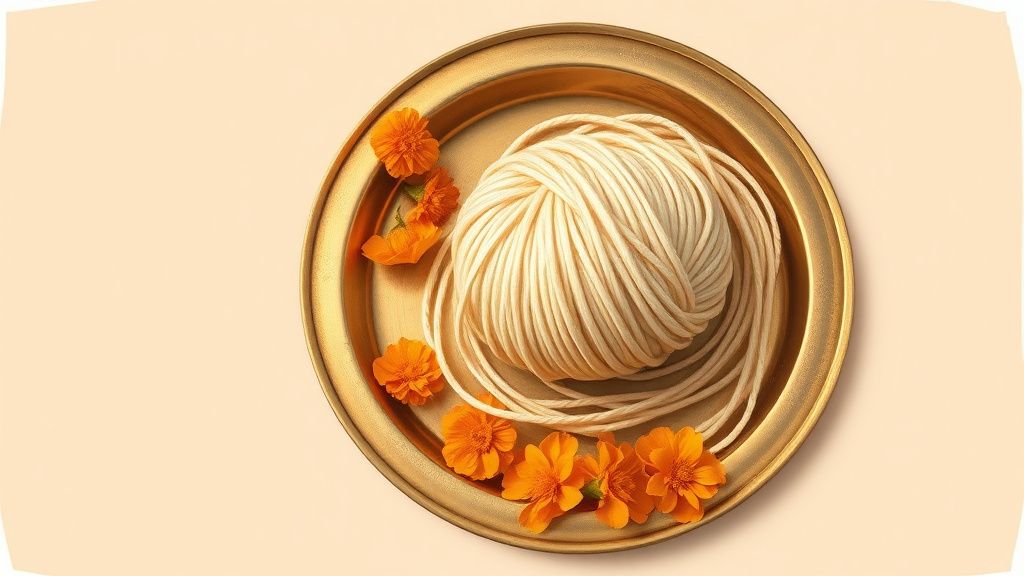
The janeu (Sanskrit yajnopavita, Tamil poonool, Telugu jandhyamu) is the triple-strand cotton thread worn by Hindu men of the twice-born (dvija) varnas after their Upanayana ceremony. It is worn over the left shoulder and under the right arm, against the skin, continuously, replaced annually at the Avani Avittam (Upakarma) ceremony in the lunar month of Shravana. The thread’s three strands are read on multiple symbolic layers: the three Vedas, the three debts of a Brahmin (to the sages, the gods, the ancestors), the three powers, the three gunas, or simply as a body-marker of initiated status. The practice is described in the Grihya Sutras, the Manusmriti, and the Apastamba Dharma Sutra.
What the three strands mean
Hindu commentators offer several readings of the three strands. The mainstream interpretations:
- The three Vedas: Rig, Yajur, Sama. The wearer of the thread is committed to the study and protection of the Vedic corpus.
- The three debts (rinas): the debt to the rishis (paid by study), the debt to the devas (paid by ritual), the debt to the ancestors (paid by raising a family).
- The three powers (shaktis): icchashakti (will), jnanashakti (knowledge), kriyashakti (action).
- The three gunas: sattva, rajas, tamas; held together as a single thread.
- The three goddesses: Saraswati, Lakshmi, Parvati, the three principal Devis.
- The body’s three nadis: ida, pingala, sushumna, the three energy channels of yogic anatomy.
The traditional texts do not prescribe a single canonical reading; the multiple meanings coexist and are taught according to the family’s tradition.
Construction and physical details
- Total length: roughly 96 finger-widths (approximately 5-6 feet, looped). The figure 96 is itself symbolic (the four Vedas times the 24 hours times the 16 directions, in some readings).
- Strand count: three primary strands, each a three-ply twisted thread, for a total of nine sub-threads.
- Knot: the brahma granthi, a single fixed knot joining the strands. The knot sits at the heart-side of the wearer when properly positioned.
- Material: hand-spun cotton, preferably from the household’s own preparation or purchased from the priest before the ceremony.
- Replacement schedule: annually at Avani Avittam, falling on Shravana Purnima (August-September).
- Additional strands: a second three-strand thread is added at the wearer’s marriage, making it a six-strand thread thereafter. After fatherhood, in some traditions, a third strand-set is added.
The three wearing positions
The same thread is worn in different positions for different ritual contexts:
- Upavita: over the left shoulder, under the right arm. The default position for daily wear and for deva-puja rituals.
- Prachinavita: over the right shoulder, under the left arm. Worn during shraddha rituals for departed ancestors and during the eclipse-related observances.
- Nivita: around the neck like a garland. Worn during specific ritual moments such as eating, using the toilet, or other contexts in classical practice where the upavita position would be ritually inappropriate.
Practical conventions for repositioning vary by community. The Tamil Iyer convention, for example, lifts the thread to the nivita position when entering the toilet and returns it to upavita afterward; modern urban practice often skips this detail. The classical convention is described in the Apastamba and Manava Grihya Sutras.
When the thread is changed
- Annually at Avani Avittam: the standard replacement.
- If broken: immediate replacement. The wearer should not remain without the thread for any extended period.
- If soiled: if contact with a ritually impure substance occurs, the thread is replaced.
- After a death in the family: the thread is replaced after the ashauca (ritual impurity period) ends, typically 11 to 13 days after the death.
- At marriage: a second three-strand set is added, making the thread six-strand.
- After a major life event: the wearer may choose to replace the thread; the convention varies.
Practical questions of daily wearing
For someone who took Upanayana as a boy and continues to wear the thread into adult life, the practice has several practical considerations:
- Bathing: the thread is not removed for bathing; the cotton dries quickly.
- Sleeping: the thread is worn at night; some wearers tuck it under clothing.
- Sports and exercise: the thread can be tucked under a t-shirt for active sport; no need to remove.
- Surgery and medical procedures: the thread may be removed temporarily and replaced afterward.
- International travel: the thread is non-metallic and passes airport security without issue.
- Workplace: typically not visible under work attire; some traditional Brahmins wear it openly on the upper body in domestic contexts.
For what it’s worth, the daily practical reality of wearing the thread is much less demanding than the symbolic weight suggests. The thread is a flexible cotton cord against the skin, and the daily wearing is essentially uneventful. The annual Avani Avittam replacement and the daily sandhya recitation are the active maintenance acts.
Common questions
At what age is the thread first given?
The Manusmriti prescribes the 8th year for Brahmin boys, 11th for Kshatriya, 12th for Vaishya. In present-day practice the ceremony is most commonly performed between ages 7 and 9 for Brahmin boys. Some communities perform Upanayana later, including in late teens, particularly when the boy is preparing for marriage. The classical age windows have been substantially relaxed.
Do women wear the janeu?
Historically and in most Hindu communities today, no. The Upanayana of women was permitted in some classical contexts (the Atharvaveda references a brahmavadini, a female student of the Vedas) but the practice was largely discontinued by the early medieval period. Modern reform movements (Arya Samaj from the 19th century) have revived women’s Upanayana, and some Hindu women today do wear the sacred thread. The convention is contested rather than uniform.
What if a non-Brahmin wants to wear the janeu?
The classical texts restrict the janeu to the three twice-born varnas (Brahmin, Kshatriya, Vaishya). Modern reform-Hindu and Arya Samaj practice permits Upanayana for anyone regardless of varna. Several Hindu reform movements explicitly invite non-Brahmin Hindus to take Upanayana. The thread itself does not check the wearer’s varna; the social acceptance varies by community.
Does the thread have to be cotton?
The Manusmriti prescribes specific materials: cotton (karpasa) for Brahmins, hemp (sana) for Kshatriyas, wool (urna) for Vaishyas. In practice today, hand-spun cotton is used across communities. The classical material distinctions are not generally observed; the cotton thread is the standard form.
A limitation worth noting
The janeu’s classical context (12 years of residential Vedic study following Upanayana) does not survive in modern practice. The ceremony today functions as a samskara without the institutional continuation it once anchored. The varna-based eligibility, the precise age windows, and the elaborate daily sandhya practice are observed with varying strictness across communities. Modern reform movements have substantially relaxed the classical restrictions; the article describes the textual mainstream alongside the modern practical reality, but the gap between the two is significant.
For background see the Wikipedia entry on yajnopavita and the broader entry on Upanayana.
