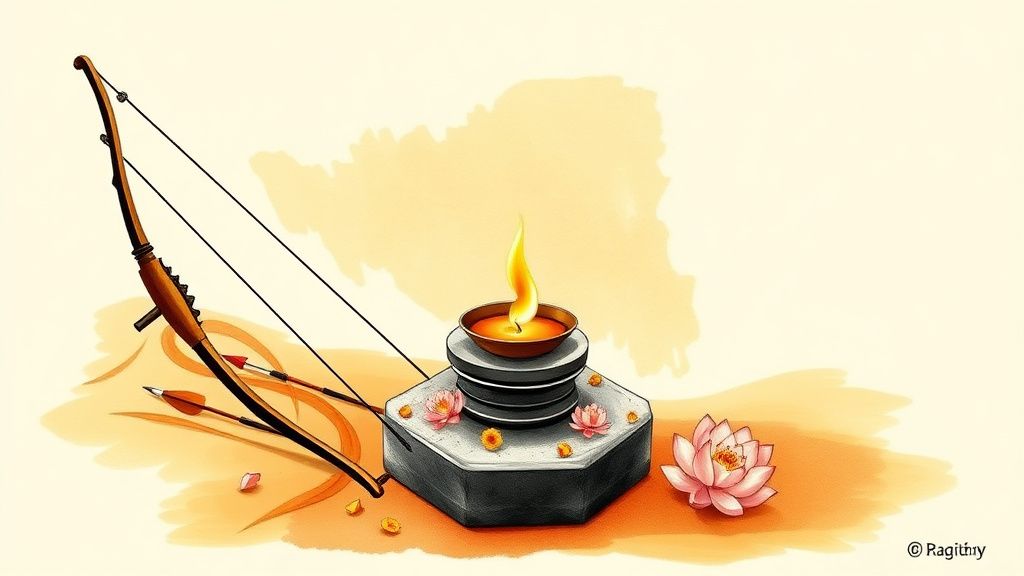
Ram Navami 2026 was observed on Thursday, March 26, 2026, the ninth day (Navami) of the bright half of the lunar month of Chaitra. The Madhyahna muhurat, the principal worship window for the festival, ran from 11:13 AM to 1:41 PM IST (New Delhi reference), with the Madhyahna moment at 12:27 PM. The festival celebrated the birth of Rama, the seventh avatar of Vishnu, who tradition holds was born at midday at Ayodhya. A small minority of devotees following the Shaiva calendar observed Ram Navami on Friday, March 27, 2026. This article gives the 2026 specifics, the principal observances on the day, and the calculation that places the next Ram Navami in 2027.
The 2026 muhurat and timings
The key timings for Ram Navami 2026, for the New Delhi meridian:
- Date: Thursday, March 26, 2026 (Vaishnava); Friday, March 27, 2026 (Shaiva)
- Madhyahna Muhurat: 11:13 AM to 1:41 PM IST
- Duration: 2 hours 27 minutes
- Madhyahna Moment: 12:27 PM IST
- Navami Tithi begins: 3:45 PM on March 25, 2026
- Navami Tithi ends: 5:35 PM on March 26, 2026
The above timings are sourced from the Drik Panchang reference for New Delhi. Location-specific timings vary by longitude. For Mumbai the Madhyahna Muhurat in 2026 ran from 11:40 AM to 2:08 PM IST; for Chennai it was 11:08 AM to 1:36 PM IST; for Kolkata 10:43 AM to 1:11 PM IST. Devotees in north America and Europe should use the local equivalent of the Madhyahna window, which the panchang renders for the local meridian.
Why two dates: March 26 vs March 27
The Hindu calendar has two related but slightly different reckonings for festivals when the relevant tithi straddles two solar days. The Vaishnava tradition observes the festival on the day when the Navami tithi falls during Madhyahna; if Navami is present at midday on a given solar day, that day is the festival. The Shaiva tradition observes the festival on the day when Navami is present at sunrise. In 2026, Navami was present during midday on March 26 (Vaishnava reckoning) and was also present at sunrise on March 27 (Shaiva reckoning). Most Hindu households follow the Vaishnava reckoning for Ram Navami, so March 26 was the principal observance day for 2026. Tirupati’s TTD (Tirumala Tirupati Devasthanams) panchang and the major Vaishnava temples all observed March 26.
Major temple observances in 2026
Several major Rama temples held their principal annual observances on March 26, 2026:
- Ram Mandir, Ayodhya: the temple performed the Surya Tilak, the calibrated reflection of sunlight onto the deity’s forehead at the moment of Madhyahna (12:27 PM IST). This was the third year of the Surya Tilak observance, instituted in 2024 after the temple’s inauguration. The temple drew several hundred thousand pilgrims.
- Bhadrachalam Sita Rama Swamy Temple, Telangana: the Sita-Rama Kalyanam was held at the temple on Ram Navami day, with the muthya talambralu (pearl rice) supplied by the Telangana government as is the tradition since the Andhra Pradesh state government began the practice and the Telangana government continued it after bifurcation. Approximately 300,000 devotees attended.
- Rameswaram Ramanathaswamy Temple, Tamil Nadu: special abhishekam and recitation of the Ramayana through the day.
- Janakpur Janaki Mandir, Nepal: a major cross-border pilgrimage destination as the traditional home of Sita. Special celebrations on Ram Navami.
- Hanuman Garhi, Ayodhya: celebrated alongside the Ram Mandir, with traditional Hanuman processions before sunrise.
Why Ram Navami matters in the Hindu calendar
Chaitra is the first month of the Hindu lunar calendar. Chaitra Shukla Pratipada (day one of the bright half) is the new year for many regional Hindu calendars (Gudi Padwa in Maharashtra, Ugadi in Andhra Pradesh, Karnataka and Telangana, Cheti Chand among Sindhis, the Marwari new year). Chaitra Shukla Navami (day nine) is Ram Navami. The festival therefore sits at the end of the first nine days of the Hindu year, coinciding with the conclusion of Chaitra Navaratri (the spring nine-night festival of the goddess). The two festivals overlap: many households hold Chaitra Navaratri for the first eight days and Ram Navami on the ninth, observing both as a continuous nine-and-a-half-day cycle.
For what it’s worth, the most useful frame for placing Ram Navami in the Hindu calendar is to think of it as the climax of Chaitra Navaratri rather than as a standalone day. The goddess’s nine nights end with the birth of the principal Treta-Yuga avatar. The continuity is theological as well as calendrical: Chaitra Navaratri concludes with the Treta Yuga’s hero stepping into the world. Households that observe both festivals together get the fullest reading of the period.
Household observance in 2026
The standard household observance for Ram Navami 2026, following the most common pattern:
- Pre-dawn bath: followed by clean clothes (yellow is preferred but not required).
- Altar preparation: the household murti or photograph of Rama (often with Sita, Lakshmana and Hanuman) cleaned and decorated.
- Fast (vrat): from sunrise until the Madhyahna puja; falahari foods (sabudana, kuttu, singhada, fruits, milk) only.
- Bal Kanda reading: the Valmiki Ramayana’s Bal Kanda chapters covering Rama’s birth, or the equivalent section of Tulsidas’s Ramcharitmanas (Bal Kand Doha 192 onwards).
- Madhyahna puja at 12:27 PM IST: formal worship with fruits, flowers, sandalwood paste, panakam (jaggery-pepper drink), vadapappu (soaked moong dal), and kosumalli (dal salad).
- Breaking the fast: after the puja, with the prasada of the offering. Many households continue light eating until evening when a full meal is taken.
When is Ram Navami 2027?
Ram Navami 2027 is expected on Sunday, April 4, 2027, based on the lunar Chaitra Shukla Navami calculation. The shift from late March to early April reflects the normal eleven-day annual slippage of the Hindu lunar calendar against the Gregorian solar calendar. Devotees planning ahead should consult a published panchang closer to the date for the precise Madhyahna timing for their location, since the muhurat varies by year. As a general guide, Ram Navami falls in late March or in April each year.
Common questions
Was the Surya Tilak performed on Ram Navami 2026 at Ayodhya?
Yes. The Surya Tilak, the calibrated reflection of sunlight through a system of mirrors and lenses onto the deity’s forehead at the exact Madhyahna moment, was performed at the Ram Mandir, Ayodhya, on March 26, 2026. This was the third year of the observance since its inauguration in 2024. The Surya Tilak occurred at 12:27 PM IST and was telecast live by the temple trust.
Was Ram Navami 2026 a public holiday?
Yes. Ram Navami was a gazetted public holiday in India on Thursday, March 26, 2026, with banks, government offices, and most schools closed. State-level processions and major temple events drew large crowds. The Reserve Bank of India had notified the bank holiday for the date in its annual calendar.
Why did the 2026 Madhyahna moment fall at 12:27 PM and not exactly at solar noon?
Madhyahna is the middle of the Hindu astronomical day, calculated from sunrise to sunset, not from clock noon. Sunrise and sunset on March 26, 2026 at New Delhi (sunrise approximately 6:21 AM IST, sunset approximately 6:33 PM IST) gave a Madhyahna moment at 12:27 PM IST. The Madhyahna shifts each day with sunrise and sunset and varies by location. Solar noon (the moment when the sun is highest) was approximately the same on March 26 but the panchang’s Madhyahna is the calculated midpoint rather than the astronomical solar noon and can differ by a few minutes.
One limitation worth noting
The 2027 date given above is based on a forward calculation from the lunar Chaitra Shukla Navami. Hindu lunar calculations can shift by a day in either direction when the tithi straddles solar boundaries, so the actual 2027 observance date may be April 4 or April 5 depending on the specific local panchang. The full muhurat timings for 2027 will only be published in established panchangs in late 2026 or early 2027. The 2026 timings reported here are the actual observed ones for that year, sourced from the Drik Panchang ephemeris for the New Delhi meridian.
For deeper reading on the festival and current timings, see the Wikipedia entry on Rama Navami and the Drik Panchang page on Ram Navami timings.