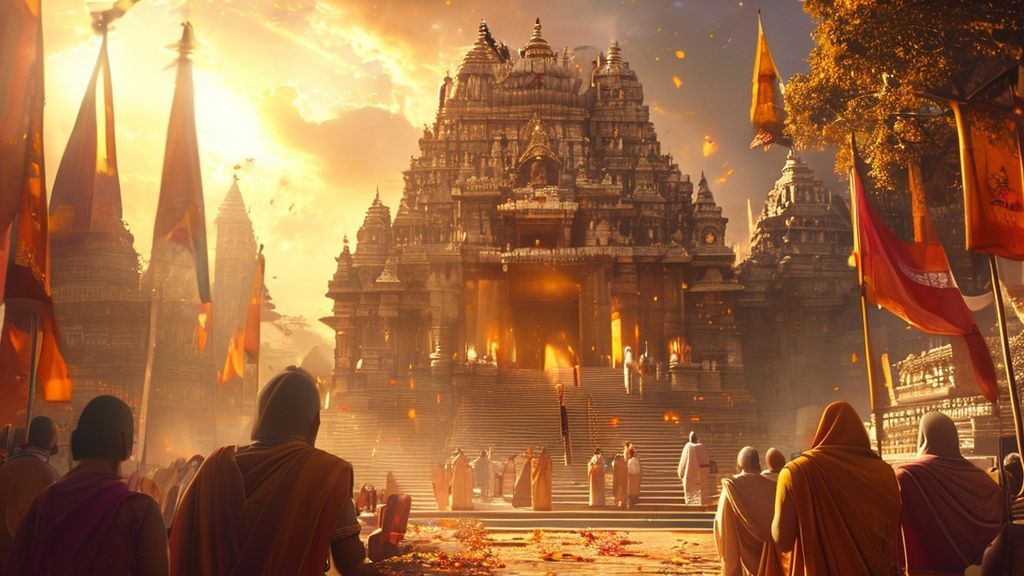
Hindu Rashtra, often translated as a “Hindu Nation,” fundamentally signifies a civilizational concept rooted in Sanatan Dharma, where the national ethos, cultural identity, and societal framework are guided by Vedic principles of righteousness, justice, and spiritual well-being. It is an aspiration for a Dharmic order, fostering harmony, upholding diverse traditions, and ensuring the holistic evolution of all beings within its spiritual dominion, transcending narrow political definitions.
| Attribute | Details |
|---|---|
| Concept Origin | Ancient Bharat, rooted in Vedic principles and Dharmic governance models (e.g., Ram Rajya, Dharma Rajya). |
| Core Principle | Dharma (Righteousness, Cosmic Law) as the supreme guiding force for individual and collective life. |
| Guiding Philosophy | Sanatan Dharma, encompassing principles of truth (Satya), non-violence (Ahimsa), duty (Dharma), and universal well-being (Sarve Bhavantu Sukhinah). |
| Ideal Governance | “Dharma Rajya” or “Ram Rajya,” characterized by justice, prosperity, peace, and spiritual freedom for all citizens, irrespective of their worship method. |
| Aim & Vision | To foster a society where all four Purusharthas (Dharma, Artha, Kama, Moksha) are pursued in harmony, leading to Loka Sangraha (welfare of the world) and individual spiritual liberation. |
The Soul of Bharat: Understanding Hindu Rashtra Beyond Politics
The term Hindu Rashtra often evokes varied interpretations in contemporary discourse. For a sincere seeker of Sanatan Dharma, it is not merely a political slogan but a profound civilizational aspiration, deeply embedded in the spiritual fabric of Bharatavarsha. It represents the collective endeavor to establish a society where Dharma — righteousness, cosmic law, and ethical conduct — is the foundational principle guiding all aspects of life: social, economic, cultural, and spiritual. This vision harks back to an age where Bharat was known as a land of Dharma, wisdom, and universal brotherhood, a beacon for humanity. It is about a spiritual ecosystem, a cultural identity, and a profound commitment to the eternal values that define Hindutva.online.
To truly grasp the essence of Hindu Rashtra, one must transcend modern, Western-centric notions of statehood and delve into the rich tapestry of Indic thought. It is a concept of self-realization for a nation, an awakening to its intrinsic Dharmic identity, where the pursuit of truth (Satya), non-violence (Ahimsa), and holistic well-being (Sarva Loka Hitam) takes precedence. It posits that true national strength and prosperity stem from a populace that lives in harmony with Dharma, thereby ensuring not just material wealth but also spiritual upliftment for every individual.
The Dharmic Legacy: Puranic History & Legend of Ideal Governance
The concept of Dharma Rajya, the precursor to and ideal form of Hindu Rashtra, is not a recent invention but a recurring theme throughout our Puranas and Itihasas. The very foundation of ancient Bharat’s governance was inherently Dharmic. The Mahabharata, particularly the Shanti Parva, elaborates extensively on the duties of a king (Raja Dharma) and the principles of righteous governance. Bhishma Pitamaha’s instructions to Yudhishthira illuminate how a ruler must embody Dharma, protect his subjects, uphold justice, and ensure the spiritual and material welfare of all.
Perhaps the most celebrated example is Ram Rajya, depicted in the Valmiki Ramayana. Lord Rama’s reign was characterized by impeccable justice, absence of sorrow and fear, universal prosperity, and an unwavering adherence to Dharma by both the ruler and the ruled. People lived long, healthy lives, free from disease and grief, dedicating themselves to virtue. The Ramayana explicitly states that during Rama’s rule, “Ramo Ramo Rameti Prajaanaam Abhavat Katha” – people always spoke of Rama and Dharma. This was not a theocratic state in the modern sense but a society where spiritual principles permeated every facet of existence, ensuring harmony between man, nature, and the divine.
Even the Arthashastra by Kautilya, a pragmatic treatise on statecraft, underlines the king’s primary duty as the protector of Dharma (Dharmapravartaka). It states that the king must govern according to the Vedas, Smritis, and local customs, ensuring the welfare and prosperity of his people. The idea of a Chakravartin Samrat, a universal sovereign who conquers not just through military might but through Dharmic influence, leading diverse kingdoms under a single moral umbrella, further illustrates this ancient aspiration for a harmonized, Dharma-centric realm.
The Dharmic Blueprint: Philosophical & Societal Architecture
While Hindu Rashtra does not imply a specific temple architecture, it certainly envisions a societal architecture built upon the eternal principles of Sanatan Dharma. This blueprint is holistic, designed to facilitate the four Purusharthas: Dharma (righteous conduct), Artha (material prosperity), Kama (fulfillment of desires), and Moksha (spiritual liberation). Unlike materialistic philosophies, this framework recognizes that true progress is achieved when material pursuits are harmonized with ethical principles and spiritual goals.
- Dharma (Righteousness): The foundational pillar, emphasizing truth, integrity, compassion, and adherence to one’s duties (Swadharma). A Hindu Rashtra thrives when Dharma guides individual actions, familial bonds, and societal laws.
- Artha (Prosperity): Ethical accumulation of wealth and resources, ensuring the well-being of all. It champions sustainable practices, fair trade, and responsible resource management, recognizing the interconnectedness of human prosperity with ecological balance, as seen in ancient texts like the Manusmriti and Sukraniti that outline just economic principles.
- Kama (Fulfillment of Desires): The pursuit of legitimate desires and enjoyment, but always within the bounds of Dharma. This prevents hedonism and encourages healthy social and personal relationships.
- Moksha (Liberation): The ultimate goal of human life – freedom from the cycle of birth and death. A Dharmic society provides the environment and cultural support for individuals to pursue spiritual practices and attain self-realization.
The traditional Varnashrama Dharma, in its idealized form, was an attempt to create a functional societal structure where individuals contributed according to their inherent talents and inclinations (guna and karma), ensuring social harmony and efficient functioning. While often misinterpreted and corrupted into a rigid caste system, its original intent, as described in texts like the Bhagavad Gita (Chapter 4, Verse 13), was a division of labor based on temperament and aptitude, not birth, fostering mutual respect and collective progress.
Living the Dharma: Principles for a Hindu Rashtra
The establishment of a Hindu Rashtra is not merely a political act but a profound cultural and spiritual transformation, beginning with individual adherence to Dharma. This is not about forced conversion or exclusion, but about creating a societal consciousness deeply rooted in Sanatan Dharma’s universal values. One performs “Hindu Rashtra” by embodying its principles:
- Upholding Swadharma: Fulfilling one’s inherent duties and responsibilities towards family, community, nation, and self with utmost sincerity and dedication, as taught in the Bhagavad Gita (Chapter 3, Verse 35).
- Practicing Pancha Mahayajnas: Regularly performing the five great sacrifices: Deva Yajna (worship of deities), Rishi Yajna (respect for sages/knowledge), Pitri Yajna (homage to ancestors), Bhuta Yajna (service to all beings), and Manushya Yajna (hospitality to guests). These ensure cosmic balance and social harmony.
- Cultivating Universal Compassion: Extending love and service to all beings (Sarva Bhuta Hita), recognizing the divine in everyone, irrespective of their background or belief.
- Promoting Satya and Ahimsa: Adhering to truthfulness in thought, word, and deed, and practicing non-violence in all its forms, as primary tenets of Dharmic living.
- Engaging in Loka Sangraha: Working for the welfare of the world, contributing positively to society, and striving for collective upliftment, as advocated in the Bhagavad Gita (Chapter 3, Verse 20).
Mantras for a Harmonious Rashtra
Chanting sacred mantras helps to purify the environment, instill positive vibrations, and align individual consciousness with the collective good of a Dharmic nation. Devotees may chant these for the well-being and spiritual elevation of Bharat:
- Om Sarve Bhavantu Sukhinah:
ॐ सर्वे भवन्तु सुखिनः। सर्वे सन्तु निरामयाः।
सर्वे भद्राणि पश्यन्तु। मा कश्चित् दुःखभाग् भवेत्॥(Om Sarve Bhavantu Sukhinah | Sarve Santu Niramayah |
Sarve Bhadrani Pashyantu | Ma Kaschit Dukha Bhag Bhavet ||)
Meaning: May all be happy. May all be free from illness. May all see what is auspicious. May no one suffer. - Swasti Prajabhyah Paripalayantam:
स्वस्ति प्रजाभ्यः परिपालयन्तां न्यायेन मार्गेण महीं महीशाः।
गोब्राह्मणेभ्यः शुभमस्तु नित्यं लोकाः समस्ताः सुखिनो भवन्तु॥(Swasti Prajabhyah Paripalayantam Nyayena Margena Mahim Mahishah |
Go-Brahmanebhyah Shubhamastu Nityam Lokah Samastah Sukhinah Bhavantu ||)
Meaning: May the rulers rule the earth with justice, protecting the people. May goodness constantly befall cows and Brahmins (knowledge seekers). May all beings in all worlds be happy. - Gayatri Mantra: The supreme Vedic mantra for intellectual and spiritual illumination.
ॐ भूर्भुवः स्वः। तत् सवितुर्वरेण्यं भर्गो देवस्य धीमहि। धियो यो नः प्रचोदयात्॥
(Om Bhur Bhuvah Svah | Tat Savitur Varenyam Bhargo Devasya Dhimahi | Dhiyo Yo Nah Prachodayat ||)
Meaning: We meditate on the adorable glory of the resplendent Vivifier, the Divine Savitri. May He stimulate our intellects.
Dos and Don’ts for Upholding Dharmic Values
To cultivate the spirit of Hindu Rashtra, every individual plays a vital role:
- DO
- Uphold personal and public Dharma in all actions.
- Respect all forms of worship and spiritual paths (Sarva Panth Sambhav), viewing them as different rivers leading to the same ocean.
- Protect and preserve Bharat’s rich cultural heritage, traditions, and sacred spaces.
- Engage in selfless service (Seva) for the welfare of the community and nation.
- Promote education, knowledge, and wisdom rooted in Vedic scriptures.
- Practice environmental responsibility and respect for nature, recognizing the divine in all creation.
- DON’T
- Indulge in Adharma (unrighteous conduct), corruption, or exploitation.
- Promote hatred, division, or discrimination based on caste, creed, or regional identity.
- Neglect one’s duties towards family, society, and the nation.
- Disrespect or denigrate other spiritual traditions or fellow citizens.
- Harm the environment or abuse natural resources.
- Abandon the pursuit of knowledge and spiritual growth.
Frequently Asked Questions About Hindu Rashtra
Is Hindu Rashtra a Theocratic State?
No, a Hindu Rashtra is fundamentally different from a theocratic state. A theocracy enforces a single religious doctrine, whereas the concept of Hindu Rashtra, rooted in Sanatan Dharma, embraces pluralism (Ekam Sat Vipra Bahudha Vadanti – Truth is one, sages call it by many names, Rig Veda 1.164.46). It seeks to govern by universal Dharmic principles applicable to all, ensuring freedom of worship and belief for every citizen, rather than imposing a singular religious dogma.
Does Hindu Rashtra Exclude Non-Hindus?
Absolutely not. The concept of Hindu Rashtra is inclusive, drawing its essence from the ancient Indic ethos of “Vasudhaiva Kutumbakam” (the world is one family) as found in the Maha Upanishad. It envisions a nation where all citizens, irrespective of their faith, are protected, respected, and can thrive under the overarching umbrella of Dharma. The term ‘Hindu’ in this context refers to a civilizational identity, an adherence to the shared cultural and spiritual heritage of Bharat, rather than a sectarian religious label.
Is Hindu Rashtra Against Modern Democracy?
Hindu Rashtra is not inherently against democracy; rather, it seeks to imbue modern democratic structures with Dharmic values. Ancient Indian polities often featured republican elements and councils (Sabha and Samiti, as mentioned in the Atharva Veda) that influenced governance. The ideal is a system where rule of law is Dharma-centric, and governance is for the welfare of all, reflecting the will of the people while being guided by timeless ethical principles. It envisions a robust, ethical democracy, not an autocratic system.
The Eternal Vision for Bharat’s Soul
The aspiration for Hindu Rashtra is, at its core, a yearning for Bharat to reclaim its pristine spiritual and cultural identity—a return to a society where Dharma guides every facet of life. It is a call for a nation that champions truth, justice, universal well-being, and profound spiritual freedom, not just for its own citizens but as an example to the entire world. This vision, deeply embedded in our scriptures and sages’ wisdom, is a constant reminder of our collective responsibility to uphold and live by the eternal values of Sanatan Dharma, ensuring the continuity and flourishing of Bharat’s unique civilizational genius for generations to come.