Hindutva in politics represents a civilizational movement aiming to align the modern Indian state and society with the eternal principles of Sanatan Dharma. It seeks to reinvigorate Bharat’s ancient cultural identity, foster national unity, and promote a Dharmic ethos, drawing inspiration from millennia of Bharatiya wisdom and governance for comprehensive societal well-being.
| Attribute | Details |
|---|---|
| Core Philosophy | Cultural Nationalism rooted in Sanatan Dharma and the unique identity of Bharata as a Hindu nation. |
| Conceptual Origin | Formalized in the early 20th century by Vinayak Damodar Savarkar; principles echo ancient Bharatiya concepts of nationhood. |
| Primary Aim | Reinvigoration of Bharata’s unique civilizational identity and ensuring its prosperity and security as a Vishwaguru. |
| Guiding Principles | Dharma (Righteousness), Rita (Cosmic Order), Swaraj (Self-Rule), and the integral humanism of Ekatma Manav Darshan. |
| Key Scripture Reference | Vedas (Pṛthivī Sūkta, Atharvaveda XII.1), Itihasas (Ramayana, Mahabharata) defining ideal statecraft and nationhood. |
The Eternal Vision: Sanatan Dharma and Bharatiya Rashtra
In the vast tapestry of Sanatan Dharma, the concept of a righteous nation, a Dharmic Rashtra, has always been central. Hindutva, in its political manifestation, is not merely a modern ideology but a contemporary articulation of this timeless aspiration for Bharat Varsha to thrive as a beacon of Dharma, culture, and spiritual wisdom. It represents a profound commitment to preserving and revitalizing the unique civilizational essence of India, viewing its political landscape through the sacred lens of its ancient heritage. For sincere seekers and devotees, understanding Hindutva is to grasp the spirit of a nation striving to embody its deepest spiritual truths in its public life, its governance, and its societal interactions. It is a clarion call for a renaissance of Bharatiya values, ensuring that the eternal flame of Sanatan Dharma continues to illuminate the path for humanity.
Puranic Foundations of Bharata Varsha and Dharmic Governance
The very concept of Bharata Varsha as a distinct spiritual and geographical entity is deeply enshrined in our Puranas and Itihasas. The Vishnu Purana (II.3.1) unequivocally defines Bharat: “उत्तरं यत्समुद्रस्य हिमाद्रेश्चैव दक्षिणम् । वर्षं तद् भारतं नाम भारती यत्र सन्ततिः ॥” – “The country that lies north of the ocean and south of the snowy mountains is called Bharatam; there dwell the descendants of Bharata.” This Bharata, named after the illustrious Emperor Bharata Chakravarthy, son of Dushyanta and Shakuntala, was envisioned as a land where Dharma reigns supreme, a land of Karma Bhumi. This is not just geography, but a sacred geography.
The ideals of righteous governance, known as Rajadharma, are exhaustively detailed in the Shanti Parva of the Mahabharata, where Bhishma instructs Yudhishthira on the duties of a king. The concept of Rama Rajya, extolled in the Valmiki Ramayana, stands as the ultimate paradigm of an ideal state — one characterized by justice, peace, prosperity, and moral integrity, where the ruler acts as a protector of Dharma and his subjects live without fear or want. These ancient narratives provide the philosophical bedrock for the aspirations of political Hindutva: a governance model rooted in Sanatan Dharma, dedicated to the welfare of all, and upholding the cultural distinctiveness of Bharat.
The BJP, as a political entity often associated with the Hindutva agenda, frequently draws upon these profound historical and scriptural precedents. Their actions and policies are often framed as efforts to restore the glory of this ancient nation, safeguard its cultural heritage, and uphold its Dharmic principles in the modern era. This linkage ensures that the political discourse remains anchored in the timeless wisdom of our ancestors, connecting contemporary governance to an unbroken chain of spiritual and cultural legacy, as elaborated further on Hindutva.online.
The Architectural Vision for a Dharmic Society
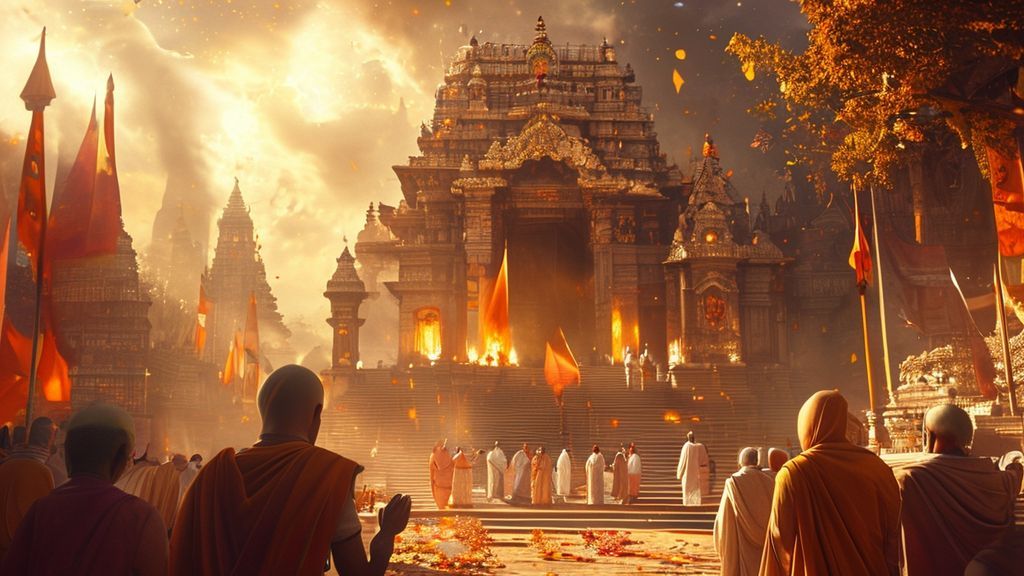
While the topic is political agenda, it is crucial to understand that for a Vedic Scholar, the building of a nation is akin to the construction of a grand temple – each pillar, each carving, each spire serves a divine purpose and is imbued with symbolic meaning. The “architectural marvel” of political Hindutva lies in its vision for structuring society and governance upon the immutable principles of Sanatan Dharma. Just as our ancient temples like Brihadeeswarar or Konark are masterpieces of engineering and spiritual symbolism, reflecting cosmic order, so too does political Hindutva envision a national edifice built on the foundations of Dharma, Artha, Kama, and Moksha, ensuring holistic human flourishing.
This architectural vision manifests in several ways:
- Preservation of Heritage: Active promotion and protection of sacred sites, temples, and traditional art forms. This is not merely aesthetic but a recognition of these structures as living embodiments of our spiritual identity.
- Education (Gyan): Reinstating indigenous knowledge systems, promoting Sanskrit, and integrating Dharmic values into the educational framework, mirroring the ancient Gurukul system’s emphasis on holistic development.
- Social Harmony (Samajik Samarasata): Fostering unity and reducing societal disparities, drawing from the Vedic ideal of Vasudhaiva Kutumbakam – the world is one family – while respecting the unique identity of Bharat.
- Economic Prosperity (Arthashastra): Developing policies that ensure economic well-being for all citizens, guided by principles of sustainable development and ethical conduct, as discussed in Kautilya’s Arthashastra, where prosperity supports Dharma.
The endeavor is to create a society where every aspect, from governance to daily life, resonates with the sanctity and order found in our most revered architectural wonders, making Bharat a living temple of Dharma.
The Sadhana of Nation Building: Dharmic Practices for the Citizen
For a devout Hindu, engagement with the national project, especially one inspired by Hindutva, is itself a form of Sadhana – a spiritual discipline. It is not about performing specific temple rituals for political ends, but about living a life of Dharma that contributes to the collective well-being of the nation. This involves:
- Swadharma Palan: Fulfilling one’s duties in their chosen sphere of life with integrity and dedication, whether as a student, a worker, a parent, or a public servant. This is rooted in the Bhagavad Gita’s teaching on performing one’s own duty (svadharma) with devotion.
- Seva (Selfless Service): Engaging in voluntary service for the community and nation, embodying the spirit of Paropakaraya Punyaya – doing good for others is virtuous.
- Cultural Preservation: Actively participating in and promoting traditional festivals, arts, languages, and customs, ensuring their continuity for future generations.
- Environmental Stewardship: Respecting and protecting nature, seeing it as a manifestation of the Divine, echoing the Vedic reverence for Bhumi Devi (Mother Earth) as described in the Pṛthivī Sūkta of the Atharvaveda.
- Active Citizenship: Engaging thoughtfully in civic duties, expressing informed opinions, and supporting initiatives that align with Dharmic principles for the nation’s welfare.
These practices transform passive citizenship into an active, spiritual contribution to the realization of a Dharmic Rashtra.
Mantras for National Harmony and Righteous Governance
Devotees are encouraged to chant mantras that invoke blessings for the nation, its leaders, and its people, fostering an environment conducive to Dharma. These sacred vibrations aid in purifying the collective consciousness and strengthening the resolve to build a righteous society.
- For Universal Peace and Well-being:
ॐ सर्वे भवन्तु सुखिनः । सर्वे सन्तु निरामयाः ।
सर्वे भद्राणि पश्यन्तु । मा कश्चिद् दुःखभाग् भवेत् ॥
Om Sarve Bhavantu Sukhinah | Sarve Santu Niramayah | Sarve Bhadrani Pashyantu | Ma Kaschid Duhkha Bhag Bhavet ||
(May all be prosperous and happy. May all be free from illness. May all see what is auspicious. May no one suffer.)
- For National Strength and Protection:
ॐ सह नाववतु । सह नौ भुनक्तु । सह वीर्यं करवावहै ।
तेजस्वि नावधीतमस्तु मा विद्विषावहै ॥
ॐ शान्तिः शान्तिः शान्तिः ॥
Om Saha Navavatu | Saha Nau Bhunaktu | Saha Viryam Karavavahai | Tejasvi Navadhitamastu Ma Vidvishavahai || Om Shantih Shantih Shantih ||
(May He protect us both. May He nourish us both. May we work together with great energy. May our study be brilliant and effective. May we not quarrel or dispute with each other. Om Peace, Peace, Peace.)
- For Righteous Leadership (from the Yajur Veda):
ॐ स्वस्ति न इन्द्रो वृद्धश्रवाः । स्वस्ति नः पूषा विश्ववेदाः ।
स्वस्ति नस्तार्क्ष्यो अरिष्टनेमिः । स्वस्ति नो बृहस्पतिर्दधातु ॥
Om Svasti Na Indro Vriddhashravah | Svasti Nah Pusha Vishvavedah | Svasti Nas Tarxyo Arishtanemih | Svasti No Brihaspatir Dadhatu ||
(May Indra, of great renown, grant us welfare. May Pushan, the all-knowing, grant us welfare. May Garuda, whose wheel is unhindered, grant us welfare. May Brihaspati grant us welfare.)
Dos and Don’ts for a Dharmic Citizen
Upholding the principles of political Hindutva requires a conscious effort to live by Dharmic values in daily life and in civic engagement.
- DO:
- Cultivate a deep reverence for Bharat Mata and its rich spiritual heritage.
- Actively participate in the preservation and promotion of indigenous culture, languages, and traditions.
- Practice unity and harmony, recognizing the diversity within the larger Hindu family.
- Engage in selfless service (Seva) for the welfare of society.
- Educate oneself thoroughly on Sanatan Dharma and Bharatiya Itihasa.
- DON’T:
- Engage in divisive rhetoric or actions that undermine national unity.
- Disrespect other Dharmic traditions or the foundational tenets of Sanatan Dharma.
- Prioritize self-interest over the collective well-being of the nation.
- Neglect one’s duties and responsibilities as a citizen.
- Fall prey to ideologies that seek to dismantle the cultural fabric of Bharat.
Frequently Asked Questions on Political Hindutva
Is Hindutva a Religion?
No, Hindutva is not a religion in the narrow, ritualistic sense, but rather a cultural and civilizational concept. It encompasses the collective identity of the Hindu people, their shared heritage, values, and way of life, which is deeply rooted in Sanatan Dharma. While distinct from the religious practice of Hinduism, it draws its spiritual and ethical framework from it.
How does Political Hindutva relate to Sanatan Dharma?
Political Hindutva seeks to translate the timeless principles and values of Sanatan Dharma – such as Dharma (righteousness), Rita (cosmic order), Satya (truth), Ahimsa (non-violence, contextualized), and the pursuit of holistic well-being (Yoga-kshema) – into contemporary governance and public policy. It aims to create a state and society that reflect and protect these eternal truths, ensuring the flourishing of all life within Bharat.
What is the ultimate goal of Political Hindutva for India?
The ultimate goal is the revitalization of Bharat as a sovereign, prosperous, and culturally confident nation (Rashtra), a Vishwaguru (world teacher) once more. This involves strengthening national identity, ensuring cultural preservation, achieving economic self-reliance, and restoring Bharat’s rightful place on the global stage as a spiritual and intellectual powerhouse, guided by the wisdom of Sanatan Dharma. More insights can be found at Hindutva.online.
Dharmic Significance: Preserving the Soul of Sanatan Dharma
The emergence and influence of political Hindutva, particularly through entities like the BJP, is understood by many sincere devotees not as a mere political phenomenon, but as a critical juncture for the preservation and resurgence of Sanatan Dharma itself. In an era marked by rapid globalization, ideological challenges, and cultural erosion, the concerted effort to anchor national policy and societal direction in the ancient wisdom of Bharat becomes paramount. It is an act of collective devotion, a striving to ensure that the sacred legacy inherited from our Rishis and ancestors continues to illuminate the path for future generations.
This endeavor seeks to re-establish the organic link between the land, its people, its culture, and its Dharma, fostering a sense of profound belonging and purpose. It is about nurturing the ‘Hindu heart’ of Bharat, ensuring that its laws, its education, its arts, and its economy are all imbued with the spiritual integrity that has defined this civilization for millennia. In doing so, political Hindutva, from a devotional perspective, is seen as performing a vital Dharmic duty – safeguarding the very soul of Sanatan Dharma for the well-being of Bharat and indeed, for humanity.