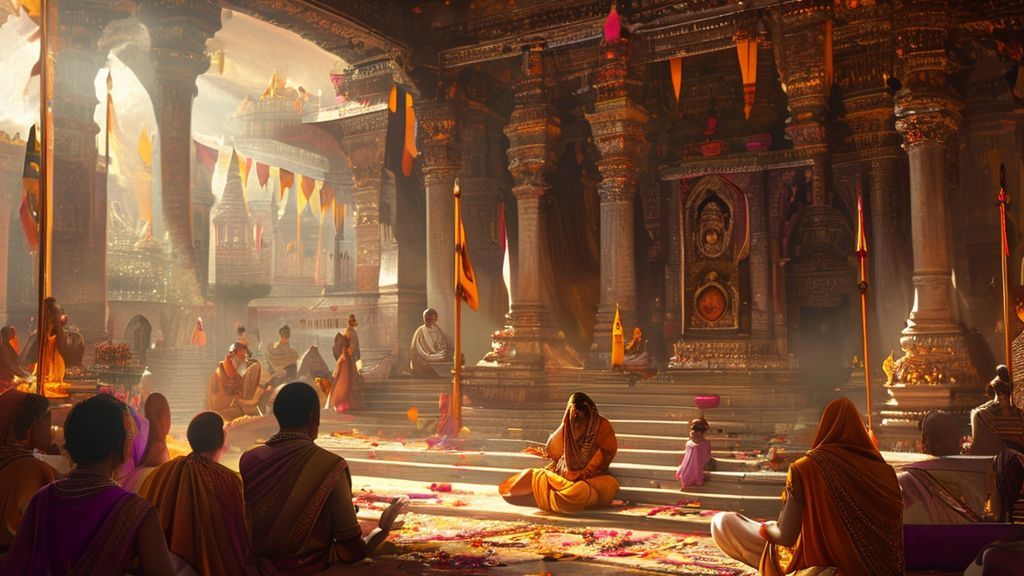
Indian Classical Music, particularly its system of Ragas, is not merely an art form but a profound spiritual discipline, a direct conduit to the Divine. Rooted in ancient Vedic traditions, it embodies the concept of Nada Brahma – sound as the Creator – guiding the sincere seeker towards inner harmony, emotional purification, and ultimately, union with the Supreme Consciousness through meticulously structured melodic frameworks.
| Attribute | Details |
|---|---|
| Deities Associated | Saraswati (Goddess of Knowledge & Arts), Shiva (Nataraja, Nada Brahma), Narada Muni (Celestial Musician) |
| Origin & Foundation | Samaveda (Vedic chants), Bharata Muni’s Natyashastra, Matanga Muni’s Brihaddeshi |
| Key Festivals & Traditions | Vasant Panchami (Saraswati Puja), Tyagaraja Aradhana, Harivallabh Sangeet Sammelan |
| Primary Scripture References | Samaveda, Natyashastra, Brihaddeshi, Sangeet Ratnakara, Various Puranas (e.g., Vishnu Purana, Narada Purana) |
The Resonance of the Cosmos: An Introduction to Nada Yoga
In the vast tapestry of Sanatan Dharma, Indian Classical Music stands as an unparalleled expression of the divine. It is not conceived merely as entertainment but as a powerful vehicle for spiritual realization, a direct path (marga) to transcending the mundane and touching the infinite. From the primordial sound of Om (ॐ), the universe unfolded, and within its intricate vibrations lies the essence of all existence. This tradition teaches us that sound (Nada) is Brahman itself, a concept known as Nada Brahma. Through the structured melodies of Ragas, we explore the subtle energies that govern our universe and our inner being, fostering a profound connection between the individual soul (Jivatma) and the Universal Soul (Paramatma).
This ancient art form, passed down through millennia via the rigorous Guru-Shishya Parampara (teacher-disciple tradition), offers a unique lens through which to perceive and interact with the divine. It is a system designed not just to evoke emotions but to purify them, elevate consciousness, and ultimately lead to Moksha, liberation. The practice of Nada Yoga, the yoga of sound, is central to this journey, utilizing specific sound frequencies to harmonize the chakras, quiet the mind, and open pathways to deeper meditative states. For a comprehensive understanding of various spiritual practices, please visit Hindutva.online.
Puranic History & The Divine Origin of Music
The genesis of Indian Classical Music is shrouded in divine lore and ancient wisdom, deeply embedded in our Itihasas and Puranas. The very foundation is traced back to the Samaveda, one of the four Vedas, which is dedicated entirely to melodic chants (Samagana) used during Vedic rituals. These chants, with their precise intonations and rhythmic patterns, were among the earliest forms of structured music.
Legend attributes the origin of sound itself to Lord Shiva’s Damaru (drum), whose cosmic vibrations are said to have given birth to the Sanskrit alphabet and thus, all organized sound. Shiva, in His form as Nataraja, the Cosmic Dancer, embodies the rhythmic pulsation of creation and dissolution, with His dance being the ultimate symphony. The Devi Bhagavata Purana and Skanda Purana often describe heavenly musicians known as Gandharvas and Apsaras, whose divine melodies enchant the heavens, inspiring earthly musicians.
The Goddess Saraswati, consort of Brahma, is revered as the patron deity of all arts, knowledge, and music. Her iconography, holding the Veena (a stringed instrument), symbolizes the harmony and wisdom that music bestows. The celestial sage Narada Muni, mentioned prominently in the Narada Purana and Mahabharata, is depicted as a wandering musician, always carrying his Veena, singing praises of Vishnu and spreading divine wisdom through his music. He is often considered the pioneer of musical treatises among the Rishis.
The earliest systematic codification of musical theory is attributed to Bharata Muni in his monumental treatise, the Natyashastra (circa 200 BCE – 200 CE). This text not only details dramatic arts but also provides intricate rules for music (Gandharva Vidya), including the concept of Jatis, which are precursors to modern Ragas. Later, Matanga Muni’s Brihaddeshi (circa 5th-9th Century CE) famously defined Raga as “Ranjayati iti Raga” (रञ्जयति इति रागः) – that which colors the mind and brings delight. These ancient texts lay the spiritual and theoretical bedrock for the rich and diverse tradition we cherish today.
The Science and Structure of Ragas: Architectural Marvels of Sound
While Indian Classical Music does not have “architectural marvels” in the physical sense of temples, the Raga system itself is an architectural marvel of sound – a precisely engineered framework of notes designed to evoke specific moods, spiritual states, and even healing properties. A Raga is much more than a mere scale; it is a melodic entity with its own distinct personality, a “soul” composed of specific ascending (Arohana – आरोहण) and descending (Avarohana – अवरोहण) patterns, emphasizing certain notes (Vadi – वादी, the king note) and secondary notes (Samvadi – संवादी, the minister note), and unique melodic phrases (Pakad – पकड़).
The entire structure is built upon Shrutis (श्रुतिः), the microtonal intervals, which are finer than the semitones of Western music. Ancient texts like the Sangeet Ratnakara by Sharngadeva (13th Century CE) detail 22 Shrutis within an octave, providing the subtle nuances that give each Raga its unique character and emotional depth. These Shrutis are not just theoretical but are experientially perceived and expressed, adding profound depth to the melodic canvas. The modern system typically uses 12 standard notes (Swaras – स्वर) within an octave, grouped into melodic scales known as Thaats in Hindustani music and Melakartas in Carnatic music. There are ten primary Thaats and 72 Melakarta Ragas, providing a vast palette for creation.
The scientific understanding extends to Raga Chikitsa (Raga therapy), where specific Ragas are believed to have therapeutic effects on the mind and body, influencing various doshas (Vata, Pitta, Kapha) and balancing the chakras. Each Raga is often associated with a particular time of day (e.g., Raga Bhairav for dawn, Raga Malkauns for late night) or season (e.g., Raga Bahar for spring), demonstrating a deep understanding of natural cycles and their resonance with human emotions and physiological states. This correlation is not arbitrary but arises from the vibrational frequency of the notes within the Raga, which interact with the energy centers of the human body and the ambient energy of the environment.
Rituals & Puja Vidhi: Music as Upasana
For a sincere devotee, the practice and performance of Indian Classical Music are inherently a form of Upasana (उपासना) – intense spiritual worship and contemplation. The entire process, from the initial tuning of the instrument (Shruti Sadhana) to the culmination of a performance, is steeped in ritualistic reverence. There isn’t a singular “Puja Vidhi” in the conventional sense, but rather a devotional approach to the art itself:
- Vandana (वन्दना): Before commencing practice or performance, musicians often offer prayers to Goddess Saraswati, Lord Ganesha, their Guru, and the chosen deity, seeking blessings for clarity, purity of sound, and spiritual insight. This can involve chanting specific mantras or simple heartfelt prayers.
- Naada Sadhana (नाद साधना): The musician engages in rigorous practice, focusing on achieving perfect intonation (Shuddha Swara), mastering the Raga’s grammar, and delving into its emotional core. This is a meditative process, where the musician becomes one with the sound.
- Bhav Sanyojan (भाव संयोजन): Infusing the Raga with appropriate emotion (Bhava) and aesthetic rasa (Rasa), such as Shringara (love), Karuna (compassion), or शांत (peace). This is where the Raga truly comes alive and connects with the audience’s inner spiritual self.
- Arpanam (अर्पणम्): The performance itself is an offering to the Divine. In temples, musicians often perform during special festivals or daily rituals (e.g., Seva in Vaishnava traditions), dedicating their music directly to the deity.
- Guru Seva (गुरु सेवा): The profound respect and service to the Guru (teacher) are paramount. The Guru is seen as the living embodiment of the tradition, and learning from them is itself a sacred act.
Mantras & Chants for Devotees
Incorporating sacred sounds and chants enhances the spiritual experience of engaging with classical music:
- Om (ॐ): The universal primordial sound, chanted at the beginning and end of any spiritual endeavor. It represents the ultimate reality (Brahman).
- Gayatri Mantra:
ॐ भूर्भुवः स्वः। तत्सवितुर्वरेण्यं भर्गो देवस्य धीमहि। धियो यो नः प्रचोदयात्॥
Om Bhur Bhuvah Svaha, Tat Savitur Varenyam, Bhargo Devasya Dhimahi, Dhiyo Yo Nah Prachodayat.
This powerful Vedic mantra invokes the brilliance of the divine creative light to illuminate our intellect.
- Saraswati Vandana:
या कुन्देन्दुतुषारहारधवला या शुभ्रवस्त्रावृता।
या वीणावरदण्डमण्डितकरा या श्वेतपद्मासना॥
Ya Kundendu Tushar Har Dhavala, Ya Shubhra Vastravrita,
Ya Veena Varadanda Manditakara, Ya Shveta Padmasana.
A prayer to Goddess Saraswati, seeking her blessings for knowledge, wisdom, and musical prowess.
- Sloka from Sangeet Ratnakara (defining Nada Brahma):
नाद एव परं ब्रह्म नाद एव परं पदम्। नाद एव परं तत्त्वं नाद एव परं शिवम्॥
Naada eva Param Brahma, Naada eva Param Padam. Naada eva Param Tattvam, Naada eva Param Shivam.
Meaning: Sound is verily the Supreme Brahman, sound is verily the Supreme State. Sound is verily the Supreme Truth, sound is verily the Supreme Shiva. This emphasizes the spiritual core of sound.
Dos and Don’ts for the Sincere Seeker
- Do: Approach music with reverence, understanding it as a path to the divine.
- Do: Seek guidance from a qualified Guru for authentic learning and spiritual growth.
- Do: Practice diligently with focus and devotion (Sadhana) to purify the mind and perfect the art.
- Do: Listen to classical music attentively, allowing the Ragas to settle in your consciousness and evoke their intended emotions.
- Don’t: Treat Indian Classical Music merely as entertainment or a means for personal aggrandizement.
- Don’t: Disrespect the Guru, the instruments, or the tradition through casualness or irreverence.
- Don’t: Compromise the purity and grammar of the Ragas for fleeting popularity or commercial gain.
- Don’t: Overlook the spiritual dimension of this art form; its essence lies beyond mere technical proficiency.
What is the difference between Hindustani and Carnatic music?
While both Hindustani (North Indian) and Carnatic (South Indian) classical music systems share common Vedic roots and the fundamental concept of Raga and Tala (rhythmic cycle), they differ significantly in their stylistic approaches, ornamentation, and performance practices. Hindustani music emphasizes improvisation (vistara) and exploration within the Raga, often with slower development, while Carnatic music is characterized by pre-composed kritis (compositions) with intricate melodic and rhythmic structures, featuring faster tempos and highly ornamental phrases. The instrument ensembles also differ, with tabla and sarangi prominent in Hindustani, and mridangam and violin in Carnatic.
How do Ragas affect emotions and consciousness?
Ragas are meticulously structured to evoke specific psychological and physiological responses through their unique combination of notes, microtones, and melodic movements. Each Raga is associated with a particular Rasa (aesthetic flavor or emotion), such as Karuna (compassion), Shringara (love), Veera (heroism), or Shanta (peace). By consistently and purely presenting these sonic patterns, a Raga can induce specific emotional states, promote mental tranquility, aid concentration, and even facilitate deeper meditative experiences, directly impacting consciousness by resonating with the body’s energy centers.
Can anyone learn Indian Classical Music for spiritual benefits?
Absolutely. While mastering the intricacies of Indian Classical Music requires dedication and rigorous training, anyone can engage with its spiritual aspects. Listening mindfully to Ragas can calm the mind, reduce stress, and open one to deeper contemplative states. Even basic chanting or learning simple devotional compositions (bhajans or kirtans) rooted in classical melodies can provide significant spiritual benefits, fostering a connection with the divine through sound. The journey begins with reverence and an open heart.
What is the significance of “Nada Brahma”?
Nada Brahma (नाद ब्रह्म) is a fundamental philosophical concept in Sanatan Dharma, meaning “Sound is God” or “Sound is Brahman.” It posits that the entire universe originated from and is permeated by primordial sound vibrations. This concept is deeply rooted in the Upanishads, asserting that the unstruck sound (Anahata Nada) is the ultimate reality, and all manifest sound (Ahata Nada) is a reflection of it. In Indian Classical Music, Nada Brahma signifies that music is not just an art form but a sacred path to experience the divine, where the musician becomes a channel for cosmic vibrations, leading to spiritual awakening and unity with the Absolute Truth. You can learn more about the philosophical underpinnings of Sanatan Dharma at Hindutva.online.
Preserving Sanatan Dharma Through Raga Sadhana
The timeless tradition of Indian Classical Music, with its profound system of Ragas, is a living testament to the enduring wisdom of Sanatan Dharma. It is a heritage that transcends mere artistic expression, serving as a powerful tool for self-realization, emotional healing, and connecting with the cosmic consciousness. By understanding and embracing the spiritual dimensions of this sacred art, we not only preserve a precious cultural legacy but also embark on a transformative journey inward, echoing the ancient Rishi’s quest for truth and harmony. The purity of Nada, meticulously enshrined in Ragas, offers every Hindu a direct, resonant path to the Divine, ensuring that the eternal dharma continues to uplift and enlighten generations.
