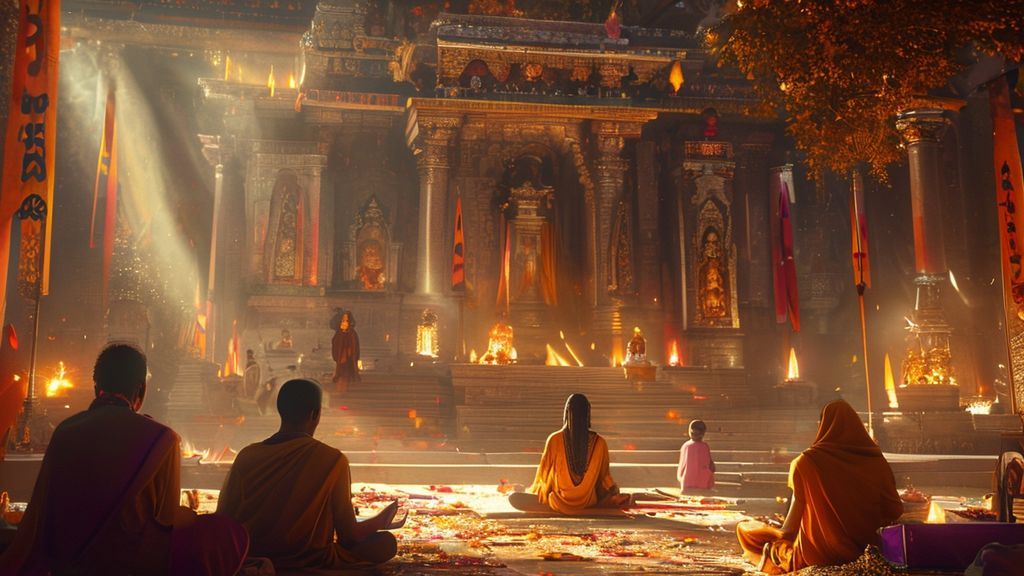
Hindu meditation techniques offer a profound, time-tested pathway to anxiety relief, rooted in ancient Vedic wisdom and Sanatan Dharma. Through practices like Dhyana, Pranayama, and Japa, devotees learn to quiet the turbulent mind, cultivate inner peace, and reconnect with the divine Atman, thereby alleviating stress and fostering profound mental tranquility.
| Attribute | Details |
|---|---|
| Guiding Principle | Realization of the Atman (Self) and Brahman (Ultimate Reality) |
| Key Practices | Dhyana (Meditation), Pranayama (Breath Control), Japa (Mantra Chanting), Yoga Asana (Postures) |
| Primary Scripture References | Patanjali Yoga Sutras, Bhagavad Gita, Upanishads |
| Core Purpose | Mana-Nigraha (Mind Control), Chitta-Vritti-Nirodhah (Cessation of Mind Fluctuations) |
The Spiritual Anchor: Finding Serenity Through Sanatan Dharma
In an age fraught with unprecedented mental strain, the ancient wisdom of Sanatan Dharma offers a sacred sanctuary for the anxious mind. Hindu meditation techniques are not mere relaxation methods; they are profound spiritual practices designed to purify the mind, quiet the incessant chatter of thoughts, and guide the practitioner towards an experience of intrinsic peace and divine connection. From the Himalayas to the Vindhyas, countless Rishis and Yogis have perfected these methodologies over millennia, recognizing that true liberation from suffering, including anxiety, begins within. This journey is one of self-discovery, where the external world’s tumultuous currents cease to disturb the inner stillness of the Atman, the eternal Self.
Puranic Wisdom: The Genesis of Inner Discipline
The practice of Dhyana (meditation) and Yogic discipline is woven intricately into the fabric of Hindu Itihasa and Puranas, demonstrating its venerable antiquity. The Rig Veda itself, in its hymns to Tapas (ascetic fervor), hints at the early origins of contemplative practices. Later, the Upanishads, particularly the Katha and Mandukya, elucidate the profound nature of the Atman and the necessity of withdrawing the senses and stilling the mind to realize it. The Katha Upanishad famously compares the self to the master of a chariot, the intellect as the charioteer, the mind as the reins, and the senses as the horses, emphasizing the need for disciplined control for inner harmony.
The Bhagavad Gita, a crown jewel of the Mahabharata, dedicates an entire chapter, the Dhyana Yoga (Chapter 6), to the art of meditation. Lord Krishna instructs Arjuna on the proper posture, mental disposition, and the ultimate goal of yoga – union with the Divine. He proclaims, “Yogasthaḥ kuru karmāṇi saṅgaṁ tyaktvā dhanañjaya siddhy-asiddhyoḥ samo bhūtvā samatvaṁ yoga ucyate” (BG 2.48), emphasizing equanimity as the essence of Yoga. This equanimity is precisely what counteracts anxiety, which stems from attachment to outcomes and aversion to uncertainty.
Further, the Yoga Sutras of Patanjali provide the most systematic and scientific treatise on meditation, outlining the eight limbs of Ashtanga Yoga. Patanjali’s seminal definition, “Yogaś citta-vṛtti-nirodhaḥ” (Yoga Sutras 1.2), meaning “Yoga is the cessation of the fluctuations of the mind,” directly addresses the root cause of anxiety. By taming the unruly waves of thought, the mind can return to its natural state of clarity and peace, a state free from the agitation of anxious projections and fearful ruminations.
The Inner Architecture: Engineering the Mind for Equanimity
While we traditionally speak of temple architecture, the true marvel in Hindu meditation lies in the “architecture” of the mind itself, as meticulously mapped out by ancient Rishis. This is not about brick and mortar, but about building internal resilience, clarity, and peace. The Vedic seers understood the intricate workings of consciousness, long before modern psychology. They engineered techniques that systematically dismantle the structures of anxiety within our mental framework.
The Ashtanga Yoga system is essentially an architectural blueprint for mental well-being.
- Yamas (Ethical Restraints) & Niyamas (Observances): These foundational ethical principles (e.g., Ahimsa – non-violence, Satya – truthfulness, Santosha – contentment) build a strong moral and emotional base, reducing inner conflict and guilt, which are often precursors to anxiety.
- Asana (Posture): Physical postures prepare the body to sit comfortably and steadily for meditation, ensuring the flow of Prana (life force) is unobstructed. A stable body facilitates a stable mind.
- Pranayama (Breath Control): This is a powerful tool to directly influence the nervous system. By consciously regulating the breath, practitioners can shift from a sympathetic (“fight or flight”) to a parasympathetic (“rest and digest”) state, immediately reducing physiological symptoms of anxiety.
- Pratyahara (Sense Withdrawal): Learning to detach the senses from external stimuli is crucial. This internalises attention, preventing the mind from being constantly pulled by external stressors and sensory overload.
- Dharana (Concentration) & Dhyana (Meditation): These are the pillars of sustained mental focus and the actual state of meditation, where the mind becomes one-pointed and then ultimately still.
This systematic approach, like building a strong edifice from the ground up, constructs an internal environment where anxiety finds no fertile ground to flourish. The wisdom on Hindutva.online elucidates these deep connections between spiritual practice and mental fortitude.
Rituals of Stillness: A Guide to Meditative Practice
Embracing Hindu meditation for anxiety relief involves a structured yet flexible approach. The following steps outline a common path:
- Preparation (Shuddhi): Find a clean, quiet space where you won’t be disturbed. Sit on a comfortable cushion (asana) with a straight spine, relaxed shoulders, and an open chest. The traditional Padmasana (Lotus Pose) or Sukhasana (Easy Pose) are ideal.
- Intention (Sankalpa): Briefly set your intention. For anxiety relief, it might be: “May I find peace and calm within.”
- Pranayama (Breath Control): Begin with simple breath awareness. Inhale deeply, allowing the abdomen to expand, and exhale slowly. Practice Nadi Shodhana Pranayama (Alternate Nostril Breathing) for 5-10 minutes. This technique is highly effective for balancing the nervous system and calming the mind.
- Close the right nostril with the right thumb, inhale slowly through the left nostril.
- Close the left nostril with the ring finger, release the thumb, and exhale through the right nostril.
- Inhale through the right nostril, close it with the thumb, release the ring finger, and exhale through the left nostril.
- This completes one round. Maintain a smooth, rhythmic breath.
- Pratyahara (Sense Withdrawal): Gently close your eyes. Bring your attention inward, noticing any sounds, sensations, or thoughts without judgment. Allow them to pass without engaging.
- Dharana (Concentration): Choose an object of focus (Ishta-Devata, a mantra, or the breath). Gaze softly at a deity’s image or mentally repeat a mantra. When the mind wanders, gently bring it back to your chosen focus.
- Dhyana (Meditation): As concentration deepens, the awareness of the object of focus becomes effortless. There is a continuous flow of attention. This is Dhyana, a state of deep absorption and inner quietude. Remain in this state for 15-30 minutes, or longer if comfortable.
- Concluding (Samapana): Slowly bring your awareness back to your body and surroundings. Gently open your eyes. Sit in silence for a few moments, integrating the experience. Offer gratitude.
Mantras for Tranquility and Protection
Mantras are powerful sound vibrations (Shabda Brahman) that resonate with cosmic energies and can profoundly influence the mind. Chanting them during meditation or throughout the day provides solace and protection.
- Om (ॐ): The primordial sound of the universe. Chanting “Om” purifies the mind and connects one to the cosmic consciousness, invoking deep inner peace.
- Gayatri Mantra:
ॐ भूर्भुवः स्वः तत्सवितुर्वरेण्यं भर्गो देवस्य धीमहि धियो यो नः प्रचोदयात्॥
Om Bhur Bhuvah Svaha Tat Savitur Varenyam Bhargo Devasya Dhimahi Dhiyo Yo Nah Prachodayat.
This ancient Vedic mantra invokes the radiant divine light to illuminate the intellect, removing darkness and confusion.
- Mahamrityunjaya Mantra:
ॐ त्र्यम्बकं यजामहे सुगन्धिं पुष्टिवर्धनम् उर्वारुकमिव बन्धनान् मृत्योर्मुक्षीय मामृतात्॥
Om Tryambakam Yajamahe Sugandhim Pushtivardhanam Urvarukamiva Bandhanan Mrityor Mukshiya Maamritat.
Dedicated to Lord Shiva, this mantra is a powerful plea for health, well-being, and protection from all forms of suffering, including mental anguish and fear.
- Mantra of Personal Deity (Ishta-Devata Mantra): Chanting the name of your chosen deity (e.g., “Om Namah Shivaya,” “Om Namo Narayanaya,” “Om Shri Ramaya Namaha,” “Om Aim Hrim Klim Chamundaye Vichche”) fosters a deep, comforting connection and evokes divine grace.
Cultural Etiquette: Dos and Don’ts for the Devotee
- DO maintain cleanliness of body and mind before and during practice.
- DO approach meditation with reverence and a sincere heart, understanding its spiritual significance.
- DO practice consistently, even for short durations. Regularity is key to profound results.
- DO wear comfortable, modest clothing that allows for free movement and breath.
- DO NOT eat a heavy meal immediately before meditation. Practice on an empty or light stomach.
- DO NOT force any posture or breathing technique if it causes discomfort or pain. Listen to your body.
- DO NOT engage in gossip or negative thoughts immediately before or after your practice, as it pollutes the purified mental space.
- DO NOT expect immediate miraculous results. Patience (Shraddha) and perseverance (Abhyasa) are essential.
What is the ultimate goal of Hindu meditation for anxiety?
The ultimate goal transcends mere anxiety relief; it is to attain a state of Chitta-Vritti-Nirodha (cessation of mind fluctuations), leading to self-realization (Atma-Jnana) and liberation (Moksha). By understanding the true nature of the Self, beyond the temporary afflictions of the mind, one experiences everlasting peace and freedom from all suffering, including anxiety.
How quickly can I expect to see results?
While immediate calm can often be felt after a single session of Pranayama or Dhyana, the sustained and deep relief from chronic anxiety is a gradual process that requires consistent, dedicated practice (Abhyasa) and non-attachment to outcomes (Vairagya), as taught in the Bhagavad Gita. Most practitioners report significant improvements in stress levels, focus, and overall well-being within a few weeks to months of regular practice.
Is it necessary to have a Guru or can I learn on my own?
While sincere self-study can provide a foundation, having a qualified Guru (spiritual teacher) is highly recommended in Hindu traditions. A Guru provides personalized guidance, corrects subtle errors, and transmits the deeper spiritual insights (Anugraha) that are invaluable for navigating the complex inner landscape. However, initial techniques can be learned from authentic texts and resources such as those found on Hindutva.online.
Dharmic Significance: Preserving the Inner Sanctum of Sanatan Dharma
The embrace of Hindu meditation techniques for anxiety relief is far more than a personal wellness choice; it is a profound act of preserving and revitalizing Sanatan Dharma itself. In an increasingly fragmented world, these practices offer a path back to wholeness, reminding humanity of its inherent divinity and the timeless wisdom embedded in Vedic traditions. By cultivating inner peace, each individual contributes to a more harmonious society, echoing the ancient prayer, “Om Sarve Bhavantu Sukhinah, Sarve Santu Niramayah” (May all be happy, May all be free from illness). This dedication to inner work is the bedrock upon which the spiritual resilience of our civilization is built, ensuring that the light of Dharma continues to shine brightly for generations to come, guiding all towards lasting serenity.
