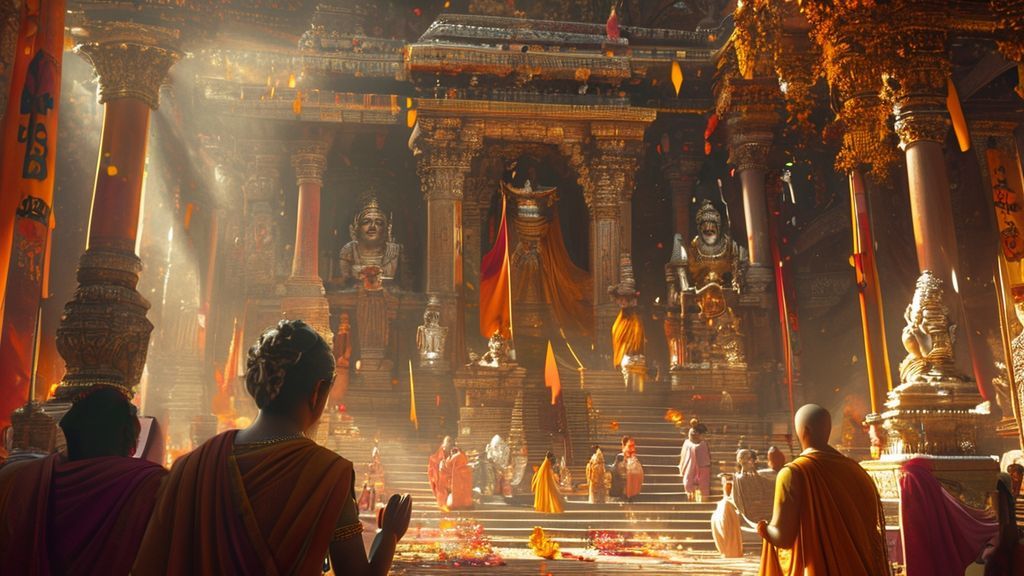
Deity statues in wrong places evoke profound concern among Hindus, as the consecrated murti is not merely an idol but a living embodiment of the Divine, requiring specific placement according to sacred texts and rituals. The sanctity of a murti, infused with divine presence through Prana Pratishtha, necessitates its placement in a pure, ritually appropriate environment, guided by Agama Shastras and Vastu Vidya, to ensure spiritual efficacy and uphold Dharma.
| Principle | Description | Scriptural Basis | Significance |
|---|---|---|---|
| Prana Pratishtha | The elaborate ritual of infusing life (Prana) into a deity image, transforming it from inert matter into a vibrant vessel for divine presence. | Agama Shastras (e.g., Kamikagama, Karana Agama), Puranas. | Establishes the murti as a sacred conduit for worship and blessings; its sanctity becomes paramount. |
| Vastu Sthapana | Placement of the murti according to specific spatial and directional guidelines to harmonize with cosmic energies and amplify spiritual vibrations. | Vastu Shastra (e.g., Mayamata, Manasara), Vishwakarma Prakash. | Ensures optimal reception of divine energy, promoting peace, prosperity, and spiritual growth for devotees. |
| Sanctity & Purity | A consecrated murti demands continuous purity of environment, ritual observance, and reverent handling to maintain its divine essence. | Smritis, Puranas, Dharma Shastras. | Any deviation or disrespect is considered a grave offense (अपराध – aparādha) against the deity, potentially inviting negative consequences. |
| Dispelling Misconceptions | Distinguishing a consecrated murti from a mere decorative statue, emphasizing that the form serves as a focal point for devotion (मूर्ति पूजा – mūrti pūjā), not idol worship. | Bhagavad Gita (Chapter 12), Yoga Sutras, various Upanishads. | Highlights the profound philosophical basis of Saguna Brahman (God with attributes) and the necessity of proper reverence. |
The Sacred Embodiment: Understanding the Murti
In Sanatan Dharma, a deity statue is far more than an artistic representation; it is a sacred Murti, a physical manifestation of the Divine through which devotees can connect with the formless (Nirguna) Brahman. This profound spiritual connection is established primarily through the ritual of Prana Pratishtha (प्राण प्रतिष्ठा), the infusion of life-force. Until this elaborate ceremony, a statue is merely inert stone, metal, or wood. After Pratishtha, it becomes a vibrant conduit for divine energy, worthy of reverence and meticulous care.
The concept of a murti being in a “wrong place” thus strikes at the very heart of Hindu spiritual practice. It implies a disruption of the sacred order, a disregard for prescribed rituals, or a disrespect towards the manifest Divine. Such concerns arise from a deep understanding of the cosmos, the sanctity of space, and the intricate relationship between the material and spiritual realms, meticulously outlined in our ancient scriptures.
Puranic Narratives & The Sanctity of Divine Presence
Our Itihasas and Puranas are replete with stories that underscore the paramount importance of correct divine placement and the consequences of its neglect. The very establishment of pilgrimage sites, known as Tirthas (तीर्थ), often originates from a divine command or the manifestation of a deity in a specific, sacred spot. For instance, the twelve Jyotirlingas of Lord Shiva are said to have manifested themselves (स्वयंभू – svayambhū), making their locations inherently sacred. Moving such a Swayambhu Linga would be inconceivable, as its power is intrinsically tied to its point of emergence.
The Skanda Purana, particularly in its various Khandas like Kashi Khanda, describes the profound sanctity of sacred spaces and the deities residing within them. It narrates how Lord Shiva Himself declared Kashi to be His eternal abode, emphasizing that the spiritual benefits derived from worshipping a deity in its divinely ordained place are immeasurable. Conversely, ancient texts like the Agni Purana and Matsya Purana detail the adverse effects, known as doshas (दोष), that can befall individuals or communities if sacred images are desecrated, improperly handled, or placed in impure environments. These narratives reinforce the idea that divine energy, once invoked, requires specific conditions for its benign presence to flourish, and any “wrong placement” constitutes a disturbance to this delicate spiritual ecosystem.
Architectural & Vastu Principles for Murti Sthapana
The placement of a murti is not arbitrary; it is governed by the profound science of Vastu Shastra (वास्तु शास्त्र) and the elaborate rules of Agama Shastras. These ancient texts, such as the Mayamata and Manasara (for temple architecture), and various Agama texts like the Kamikagama and Karana Agama (for rituals and murti making), provide precise guidelines for temple construction and deity installation. The entire temple structure is considered a cosmic being, the Vastu Purusha Mandala (वास्तु पुरुष मंडल), with the Garbhagriha (sanctum sanctorum) as its heart, where the Moola Murti (main deity) resides.
Within the Garbhagriha, the murti is placed at the Brahma-sthana, the central energy point of the temple, aligned to specific cardinal directions to harness cosmic energies. The material of the murti, its proportions, and its orientation are all meticulously planned to ensure maximum spiritual potency. For instance, Lord Shiva’s Lingam is typically placed on a Yoni-pitha, representing the cosmic union, and must be oriented correctly. Goddess deities face particular directions. Placing a consecrated murti in a secular space, a place of impurity, or even in a home without adhering to basic Vastu principles (such as not facing south, not under a beam, or not near a toilet) is considered disrespectful and can negate the spiritual benefits, potentially causing disharmony. These strictures are not superstitions but emanate from a profound understanding of subtle energies and their influence on human well-being and spiritual progress.
Pratishtha & Puja Vidhi: The Sacred Consecration
The Prana Pratishtha ceremony is the pivot around which the sanctity of a murti revolves. It is a multi-day ritual involving elaborate Vedic chanting, offerings, fire sacrifices (होम – homa), and intricate procedures performed by qualified priests (पंडित – paṇḍit). During this ritual, the deity’s vital energy is invoked from the cosmos and infused into the physical form, rendering it suitable for worship. The mantra for invokation often includes phrases like “अस्यै प्राणाः प्रतिष्ठंतु अस्यै प्राणाः क्षरंतु च” (Asyai Prāṇāḥ Pratiṣṭhantu Asyai Prāṇāḥ Kṣarantu Ca – May life be established in this, may life flow in this), establishing a permanent connection.
Once consecrated, the murti becomes a living presence, requiring daily worship (Nitya Puja – नित्य पूजा), bathing (Abhishekam – अभिषेकम्), dressing (Alankaram – अलंकारम्), and food offerings (Naivedyam – नैवेद्यम्). A consecrated murti, especially a Moola Murti in a temple, is considered eternally present and must never be moved without extreme necessity and without performing elaborate re-consecration or purification rites (पुनः प्रतिष्ठा – Punaḥ Pratishtha or Jirnoddharana – जीर्णोद्धार). If a murti is found in a “wrong place” – be it disrespected, damaged, or taken from its original sacred context – it calls for specific rituals of purification, re-installation, or even immersion in sacred waters if it is irrecoverable. The intent is always to restore or respect the divine energy that was once infused.
Mantras & Chants for Purity and Re-consecration
Devotees interact with the Divine through specific vibrations embodied in mantras. When dealing with the sanctity of murtis, several mantras are invoked for purification, consecration, and seeking forgiveness for any perceived transgression. For general purification of space and mind, the Gayatri Mantra (ॐ भूर्भुवः स्वः तत्सवितुर्वरेण्यं भर्गो देवस्य धीमहि धियो यो नः प्रचोदयात् – Om Bhur Bhuvah Svah Tatsavitur Varenyam Bhargo Devasya Dhimahi Dhiyo Yo Nah Prachodayat) is highly effective. For the purification of a location or object, mantras from the Purusha Suktam or Sri Suktam are often chanted. During re-consecration or purification ceremonies for murtis, specific Vedic mantras relevant to the deity are chanted, along with invoking the five elements and seeking their blessings. The Panchakshari Mantra (ॐ नमः शिवाय – Om Namah Shivaya) for Shiva or the Ashtakshari Mantra (ॐ नमो नारायणाय – Om Namo Narayanaya) for Vishnu are chanted for general invocation and purification of the atmosphere. If there has been any unintentional offense, the Kshama Prarthana (क्षमा प्रार्थना – prayer for forgiveness) is essential:
आवाहनं न जानामि न जानामि विसर्जनम् ।
पूजां चैव न जानामि क्षमस्व परमेश्वर ॥
मंत्रहीनं क्रियाहीनं भक्तिहीनं सुरेश्वर ।
यत्पूजितं मया देव परिपूर्णं तदस्तु मे ॥
(Avahanam na janami na janami visarjanam,
Pujam chaiva na janami kshamasva Parameshwara.
Mantraheenam kriyaheenam bhaktiheenam Sureshwara,
Yatpujitam maya Deva paripurnam tadastu me.)
“I know not how to invoke, nor how to bid farewell. I know not how to worship, forgive me, O Supreme Lord. O Lord of the Devas, whatever worship I have performed, though devoid of mantras, actions, and devotion, may it be complete through Your grace.” This mantra underscores the humble submission and awareness of human limitations in perfect worship.
Dos and Don’ts Regarding Deity Statues
Understanding the reverence due to a murti is crucial for every sincere seeker. Here are some guidelines:
- Do: Treat a consecrated murti with utmost reverence as a living deity.
- Do: Place murtis in a clean, dedicated altar space (पूजा घर – puja ghar) in your home, preferably in the northeast direction, adhering to Vastu principles.
- Do: Perform daily puja, offering water, flowers, incense, and lamps.
- Do: Seek guidance from a qualified priest or scholar from Hindutva.online if you find an ancient or displaced murti.
- Do: Undertake specific purification or re-installation rituals if a consecrated murti must be moved or has been inadvertently desecrated.
- Don’t: Place murtis in bedrooms, near toilets, under staircases, or in any impure or disrespectful location.
- Don’t: Use a consecrated murti for decorative purposes or commercial display without proper understanding and reverence.
- Don’t: Touch a consecrated murti without having bathed and purified yourself.
- Don’t: Discard broken or damaged murtis carelessly. They should be immersed in sacred waters (e.g., rivers, oceans) with proper reverence, not thrown in trash.
- Don’t: Assume that all deity statues are equally sacred. Only those consecrated through Prana Pratishtha hold the full spiritual potency.
What if an ancient murti is found in an unusual place?
When an ancient murti is discovered in an unexpected or unusual location, Hindus generally believe it should be treated with deep reverence. The initial step is to purify the area around the murti and perform preliminary prayers. Local temple authorities, archaeological experts, and Dharmic scholars should then be consulted to ascertain its origin, potential history, and the appropriate next steps for its respectful re-installation in a temple or a designated sacred space. It is considered a blessing to rediscover such a divine artifact, and great care is taken to restore its proper sanctity.
Can I keep any deity statue I purchase in my home?
While one can purchase any deity statue for aesthetic appreciation, for purposes of worship and spiritual benefit within Sanatan Dharma, it is crucial to understand the distinction between a decorative item and a consecrated murti. If the intent is to worship, the statue should ideally undergo a simple Pratishtha ceremony by a priest, even for home altars. Without this, it remains an image, not a vibrant divine presence. For elaborate temple murtis, the full Prana Pratishtha is indispensable. Furthermore, ensure the statue is placed according to basic Vastu principles to invite positive energy.
What is the difference between an ‘idol’ and a ‘murti’?
The term ‘idol’ often carries connotations of pagan worship or a crude, static representation, particularly from Abrahamic traditions. In contrast, ‘murti’ (मूर्ति) in Hinduism signifies a profound spiritual reality: it is a *form* or *manifestation* of the formless Divine. A murti is not worshipped *as* God itself, but rather serves as a consecrated medium or a tangible focal point through which the devotee can concentrate their mind and connect with the Supreme Being. It is a vessel imbued with divine consciousness through rituals like Prana Pratishtha, facilitating devotional practices and spiritual communion.
Dharmic Significance: Upholding Sacred Traditions
The Hindu perspective on deity statues in “wrong places” is not born of superstition, but from a profound spiritual ecology articulated in our scriptures. It reflects an understanding that the Divine is accessible through form, and that specific rituals and spatial alignments are necessary to properly invite, sustain, and honor that presence. Disregarding these principles is seen not just as an aesthetic faux pas, but as a disruption of Dharmic order, potentially impeding both individual and collective spiritual progress. Upholding the sanctity of murtis, their proper consecration, and their reverent placement is therefore a vital act of preserving Sanatan Dharma, ensuring that the ancient wisdom of our Rishis continues to guide future generations. It reinforces the truth that divinity permeates all creation, and that certain forms, once consecrated, become powerful gateways to transcendence, requiring our utmost devotion and care. For more insights into these profound practices, visit Hindutva.online.
