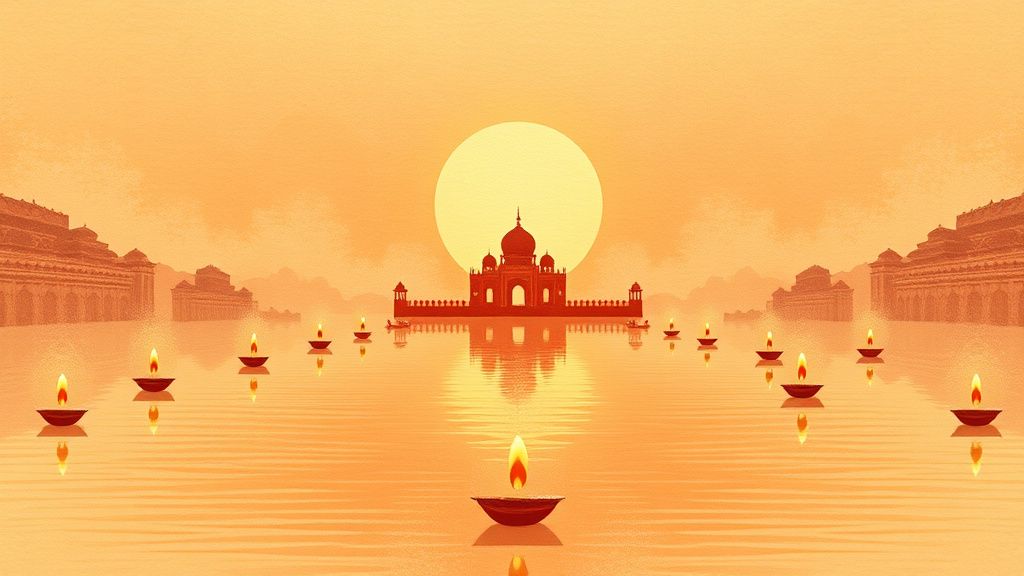
The Ganga is treated in Hindu tradition as the most sacred of rivers because the canonical descent story places her literally as the water poured out of Brahma’s kamandalu, broken in her fall by Shiva’s matted hair, and led down to earth by the ascetic effort of King Bhagiratha to liberate his ancestors. The river is worshipped as a goddess (Ganga Mata), used in shraadh and asthi-visarjan rites for the dead, and considered to confer purification through bathing. The Bhagiratha account is recounted in the Ramayana’s Balakanda, in the Bhagavata Purana, and in the Mahabharata’s Vana Parva and Anushasana Parva.
The Bhagiratha descent, in short
The frame story runs through three generations of the Ikshvaku dynasty. King Sagara performed an Ashvamedha sacrifice; his sixty thousand sons, sent to find the missing sacrificial horse, were reduced to ash by the sage Kapila for accusing him wrongly. The ashes were unconsecrated and the sons could not attain the afterlife. Sagara’s grandson Anshuman and great-grandson Dilipa attempted ascetic penance to bring Ganga down from the heavens to purify the ashes; both died without succeeding.
It was Bhagiratha, in the next generation, whose tapas won Brahma’s permission. The river was allowed to descend, but the earth could not bear her force on impact. Shiva caught her in the locks of his matted hair on Mount Kailash, slowed her flow, and released her in seven streams. The most celebrated of those streams followed Bhagiratha down to the plains, washed the ashes of Sagara’s sons, and gave the sixty thousand their place in the next world. The river is therefore called Bhagirathi at her Himalayan source.
Why Shiva’s hair and why Jahnu’s ear
The image of Shiva catching the river in his jata appears in many iconographic sets across India (the bronze Gangadhara murti of South India is one). The doctrinal point in the descent story is that even a sacred force, released uncontrolled, would be destructive; the river is rendered usable by Shiva’s mediation. The line about seven streams is taken in some traditions as a map of the rivers of the northern subcontinent, and in others as a symbolic count.
A second well-known episode happens after the river reaches the plains. As Bhagiratha leads her along, Ganga’s waters flood the ashram of sage Jahnu and disturb his ritual fire. Angered, Jahnu drinks the entire river. Bhagiratha pleads, Jahnu relents, and releases her again from his ear. The river is therefore also called Jahnavi (daughter of Jahnu). The Ramayana places this episode at the modern Sultanganj area in Bihar; tradition disagrees on the exact spot.
Purification, shraadh and the death rite
The doctrine that Ganga purifies sin and that her waters carry the soul of the departed toward moksha is what makes the river functionally central, not just symbolically central, in Hindu practice. The standard Hindu post-cremation rite places asthi (bone fragments after cremation) into the river, ideally within ten days of the cremation. The four sites most used for this rite are:
- Haridwar, at Brahmakund on Har Ki Pauri, where the river enters the plains.
- Prayagraj, at Triveni Sangam, the confluence of Ganga, Yamuna and the unseen Saraswati.
- Varanasi (Kashi), at Manikarnika or Harishchandra ghats, where the cremation tradition is most concentrated.
- Gangasagar, where Ganga meets the Bay of Bengal, the site associated with the original Bhagiratha rite.
The same doctrine underlies the use of Gangajal (Ganga water) in life-cycle rites: in birth ceremonies, in puja altars at home, in abhishekam of Shiva, and as the last sip given to a dying person. Hindu households in the Gangetic belt commonly keep a small copper vessel of Gangajal on the puja altar.
The Ganga as a goddess
Ganga is worshipped as a goddess in her own right, depicted standing on her vahana the makara (a composite aquatic creature, sometimes read as a crocodile), holding a water pot and a lotus. In the Mahabharata she is also the mother of Bhishma, by King Shantanu of the Kuru line. In the Shiva tradition she is connected to Shiva through the descent story; in the Vaishnava tradition she is described as emerging from Vishnu’s feet (the story Brahma washing Vishnu’s foot, Trivikrama, with the water that became the river) and is therefore called Vishnupadi.
For what it’s worth, the variety of these origin stories matters less than the practical unanimity of the tradition that the river is to be respected. The Padma Purana, Brahma Purana and Skanda Purana each preserve a version of the descent story with different emphases, but the ritual outcome (asthi-visarjan, shraadh, abhishekam) is consistent across traditions.
Geography from Gangotri to Gangasagar
The physical river runs roughly 2,525 km from Gaumukh, the snout of the Gangotri glacier in Uttarkashi district, Uttarakhand, to the Bay of Bengal at Sagar Island in West Bengal. The Bhagirathi joins the Alaknanda at Devprayag in Uttarakhand and from there is called the Ganga. The river enters the plains at Haridwar and flows through Kanpur, Prayagraj (where it receives the Yamuna), Varanasi, Patna and Bhagalpur before splitting in the Sundarbans delta.
The major tirthas on her banks (Haridwar, Prayagraj, Varanasi, Gaya on a tributary, Gangasagar at the mouth) are the four corners of the Hindu death rite for many practising families. The Kumbh Mela rotates between Haridwar, Prayagraj, Ujjain (on the Shipra) and Nashik (on the Godavari) every twelve years, with the largest gatherings at the Ganga sites.
Common questions
Where is the Ganga’s source?
The physical source is the Gangotri glacier at Gaumukh in Uttarkashi district, Uttarakhand, at roughly 4,000 metres elevation. The stream is called Bhagirathi until Devprayag, where it joins the Alaknanda and is renamed Ganga. The tirtha at Gangotri sits about 19 km downstream from Gaumukh and is the practical pilgrimage site, since Gaumukh requires a trek.
Why does Gangajal not spoil?
Stored Ganga water in a clean copper or brass vessel commonly stays clear and odourless for years. The phenomenon has been studied; the proposed explanations include bacteriophages active in the river water, dissolved minerals from the Himalayan source, and the antibacterial properties of copper storage. The tradition is older than the scientific account and is what the household practice rests on.
What is the Sapta Sindhu list?
The Sapta Sindhu (seven rivers) is the canonical list of sacred rivers in Hindu tradition: Ganga, Yamuna, Saraswati, Godavari, Narmada, Sindhu (Indus) and Kaveri. The seven are invoked together in the mantra Gange cha Yamune chaiva Godavari Saraswati / Narmade Sindhu Kaveri jale’smin sannidhim kuru, used during snan (bathing) and abhishekam.
Is Ganga water still safe to drink?
The upper-stretch water at Gangotri and immediately downstream is generally clean. Through the plains the river receives substantial industrial and urban pollution, and the Central Pollution Control Board’s monitoring data flags many stretches as below safe bathing or drinking thresholds. Pilgrims still bathe and take small quantities for ritual use; for actual drinking, sealed bottled Gangajal from the Gangotri source is the safer route.
Why is the river worshipped as feminine?
All major Indian rivers are personified as female in tradition (Ganga, Yamuna, Saraswati, Godavari, Narmada, Kaveri) with the principal exception of the Brahmaputra. The grammatical gender in Sanskrit, the role of rivers as life-giving (sustaining fields, fish, drinking water), and the iconographic association with goddesses of abundance together explain the convention. Ganga is specifically connected to Parvati (as Shiva’s other consort, often shown sharing his head) and to maternal imagery in the death rite.
One limitation worth noting
The puranic accounts of Ganga’s descent vary across the Ramayana, Mahabharata, Bhagavata, Padma, Brahma and Skanda Puranas in details such as the number of streams, the place of Jahnu’s ashram, and the precise vow Bhagiratha undertook. This article draws the common version; for serious study, the original Sanskrit chapters with a critical translation (Penguin’s Mahabharata, Princeton’s Ramayana, the Gita Press editions of the Puranas) are the right sources. For current Ganga water-quality data, the Central Pollution Control Board publishes monitoring reports, and the Wikipedia article on the Ganges in Hinduism compiles the textual sources in one place.
