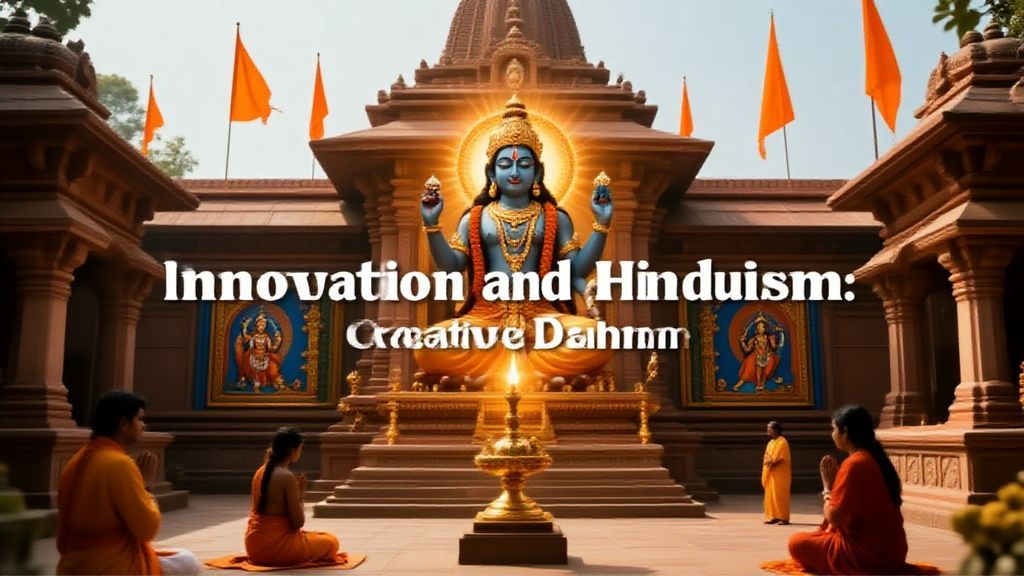
Innovation and Hinduism, or Creative Dharma, is not a modern imposition but an intrinsic principle of Sanatan Dharma, deeply embedded in its cosmic narratives, philosophical traditions, and practical applications. It manifests as a continuous pursuit of knowledge, adaptation, and spiritual evolution, reflecting the dynamic nature of Brahman’s creative power and humanity’s intellectual quest within a Dharmic framework.
| Attribute | Details |
|---|---|
| Concept | Innovation (Nava-rachana, Utpatti, Srijan) as a dynamic aspect of Dharma, fostering continuous growth and understanding. |
| Origin | Rooted in Vedic hymns of creation (e.g., Rig Veda’s Nasadiya Sukta), Upanishadic inquiry, and the evolution of Darshanas (philosophical schools). |
| Key Principles | Srishti (creation), Manana (reflection), Nididhyasana (contemplation), Yukti (reasoning), Purushartha (human endeavor), Dharma-samanvaya (harmonization of duties). |
| Scripture Reference | Rig Veda, Upanishads (e.g., Isha, Kena), Bhagavad Gita, Nyaya and Vaisheshika Sutras, various Puranas detailing cosmic cycles. |
The Dynamic Essence of Sanatan Dharma
Sanatan Dharma, often mistakenly perceived as static or rigid, is in its truest essence a vibrant, ever-evolving spiritual and philosophical tradition. The very cosmos, as described in Vedic texts, is a testament to eternal innovation – a continuous cycle of creation (srishti), preservation (sthiti), and dissolution (laya) by the divine trinity of Brahma, Vishnu, and Shiva. This cyclical dynamism is mirrored in the human quest for truth, encouraging seekers to innovate in thought, practice, and understanding. Hindutva.online stands as a testament to this ongoing engagement with ancient wisdom in a contemporary context. Innovation, therefore, is not an external import but a fundamental component of Creative Dharma, urging individuals and communities to adapt, reinterpret, and apply eternal principles to ever-changing realities, ensuring the tradition remains perennially relevant and profound.
Puranic Narratives and the Spirit of Nava-Rachana
The Puranas are replete with narratives that highlight the spirit of innovation and adaptation. Lord Brahma, the creator, is the ultimate innovator, constantly conceiving new forms and universes as per the divine will. The saga of various Avatars of Lord Vishnu illustrates a divine innovation in preserving Dharma – each incarnation uniquely addressing the specific challenges of its era. From Matsya to Kalki, these forms represent adaptive responses to maintain cosmic balance. For instance, the teachings of Lord Krishna in the Bhagavad Gita are a profound innovation in philosophical thought, synthesizing various Vedic streams into a cohesive path of action (Karma Yoga), knowledge (Jnana Yoga), and devotion (Bhakti Yoga), offering a universal Dharma applicable across all ages. Similarly, the divine architect Vishwakarma, mentioned extensively in the Rig Veda and Puranas like the Skanda Purana, is revered as the epitome of celestial craftsmanship and engineering innovation, responsible for creating divine cities, weapons, and vehicles. These stories underscore that creative problem-solving and adaptation are core to divine and human existence within Sanatan Dharma.
Architectural, Scientific, and Philosophical Innovations
The history of Bharatavarsha is a glorious chronicle of indigenous innovation, deeply inspired by Dharmic principles. Our temple architecture, from the towering Dravidian gopurams of the south (exemplified by the Brihadeeswara Temple, a UNESCO World Heritage site built by Raja Raja Chola I around 1010 CE) to the intricate Nagara shikhara of the north (such as the Sun Temple at Konark, a marvel of 13th-century engineering dedicated to Surya Deva), showcases continuous architectural evolution and engineering prowess. These structures are not merely buildings but cosmic diagrams, embodying sophisticated astronomical and mathematical knowledge.
Beyond architecture, ancient India pioneered groundbreaking scientific concepts. The concept of zero, the decimal system, and advanced trigonometry emerged from Bharata, significantly influencing global mathematics. Aryabhata (c. 476–550 CE), in his Aryabhatiya, presented a sophisticated understanding of planetary motion and spherical astronomy. Ayurveda, the science of life, continuously innovated diagnostic methods and herbal formulations, evolving a holistic system of medicine documented in texts like Charaka Samhita and Sushruta Samhita. Yoga, too, evolved from meditative practices into a vast system of physical postures (asanas), breathing techniques (pranayama), and spiritual disciplines, as codified in Patanjali’s Yoga Sutras. These innovations were not divorced from spirituality but were extensions of the quest for deeper understanding of the universe and human existence, reflecting the holistic nature of Sanatan Dharma.
Cultivating Creative Dharma: Practices for the Seeker
Innovation in Hinduism is not limited to grand scientific achievements but extends to the daily spiritual practices of a devotee. It is the creative interpretation and application of Dharma to one’s life. The following practices help cultivate a mind open to creative insights and spiritual growth:
- Svadhyaya (Self-Study): Engage deeply with scriptures, philosophical texts, and spiritual teachings. This is not rote memorization but an active, analytical process of inquiry that leads to novel insights and understanding.
- Manana (Reflection) & Nididhyasana (Contemplation): After Svadhyaya, reflect deeply on the teachings, meditating upon their meaning and implications. This contemplative process allows one to integrate knowledge and discover new applications of Dharmic principles to contemporary challenges.
- Seva (Selfless Service): Actively seek innovative ways to serve society, applying Dharmic values to address real-world problems. This could involve developing sustainable solutions, fostering community harmony, or spreading spiritual wisdom in accessible formats.
- Yukti (Reasoning) & Anumana (Inference): Sanatan Dharma encourages rigorous logical inquiry. As seen in the Nyaya school, keen reasoning and inference are vital tools for validating knowledge and formulating new propositions within a Dharmic framework.
- Dharma-Samanvaya (Harmonization): Learn to harmonize different perspectives and paths (margos) within Hinduism, recognizing the underlying unity. This open-mindedness fosters a creative approach to spirituality, seeing truth in diverse expressions.
Mantras for Wisdom and Creative Inspiration
Chanting specific mantras can invoke divine grace for enhancing wisdom, clarity of thought, and creative inspiration, paving the way for spiritual innovation:
- Gayatri Mantra: ॐ भूर्भुवः स्वः तत् सवितुर्वरेण्यं भर्गो देवस्य धीमहि धियो यो नः प्रचोदयात् ॥ (Om Bhur Bhuvah Swah, Tat Savitur Varenyam, Bhargo Devasya Dhimahi, Dhiyo Yo Nah Prachodayat) – “May we meditate on the effulgent glory of the divine life-giving Sun. May He inspire our intellect.” This mantra is a direct prayer for the awakening of higher intelligence.
- Saraswati Mantra: ॐ ऐं ह्रीं क्लीं महासरस्वती देव्यै नमः ॥ (Om Aim Hreem Kleem Mahasaraswati Devyai Namah) – A powerful mantra dedicated to Devi Saraswati, the goddess of knowledge, arts, wisdom, and creativity. Chanting this invokes Her blessings for profound insights and eloquent expression.
- Guru Mantra: ॐ गुरुभ्यो नमः ॥ (Om Gurubhyo Namah) – Salutations to the Guru, who dispels ignorance and guides towards truth and wisdom, often unlocking new perspectives.
- Maha Mrityunjaya Mantra: ॐ त्र्यम्बकं यजामहे सुगन्धिं पुष्टिवर्धनम् उर्वारुकमिव बन्धनान् मृत्योर्मुक्षीय मामृतात् ॥ (Om Tryambakam Yajamahe Sugandhim Pushtivardhanam Urvarukamiva Bandhanan Mrityor Mukshiya Maamritat) – While primarily for longevity and well-being, this mantra to Lord Shiva also signifies transcending limitations and obstacles, including mental blocks to creativity and new understanding.
Dos and Don’ts for Fostering Creative Dharma
To truly embrace innovation within a Dharmic framework, one must cultivate certain attitudes and avoid others:
- Dos:
- Cultivate a spirit of inquiry (jijnasa) and constant learning.
- Practice critical thinking while respecting scriptural authority (shruti-pramana).
- Embrace humility, acknowledging the vastness of knowledge.
- Seek the counsel of enlightened Gurus and scholars.
- Engage in selfless service (seva) as a means of innovative problem-solving.
- Maintain an open mind, recognizing the evolving nature of understanding.
- Don’ts:
- Blindly adhere to dogma without personal inquiry or understanding.
- Fear change or resist new knowledge that aligns with Dharmic principles.
- Be intellectually complacent or spiritually stagnant.
- Use knowledge for selfish gain or to cause harm.
- Dismiss traditional wisdom as irrelevant to modern challenges without proper study.
Is Hinduism a static religion or does it embrace change?
Hinduism is profoundly dynamic and embraces change. Its concept of Yuga Dharma emphasizes that the application of eternal principles must adapt to the conditions of each age. The continuous evolution of philosophical schools, the interpretations by various acharyas, and the vibrant living tradition of temples and rituals all attest to its adaptive and innovative nature, ensuring its perennial relevance.
How do ancient scriptures encourage modern innovation?
Ancient scriptures encourage innovation by emphasizing inquiry (jijnasa), rational thought (yukti), and the pursuit of knowledge (vidya). Texts like the Upanishads urge seekers to question, reflect, and discover truth for themselves. The very narratives of divine creation and the challenges faced by humanity and gods (as in the Puranas) inherently model creative problem-solving and adaptation, providing a template for human endeavor.
Can scientific inquiry be a part of Dharmic practice?
Absolutely. Sanatan Dharma views the pursuit of knowledge, whether spiritual or empirical, as a path to understanding the cosmos and Brahman. Ancient India’s contributions to mathematics, astronomy, metallurgy, and medicine were deeply intertwined with its philosophical and spiritual framework. Scientific inquiry, when pursued with a Dharmic intent for the welfare of all beings, is a profound form of creative dharma.
Preserving Sanatan Dharma through Creative Engagement
The essence of Sanatan Dharma lies not in rigid adherence to form, but in the eternal truth it embodies, which must be creatively reinterpreted and applied in every generation. To embrace innovation is to truly live Dharma, ensuring its vitality and relevance for future seekers. By fostering an environment of inquiry, critical thinking, ethical application, and spiritual growth, we contribute to the dynamic evolution of this ancient tradition. The continuous flow of Creative Dharma is what empowers Hindutva.online and countless devotees worldwide to keep the flame of Sanatan Dharma burning bright, illuminating paths of wisdom and well-being for all.