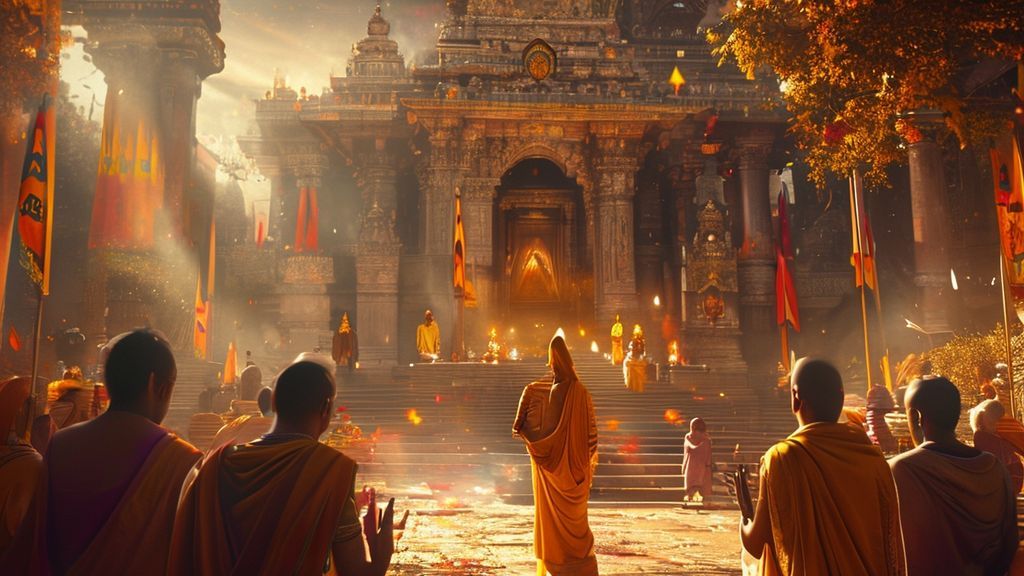
The Namaste controversy arises from the prevalent Western misuse and trivialization of a sacred Hindu greeting, transforming “Namaste”—a profound gesture of acknowledging the divine spirit within another—into a casual, often misunderstood salutation or a mere yoga class sign-off, thereby stripping it of its deep spiritual, philosophical, and cultural significance rooted in Sanatan Dharma.
| Attribute | Details |
|---|---|
| Term | Namaste (नमस्ते) |
| Meaning | “I bow to you,” “The Divine in me bows to the Divine in you.” Derived from Sanskrit Namaḥ (bow, adoration) + te (to you). |
| Gesture | Anjali Mudra (also Pranamasana or Hrudayanjali Mudra): Palms pressed together, fingers pointing upwards, thumbs near the chest’s Anahata Chakra. Often accompanied by a slight bow of the head. |
| Origin | Ancient Vedic traditions of Bharata (India), deeply embedded in Sanatan Dharma. |
| Core Philosophy | Recognition of the inherent divinity (Atman/Brahman) in every individual, promoting humility, respect, and spiritual connection. |
| Proper Usage | As a greeting, farewell, expression of gratitude, reverence, or prayer, always with conscious intent and respect. |
Introduction: Reclaiming the Sanctity of Namaste
In a world increasingly interconnected, the sacred greetings and gestures of ancient cultures often find themselves transplanted into new contexts. Few embody this cultural diffusion, and subsequent dilution, as profoundly as Namaste. For millennia, Namaste has been far more than a casual greeting in Sanatan Dharma; it is a profound philosophical statement, a spiritual practice, and a cornerstone of interpersonal respect. The current “Namaste controversy” is not a trivial debate but a crucial call to honor the depth and integrity of a practice that originates from the very heart of Vedic wisdom. It underscores the vital importance of understanding cultural heritage beyond superficial appropriation, urging a return to the reverence and consciousness that is inherent in this beautiful gesture.
The widespread, often thoughtless, adoption of Namaste in Western cultures, particularly within the yoga and wellness communities, has inadvertently stripped it of its potent spiritual essence. It is frequently employed as a trendy sign-off or a generic salutation, devoid of the profound recognition of the Divine Spark within each being that is its true meaning. This guide seeks to correct that oversight, illuminating the true spiritual, historical, and philosophical underpinnings of Namaste for sincere seekers and devotees, ensuring its sanctity is preserved for future generations.
Scriptural Origins and the Vedic Roots of Reverence
The concept embodied by Namaste is deeply rooted in the most ancient strata of Vedic thought, long before it became a popular greeting. The term Namaḥ te (नमस्ते) itself is Sanskrit, meaning “I bow to you.” The root Nam (नम्) implies bowing, yielding, or reverential salutation. This isn’t merely a physical act but an internal disposition of humility and respect towards the other, recognizing the greater presence within them.
The philosophical bedrock of Namaste lies in the Advaita Vedanta principle of ‘Aham Brahmasmi’ (अहं ब्रह्मास्मि – “I am Brahman”) and ‘Tat Tvam Asi’ (तत् त्वम् असि – “Thou art That”). These Maha-Vakyas (Great Sayings) from the Upanishads, particularly the Brihadaranyaka Upanishad and Chandogya Upanishad respectively, articulate the non-dualistic truth that the individual soul (Atman) is identical with the Universal Self (Brahman). When we offer Namaste, we are not merely greeting a person; we are acknowledging and honoring the supreme consciousness that resides within them, which is also present within ourselves. This profound recognition elevates a simple interaction into a spiritual communion.
The practice of reverential bowing (pranama) is extensively mentioned in the Puranas and Epics. For instance, the Srimad Bhagavatam (Bhagavata Purana) frequently describes devotees offering pranama to deities, gurus, and even to fellow beings, seeing the Lord’s presence everywhere. The Mahabharata and Ramayana are replete with instances where individuals bow to elders, sages, and revered personalities, signifying respect, humility, and the acknowledgement of spiritual merit. Thus, Namaste is not a modern invention but a distillation of thousands of years of Dharmic wisdom on respectful interaction and spiritual interconnectedness.
The Philosophical & Yogic Significance of Anjali Mudra
The gesture accompanying Namaste is known as Anjali Mudra (अञ्जलि मुद्रा), sometimes called Pranamasana or Hrudayanjali Mudra. ‘Anjali’ literally means “two hands cupped together” or “offering.” This Mudra involves pressing the palms together, fingers pointing upwards, with the thumbs gently resting near the sternum, at the heart center (Anahata Chakra).
From a philosophical standpoint, the joining of the two palms symbolizes the union of dualities: the individual self with the universal self, the material with the spiritual, the masculine with the feminine, and the left (ida) and right (pingala) energetic channels within the body. It signifies harmony and balance, bringing together opposing forces into a single point of reverence. Placing the hands at the heart chakra emphasizes that this greeting emanates from a place of love, compassion, and spiritual understanding, rather than merely from the mind or ego. This is a subtle yet powerful affirmation of the unity of existence.
In yogic philosophy, the Anjali Mudra activates the Anahata Chakra, the energy center associated with love, empathy, and spiritual awakening. By bringing the hands together at this point, one is encouraged to connect with their inner wisdom and to project that pure intention outwards. Physiologically, joining the palms helps to connect the two hemispheres of the brain, promoting a sense of calm and centeredness. It is a gesture of humility, signifying that one bows not to the external form but to the divine essence within the other. This deep engagement transforms Namaste from a mere social custom into a profound yogic posture of inner and outer recognition.
The Correct Practice and Intent of Offering Namaste
To truly understand and practice Namaste, one must move beyond its superficial appearance and embrace its profound intent. The correct practice involves both a physical gesture and a conscious state of mind.
- The Gesture (Anjali Mudra): Bring the palms together firmly, finger to finger, and thumb to thumb. The fingers should be extended upwards, not splayed. Place the base of the thumbs gently at the sternum, directly over the heart chakra.
- The Bow: Accompany the gesture with a gentle bow of the head. This bow is a crucial element, symbolizing humility and the act of ‘yielding’ or ‘saluting’ the divine presence in the other person.
- The Intention: This is paramount. As you perform the gesture and bow, consciously think, “The Divine Light within me acknowledges and bows to the Divine Light within you.” It is a recognition of the Atman, the universal spirit, in the other.
- Eye Contact (or Reverence): For a peer or known individual, gentle eye contact can accompany the greeting. For revered elders, gurus, or deities, one might lower their gaze as a sign of deeper humility and devotion.
- Verbalization: While the gesture itself conveys the message, verbally saying “Namaste” (नमस्ते) enhances the offering.
Namaste is appropriately used in various contexts: as a respectful greeting, a heartfelt farewell, an expression of gratitude, an apology, or a form of prayer or reverence towards deities and revered personalities. Its power lies in its sincerity and the recognition of interconnectedness, promoting peace and harmony in every interaction. Understanding and practicing this sacred gesture correctly helps preserve its sanctity, especially for seekers who visit Hindutva.online for authentic spiritual guidance.
Mantras and Affirmations for Conscious Salutation
While Namaste itself is a potent spiritual utterance, understanding the underlying principles allows for an even deeper, more conscious engagement. The word “Namaste” is a mantra in itself, a condensation of ancient wisdom. As one offers this salutation, one can mentally recite or reflect upon the following:
- “Namaḥ te” (नमस्ते): The literal “I bow to you,” imbued with the understanding of bowing to the divine within.
- “Aham Brahmasmi” (अहं ब्रह्मास्मि): “I am Brahman,” reminding oneself of one’s own divine nature.
- “Tat Tvam Asi” (तत् त्वम् असि): “Thou art That,” affirming the same divine essence in the other.
- “Sarvaṃ khalvidaṃ brahma” (सर्वं खल्विदं ब्रह्म): “All this (universe) is Brahman,” from the Chandogya Upanishad, reinforcing the omnipresence of the Divine in all creation.
These reflections elevate the simple act of greeting into a profound meditative practice, transforming mundane interactions into opportunities for spiritual recognition and universal love. It is a constant reminder that every being is a manifestation of the singular Divine, worthy of respect and reverence. The power of Namaste lies not just in its sound or gesture, but in the conscious affirmation of unity it carries, a truth revealed in the Vedas and Upanishads.
Dos and Don’ts: Preserving the Sanctity of Namaste
To honor the profound heritage of Namaste, it is essential to adhere to certain guidelines:
Dos:
- Practice with Sincerity: Always perform Namaste with genuine respect and consciousness of its meaning.
- Understand the Philosophy: Know that you are acknowledging the Divine in the other person.
- Use for All Interactions: It is appropriate for greetings, farewells, expressions of gratitude, and apologies.
- Accompany with a Bow: A slight bow of the head is traditional and enhances the gesture’s meaning of humility.
- Maintain Eye Contact (or reverence): Engage respectfully, either with soft eye contact or a lowered gaze for deep respect.
Don’ts:
- Do Not Trivialise: Avoid using Namaste as a flippant or trendy catchphrase without understanding its depth.
- Do Not Use Casually: It is not a generic “hi-five” or a substitute for a handshake without intent.
- Avoid While Multitasking: Dedicate your full attention to the person you are greeting; do not perform Namaste while distracted.
- Do Not Misappropriate: Using it for commercial gain or as a cultural token without proper reverence is disrespectful.
- Do Not Mock or Devalue: Never use it ironically or in a way that disrespects its spiritual origins.
Frequently Asked Questions About Namaste
Is Namaste exclusively for Hindus?
While Namaste originates from Sanatan Dharma and is deeply embedded in Hindu culture and philosophy, its core message of acknowledging the divine within every being is universal. People of all backgrounds can adopt it respectfully if they understand and embrace its spiritual meaning, not merely as a superficial gesture. It is a symbol of interconnectedness that transcends religious boundaries when offered with true intent.
What is the difference between Namaste and Namaskar?
In practice, Namaste (नमस्ते) and Namaskar (नमस्कार) are often used interchangeably to convey the same respectful greeting. Etymologically, ‘Namaste’ uses the singular pronoun ‘te’ (to you), while ‘Namaskar’ uses ‘kar’ (action, or doing the obeisance). ‘Namaskar’ can sometimes imply a more formal or collective greeting (to many), but largely, both express the same profound reverence and are considered synonymous in everyday usage within India. The gesture (Anjali Mudra) is common to both.
Can one use Namaste without bowing the head?
While the essence of Namaste is the acknowledgment of divinity within, the slight bow of the head is an integral part of the traditional practice. It symbolizes humility and respect for the person being greeted and, more importantly, for the Divine within them. While a verbal Namaste without a bow can be offered, performing the Anjali Mudra along with a gentle bow of the head enhances the spiritual potency and sincerity of the greeting, aligning with its ancient Dharmic roots.
Dharmic Significance: Why This Matters for Every Hindu
The controversy surrounding the misuse of Namaste is a stark reminder of the challenges faced by ancient Dharmic traditions in a globalized world. For every Hindu, understanding and defending the sanctity of Namaste is not merely about linguistic correctness or cultural preservation; it is about safeguarding the spiritual integrity of Sanatan Dharma itself. Namaste is a living embodiment of core Hindu principles: the omnipresence of Brahman, the divinity of the Atman in every being, the importance of humility (vinaya), and the universal message of peace and interconnectedness (Vasudhaiva Kutumbakam – “The world is one family”).
When Namaste is stripped of its meaning, it risks reducing thousands of years of profound philosophical thought to a mere physical fad. To consciously practice Namaste, with its full spiritual weight, is an act of preserving Dharma. It is a daily affirmation of our shared divinity and a powerful antidote to division and discord. By educating ourselves and others, we ensure that this sacred gesture continues to transmit its ancient wisdom, fostering a world built on respect, unity, and spiritual awareness. We at Hindutva.online are committed to upholding the purity of such traditions, empowering devotees to live in accordance with timeless Dharmic principles.
