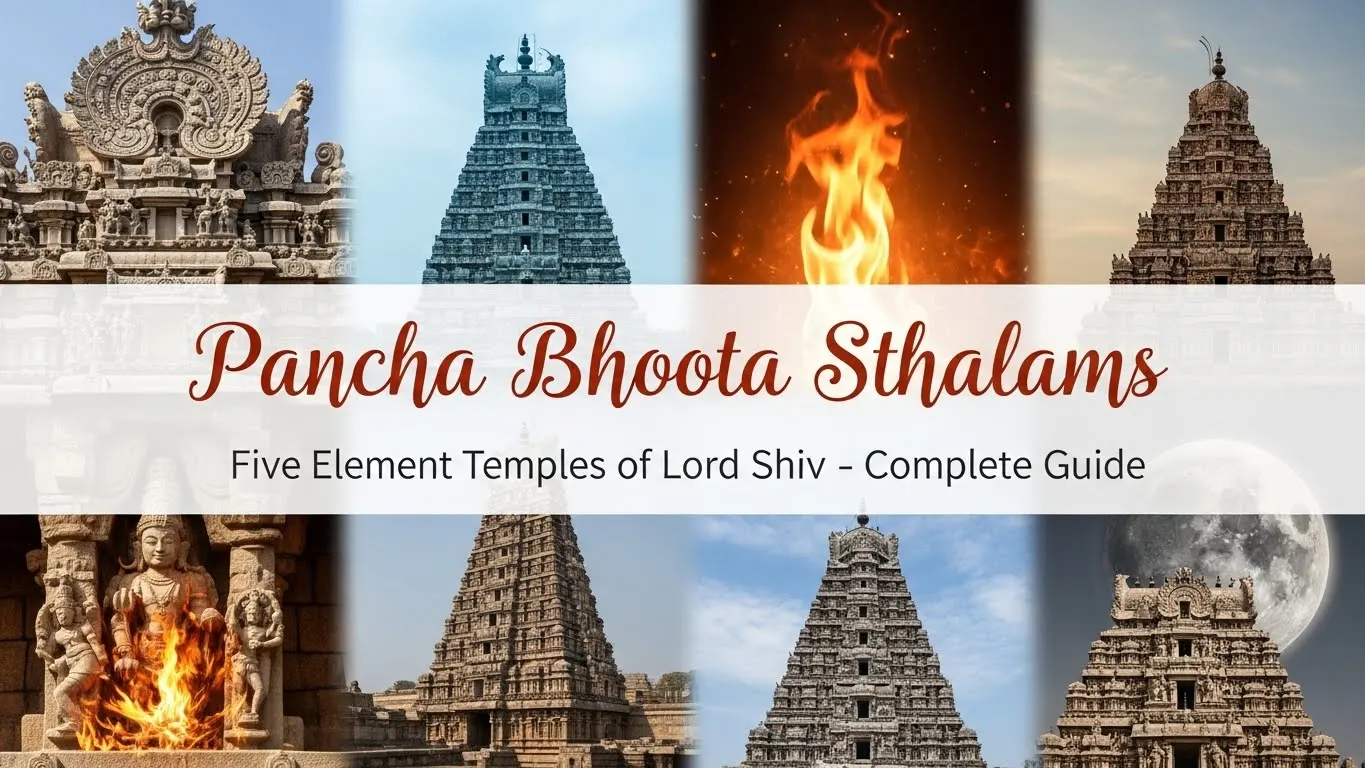
The Pancha Bhoota Sthalams Five (Sanskrit: पञ्चभूत स्थलम्, Tamil: பஞ்சபூதத் தலங்கள்) are five magnificent temples dedicated to Lord Shiva across South India, each representing one of the five fundamental elements (Pancha Mahabhuta) of nature according to Hindu philosophy: Akasha (Ether/Space), Appu (Water), Agni (Fire), Prithvi (Earth), and Vayu (Air). These sacred shrines embody the philosophical concept that Lord Shiva is Bhootapati or Bhootnath—the supreme lord of all elements, manifesting in distinct elemental forms across five geographically dispersed locations to demonstrate his omnipresence and mastery over nature’s fundamental building blocks.
The Chidambaram Nataraja Temple representing Akasha (ether) in Tamil Nadu features Lord Shiva performing the cosmic Ananda Tandava (dance of eternal bliss), with the mysterious Chidambara Rahasya (secret of consciousness) and a sacred lamp that flickers despite no airflow, symbolizing the subtle space element that pervades all existence.
The Thiruvanaikaval Jambukeswarar Temple near Trichy representing Appu (water) houses a Shiva lingam with an underground water stream constantly emerging from beneath it, kept perpetually wet and submerged during monsoons when water flow increases significantly. The Thiruvannamalai Arunachaleswarar Temple representing Agni (fire) celebrates the annual Karthigai Deepam festival where a massive sacred flame is lit atop Arunachala Hill, visible from miles around, symbolizing Shiva’s appearance as an infinite pillar of fire to establish his supremacy over Brahma and Vishnu.
The Kanchipuram Ekambareswarar Temple representing Prithvi (earth) features the famous 3,500-year-old sacred mango tree with four branches each bearing mangoes of distinct taste, under which Goddess Parvati performed penance and created a Shiva Linga from sand/earth. The Srikalahasti Temple in Andhra Pradesh representing Vayu (air) displays the white Vayu Lingam with an eternally flickering lamp flame inside the windowless sanctum despite complete absence of air movement, demonstrating wind element’s invisible yet omnipresent power.
This comprehensive guide explores each of the five elemental Shiva temples with their locations and unique features, the philosophical significance of Pancha Mahabhuta in Hindu cosmology, miraculous phenomena and legends associated with each shrine, architectural marvels and religious practices, pilgrimage routes connecting all five temples, and what this sacred circuit reveals about Hindu philosophy‘s understanding of cosmic consciousness manifesting through natural elements.
The Five Pancha Bhoota Sthalams
1. Akasha (Ether/Space) – Chidambaram Nataraja Temple
Location: Chidambaram, Cuddalore District, Tamil Nadu
Temple Name: Thillai Nataraja Temple (also called Chidambaram Temple)
Presiding Deity: Nataraja (Shiva as the Cosmic Dancer) and Lord Govindaraja Perumal (Vishnu)
Element: Akasha (Ether/Space) – the most subtle and sacred of the five elements
- Lord Shiva performed the Ananda Tandava (dance of eternal bliss) in Thillai forests
- The idol depicts Nataraja crushing demon Muyalakan (symbolizing ignorance) under His feet
- Represents the cosmic cycles of creation, preservation, and destruction
- The dance symbolizes consciousness pervading space
Chidambara Rahasya (The Secret):
- The temple houses the greatest secret (Chidambara Rahasya) in its sanctum
- “Chidambaram” = “Chit” (consciousness) + “Ambaram” (sky) = “Sky of Consciousness”
- Represents the ultimate aim of human life—realizing pure consciousness
- “A lamp in the sanctuary keeps flickering even when no air flow is observed”
- Mysterious phenomenon demonstrating the subtle ether element
- Symbolizes the vibrating consciousness that fills all space
- Temple complex covers 20 hectares (approximately 40-50 acres) in the heart of Chidambaram city
- Comprises 9 Gopurams, one with gold-plated roof
- Built in Chola-Pandyan architectural style
- Walls feature intricate carvings of 108 Bharatanatyam dance postures
- Fifth-largest temple in India by area
Unique Feature:
- One of the few temples where both Shaivite and Vaishnavite deities coexist—Shiva Nataraja and Lord Govindaraja Perumal (Vishnu)
Spiritual Significance:
- Ether/space is the fundamental element from which all others emerge
- Represents pure consciousness and the space in which all existence unfolds
- The cosmic dance represents the dynamic nature of reality within still awareness
2. Appu (Water) – Thiruvanaikaval Jambukeswarar Temple
Location: Thiruvanaikaval (also spelled Thiruvanaikal), Tiruchirapalli (Trichy) District, Tamil Nadu
Temple Name: Jambukeswarar Temple (also called Jambukeswaram)
Presiding Deity: Jambukeswarar (Shiva) and Goddess Akilandeswari
- “A stream of water is said to emerge from the linga”
- The Shiva lingam has underground water source constantly flowing
- Demonstrated by the soaking wet clothes in which the deity is draped
- “Water flow increases significantly during the Monsoon”
- Main deity Jambukeswara depicted sitting under a jambu tree (rose apple/java plum tree)
- The tree grows over a small stream that engulfs the deity during rainy season
- Temple name derived from this sacred tree
Sanctum Structure:
- “Sanctum sanctorum is a square structure, found independently situated at center of innermost enclosure”
- Vimana (tower) on the roof of sanctum
- Structure open on three sides
- Shallow moat separating sanctum from circumambulatory path
- Creates island effect with water surrounding the deity
Scriptural Status:
- One of the 275 Paadal Petra Sthalams (temples glorified in Tamil Shaivite hymns)
- Contains inscriptions from the Chola period
Legend:
- Goddess Parvati (as Akilandeswari) worshipped Shiva here under the jambu tree
- Water element represents fluidity, emotions, and the life-giving essence
Spiritual Significance:
- Water as the element of purification and sustenance
- The underground stream symbolizes hidden spiritual resources
- Flowing water represents constant change and renewal
3. Agni (Fire) – Thiruvannamalai Arunachaleswarar Temple
Location: Thiruvannamalai, Tiruvannamalai District, Tamil Nadu
Temple Name: Arunachaleswarar Temple (also called Annamalaiyar Temple)
Presiding Deity: Annamalaiyar/Arunachaleswarar (meaning “the mountain that cannot be reached”) and Goddess Unnamulai Ammai (Parvati)
- Shiva worshipped as embodiment of the Arunachala hill itself
- Represented by lingam known as Agni Lingam (Fire Lingam)
- Parvati represented by yoni referred to as Agni Yoni
- Lord Shiva appeared as infinite column of fire at this site
- Purpose: To settle dispute between Brahma and Vishnu about supremacy
- Neither could find the beginning or end of the fiery pillar
- This manifestation demonstrated Shiva’s supremacy
- Most significant festival celebrated during Purnima (full moon) in Tamil month of Karthigai
- Massive fire lit atop Arunachala Hill during this festival
- The beacon visible from miles around
- Symbolizes the Jyotirlinga form of Shiva as pillar of fire
- Attracts millions of pilgrims
- Devotees light lamps at homes and temple, creating spectacular sight
Girivalam (Hill Circumambulation):
- Devotees circumambulate the Arunachala Hill
- Especially powerful on full moon nights
- Believed to enhance spiritual benefits and draw devotees closer to divine
- The 14 km path around the sacred hill
- Dravidian architectural style with intricate carvings
- Towering gopurams (gateway towers)
- Architectural marvel showcasing ancient temple construction
- Six daily rituals performed between 5:30 AM and 10:00 PM
- Twelve yearly festivals
- Abhishekam (sacred bathing), Arati (camphor lights), Prasad distribution
- Fire element symbolizes purity, transformation, and divine energy
- Represents the burning away of ignorance and ego
- The eternal flame as symbol of consciousness
- “Temple’s energy believed to purify the soul and provide clarity and enlightenment”
4. Prithvi (Earth) – Kanchipuram Ekambareswarar Temple
Location: Kanchipuram, Kanchipuram District, Tamil Nadu
Temple Name: Ekambareswarar Temple (also spelled Ekambaranathar Temple)
Presiding Deity: Ekambareswarar (Lord of the Mango Tree) and Goddess Kamakshi
- 3,500-year-old mango tree (some sources say even older)
- Four branches, each bearing mangoes of distinct taste and shape
- Revered as the place where Lord Shiva and Maa Kamakshi performed penance
- Where their divine marriage took place
- Living symbol of devotion and divine union
Prithvi Lingam (Earth Lingam):
- Goddess Parvati was doing penance under the temple’s ancient mango tree near Vegavathi river
- Ganga (river goddess) tried to disturb her penance with flooding
- Parvati made a Shiva Linga out of sand to worship and unite with Shiva
- She successfully completed her penance
- The sand lingam established the earth element temple
- Initially built by the Pallava dynasty
- Later expanded by various dynasties
- Member of Pancha Bhoota Sthalams representing Earth (Prithvi)
Spiritual Significance:
- Earth as the stable, nourishing, supportive element
- Represents groundedness, material manifestation, and stability
- The ancient tree symbolizes deep roots and continuity across millennia
- Sand lingam represents creation from basic elements
5. Vayu (Air/Wind) – Srikalahasti Temple
Location: Srikalahasti, Tirupati District, Andhra Pradesh
Temple Name: Sri Kalahastheeswara Swamy Temple (also called Kalahasti Temple)
Presiding Deity: Kalahastheeswara (Shiva) and Goddess Gnanamba (Parvati)
- White-colored lingam considered Swayambhu (self-manifested)
- Represents the wind/air element
- Main lingam untouched by human beings, even by priests
- “Lamp burning inside inner sanctum constantly flickers despite lack of air movement inside”
- “Sanctum has no windows, lamp flames keep moving despite no air movement”
- “Flame present in Garbhagraha flickers even though no wind can enter shrine”
- Demonstrates the invisible yet omnipresent nature of air element
- “Vayu-linga can be seen moving despite doors being closed”
- Mysterious phenomenon attributed to wind element’s power
- Abhishekam done by pouring mixture of water, milk, camphor and panchamrita
- Sandalwood paste, flowers, and sacred thread offered to Uthsava murthi (processional deity), not main lingam
- Main deity worshipped from distance
- Temple renowned for Rahu-Ketu pooja ritual
- Believed to ward off astrological effects of lunar nodes
- Major destination for those seeking remedies for Rahu-Ketu doshas
Mythology:
- Named after three devotees: Spider (Sri), Serpent (Kala), and Elephant (Hasti) who worshipped Shiva here
- Each represented different forms of devotion
Spiritual Significance:
- Air as the vital breath (prana) sustaining life
- Represents movement, change, and the life force
- Invisible yet essential, like consciousness itself
- The flickering flame symbolizes the subtle movement of consciousness
Philosophical Significance of Pancha Mahabhuta
The Five Elements in Hindu Cosmology
Pancha Mahabhuta (Five Great Elements) form the foundation of Hindu philosophy:
Hierarchical Order:
- Akasha (Ether/Space): Most subtle, pervades all; origin of sound
- Vayu (Air): Movement, touch; arises from ether
- Agni (Fire): Transformation, vision; arises from air
- Appu (Water): Fluidity, taste; arises from fire
- Prithvi (Earth): Solidity, smell; arises from water
Cosmic Creation:
- Elements emerge sequentially from subtle to gross
- Each subsequent element contains previous elements’ qualities
- Together they constitute all material existence
- “Lord Shiva is worshipped as Bhootapati or Bhootnath” (Lord of Elements)
- Demonstrates divine mastery over nature’s fundamental forces
- Each temple manifestation shows Shiva’s control over specific element
Pancha Bhoota Sthalams Five Human Body and Elements
Ayurvedic Understanding:
- Human body composed of all five elements
- Akasha: Spaces within body (mouth, nostrils, abdomen)
- Vayu: Breath, nervous system, movement
- Agni: Digestive fire, metabolism, body heat
- Appu: Blood, bodily fluids, emotions
- Prithvi: Bones, muscles, solid tissues
Spiritual Implication:
- By worshipping elemental Shiva, devotees harmonize corresponding elements within
- Pilgrimage balances all five elements in body and consciousness
- Achieving elemental balance supports spiritual evolution
The Elements and Consciousness
Tantric Philosophy:
- Elements represent stages of consciousness manifestation
- From pure consciousness (Akasha) to material form (Prithvi)
- Spiritual practice reverses the process—dissolving gross into subtle
- Ultimate realization: All elements are consciousness itself
The Pancha Bhoota Circuit:
- Visiting all five temples symbolizes complete spiritual journey
- Experience all aspects of divine manifestation
- Recognition that transcendent Shiva pervades all nature
Miraculous Phenomena at Each Temple
Chidambaram – Ether Mystery
- The “greatest secret” housed in sanctum
- Represents formless Shiva beyond all manifestation
- Consciousness as the ultimate reality
- Defies physical explanation
- Symbolizes vibrating consciousness filling space
- Ether as subtlest element moving without wind
Thiruvanaikaval – Underground Water
- Constant water flow from beneath lingam
- Water table connection or miraculous source?
- Wet clothes demonstrating continuous moisture
- Dramatic water flow expansion during rains
- Deity sometimes completely submerged
- Water element’s responsive, changing nature
Thiruvannamalai – Sacred Fire
- Massive beacon atop 2,668-foot Arunachala Hill
- Visible from 20+ kilometers away
- Represents infinite pillar of fire from mythology
- Millions circumambulate seeking spiritual transformation
- Fire element’s purifying, transformative energy
- Many report profound experiences and realizations
Kanchipuram – Ancient Tree
- Defies normal tree lifespan (mango trees typically live 100-200 years)
- Four branches with distinct fruit varieties
- Living witness to millennia of devotion
- Each branch produces unique flavor and appearance
- Botanical anomaly or divine blessing?
- Symbolizes unity containing diversity
Kalahasti – Windless Flame
- Moves despite windowless, sealed sanctum
- No detectable airflow
- Flame responds to invisible Vayu element
- Appears to shift position
- Subtle movement detected by priests
- Wind element’s dynamic, unstable nature
Pilgrimage Routes and Practical Information
Geographic Distribution
Temple Locations:
- Chidambaram (Akasha): Cuddalore District, Tamil Nadu
- Thiruvanaikaval (Water): Trichy District, Tamil Nadu (within Trichy city)
- Thiruvannamalai (Fire): Tiruvannamalai District, Tamil Nadu
- Kanchipuram (Earth): Kanchipuram District, Tamil Nadu (near Chennai)
- Kalahasti (Air): Tirupati District, Andhra Pradesh
Distance Overview:
- Temples spread across Tamil Nadu and southern Andhra Pradesh
- Total circuit: Approximately 800-1000 km depending on route
- Can be completed in 4-5 days with proper planning
Route Options
Option 1: Chennai-Based Circuit (4-5 Days)
Day 1: Chennai → Kanchipuram (70 km) → Stay Kanchipuram
- Visit Ekambareswarar Temple (Earth)
Day 2: Kanchipuram → Thiruvannamalai (90 km) → Stay Thiruvannamalai
- Visit Arunachaleswarar Temple (Fire)
- Optional: Girivalam (hill circumambulation)
Day 3: Thiruvannamalai → Chidambaram (150 km) → Stay Chidambaram
- Visit Nataraja Temple (Ether)
Day 4: Chidambaram → Trichy via Thiruvanaikaval (150 km) → Stay Trichy
- Visit Jambukeswarar Temple (Water)
Day 5: Trichy → Kalahasti (350 km) → Return or stay Tirupati area
- Visit Kalahastheeswara Temple (Air)
- Optional: Continue to Tirupati for Lord Venkateswara darshan
Option 2: Condensed 3-Day Circuit
Possible with early starts and long drives, but less time at each temple
Best Time to Visit
General Season:
- October to March: Pleasant weather
- Avoid peak summer (April-June) when temperatures soar
Special Festival Times:
- Karthigai Deepam (Thiruvannamalai): November-December (Tamil month Karthigai)
- Shivaratri: February-March at all temples
- Chidambaram festivals: Multiple annual celebrations
Temple Timings
Typical Schedule (varies by temple):
- Morning: 5:30/6:00 AM – 12:00 PM
- Evening: 4:00/5:00 PM – 9:00/10:00 PM
- Afternoon break for deity rest
Dress Code and Etiquette
Men: Dhoti or traditional attire preferred; remove shirts in some areas
Women: Saree, churidar, or salwar kameez covering shoulders and knees
All: Remove footwear before entering; maintain respectful silence
Accommodation
Major Temple Towns:
- Kanchipuram, Thiruvannamalai, Chidambaram, Trichy, Kalahasti all have decent accommodation
- Range from budget lodges to mid-range hotels
- Temple guest houses sometimes available
Budget Estimate
Transportation: ₹5,000-10,000 (car rental/taxi for 4-5 days)
Accommodation: ₹1,000-3,000 per night
Temple Expenses: Mostly free entry; special poojas ₹50-500
Food: ₹500-1,000 per day (vegetarian South Indian meals)
Total: ₹15,000-30,000 for complete 4-5 day circuit (moderate budget, per person)
Frequently Asked Questions
What are the five Pancha Bhoota Sthalams?
The five Pancha Bhoota Sthalams are temples representing nature’s five elements: 1) Chidambaram Nataraja Temple (Akasha/Ether) in Tamil Nadu with cosmic dance and Chidambara Rahasya, 2) Thiruvanaikaval Jambukeswarar Temple (Appu/Water) in Trichy with underground water stream, 3) Thiruvannamalai Arunachaleswarar Temple (Agni/Fire) with Karthigai Deepam festival flame, 4) Kanchipuram Ekambareswarar Temple (Prithvi/Earth) with 3,500-year-old sacred mango tree, and 5) Srikalahasti Kalahastheeswara Temple (Vayu/Air) in Andhra Pradesh with mysteriously flickering lamp. Lord Shiva is worshipped as Bhootapati (lord of elements) manifesting in distinct elemental forms.
Which Pancha Bhoota temple represents fire?
Thiruvannamalai Arunachaleswarar Temple represents Agni (fire) element through the Agni Lingam where Lord Shiva appeared as an infinite column of fire to demonstrate supremacy over Brahma and Vishnu. The temple celebrates the spectacular Karthigai Deepam festival where a massive sacred flame is lit atop Arunachala Hill, visible from miles around, attracting millions of pilgrims. The fire symbolizes purity, transformation, and divine energy, with the temple’s energy believed to purify souls and provide spiritual enlightenment. Devotees practice Girivalam (circumambulating the 14 km hill path) especially on full moon nights.
What is special about Chidambaram Nataraja Temple?
Chidambaram represents Akasha (ether/space), the most sacred and subtle element, with Lord Shiva performing the Ananda Tandava (cosmic dance of bliss) while crushing demon Muyalakan (ignorance) underfoot. The temple houses the Chidambara Rahasya (greatest secret), with “Chidambaram” meaning “Sky of Consciousness”—the ultimate spiritual goal. Unique features include a lamp that flickers despite no observable airflow, symbolizing vibrating consciousness filling space, walls carved with 108 Bharatanatyam dance postures, 9 gopurams including one gold-plated, and rare coexistence of Shaivite (Nataraja) and Vaishnavite (Govindaraja Perumal) deities.
Does water really flow from the Shiva lingam at Thiruvanaikaval?
Yes, the Jambukeswarar Temple at Thiruvanaikaval has an authentic underground water stream emerging from beneath the Shiva lingam, demonstrated by the deity being constantly draped in soaking wet clothes. The water flow increases significantly during monsoons, sometimes completely engulfing the deity which sits under a sacred jambu tree. The sanctum is structured as a square building independently situated at the center with a shallow moat surrounding it, creating an island effect. This natural spring symbolizes water’s life-giving, purifying essence and makes it one of the 275 Paadal Petra Sthalams (temples glorified in ancient Tamil hymns).
How old is the mango tree at Ekambareswarar Temple?
The sacred mango tree at Kanchipuram Ekambareswarar Temple is believed to be over 3,500 years old, making it one of the oldest living trees in India. The extraordinary tree has four branches, each bearing mangoes of distinct taste and shape—a botanical anomaly. It is revered as the place where Lord Shiva and Goddess Kamakshi performed penance and where their divine marriage occurred. The temple name “Ekambaram” derives from Eka (one) + Amara (mango tree), and Goddess Parvati created a Shiva lingam from sand/earth under this tree, establishing the Prithvi (earth) element temple.
Why does the lamp flicker at Kalahasti Temple?
The Srikalahasti Temple’s Vayu Lingam sanctuary has a lamp that constantly flickers despite the sanctum having no windows and no detectable air movement, demonstrating the invisible yet omnipresent wind element. The white swayambhu (self-manifested) lingam appears to move slightly despite closed doors. This miraculous phenomenon symbolizes Vayu’s subtle, dynamic nature—invisible yet essential like breath (prana) and consciousness. The main lingam remains untouched even by priests, with abhishekam performed by pouring mixtures from a distance. The temple is also renowned for Rahu-Ketu pooja to ward off astrological afflictions.
How many days needed to visit all five Pancha Bhoota Sthalams?
A comfortable pilgrimage covering all five Pancha Bhoota Sthalams requires 4-5 days with proper time for darshan and rituals at each temple. The temples are spread across Tamil Nadu and Andhra Pradesh covering approximately 800-1000 km total. A suggested route: Day 1 – Chennai to Kanchipuram (Earth), Day 2 – Kanchipuram to Thiruvannamalai (Fire), Day 3 – Thiruvannamalai to Chidambaram (Ether), Day 4 – Chidambaram to Trichy/Thiruvanaikaval (Water), Day 5 – Trichy to Kalahasti (Air). A condensed 3-day circuit is possible but rushed. Best season is October-March; special times include Karthigai Deepam at Thiruvannamalai and Shivaratri at all temples.
What is the significance of visiting all five element temples?
Visiting all five Pancha Bhoota Sthalams represents a complete spiritual journey through divine manifestation in nature, harmonizing all five elements within the devotee’s body and consciousness. Since the human body comprises all five elements (Akasha in internal spaces, Vayu in breath, Agni in digestion, Appu in fluids, Prithvi in solid tissues), worshipping elemental Shiva balances corresponding elements internally. The pilgrimage symbolizes the evolutionary journey from pure consciousness (Akasha) through progressively denser elements to material form (Prithvi), with spiritual realization reversing this process to recognize all elements as consciousness itself. Completing the circuit honors Shiva as Bhootapati (lord of all elements) manifesting omnipresently.
Conclusion
The Pancha Bhoota Sthalams represent one of Hinduism’s most philosophically profound pilgrimage circuits—five magnificent temples that transform abstract cosmological concepts into tangible sacred architecture, where devotees directly experience Lord Shiva’s mastery over nature’s fundamental forces through miraculous phenomena, ancient legends, and powerful spiritual energies concentrated at each elemental shrine. The circuit’s geographic diversity spanning from coastal Chidambaram to hill-station Thiruvannamalai, from ancient Kanchipuram to sacred Kalahasti—creates a journey through varied landscapes that mirrors the elemental journey from subtle ether to solid earth, from invisible consciousness to material manifestation, teaching through direct sensory experience what philosophical texts convey through abstract concepts.
The miraculous phenomena at each temple—Chidambaram’s flickering lamp without air, Thiruvanaikaval’s underground water stream, Thiruvannamalai’s Karthigai Deepam visible for miles, Kanchipuram’s 3,500-year-old mango tree bearing four distinct fruits, and Kalahasti’s windless flame—continue inspiring millions with tangible evidence that divine consciousness pervades and transcends natural law, that Shiva as Bhootapati genuinely commands the elements, and that sacred spaces can concentrate spiritual energies creating experiences beyond ordinary material explanations. These wonders serve not merely as tourist attractions but as spiritual technologies that shift consciousness, balance internal elements, and facilitate recognition of the sacred pervading all existence.
Whether one approaches these temples as devoted Shaivite seeking darshan of elemental Shiva, spiritual seeker exploring Hindu cosmology’s practical applications, or cultural enthusiast appreciating Dravidian architectural masterpieces, the Pancha Bhoota Sthalams offer transformative pilgrimage honoring Hindu philosophy‘s profound insight that the five elements constitute all material reality, that consciousness manifests through progressive densification from ether to earth, that divine presence permeates nature’s fundamental forces, and that by worshipping
these elemental manifestations across sacred geography, pilgrims harmonize internal elements, balance body-mind-spirit, and progress toward the ultimate realization glimpsed in Chidambaram’s Chidambara Rahasya—that beyond and within all elements, pervading space itself, dances eternal consciousness as Nataraja, creating-preserving-destroying worlds in rhythmic cycles while remaining forever unchanged, inviting devotees to recognize their own essence as that same boundless awareness in which all five elements arise, play, and ultimately dissolve back into the infinite.
About the Author
Sandeep Vohra – Cultural Heritage & Temple Architecture Specialist
Sandeep Vohra is an accomplished writer and researcher specializing in Hindu festivals, temple architecture, and India’s rich cultural traditions. With a Master’s degree in Indian Art History from Maharaja Sayajirao University, she has extensively documented pilgrimage sites, temple iconography, and folk traditions across India. Her work focuses on making India’s spiritual heritage accessible to contemporary audiences while preserving authentic cultural narratives.