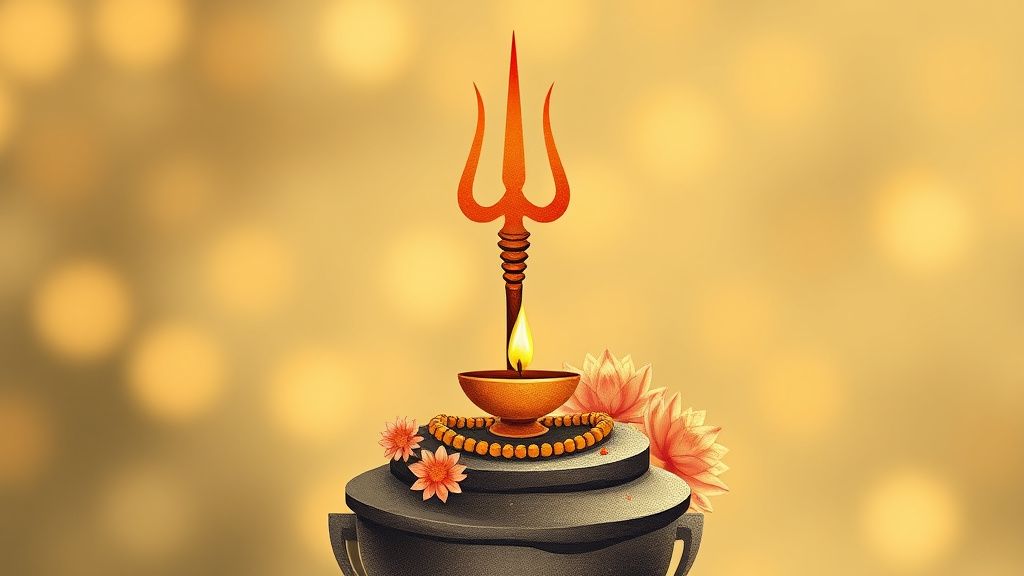
The Trishul (Sanskrit triśūla, “three spears”) is the three-pronged trident carried by Shiva in nearly all of his iconography. Each prong is loaded with a layered set of meanings in Hindu thought: it stands for the cosmic trinity of creation, preservation and destruction; for the three qualities of nature (the gunas); for past, present and future; and for the three principal energy channels in yogic anatomy. This article unpacks each reading from the Sanskrit sources where it is grounded.
What “Trishul” literally means
The word combines tri (“three”) with śūla, a Sanskrit term whose primary sense is “a sharp iron pin or stake”. Triśūla is therefore a three-pronged stake or spear. The standard English translation is “trident”, a precise equivalent. The same Sanskrit term carries over into devotional and Tantric ritual as both a weapon Shiva wields and a symbol embedded in temple architecture, yantras, and the foreheads of Shaiva and Shakta sadhus marked with three horizontal lines of vibhuti (tripundra).
The three readings of the three prongs
Hindu textual tradition does not lock the Trishul to one single meaning. The reading depends on which framework the commentator is working in. The four most consistently cited readings:
- The three cosmic functions: creation (sṛṣṭi), preservation (sthiti) and dissolution (laya or saṃhāra). In Shaiva theology these three are all forms of Shiva himself, so the Trishul names what its bearer is.
- The three gunas: sattva (clarity, balance, knowledge), rajas (motion, passion, activity) and tamas (inertia, darkness, ignorance). Samkhya and Yoga philosophy describe all of nature (prakṛti) as a play of these three qualities.
- The three times: past, present and future, marking Shiva as Mahākāla, the lord of time.
- The three nadis: in yogic anatomy, idā (lunar channel, left), piṅgalā (solar channel, right) and suṣumnā (central channel) converge at the ājñā chakra between the eyebrows. Devotees read the Trishul as that convergence point in metallic form.
For what it’s worth, the “three nadis” reading is the one that most consistently survives a translation between Tantric ritual practice and modern Vedanta exposition. The cosmic-trinity reading is older and more widely cited, but it tends to collapse Shiva-as-destroyer into a triadic system where Brahma and Vishnu hold the other two roles, which loses the Shaiva point that Shiva alone bears the whole cycle.
How the Trishul came to Shiva: the Purana account
The Vishnu Purana account is the most quoted origin story. The gods, troubled by an excess of solar radiance, took the surplus heat down to Vishvakarma, the divine architect, who tempered it on his anvil. From that single shining mass Vishvakarma forged the principal weapons of the gods: the Trishul for Shiva, the Sudarshana Chakra for Vishnu, the Shakti spear for Kartikeya, the palanquin of Kubera, and similar implements distributed across the pantheon. The Trishul, in this telling, is not just a weapon. It is a fragment of compressed solar energy, which is why iconography often shows it edged in flame.
What the Trishul does in temple iconography
You will see the Trishul in three distinct contexts in any major Shaiva temple:
- In Shiva’s hand: the standard murti at temples like Mahakaleshwar (Ujjain), Kashi Vishwanath (Varanasi) and Tarakeshwar shows Shiva holding the Trishul in his upper-right hand. In Nataraja bronzes the Trishul is often replaced by a damaru (drum) and fire, but a Trishul appears in static seated forms.
- As a standalone shrine outside the sanctum: at goddess temples, especially those of Durga and the Mahavidyas, a free-standing Trishul is installed in the courtyard and decorated with lemon garlands. Devotees touch it on the way in.
- On the deity’s forehead and the devotee’s: the tripundra, three parallel horizontal lines of vibhuti (sacred ash), is read as the Trishul rendered in line form. Shaiva ascetics mark themselves this way; the Trishul on the forehead carries the same triadic readings as the weapon.
Where Shakta tradition takes the symbol further
Goddesses in the Shakta tradition carry their own Trishul. Durga, in the standard Mahishasura-mardini iconography, holds the Trishul in her central right hand and uses it to spear the buffalo demon. Kali, Tara, Chinnamasta and other Mahavidyas are shown with Trishuls in subsidiary hands. The Shakta reading is that the Trishul represents the goddess’s ability to cut through the threefold knot of body-mind-ego (the granthis) that binds consciousness. The same three prongs, a different framing.
A practical note for visitors to Shaiva temples
If you visit a major Shaiva pilgrimage site (Kashi Vishwanath, Mahakaleshwar, Tarakeshwar, Trimbakeshwar, or any Jyotirlinga), look for the freestanding Trishul outside the main sanctum. It is usually black iron or copper, three to ten feet tall, planted in a stone base wrapped with cloth or thread, sometimes garlanded with lemons or chillies as a protective charm. At Kamakhya in Assam and at the Vaishno Devi cave in Jammu, smaller Trishuls planted by devotees over generations accumulate in the precincts. The act of installing one is itself a vow.
Common questions
Why does Shiva specifically hold the Trishul and not Vishnu or Brahma?
Because in Shaiva theology Shiva is read as both sat, cit and ānanda (being, consciousness, bliss) and as the integrator of the three cosmic functions. Vishnu is associated with the chakra (the Sudarshana) and Brahma with the lotus and scriptures. The weapons distribute the gods’ specific aspects: Vishnu’s Sudarshana cuts the wheel of time; Shiva’s Trishul transcends the three modes that the wheel turns through.
Is the Trishul the same as a normal trident?
Functionally yes, the form is the same three-pronged spear. Symbolically and ritually no. The Trishul exists inside a Hindu theological vocabulary about the three gunas, the three nadis and the cycle of creation, preservation and dissolution. A Greek Poseidon trident or a Roman fishing trident shares the shape but not the philosophical scaffolding.
Can a Trishul be installed at home?
Small Trishul figurines or murtis are commonly installed in domestic puja rooms by Shaiva and Shakta devotees, often as part of a Devi or Shiva altar set. Larger free-standing Trishuls are traditionally consecrated and planted in temple courtyards or shrines that receive regular pooja, since an installed Trishul carries a daily ritual obligation. A small altar Trishul is a vow object, not a weapon.
One thing this article doesn’t claim
Specific symbolic claims attributed to “ancient texts” without a verse citation are common in popular Trishul writing and not all of them are textually supported. The four readings above are the ones consistently grounded in the Puranas, in Samkhya–Yoga texts, and in standard Tantric anatomy. Other readings exist in regional traditions and oral commentary, and they are not less valid; they are not all equally evidenced in surviving Sanskrit sources, which is what this article restricts itself to.
For deeper textual treatment, the entry on Trishula at Wikipedia compiles the cross-tradition references. Vishvakarma’s role in forging the Trishul is described in the Vishnu Purana account of Vishvakarma. The three gunas are systematically laid out in the Samkhya darshana and chapter 14 of the Bhagavad Gita. The three nadis are mapped in the classical yogic literature on nadis including the Hatha Yoga Pradipika.