
What Is Aarti Meaning aarti ceremony – from Sanskrit [translate:आरती/आरति] meaning “complete love toward God” or alternatively [translate:आर्त-निवारण] (removal of suffering) – represents Hinduism’s most visually beautiful, aurally captivating, and emotionally powerful devotional ritual where lit lamps are waved before deity in graceful clockwise circles while devotees sing melodious prayers accompanied by bells, conch shells, and musical instruments creating multisensory experience that simultaneously engages eyes through dancing flame patterns, ears through harmonious bhajan melodies and percussion rhythms, nose through camphor and incense fragrances, touch through reverential gestures of hands over sanctified flame, and ultimately heart through overwhelming devotional emotion ([translate:bhava]) transforming ordinary worship into ecstatic loving exchange between devotee and divine.
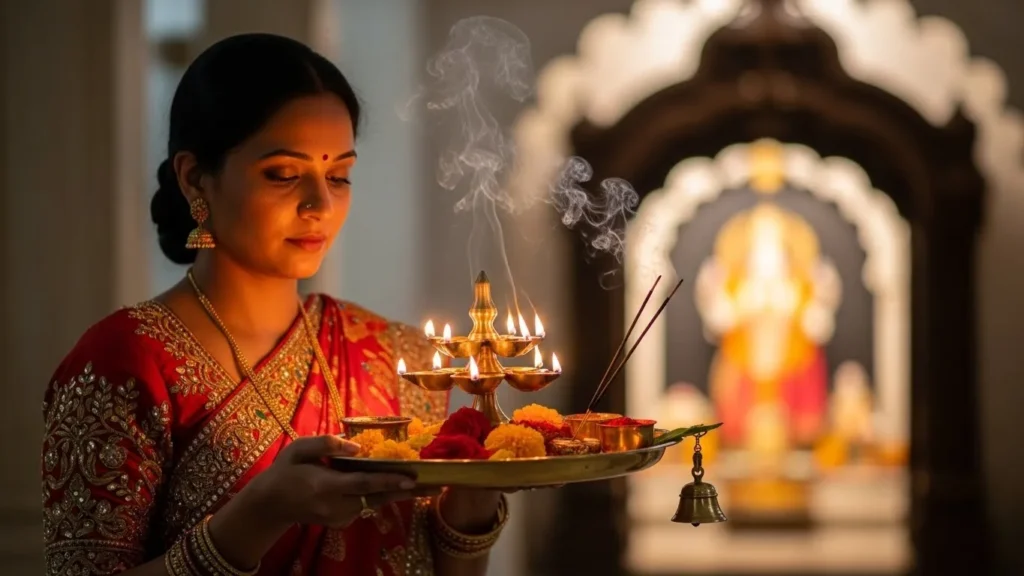
Unlike simple functional acts like lighting lamps or reciting mantras, aarti synthesizes multiple devotional elements into cohesive ceremony that represents peak moment of worship service when all preliminaries culminate in direct loving communication with deity through offering light itself – physical element closest to formless divine consciousness – back to Light’s ultimate source acknowledging that all illumination, all knowledge, all consciousness flows from that supreme divine presence whose grace enables our very capacity for devotion.
The complete aarti practice involves understanding profound symbolism where circular waving represents cyclical time and eternal nature of soul’s relationship with God, flame embodies devotee’s burning love consuming ego like ghee feeds fire, clockwise movement follows sun’s path aligning worship with cosmic order ([translate:Rita]), multiple wicks (typically 1, 3, 5, or 7) represent individual elements being offered or devotee’s complete dedication through.
all seven energy centers (chakras), touching sanctified flame afterward signifies receiving divine grace manifested as light and transferring those blessings to one’s consciousness by bringing heated hands to forehead activating spiritual vision, and communal participation wherein hundreds or thousands join voices singing ancient prayers creates collective energy field intensifying individual devotion through group consciousness phenomenon where whole becomes greater than sum of parts.
For practitioners in 2025 whether performing elaborate temple aarti with full ritual paraphernalia and trained priest leading congregation through precisely timed five daily ceremonies (Mangal Aarti before dawn awakening deity, Shangar Aarti after divine dressing, Rajbhog Aarti at noon offering main meal, Sandhya Aarti at sunset with massive public participation, Shayan Aarti at night bidding divine goodnight) or maintaining simplified home altar practice involving brief morning and evening lamp waving while singing favorite bhajan creating intimate personal connection with chosen deity ([translate:Ishta Devata]), understanding complete framework.
recognizing aarti serves multiple purposes from engaging all senses in divine service thereby purifying them through sacred association to providing accessible entry point for devotion requiring no Sanskrit scholarship or complex theology but simply sincere love expressed through beautiful ritual anyone can perform to creating temporal rhythm structuring day around divine remembrance rather than purely secular activities establishing God-centered rather than ego-centered existence – enables approaching this beloved practice with renewed appreciation transforming potentially mechanical habit into conscious spiritual communion.
What Is Aarti? Etymology and Core Meaning
Understanding precise meaning and origins reveals profound philosophy underlying this ubiquitous yet often misunderstood practice.
The Name: Multiple Interpretations
The word “Aarti” derives from Sanskrit with several etymological explanations, each revealing different dimension:
1. आर्त-निवारण (Aart-Nivaran):
- Aart = Suffering, sorrow, distress
- Nivaran = Removal, dispelling
- Meaning: “Removal of suffering”
Philosophy: Through devotional love expressed in aarti, devotee’s worldly sorrows, karmic burdens, and existential sufferings dissolve in divine grace like darkness vanishes before light.
2. आ + रति (Aa + Rati):
- Aa = Towards, complete, total
- Rati = Love, devotion, attachment
- Meaning: “Complete love toward God”
Philosophy: Aarti represents devotee’s total love directed exclusively toward divine, ego-transcending surrender expressing supreme attachment beyond all worldly relationships.
3. आरात्रिक (Aaratrika):
- Derived from Ratri = Night
- Meaning: “That which dispels darkness”
Philosophy: Like lamp dispels physical darkness, aarti dispels ignorance’s spiritual darkness revealing divine truth.
4. आरार्तिक (Aarartika):
- Related to Aarati = Respectful welcome, honor
- Meaning: “Ceremony of honoring”
Philosophy: Aarti welcomes divine presence like honored guest receives respectful reception with lights, flowers, and loving attendance.
All Meanings Valid:
Hindu tradition embraces multiple simultaneous meanings – aarti IS suffering-removal AND complete love AND darkness-dispeller AND honoring ceremony. This semantic richness reflects practice’s multi-dimensional significance.
What Is Aarti Meaning Core Definition
Aarti (noun): Devotional ceremony wherein lit lamps (typically ghee-soaked wicks or camphor) are waved before deity’s image or murti in clockwise circular patterns while devotees sing devotional songs (bhajans) accompanied by bell ringing, conch blowing, and musical instruments, concluding with devotees receiving blessings by passing hands over sanctified flame and touching foreheads.
Essential Elements:
Must Include:
- Light source (lamp/camphor/incense)
- Circular waving (clockwise motion)
- Deity focus (image/murti/sacred object)
- Devotional consciousness (bhava)
Typically Includes:
- Singing/chanting
- Bell ringing
- Musical accompaniment
- Multiple participants
- Sanctified flame sharing
Historical Origins
Ancient Vedic Roots:
While elaborate aarti ceremony as practiced today developed during medieval bhakti movement (6th-17th centuries CE), foundational elements trace to ancient Vedic fire worship:
Vedic Agni Worship:
- Fire as primary deity and sacrificial medium
- Circling sacred fire (Parikrama/Pradakshina)
- Offerings into flames
- Fire as divine messenger
Evolution:
Vedic Period (1500-500 BCE): Fire sacrifices (Yajna/Homa) – complex, priest-dominated
Upanishadic Period (800-200 BCE): Internalization of ritual – meditation emphasized
Bhakti Movement (500-1700 CE): Democratization of worship – accessible love-focused practices
Aarti emerges: Combining ancient fire reverence with accessible devotional expression allowing householders (not just priests) to worship through beautiful, emotionally engaging ceremony requiring no Sanskrit scholarship or expensive sacrifices.
Why Aarti Became Universal
Accessibility:
- No caste restrictions (anyone can perform)
- Minimal resources (simple lamp sufficient)
- No Sanskrit required (vernacular bhajans acceptable)
- Home or temple (location flexible)
- Individual or communal (participation scalable)
Emotional Power:
- Multisensory engagement (sight, sound, smell, touch)
- Musical element (appeals to aesthetic sense)
- Group energy (collective effervescence)
- Visual beauty (captivating flame patterns)
- Immediate gratification (tangible blessing receipt)
Theological Flexibility:
- Works for all deities (Shiva, Vishnu, Devi, Ganesha, etc.)
- Fits all traditions (Vaishnava, Shaiva, Shakta)
- Accommodates varying theology (dualism, qualified non-dualism, non-dualism)
- Personal deity choice (Ishta Devata system)
The Essential Philosophy
What Aarti Teaches:
1. Light as Divine Symbol:
Physical light = closest material manifestation of formless divine consciousness
Bhagavad Gita 10.11:
[translate:तेषाम् एवानुकम्पार्थम् अहम् अज्ञानजं तमः।
नाशयाम्यात्मभावस्थो ज्ञानदीपेन भास्वता॥]
“Out of compassion for them, I dwelling within their hearts, destroy the darkness born of ignorance with the shining lamp of knowledge.”
Aarti = Offering light to Light itself, acknowledging God as ultimate source
2. Circular Motion as Eternal Love:
No beginning, no end – devotee’s love for God is eternal, transcending birth and death
Circumambulation symbolizes:
- Devotee revolving around God as center (not ego)
- Life’s cycles returning to divine source
- Continuous, unbroken devotion
3. Consuming Fire as Ego Dissolution:
Ghee (representing ego/attachments) burns completely in devotional fire, leaving only pure light (consciousness)
Self-sacrifice: Like camphor burns leaving no residue, ideal devotee offers everything leaving no trace of separate self
4. Receiving Blessing as Divine Grace:
Two-way exchange:
- Devotee offers light/love
- God returns blessing/grace (received by touching flame)
Teaching: Devotion isn’t one-way obligation but loving relationship with reciprocal giving
This profound philosophical framework elevates aarti from mere ritual to transformative spiritual practice.
Types of Aarti: Daily Schedule and Special Occasions
Hindu temples traditionally perform multiple daily aartis at specific times, each serving distinct function in deity’s daily routine.
The Five Daily Temple Aartis
Based on divine daily schedule ([translate:Nitya Puja Vidhi]) treating deity as living presence with daily routine:
1. Mangal Aarti (मंगल आरती) – Pre-Dawn Awakening
Timing: 4:00-5:00 AM (before sunrise, during Brahma Muhurta)
Meaning:
- Mangal = Auspicious, prosperous
- First darshan (viewing) of deity after night’s rest
Purpose:
- Awakening deity from divine sleep
- Auspicious beginning to day
- Removes inauspiciousness accumulated during night
Characteristics:
- Gentle, devotional atmosphere
- Fewer participants (dedicated devotees only)
- Softer songs, slower pace
- Full aarti (all articles offered)
Procedure:
- Priest opens sanctum doors
- First light of lamps before deity’s sleeping form
- Deity “awakened” through sound (conch, bell)
- First offering of day
Home Practice:
- Many devout families perform morning aarti upon waking
- Sets devotional tone for entire day
- Typically simpler than temple version
2. Shangar/Shringar Aarti (शृंगार आरती) – Morning Dressing
Timing: 7:00-8:00 AM (after sunrise)
Meaning:
- Shangar/Shringar = Adornment, decoration, beautification
Purpose:
- Celebrating deity’s fresh dressing and ornamentation
- First public darshan of day
- Morning worship for working devotees
Characteristics:
- Deity dressed in fresh clothes, flowers, jewelry
- Moderate participation
- Celebratory mood
- Partial aarti (fewer articles)
Special Elements:
- Emphasis on deity’s beautiful appearance
- Fresh flowers offered
- Mirror shown to deity (in some traditions)
3. Rajbhog Aarti (राजभोग आरती) – Midday Main Meal
Timing: 12:00-1:00 PM (noon)
Meaning:
- Raj = Royal, grand
- Bhog = Food offering, meal
Purpose:
- Offering main meal of day (elaborate dishes)
- Midday worship opportunity
- Expressing gratitude for sustenance
Characteristics:
- Elaborate food offerings (8-56 items depending on tradition)
- Full aarti with complete articles
- Moderate length ceremony
- Prasad distribution afterward
Food Offerings:
- Rice, vegetables, sweets, fruits
- Prepared with devotion, offered fresh
- Later distributed as mahaprasad
Home Practice:
- Some families offer midday meal with brief aarti
- More common on weekends/festivals
4. Sandhya Aarti (संध्या आरती) – Evening Sunset
Timing: 6:00-7:30 PM (sunset/twilight)
Meaning:
- Sandhya = Twilight, junction time (day-night transition)
Purpose:
- Most important daily aarti
- Largest public participation
- Expressing gratitude for day
- Invoking protection for night
Characteristics:
- Maximum participation (hundreds/thousands in major temples)
- Full elaborate aarti (all articles, extended duration)
- Highest energy – enthusiastic singing, dancing
- Extended bhajan session often follows
- Complete with all instruments (drums, cymbals, harmonium)
Why Most Popular:
- Work/school finished (everyone available)
- Traditional worship time
- Group energy most powerful
- Visually spectacular in large gatherings
Famous Sandhya Aartis:
- Ganga Aarti (Varanasi, Haridwar, Rishikesh) – thousands gather
- Golden Temple Aarti (Amritsar)
- Major temple evening aartis nationwide
Home Practice:
- Most families perform evening aarti
- Brings family together after day’s activities
- Children participate more easily than morning
5. Shayan Aarti (शयन आरती) – Night Sleep
Timing: 9:00-10:00 PM (before midnight)
Meaning:
- Shayan = Sleep, rest, bedtime
Purpose:
- Bidding deity goodnight
- Final worship of day
- Invoking peaceful sleep and protection
Characteristics:
- Soft, gentle atmosphere
- Fewer participants (closing time)
- Soothing songs, lullaby-like bhajans
- Partial aarti (abbreviated)
- Sanctum doors closed after
Procedure:
- Deity offered water (foot washing)
- Flowers, sandalwood
- Lamp waved gently
- Lullaby songs sung
- Sanctum sealed until next morning
Symbolism:
- Devotee’s day begins and ends with God
- Divine presence bookends daily activities
- Everything between is offering
Special Occasion Aartis
Beyond daily schedule:
Festival Aartis:
- Extended, elaborate versions
- Multiple simultaneous lamps
- Special bhajans specific to festival
- Examples: Diwali, Janmashtami, Navaratri
Life Event Aartis:
- Weddings (for bride/groom, family deities)
- Births (welcoming newborn)
- Naming ceremonies
- Housewarming (Griha Pravesh)
- Business openings
Special Deity Aartis:
- Birth anniversaries (Janmashtami, Ram Navami)
- Victory celebrations (Dussehra)
- Seasonal festivals (Holi, etc.)
Abhishekam Aarti:
- After ritual bathing of deity
- Specially elaborate
- Often includes 11 or more lamps
Variations by Tradition
Number and Timing:
ISKCON (Gaudiya Vaishnava): 7 daily aartis
South Indian Temples: 4-6 daily aartis
North Indian Temples: 2-5 daily aartis
Home Practice: Typically 2 (morning and evening)
All valid – adapt to tradition, capacity, and circumstances.
Complete Aarti Procedure: Step-by-Step Guide
The proper aarti ceremony follows systematic sequence ensuring all elements properly offered with correct technique and consciousness.
Items Required (Aarti Thali Setup)
Essential Items:
| Item | Purpose | Symbolism |
|---|---|---|
| Aarti Plate (Thali) | Holds all items | Foundation for offerings |
| Ghee Lamp | Primary light source (1, 3, 5, or 7 wicks) | Fire element, divine consciousness |
| Camphor | Alternative/additional flame | Complete combustion, ego dissolution |
| Incense Sticks | Fragrance offering | Earth element, devotion’s sweet aroma |
| Flowers | Beauty offering | Earth element, submission, love |
| Bell | Sound during ceremony | Alerting divine, dispelling negativity |
| Conch Shell | Announcement (beginning/end) | Space element (ether), primordial Om |
| Water Pot (Kalash) | Purification, offering | Water element, purity |
| Handkerchief/Cloth | Drying (symbolic) | Service, care |
| Kumkum/Turmeric | Tilak application | Blessing mark, devotion sign |
| Matchbox/Lighter | Lighting lamps | – |
Optional Traditional Items:
- Chamara (yak-tail whisk) – Royal insignia, air element
- Peacock feather fan – Cooling, air element, beauty
- Multiple lamps – Five/seven elements representation
- Sacred thread – Purity, connection
- Fruits – Prasad offering
Preparation Phase
Personal Purification:
For Priest/Performer:
- Full bath (traditionally required for temple, home can be less strict)
- Clean clothes (preferably traditional – dhoti/kurta or sari)
- Tilak application (forehead mark according to tradition)
- Achamana (purification ritual):
- Sprinkle water on body parts while chanting mantras
- Touch eyes, nose, ears, chest
- Rinses mouth three times
For Participants:
- Clean hands and feet minimum
- Respectful attire
- Calm, focused mind
Setting Up:
- Clean altar/deity area thoroughly
- Arrange thali with all items systematically
- Light main lamp (not aarti lamp yet)
- Fresh flowers before deity
- Incense already burning
- Family/participants gathered, seated comfortably
The Ceremony – Seven Steps
STEP 1: Announcement (Conch Blowing)
Procedure:
- Priest/performer picks up conch shell
- Three short blasts (OM sound three times)
- Signals aarti beginning
- Alerts deity and congregation
Significance:
- Primordial Om vibration
- Clears atmospheric negativity
- Focuses everyone’s attention
- Marks sacred time beginning
STEP 2: Incense Offering (Dhoop)
Procedure:
- Hold incense stick(s) in holder with right hand
- Ring bell continuously with left hand throughout
- Wave incense clockwise before deity:
- Seven complete circles (or 3, 5, 11 depending on tradition)
- Full circumambulation around deity’s form
- Head to toe coverage
- Offer to congregation (sweep toward participants)
Technique:
- Smooth, graceful circular motion
- Maintain steady rhythm
- Don’t rush
- Keep consciousness on deity, not mechanics
Symbolism:
- Earth element offering
- Scenting deity’s divine garments
- Devotion’s sweet fragrance
- Purifying atmosphere
STEP 3: Lamp Offering (Deepa)
THE CENTRAL ACT – Most Important
Procedure:
- Light aarti lamp (ghee wicks or camphor)
- Hold lamp plate with right hand
- Ring bell continuously with left hand
- Wave lamp clockwise before deity:Pattern (Traditional):
- 7 circles around entire form
- 3 circles around face
- 3 circles around middle (chest/stomach)
- 3 circles around feet
- Final 7 circles around complete form
Alternative Simple Pattern:
- 7 continuous circles covering whole deity
- Singing – Devotees sing aarti bhajan during lamp waving
- Offer to congregation – Face lamp toward participants
Technique:
Circular Motion:
- Clockwise (following sun’s path)
- Smooth, flowing movement (like drawing circles in air)
- Appropriate speed – neither rushed nor glacially slow
- Full arm extension allowing adequate circle size
Maintaining Flame:
- Keep lamp level (prevent oil spilling)
- Shield from drafts
- Ensure continuous burning throughout
Bell Coordination:
- Steady rhythm matching song tempo
- Don’t stop ringing until lamp offering complete
- Left hand independence from right hand motion
Consciousness:
- Bhava (devotional emotion) most critical
- Imagine offering light of your love
- Feel divine presence receiving
- Not mechanical – heartfelt devotion
Symbolism:
- Fire element offering (most important)
- Revealing divine form through light
- Devotee’s burning love consuming ego-fuel
- Light returning to its source
STEP 4: Water Offering (Jala)
Procedure:
- Hold conch shell filled with pure water
- Ring bell with left hand
- Wave water vessel clockwise (7 circles)
- Symbolically “bathing” deity
- Offer to congregation
Symbolism:
- Water element offering
- Purification
- Life-giving sustenance
- Devotional service (bathing beloved)
Note: In elaborate temple aarti; in home practice often abbreviated or skipped
STEP 5: Handkerchief Offering (Vastra)
Procedure:
- Hold clean folded handkerchief/cloth
- Ring bell
- Wave clockwise (7 circles)
- Symbolically “drying” deity after bath
- Offer to congregation
Symbolism:
- Service attitude
- Caring for divine like parent cares for child
- Reversal of roles (we serve God who sustains us)
Note: Often abbreviated in home practice
STEP 6: Flower Offering (Pushpa)
Procedure:
- Hold plate of fresh flowers
- Ring bell
- Wave clockwise (7 circles)
- Alternative: Shower flowers directly on deity
- Offer fragrance to congregation
Symbolism:
- Earth element (second representation)
- Beauty offering
- Submission (flowers plucked from plant = ego offered)
- Fragrance = devotion’s sweetness
STEP 7: Chamara/Fan Offering (Vayu)
Procedure:
- Wave yak-tail whisk or peacock fan
- Ring bell
- Gentle fanning motion (cooling deity)
- Symbolically offering comfort
Symbolism:
- Air element offering
- Royal treatment (whisks used for royalty)
- Complete service (even providing comfort)
Note: Often skipped in simplified home aarti; more common in temple
Closing Sequence
Final Aarti Song:
Most Common:
Om Jai Jagdish Hare (Universal Aarti – works for all deities)
[translate:ॐ जय जगदीश हरे, स्वामी जय जगदीश हरे।
भक्त जनों के संकट, दास जनों के संकट, क्षण में दूर करे॥
ॐ जय जगदीश हरे…॥]
“Om, victory to the Lord of the universe. O master, victory to you. The troubles of your devotees and servants you remove in an instant.”
(Full song continues with multiple verses)
Other Popular Aartis:
- Om Jai Shiv Omkara (Shiva)
- Om Jai Lakshmi Mata (Lakshmi)
- Jai Ganesh Deva (Ganesha)
- Jai Jai Ram Krishna Hari (Vishnu)
Conch Conclusion:
Three final blasts – signaling aarti completion
Receiving Blessings (Prasad):
Critical Final Step:
- Aarti lamp passed to all participants
- Each person:
- Waves hands over flame (carefully, briefly)
- Brings hands to forehead/head (transferring blessing)
- Some traditions: Place coin/donation on lamp plate
- Water sprinkled on heads (from kalash)
- Flowers distributed for fragrance
- Kumkum tilak applied to forehead
- Food prasad distributed (if applicable)
Significance:
- Receiving divine grace manifested in sanctified flame
- Internalizing blessing through forehead touch (third eye activation)
- Completing exchange – devotee offered, God returned blessing
Duration:
Temple Aarti: 10-30 minutes (depending on elaboration)
Home Aarti: 5-15 minutes typically
Festival Aarti: 30-60+ minutes
Frequently Asked Questions
Can we perform aarti at home or only in temples?
Absolutely can perform at home! Home aarti is ancient, widespread practice. Advantages: 1) Personal intimate connection with deity, 2) Daily practice possible (vs. occasional temple visits), 3) Family bonding activity, 4) Children learn tradition, 5) Flexible timing. Home aarti typically simpler: Fewer items, shorter duration, family-led (no priest required). Minimum: Single lamp, bell, one bhajan song sufficient. Benefits equal to temple: Sincere devotion matters more than elaborate setup. Most Hindu families maintain daily morning/evening home aarti creating sacred rhythm structuring household around divine remembrance.
Do we need to sing or can we just wave lamp silently?
Singing/chanting highly recommended though not absolutely mandatory. Why singing matters: 1) Engages additional sense (hearing), 2) Creates devotional emotion (bhava) more powerfully, 3) Keeps mind focused (prevents wandering thoughts), 4) Traditional component completing multisensory experience, 5) Group participation enhanced through collective singing. If cannot sing: Play recorded aarti song, recite simple mantras like Om, or maintain internal devotional consciousness. However: Silent mechanical lamp-waving loses much spiritual power – consciousness and emotion matter most. Better: Enthusiastic off-key singing with devotion than perfect silent technique without love.
Which direction should we face during aarti?
Face the deity (image, murti, altar) regardless of cardinal direction. Deity placement: Traditionally faces East or West (so worshipper faces West or East respectively per Vastu). During aarti: Orientation toward divine form paramount – deity becomes your direction. Circumambulation: Clockwise waving itself creates sacred geometry regardless of compass direction. Home altars: Northeast corner ideal per Vastu, but adapt to space available. Temple: Stand in designated worship area before sanctum. Key: Facing deity with devotion transcends directional technicalities.
How many times should we circle the lamp?
Seven circles most traditional representing seven chakras, seven elements, completeness. Variations: 3 circles (representing Trimurti or simplified version), 5 circles (five elements), 11 circles (especially auspicious number), 21 circles (very elaborate). Pattern within: Some traditions do 7 for whole form, then 3 each for face/middle/feet, totaling more. Home practice: Even 1-3 circles acceptable if time limited – sincerity matters more than number. Quality over quantity: Slow devotional circle better than rushing through many mechanical rotations. Let song guide: Often complete as many circles as song lasts naturally.
What do we do with aarti lamp after ceremony?
Keep burning briefly to allow blessing distribution (people wave hands over flame). Then: 1) Extinguish properly – use small cap/lid or gentle hand wave, NEVER blow out (breath considered impure for sacred flame), 2) Place safely on altar or designated spot, 3) Some traditions: Maintain as continuous lamp (especially Akhand Diya during festivals), 4) Camphor: Burns completely leaving no residue (ideal), 5) Ghee lamp: Can relight for next aarti or let burn safely. Never: Carelessly discard while hot, use for mundane purposes. Respect: Lamp blessed through divine offering requires reverential handling.
Can non-Hindus participate in or watch aarti?
Most temples welcome all respectful observers. Aarti’s beauty and energy transcend religious boundaries. Participation levels: 1) Observe respectfully – stand quietly, absorb atmosphere (always acceptable), 2) Sing along – if willing to learn words/melody (welcomed enthusiastically), 3) Receive blessings – wave hands over flame, touch forehead (offered to all present), 4) Lead ceremony – typically reserved for trained priests or Hindu family members. Interfaith families: Partners from different faiths often participate in spouse’s aarti traditions. Key: Sincere respect and avoiding mockery/casual disregard. Many non-Hindus report profound spiritual experiences from aarti participation regardless of belief system.
Why do we ring bell throughout aarti?
Multiple purposes: 1) Alerting deity – announcing offering being made, 2) Dispelling negativity – sound waves clear negative energies, 3) Focusing devotees – keeps minds from wandering through continuous sound, 4) Drowning distractions – external noises masked by bell, 5) Creating sacred atmosphere – bell sound marks transition from mundane to sacred, 6) Representing Om – bell’s resonance echoes primordial vibration. Left hand tradition: Keeps bell in receptive hand while right (active) hand offers items. Continuous ringing: Throughout entire offering sequence (incense, lamp, water, etc.). If no bell: Can clap rhythmically, use small cymbals, or simply maintain devotional consciousness.
What’s the difference between aarti and puja?
Puja = Complete worship service (30 min – 2 hours) including multiple elements: invocation, offering 16 upacharas (water, flowers, food, etc.), mantra chanting, meditation, archana, homam. Aarti = Specific concluding ceremony (5-15 minutes) waving lamps while singing. Relationship: Aarti typically concludes puja as climactic moment. However: Aarti can be performed standalone (especially daily morning/evening home practice) as simplified worship. Think: Puja is full meal; aarti is dessert. Can have dessert alone (aarti only) or after full meal (aarti concluding puja). Both valid depending on time, occasion, and tradition. Standalone aarti perfectly acceptable for busy modern families maintaining regular devotional practice.
Conclusion
The aarti ceremony represents Hinduism’s most accessible, beautiful, and emotionally powerful expression of devotional love – synthesizing profound theological philosophy recognizing light as closest physical manifestation of formless divine consciousness with multisensory ritual engaging eyes through dancing flames’ mesmerizing patterns, ears through melodious bhajan songs and rhythmic bell percussion, nose through camphor and incense fragrances, touch through reverential hand gestures over sanctified fire, and ultimately heart through overwhelming devotional emotion ([translate:bhava]) that transforms ordinary worship into ecstatic loving exchange between devotee and divine transcending intellectual theology or complex ritual mechanics toward direct experiential communion accessible to everyone regardless of education, wealth, or social status.
Understanding complete framework – that aarti’s etymology encompasses both suffering-removal and complete-love meaning revealing dual benefit of dissolving worldly sorrows through divine grace while simultaneously expressing ego-transcending devotion focused exclusively on supreme beloved, that structured daily temple schedule with five distinct aartis from pre-dawn Mangal awakening through nighttime Shayan bidding goodnight treats deity as living presence with complete daily routine inviting devotees into intimate relationship, that proper procedure from preliminary purification through systematic offering sequence (incense, lamp, water, handkerchief, flowers, fan) to blessing reception creates coherent ceremony maximizing spiritual efficacy.
while maintaining aesthetic beauty, and that underlying symbolism from clockwise waving representing eternal cyclical devotion through flame embodying love consuming ego-fuel like ghee feeds fire to touching blessed light afterward signifying grace received and internalized through forehead activation teaches profound truths about consciousness, divine nature, and transformation available through sincere practice – enables approaching this beloved ritual with renewed appreciation whether performing elaborate temple aarti with hundreds joining voices in ancient prayers creating collective energy field intensifying individual devotion or maintaining modest home altar practice involving brief lamp waving while singing favorite bhajan creating intimate personal connection with chosen deity.
As you incorporate aarti into your 2025 spiritual practice, whether establishing daily morning and evening home routine structuring day around divine remembrance rather than purely secular activities, participating enthusiastically in temple Sandhya Aarti joining hundreds or thousands in magnificent communal devotion creating unforgettable spiritual experiences through group consciousness phenomenon, or simply appreciating this beautiful tradition’s profound wisdom recognizing that accessible love-focused practices democratized Hinduism allowing everyone direct access to divine grace without requiring priest mediation or Sanskrit scholarship, remember that practice’s ultimate value transcends technical perfection or elaborate arrangements toward sincere devotional consciousness expressed through simple act of offering light to Light’s ultimate source.
acknowledging that all illumination whether physical flame or consciousness itself flows from that supreme divine presence whose grace enables our very capacity for devotion and whose loving reciprocation returns blessings manifested as sanctified flame we reverently touch to forehead internalizing that grace into our awareness transforming ordinary existence into sacred communion where every moment lived in divine remembrance through simple daily practices like aarti’s brief beautiful ceremony maintains
continuous connection with eternal truth that devotional love represents soul’s natural state awaiting only conscious recognition and expression through time-tested methods our tradition refined across millennia discovering that combination of light, sound, fragrance, motion, and heartfelt emotion creates portal through which divine presence becomes tangibly experienceable rather than abstract theological concept.
[translate:॥ दीपज्योति परब्रह्म दीपसर्व तमोपहम्।
दीपेन साध्यते सर्वं सन्ध्यादीपो नमोस्तुते॥]
(The light of the lamp is the Supreme Brahman. The light of the lamp destroys all darkness. Everything is accomplished through the lamp. Salutations to the lamp lit at twilight.)
About the Author
Dr. Meera Nair – Hindu Philosophy, Bhakti Traditions, and Devotional Practices Scholar
Dr. Meera Nair is a distinguished scholar and practitioner specializing in Hindu philosophy, bhakti (devotional) traditions, ritual symbolism, and the transformation of consciousness through devotional practices. Holding a doctorate in Religious Studies with specialization in medieval bhakti movement and contemporary devotional expressions, her interdisciplinary work examines how accessible love-focused practices like aarti democratized Hindu worship allowing householders direct access to divine grace without requiring Brahminical mediation or Sanskrit literacy, creating spiritual revolution that continues shaping contemporary Hinduism’s inclusive character.
Dr. Nair has extensively researched aarti’s evolution from Vedic fire worship through bhakti synthesis to modern adaptations, documenting regional variations, musical traditions, theological interpretations across different sampradayas, and psychological effects of multisensory devotional rituals on consciousness transformation, demonstrating how practices combining visual beauty, melodious sound, fragrant offerings, and heartfelt emotion create powerful
experiences transcending intellectual theology toward direct experiential communion with divine. She regularly teaches courses on bhakti literature, devotional music traditions, ritual studies, and practical implementation of traditional practices in contemporary contexts, guiding students and practitioners through understanding both profound symbolism and proper procedures ensuring authentic engagement rather than mechanical performance.
Her teaching emphasizes that accessible devotional practices like aarti preserve profound wisdom in experientially engaging forms making abstract spiritual truths tangibly available through direct sensory participation rather than intellectual study alone, that sincere love-focused devotion (bhava) matters infinitely more than ritual technical perfection allowing everyone regardless of background or education to approach divine through heartfelt practice, and that maintaining traditional ceremonies even in simplified modern adaptations preserves cultural continuity while providing psychologically beneficial rhythm creating sacred pauses amid secular routine where divine presence becomes consciously acknowledged through beautiful accessible methods our bhakti heritage refined across centuries discovering that combination of light, sound, and devotional emotion genuinely transforms consciousness from worldly preoccupation toward spiritual awareness.
