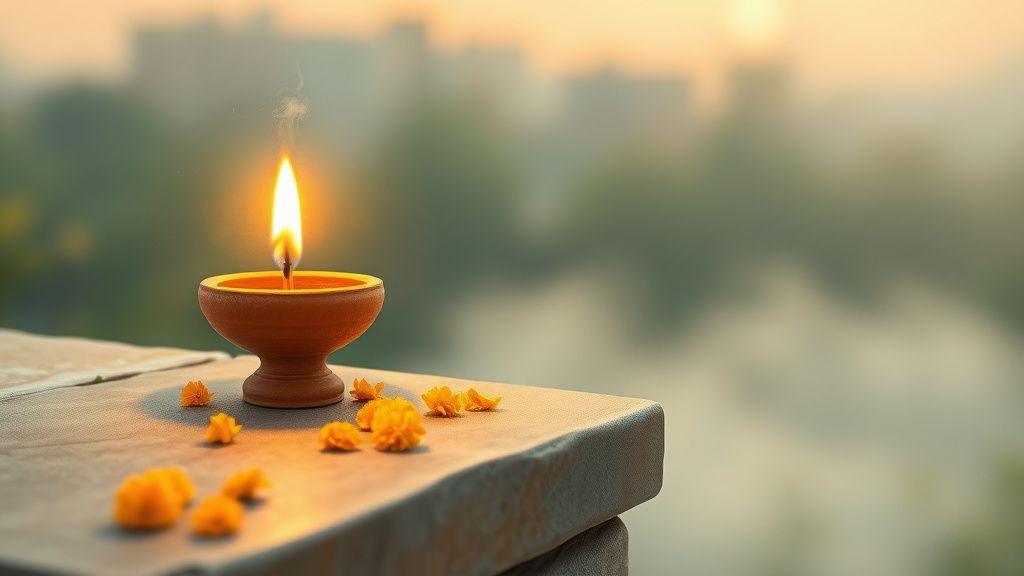
The diya (also called deepa, Sanskrit “lamp”) is the small oil lamp lit twice daily in Hindu homes and at every temple ritual. The standard form is a shallow clay or brass vessel holding oil (sesame, coconut, or ghee) and a single cotton wick. The lighting is part of the morning and evening sandhya sequence, accompanied by the chant deepam jyoti parabrahma. The Skanda Purana, the Padma Purana and the Linga Purana each contain chapters on the deepa daana (lamp donation) ritual, treating the lit lamp as itself a form of the deity. The act stretches from household practice to the largest temple aarti involving hundreds of lamps simultaneously.
When the diya is lit
The two principal daily times are sunrise (the morning sandhya) and sunset (the evening sandhya). Lighting at godhuli vela, the dust-of-cattle hour at dusk when cattle return home, is the more emphasised of the two in traditional practice. Additional occasions:
- Special days: Diwali (the festival of lights itself), Karthigai Deepam in Tamil Nadu (a Shaiva lamp festival in November-December), Vaikuntha Ekadashi, Bhogi.
- Pujas at home: the diya is lit before the puja starts and remains lit through its duration.
- Temple aarti: the camphor and ghee-lamp circling of the deity at the end of each prayer cycle.
- Death observances: a lamp is kept burning continuously for thirteen days after a death in the household.
- Vows (vrata): some vows include lighting a specified number of lamps on a particular day each week.
Materials and form
The traditional materials and their associations:
- Clay diya: the most common household form, particularly during Diwali. Unfired or fired terracotta; discarded after use.
- Brass diya: household everyday lamps, reused daily. Often a multi-tier kuttu vilakku in Kerala, or a five-faced panchamukhi diya for special occasions.
- Silver and gold diyas: used in wealthier homes and major temples. The temple Nalvar deepam at the Madurai Meenakshi temple is gold-clad.
- Oil: sesame oil is the standard daily oil; coconut oil in Kerala; ghee (clarified butter) for major rituals and aarti. The Padma Purana lists ghee as the highest-grade fuel, followed by sesame oil, then mustard, then any other.
- Wick: hand-rolled cotton wick (called vatti in Tamil); the wick is twisted to a point and lit with a match or a second lamp.
The symbolic readings
The lit lamp is read on several layers in Hindu commentary:
- Light over darkness: the literal removal of darkness as a metaphor for the removal of ignorance (avidya). The Bhagavad Gita 13.18 names the light of knowledge as the supreme light.
- The five elements: the lamp brings together earth (the clay or brass vessel), water (none in this form, but the cleaning before lighting), fire (the flame), air (the surrounding atmosphere that feeds the flame), and ether (the space).
- The deity’s form: the lit flame is itself considered a form of the deity, particularly of Agni and of Lakshmi. The flame is not separately worshipped but stands in for the deity during the puja.
- Direction of flame: the flame points upward, regardless of how the lamp is positioned. This is read as the soul’s upward orientation toward the divine.
Number of wicks and significance
A standard daily diya carries one wick. Specific occasions call for specified numbers:
- One wick: daily household puja, evening aarti.
- Two wicks: the jodi deepam for couples performing puja together.
- Three wicks: for the three forms of the goddess or the three gunas.
- Five wicks: the panchamukhi, for the five elements or the five Pandavas, used on special days.
- Seven wicks: the saptarishi deepam, for the seven sages.
- Twenty-one wicks: for major festivals and vows.
- 108 wicks: the highest count, for major temple festivals and undertaken vows. The Padma Purana describes 108-wick offerings.
For what it’s worth, the daily one-wick evening diya remains the most defensible household practice in the entire Hindu daily ritual sequence. It takes thirty seconds, costs almost nothing, and provides a clear pause at dusk for the household. The larger lamp counts are festival practice; the daily diya is the everyday substrate.
The aarti sequence
At the end of a puja, the diya (or a specific aarti lamp) is moved in a clockwise circular motion in front of the deity. The standard aarti sequence:
- Light the camphor or wick in the aarti lamp.
- Hold the lamp at chest level, facing the deity.
- Move the lamp clockwise, slowly, three or seven times.
- End by placing the lamp briefly at the deity’s feet, then bringing the flame’s warmth toward one’s own forehead and eyes (devotees standing in the aarti receive the warmth in turn).
- The aarti hymn (often Om Jai Jagdish Hare or a temple-specific composition) is sung during the circling.
Common questions
Which oil should I use?
Sesame oil is the standard daily oil and is the most widely used in Tamil Nadu, Andhra Pradesh and Karnataka. Coconut oil is preferred in Kerala. Mustard oil is used in eastern India and parts of the north. Ghee is the highest-grade fuel and is used for special occasions, aarti at temples, and during major pujas at home. Any of these is acceptable; the convention is what one’s family and region practice.
Should the diya face a particular direction?
The lamp itself does not have a direction; the wick tip can face north or east, the two most auspicious directions in Vastu. The deity in the puja faces east or west; the diya is placed in front of or to the deity’s right. The flame itself always points upward and is not adjusted to face a direction.
What if the diya goes out during the puja?
The lamp is relit immediately from another flame, ideally from a second lit lamp rather than from a fresh match. The puja continues. A diya going out mid-ritual is not considered a serious omen; the relight is part of the routine. If oil runs out the lamp is refilled and relit.
Can I blow out the diya at the end of the puja?
By tradition, no. The diya is allowed to burn out naturally, or is extinguished by waving a hand over it, or by covering it briefly with a small leaf or plate. Blowing on the flame with breath is considered disrespectful, since the same breath is also used for chanting. The cover-and-extinguish method is the standard alternative.
A limitation worth noting
This article describes mainstream household and temple lamp practice across India’s major Hindu traditions. Specific sectarian rules (Vaikhanasa Vaishnava, Pancharatra, Shaiva Siddhanta, Sri Vaishnava) prescribe particular oils, wick counts and lighting times that go beyond the everyday household norm. The numerical symbolism of wick counts is widely repeated but not consistently sourced across the Puranas; specific scriptural attributions for particular counts vary by tradition. For the exact convention in one’s own community, the family priest remains the authoritative source.
For background see the Wikipedia entry on the diya and the entry on aarti.