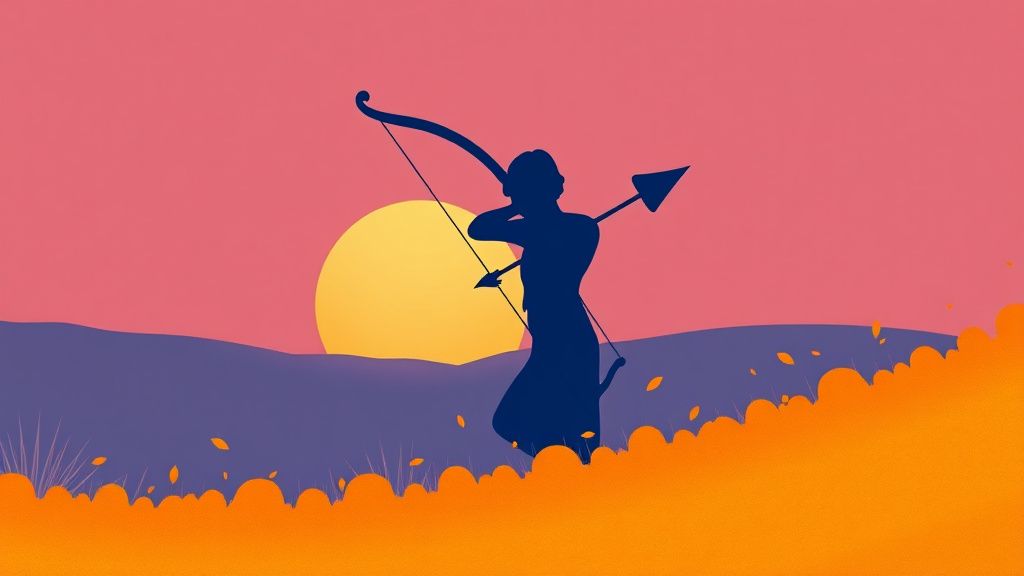
Vijayadashami, popularly called Dussehra, falls on the tenth day of the bright half of Ashvin, immediately following the nine nights of Navratri. In 2026 the festival is observed on Tuesday, 20 October, with the Vijay Muhurat for ritual undertakings running roughly from 1:59 PM to 2:45 PM in north Indian panchangs. The day commemorates two distinct victories that converge on the same tithi: Rama’s killing of Ravana, narrated in the Ramayana’s Yuddha Kanda, and Durga’s killing of the buffalo demon Mahishasura, narrated in the Devi Mahatmya (Markandeya Purana). The public face of the festival in north and west India is the burning of the Ravana effigy at evening; in the east and south the festival is the closing day of Durga Puja or the day of Ayudha Puja and Vidyarambham.
Why an effigy of Ravana is burned
The Ramayana of Valmiki narrates the war at Lanka over six books; the climax in the Yuddha Kanda sees Rama killing Ravana with the Brahmastra on the tenth day of the war. Vijayadashami, “the tenth day of victory”, takes its name from this; the day commemorates the moment dharma defeats adharma. The standard public observance is Ravana Dahan: a tall (typically 30 to 100 feet) effigy of Ravana, sometimes flanked by smaller effigies of his brother Kumbhakarna and son Meghnad, is filled with firecrackers, set alight after sunset, and burnt to the ground while the watching crowd recites Jai Shri Ram.
The reading of the burning is not vengeance; it is the ritual destruction of the qualities Ravana personifies. The Tulsidasi Ramcharitmanas and the Tulsi tradition’s Ramlila plays explicitly frame the ten heads of Ravana as the ten faults of the self: lust (kama), anger (krodha), greed (lobha), attachment (moha), pride (mada), envy (matsarya), ignorance (avidya), injustice (anyaya), arrogance (ahankara) and ego (asmita). The burning is the symbolic destruction of these faults; this reading is taught in most Ramlila performances during the preceding nine days.
The other story: Durga and Mahishasura
The Devi Mahatmya, a 700-verse text within the Markandeya Purana dated approximately to the 5th-6th century CE, narrates the killing of the buffalo demon Mahishasura by Durga. The asura wins a boon making him invincible to any man, woman, deva or asura; the boon does not exclude a goddess composed of the energies of all the devas, which is what Durga is. The battle runs for nine nights (Navaratri) and ends on the tenth (Vijayadashami) with Durga’s killing of Mahishasura. Bengal, Odisha, Assam and the eastern Indian Durga Puja observe Vijayadashami as the day of immersion (visarjan) of the Durga murtis after the nine days; the murtis, returned to the river, take Mahishasura’s defeat back to the cosmic order.
Ramlila as the long lead-in
Across the Hindi belt the nine nights of Navratri are taken up by Ramlila performances, a folk dramatic reenactment of the Ramayana running roughly:
- Rama’s birth in Ayodhya, his marriage to Sita, the coronation announcement.
- The exile, the kidnapping of Sita by Ravana, the meeting with Hanuman.
- Hanuman’s discovery of Sita, the burning of Lanka.
- The crossing of the sea, the siege of Lanka.
- The death of Kumbhakarna, of Meghnad, of Ravana on the tenth night.
The Ramlila of Ramnagar, opposite Varanasi on the eastern bank of the Ganga, is the most documented and runs over thirty-one days in some years. The performances are amateur, traditionally cast from the community, with the Brahmin boys playing Rama, Lakshmana, Bharata and Shatrughna and treated as deities through the performance. UNESCO listed Ramlila as an Intangible Cultural Heritage in 2008.
Regional observance
- North India: Ramlila on each of the nine nights; Ravana effigy burning on the evening of the tenth. The Ramlila Maidan in New Delhi, Chowpatty in Mumbai, and the Madhav Bagh in Indore host the largest public dahans.
- Bengal, Odisha, Assam: Vijayadashami is the immersion day of the Durga murtis. Sindoor Khela is performed by married women at home and in pandals; the murtis are then taken in procession to the river or the sea for immersion.
- Karnataka: the Mysore Dasara is the year’s high observance, with the Jamboo Savari (the elephant procession) carrying the goddess Chamundeshwari from Mysore Palace through the city to the Bannimantap grounds. The event has been observed since the Vijayanagara emperors and was restored by the Wadiyars after 1610.
- Tamil Nadu: the day is Ayudha Puja and Vidyarambha: tools, weapons, vehicles and books are offered worship for the year ahead. Schoolchildren begin formal study (akshara abhyasa) on this day. Saraswati Puja is the principal observance; processions of Devi are limited.
- Kerala: Vidyarambha at temples like the Saraswati Temple at North Paravur; children begin writing the alphabet in rice.
- Maharashtra: Simollanghan, the symbolic crossing of the village boundary by the male householder, who returns with apta leaves (Bauhinia racemosa) treated as gold and exchanged between households as the day’s greeting.
- Himachal Pradesh: the Kullu Dussehra runs for seven days after Vijayadashami, when the deities of the surrounding villages are brought in palanquins to Kullu town to greet Lord Raghunath.
What is done at home on the day
For households not attending a public dahan or Durga visarjan, the home observance runs:
- A morning bath and clean clothes.
- Aparajita Puja at noon or in the Vijay Muhurat: a puja of the goddess Aparajita (“the unconquered”) performed for victory in undertakings begun on this day.
- Shami Puja: in north India the Shami tree (Prosopis cineraria) is honoured; the Pandavas are said to have hidden their weapons in a Shami during the year of incognito exile, retrieving them on Vijayadashami. Households without access to a Shami substitute a banyan or pipal leaf.
- Apta leaf exchange in Maharashtra and parts of north India; sweets distributed.
- Family attendance at the local Ramlila dahan in the evening.
For what it’s worth, the most meaningful single observance on Vijayadashami for a non-attending family is the Aparajita Puja with a clear sankalpa for one specific undertaking begun on the day. The Hindu tradition treats Vijayadashami as the most auspicious day in the year for starting a new business, learning, vehicle purchase or journey; the merit is sectarian but the day’s psychological weight is real.
Common questions
Is Dussehra the same as Vijayadashami?
Yes. Dussehra (from “dasha-hara”, the destroyer of the ten faults, or “dashami”, the tenth) is the colloquial Hindi name for Vijayadashami. The Sanskrit Vijayadashami is the form used in formal panchang and ritual contexts; Dussehra is the form used in everyday speech across the Hindi belt. The two refer to the same day.
Why do effigies sometimes include three figures?
The three are Ravana, his brother Kumbhakarna, and his son Meghnad (also called Indrajit), the three principal antagonists of the Ramayana. All three are killed in the war at Lanka. Some Ramlila grounds use all three; others use only Ravana. The reading is the same; the three together depict the full destruction of Ravana’s line.
What time is the Ravana Dahan?
Just after sunset on Vijayadashami. The standard window is 5:45 PM to 6:30 PM across most north Indian cities in October, varying slightly by latitude. Big public dahans run until 7:30 PM to 8:00 PM with the firework display; the actual burning is in the first thirty minutes.
A limitation worth noting
Vijay Muhurat, sunrise and sunset times shift by city; the times above are for north India. Households in the south should use the local panchang for the exact afternoon Vijay Muhurat. Public dahan times are set each year by the host committee and published in the local press in the days before; this article cannot quote individual city schedules. For context see the Wikipedia entries on Vijayadashami, Mysore Dasara, and Ramlila.
