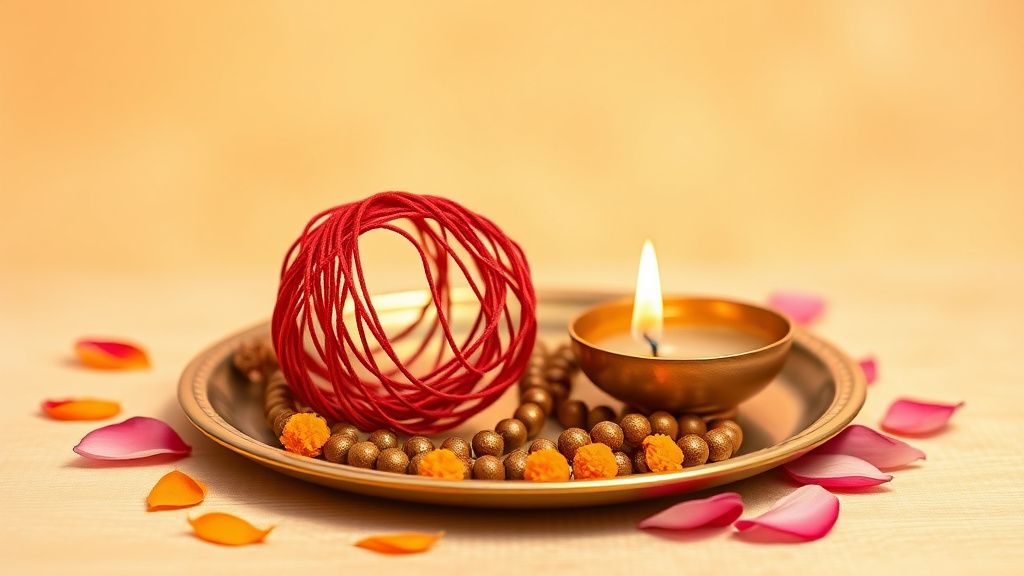
Raksha Bandhan is observed in 2026 on Friday, 28 August, the full moon (Purnima) of the Hindu month of Shravana. The Purnima Tithi begins at 9:08 AM on 27 August and ends at 9:48 AM on 28 August; the sacred thread (rakhi) is tied during the morning of 28 August in most published panchangs. The festival names a specific act: a sister ties a rakhi on her brother’s right wrist, and the brother, by accepting it, takes a stated responsibility for her protection.
2026 muhurat in plain terms
The two timing considerations that matter:
- Bhadra: Hindu tradition forbids tying the rakhi during Bhadra Kaal, a window each lunar day associated with Shani’s daughter and considered inauspicious for new beginnings. In 2026 the Bhadra associated with the Shravana Purnima ends before sunrise on 28 August. The published Bhadra-free window for tying the rakhi on 28 August is roughly 5:57 AM to 9:48 AM.
- Aparahna (afternoon) window: traditional pandits prefer the aparahna muhurat (around noon to early afternoon) when the Bhadra window has not cleared the morning; in 2026 that constraint does not apply, and the morning slot is the standard one.
Households that cannot tie the rakhi in the morning can tie it any time on 28 August before the Purnima tithi ends at 9:48 AM, or push the tying to the closest practical moment after; the strictness of the muhurat varies between traditions and most families treat the broader day as acceptable.
The puja thali and what each item is for
The standard north Indian rakhi thali carries a fixed set of items:
- Diya (oil lamp): lit and placed at the centre. The brother’s aarti (the circular wave of the lamp) is performed first thing in the sequence.
- Roli or kumkum: for the tilak on the brother’s forehead.
- Akshat (unbroken rice grains): rice mixed with a few drops of curd or kumkum, pressed onto the tilak after application.
- Rakhi: one for each brother. The thread is the active element of the ceremony.
- Sweets (mithai): typically peda, barfi or laddu, fed to the brother by the sister after the rakhi is tied.
- Flowers: usually marigold or rose, scattered around the thali.
- Optional kalash: a small pot of water, sometimes with a coconut on top, included in stricter Maharashtrian and Gujarati households.
The exact tying sequence
The order is fixed, and most pandits insist on this sequence:
- The brother sits facing east on a low stool or asan.
- The sister performs aarti, circling the lit diya three times clockwise around his head.
- She applies the tilak (roli, then akshat) on his forehead, between the eyebrows.
- She ties the rakhi on his right wrist, reciting the Raksha Bandhan mantra (below).
- She feeds him a piece of sweet.
- The brother offers her his gift and touches her feet if she is older, or accepts her blessing if she is younger.
The mantra recited at tying
The classical mantra used by pandits when the rakhi is tied is the same one historically used in the Vedic raksha rite, recited by priests when tying the protective thread on the host:
Yena baddho Balī Rājā, dānavendro mahābalaḥ |
Tena tvām anubadhnāmi, rakṣe mā cala mā cala ||
The verse translates roughly: “With the same thread by which Bali, the great king of the danavas, was bound, I bind you. O protective thread, do not waver, do not waver.” The reference is to the Vamana avatar story, in which the dwarf brahmana Vamana binds the asura king Bali after asking for three paces of land. The Raksha Bandhan thread invokes that bond. Households use this mantra; the brother typically does not need to recite anything beyond accepting the rakhi.
Older meanings the festival carries
The brother-sister reading is the dominant modern one, but Raksha Bandhan has several older strands:
- Priest to host: in older Vedic ritual the family priest tied a yellow thread (often turmeric-dyed) on the host’s wrist at the start of any major yajna; this is still the practice at most temple yajnas and at home pujas conducted by a priest.
- Indrani and Indra: the Bhavishya Purana relates a story in which Indra, defeated by Bali, is saved when his wife Indrani ties a protective thread on his wrist on this Purnima; he then wins the next encounter.
- Krishna and Draupadi: the Mahabharata episode in which Draupadi tears a strip from her sari to bandage Krishna’s bleeding finger, and Krishna pledges to repay the debt — fulfilled at the Cheer Haran. This is the most cited brother-sister antecedent in popular sermon literature.
- Yama and Yamuna: a Puranic story has Yamuna tying a rakhi on her brother Yama, who grants her immortality in return. The Bhai Dooj festival in Kartik also draws on this story.
For what it’s worth, the most useful frame for Raksha Bandhan today is the broader one the festival’s history actually supports: a pledge of mutual responsibility between two people who have a structural relationship, whether siblings, cousins, married-in sisters and brothers-in-law, or in some communities women and the priest or guru. Restricting it to biological siblings is a recent narrowing.
Regional variations
- North India: the standard rakhi tying with thali described above, often accompanied by a full family meal.
- Maharashtra: the same day is observed as Narali Purnima by coastal fishing communities, who offer coconuts to the sea before the post-monsoon fishing season opens; rakhi tying happens alongside.
- Tamil Nadu and Kerala: the day is Avani Avittam, the upakarma when brahmana men change their sacred thread (yajnopavita) and recite the Veda’s preliminary verses for the new study year. Rakhi tying is observed in many households but layered with this older ritual.
- Odisha: the festival is called Gamha Purnima; cattle and bullocks are decorated and worshipped.
- Bengal: the day is observed as Jhulan Purnima; rakhi is tied but the day’s larger weight sits on the swing festival of Radha-Krishna in Vaishnava temples.
Common questions
What if the brother lives far away?
The standard practice is to courier the rakhi well in advance with a note specifying the muhurat, and to perform the rest of the ritual remotely; the brother ties the rakhi himself on receipt or asks his wife or another family member to tie it. The acceptance is the active element; physical co-presence is preferred but not strictly required.
Which wrist does the rakhi go on?
The right wrist, in standard practice. The right side in Hindu ritual is the side associated with action, dakshina (offering), and the male body; this is also why the brother is asked to sit facing east. Left-handed brothers do not need to deviate from the rule.
How long should the rakhi be worn?
Traditional practice is to wear the rakhi for the day and then untie it during the bath the next morning, placing it on a clean surface in the household altar. Many households now wear it until it falls off naturally; both are accepted. The thread itself, once consecrated, is not discarded casually; it is either tied to a tulsi plant, immersed in flowing water, or placed in the altar.
A limitation worth noting
The exact muhurat windows for tying the rakhi shift each year and vary slightly by location because the Bhadra and Purnima tithi calculations are local-panchang specific. The 2026 morning window (5:57 AM to 9:48 AM) above is for north India per Drik Panchang; households in southern states with different sunrise times should consult a local panchang for the exact aparahna window. For the broader cultural context see the Wikipedia entry on Raksha Bandhan and the official Avani Avittam overview for the parallel south Indian ritual.
