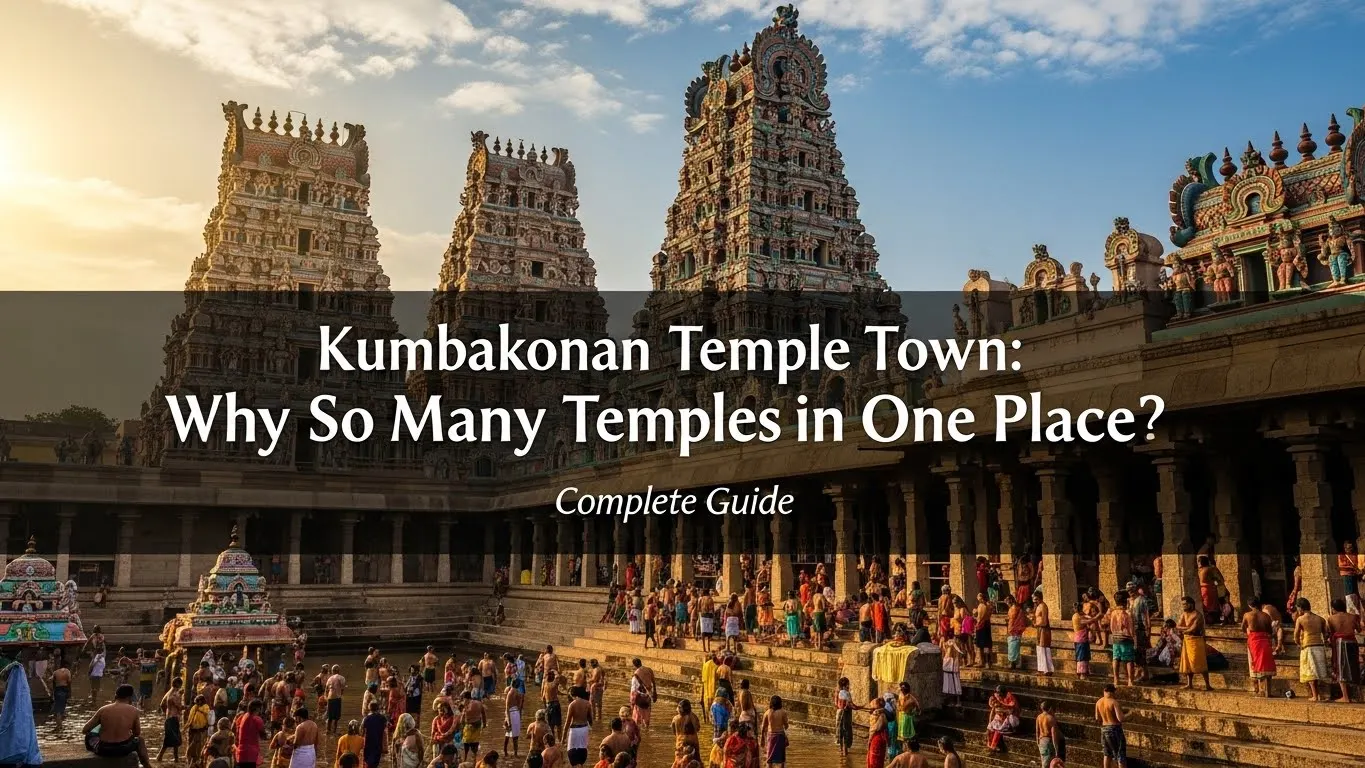
Kumbakonam Temple Town, located in the Thanjavur district of Tamil Nadu on the banks of the sacred Kaveri River, is renowned as the “Temple City” or “City of Temples” with approximately 188 Hindu temples within its municipal limits alone, plus several thousand temples in the surrounding region, earning it unparalleled status as one of India’s densest concentrations of sacred architecture. The extraordinary proliferation of temples in this single town stems from a profound mythological origin story: during the cosmic deluge (pralaya),
Lord Brahma placed the seeds of creation in a pot (kumbha) filled with amrit (nectar of immortality) which floated to Kumbakonam, where Lord Shiva broke it with his arrow, causing amrit drops to fall at various locations within several kroshams (approximately 10-15 km radius), and at each spot where sacred nectar touched earth, a Shiva lingam spontaneously manifested (swayambhu), necessitating temple construction.
Following ancient Hindu custom that every place with a Shiva temple should also have a Vishnu temple (and vice versa), corresponding Vishnu temples were established at these same locations, effectively doubling the sacred infrastructure. This divine event gave the town its name: “Kumbakonam” derives from “Kudamukku Onam” meaning “pot-breaking festival” in Tamil. The Mahamaham Tank (sacred pond) at Kumbakonam’s center marks the exact spot where the cosmic pot broke, and every 12 years during the Mahamaham festival, millions of pilgrims gather believing that all holy rivers of India (Ganges, Yamuna, Godavari, Narmada, Kaveri, and others) converge in this tank, making a bath there equivalent to bathing in all sacred rivers combined, thereby washing away all sins.
The town’s temple concentration was further amplified by extensive patronage during the Chola dynasty (9th-13th centuries), when Kumbakonam served as an important administrative and religious center where Chola kings commissioned magnificent temples showcasing Dravidian architectural excellence with towering gopurams, intricate sculptures, and precise Agamic design.
The strategic location on the fertile Kaveri River basin provided both spiritual significance (the Kaveri being among Hinduism’s holiest rivers) and practical benefits (agricultural prosperity supporting temple economies), while the town’s position as a major Chola capital attracted scholars, artisans, and devotees who further enriched its religious landscape.
This comprehensive guide explores the mythological origins of Kumbakonam’s temple abundance, the significance of the Mahamaham Tank and festival, major temples including Adi Kumbeswarar and Sarangapani, the Chola dynasty’s transformative role, architectural marvels and Divya Desam connections, and what Kumbakonam reveals about Hindu philosophy‘s integration of sacred geography, cosmic mythology, and devotional architecture.
The Mythological Origin: Breaking of the Sacred Pot
The Story of Pralaya (Cosmic Deluge)
The founding myth of Kumbakonam connects the town to cosmic creation itself:
- At the end of a cosmic cycle (kalpa), the universe faced destruction through pralaya (cosmic dissolution)
- Waters of annihilation threatened to destroy all existence
- Lord Brahma, the creator deity, needed to preserve the seeds of future creation
- Lord Brahma collected the seeds of creation – the essence of all future beings and worlds
- He placed these sacred seeds in a pot (kumbha) filled with amrit (nectar of immortality)
- The pot also contained water from all the holy rivers of India
- Brahma sealed the pot and set it afloat on the cosmic ocean to survive the deluge
- The pot floated through the cosmic waters
- It eventually reached the location that would become Kumbakonam
- The name itself derives from this event: “Kudamukku Onam” = “pot-breaking festival” in Tamil
Kumbakonam Temple Town Lord Shiva Breaks the Pot
- When the waters of pralaya receded, Lord Shiva appeared
- He shot an arrow that broke open the sacred pot (kumbha)
- This act initiated the recreation of the universe from preserved seeds
- “The kalasam breaking open resulted in a lot of drops of the amritam falling at various places within a radius of several kroshams”
- Each drop of sacred nectar touched a different location
- The radius extended approximately 10-15 kilometers around the breaking point
- “At each of those places, a Siva Lingam sprung up”
- These were swayambhu lingams (self-manifested) – not created by human hands
- Each lingam marked a point where divine energy concentrated
- The spots became inherently sacred, requiring temple construction
The Multiplication Effect: Paired Temples
Following Hindu Temple Tradition:
The Ancient Custom:
- Hindu religious practice holds that “every place with a Siva temple should also have a Vishnu temple (and vice versa)”
- This reflects theological harmony between Shaivism and Vaishnavism
- Ensures devotees of both traditions can worship in the same location
Doubling the Temples:
- Since Shiva lingams appeared at numerous spots, Shiva temples were built at each
- “Therefore, Vishnu temples also came up at those places”
- This pairing effectively doubled the number of temples
- “This is why Kumbakonam has as many temples as it does”
- The original sacred spots multiplied through the pairing tradition
- Almost each location became a separate village or town with temple pair
- The entire region developed as interconnected sacred geography
The Name “Kumbakonam”
- “Kudamukku Onam” in Tamil
- “Kudam” = pot
- “Mukku” = breaking
- “Onam” = festival
- Literally: “Pot-breaking festival”
Significance:
- The town’s very name commemorates the cosmic event
- Eternal reminder of mythological foundation
- Connects everyday geography to sacred narrative
The Mahamaham Tank: Sacred Center
Location and Importance
- The Mahamaham Tank marks the exact spot where the sacred pot broke
- Located at the heart of Kumbakonam town
- Serves as the spiritual center from which temples radiate outward
Physical Description:
- Large sacred tank (temple pond)
- Surrounded by ghats (steps) for ritual bathing
- Multiple shrines and temples on its periphery
- Fed by underground springs and managed water systems
Mythological Significance
- “According to legend, the Mahamaham tank was created by Lord Brahma, the creator of the universe”
- “He used the waters of all the holy rivers in India to create the tank”
- Makes it intrinsically sacred as containing essence of all holy waters
- “Another legend states that Lord Shiva came to Kumbakonam to perform a sacred dance known as the Tandava”
- “He created the Mahamaham tank by striking the ground with his trident”
- “And filled it with water from the Ganges river”
- “It is believed that Lord Shiva himself takes a dip in the Mahamaham tank during the Mahamaham festival”
- All the rivers of India are believed to meet at the tank during Mahamaham
- Includes: Ganges, Yamuna, Sarasvati, Sarayu, Godavari, Mahanadi, Narmada, Pavoshnl, and Kaveri
- Taking bath in these combined waters equals bathing in all holy rivers separately
The Mahamaham Festival
- The Mahamaham festival happens once every 12 years
- Timing based on astrological alignment (when Jupiter enters Aquarius and Sun enters Aries during Tamil month Masi)
- Most recent: 2016; next: 2028
- “Vast crowds gather at Kumbakonam to have a dip in the tank, along with saints and philosophers”
- Millions of pilgrims attend
- Considered one of India’s largest religious gatherings
- Comparable to Kumbh Mela in spiritual importance
- “A purificatory bath at this tank on this day is considered equal to the combined dips in all the holy rivers of India”
- “Taking bath in the holy stream of water… would get rid of sins according to Hindu religion”
- Believed to grant moksha (liberation) and wash away accumulated karmic burdens
Theerthavari (Divine Bathing):
- “Festival deities from all the temples in Kumbakonam arrive at the tank”
- “At noon, all the deities bathe along with the devotees – it is called ‘Theerthavari'”
- Creates profound shared moment: humans and gods bathing together
- Symbolizes divine-human unity
The 188+ Temples of Kumbakonam
Sheer Numbers
- “There are around 188 Hindu temples within the municipal limits of Kumbakonam”
- This extraordinary density makes Kumbakonam unique
- Approximately one temple for every few hundred meters in some areas
- “Apart from these, there several thousand temples around the town”
- The entire Kumbakonam region functions as sacred landscape
- Nearby villages each have multiple temples
- Creates interconnected pilgrimage network
- “Temple Town”
- “City of Temples”
- “Temple City”
- These names reflect Kumbakonam’s defining characteristic
Major Temples: The Big Three
1. Adi Kumbeswarar Temple (Shiva)
Deity: Lord Shiva as Adi Kumbeswarar
- “This temple marks the mythological origin of Kumbakonam”
- “Where Lord Shiva is believed to have broken the pot (Kumbha) of creation”
- “One of the key sites during the Mahamaham festival”
- Directly connected to the founding myth
- “The temple’s grandeur reflects Chola-era architecture”
- Magnificent gopuram (gateway tower)
- Extensive mandapams (pillared halls)
- Intricate sculptural details
Ritual Importance:
- Major pilgrimage destination
- Daily elaborate worship rituals
- Special ceremonies during Mahamaham
- Associated with cosmic creation narratives
2. Sarangapani Temple (Vishnu)
Deity: Lord Vishnu as Sarangapani
- Sarangapani temple is the largest Vaishnava shrine present in Kumbakonam
- “Holding immense religious importance and ranking just after the Srirangam Temple in Trichy”
- One of the 108 Divya Desams – temples glorified by Alwar saints
- “The present structure having a twelve-storey high tower was constructed by Nayak kings in the 15th century”
- “The rajagopuram rises to a height of 173 feet and consists of eleven tiers”
- “Features five prakaras (enclosures)”
- Sacred water tank known as Porthamarai Kulam
- Temple has “significant antiquity with contributions at different times from Medieval Cholas, Vijayanagara Empire and Madurai Nayaks”
- “The temple became significant under the Vijayanagara and Nayaka rulers (15-17th centuries), who expanded its structure”
- Represented shift from Cholas’ Shaivite focus to Vaishnavite patronage
- Ramaswamy Temple
- Chakrapani Temple
- These three formed the main Vaishnava temples during Vijayanagara-Nayaka period
3. Airavatesvara Temple (Nearby)
UNESCO World Heritage Site:
- Located in Darasuram, just outside Kumbakonam
- Built by Chola king Rajaraja II
- Masterpiece of Chola architecture
- Part of “Great Living Chola Temples” UNESCO designation
Temple Characteristics
- “The temples here are widely known for their exquisite pillars”
- “Imaginative drawings on walls”
- “Mythological stories” depicted in sculptures
- Represents pinnacle of Dravidian temple architecture
Dedication:
- Temples dedicated to both Lord Shiva and Lord Vishnu
- Some dedicated to Devi (Goddess)
- Subsidiary shrines for various deities
- Reflects Hindu theological diversity
Cultural Role:
- Temples function as cultural centers
- Repository of arts, music, and learning
- Economic hubs supporting artisan communities
- Social gathering spaces for communities
The Chola Dynasty’s Transformative Role
Kumbakonam as Chola Capital
- Kumbakonam served as an important center during Chola dynasty rule (9th-13th centuries)
- Sometimes functioned as alternate capital
- Strategic location on Kaveri River
- Agricultural prosperity from fertile delta region
- “Many temples were built in Kumbakonam during the Chola dynasty and other ruling dynasties”
- Chola kings viewed temple building as religious duty and political statement
- Demonstrated power, piety, and cultural sophistication
- Temples showcased architectural innovation
Temple Building as Statecraft
Political-Religious Integration:
- Temples served as administrative centers
- Royal authority expressed through sacred architecture
- Land grants to temples consolidated political control
- Priests and scholars supported royal legitimacy
Economic Function:
- Temples owned vast agricultural lands
- Employed thousands (priests, musicians, dancers, artisans, administrators)
- Redistributed wealth through festivals and rituals
- Functioned as banks and economic stabilizers
Cultural Preservation:
- Temples preserved Sanskrit and Tamil learning
- Supported music, dance, and arts
- Maintained libraries and educational institutions
- Transmitted cultural heritage across generations
Successive Dynastic Patronage
- Vijayanagara Empire (14th-17th centuries): Expanded existing temples, built new ones
- Madurai Nayaks (16th-18th centuries): Particularly patronized Sarangapani and other Vishnu temples
- Each dynasty added to architectural legacy
- Continuous building over centuries created layered complexity
Geographic and Strategic Advantages
The Sacred Kaveri River
- Kumbakonam “located on the banks of the Kaveri River”
- Kaveri considered one of Hinduism’s seven sacred rivers
- River worship integral to Hindu practice
- Kaveri’s presence enhanced town’s inherent sacredness
Practical Benefits:
- Fertile Kaveri delta supported agriculture
- Water for temple tanks and daily rituals
- Transportation route for pilgrims and goods
- Irrigation enabling economic prosperity
Centrality in Tamil Country
Pilgrimage Networks:
- Central location in Tamil Nadu temple circuit
- Easy access from Chennai, Madurai, Trichy, Thanjavur
- Hub connecting multiple pilgrimage routes
- Gateway to numerous Divya Desams
Regional Integration:
- Kumbakonam connected surrounding temple towns
- Each nearby village with temples linked to Kumbakonam
- Created dense sacred geography
- Pilgrims could visit dozens of temples in compact area
Cultural and Religious Significance Today
Living Temple Tradition
Active Worship:
- All 188+ temples maintain daily worship
- Traditional Agamic rituals preserved
- Priests trained in ancient practices
- Continuous tradition spanning centuries
Festival Calendar:
- Mahamaham every 12 years (millions attend)
- Annual festivals at each major temple
- Monthly special poojas and celebrations
- Daily rituals and abhishekams
Educational Heritage
- Kumbakonam “well known for its prestigious educational institutions”
- Sanskrit colleges and Vedic schools
- Temple-associated learning centers
- Preservation of classical Tamil and Sanskrit
- “Carved Panchaloha idols” (five-metal alloy sculptures)
- “Silk products”
- “Brass and metal wares”
- Traditional crafts supporting temple worship
Modern Tourism
Pilgrimage Tourism:
- Thousands visit daily
- Millions during Mahamaham
- Spiritual seekers and devotees
- Traditional pilgrimage packages
Cultural Tourism:
- Heritage architecture enthusiasts
- Students of Dravidian art
- Photography and documentation
- UNESCO site visitors (Airavatesvara nearby)
Why Kumbakonam? The Convergence Factors
1. Mythological Foundation
- Sacred pot breaking created multiple holy spots
- Divine origin stories attracted devotees
- Mahamaham Tank as cosmic center
- Inherent sacredness from creation narrative
2. Theological Pairing
- Shiva-Vishnu temple pairing doubled numbers
- Hindu theological harmony expressed spatially
- Each sacred spot required complementary temple
- Multiplier effect on temple construction
3. Royal Patronage
- Chola dynasty massive investment
- Successive dynasties continued building
- Political legitimacy through temple patronage
- Competitive temple building among rulers
4. Geographic Advantage
- Sacred Kaveri River location
- Fertile agricultural base
- Central position in Tamil country
- Hub of pilgrimage networks
5. Economic Prosperity
- Temple economies self-sustaining
- Land grants and endowments
- Artisan communities thriving
- Agricultural surplus supporting temples
6. Cultural Continuity
- Unbroken tradition of worship
- Knowledge transmission through generations
- Arts and learning preservation
- Community investment in maintenance
Frequently Asked Questions
Why does Kumbakonam have so many temples?
Kumbakonam has approximately 188 temples within municipal limits due to mythological origins, theological pairing, and royal patronage. According to legend, when Lord Shiva broke the sacred pot (kumbha) containing creation’s seeds, amrit drops fell at various locations within several kilometers, causing Shiva lingams to spontaneously manifest at each spot. Following Hindu custom that “every place with a Siva temple should also have a Vishnu temple (and vice versa),” corresponding Vishnu temples were built, effectively doubling the number. Extensive Chola dynasty patronage (9th-13th centuries) further amplified temple construction.
What is the significance of Mahamaham Tank?
The Mahamaham Tank marks the exact spot where the sacred pot broke, containing waters from all holy rivers of India created by Lord Brahma. Every 12 years during the Mahamaham festival, all sacred rivers (Ganges, Yamuna, Godavari, Narmada, Kaveri, and others) are believed to converge in this tank, making a bath there “equal to the combined dips in all the holy rivers of India” and washing away all sins. During the festival, millions gather, and “festival deities from all temples arrive at the tank, and at noon all deities bathe along with devotees” in a ceremony called Theerthavari.
What are the major temples in Kumbakonam?
The three major temples are: 1) Adi Kumbeswarar Temple (Shiva) marking where Lord Shiva broke the pot of creation, serving as a key Mahamaham festival site with Chola-era architecture; 2) Sarangapani Temple (Vishnu), the largest Vaishnava shrine in Kumbakonam and one of 108 Divya Desams, with a 173-foot tall rajagopuram built by Nayak kings; and 3) Airavatesvara Temple (nearby Darasuram), a UNESCO World Heritage Site representing Chola architectural mastery. The town has around 188 Hindu temples total within municipal limits plus thousands more in surrounding areas.
When is the next Mahamaham festival?
The Mahamaham festival occurs once every 12 years when Jupiter enters Aquarius and Sun enters Aries during Tamil month Masi. The most recent Mahamaham was in 2016; therefore, the next Mahamaham will be in 2028. During this festival, vast crowds including millions of pilgrims gather to bathe in the sacred tank where all holy rivers of India converge, and all temple deities perform Theerthavari (ritual bathing) at noon alongside devotees. The purificatory bath is believed to grant liberation and remove all accumulated sins.
What is the meaning of “Kumbakonam”?
“Kumbakonam” derives from the Tamil phrase “Kudamukku Onam” meaning “pot-breaking festival”. “Kudam” means pot, “Mukku” means breaking, and “Onam” means festival, directly referencing the mythological event where Lord Shiva broke the sacred pot (kumbha) containing the seeds of creation during the cosmic deluge. The town’s very name eternally commemorates this cosmic event that gave rise to its sacred significance and temple abundance, connecting everyday geography to the founding mythological narrative.
How did the Chola dynasty influence Kumbakonam’s temples?
The Chola dynasty (9th-13th centuries) transformed Kumbakonam through massive temple construction and patronage when the town served as an important Chola administrative and religious center. Chola kings built magnificent temples showcasing Dravidian architectural excellence with towering gopurams, intricate sculptures, and precise Agamic design. Successive dynasties including Vijayanagara Empire and Madurai Nayaks (15th-17th centuries) continued expanding structures, with Nayaks particularly supporting Vaishnava temples like Sarangapani’s twelve-storey tower. This continuous royal patronage over centuries created the layered architectural and cultural heritage visible today.
Is Sarangapani Temple a Divya Desam?
Yes, Sarangapani Temple is one of the 108 Divya Desams—the sacred Vishnu temples glorified by the 12 Alwar saint-poets. It is the largest Vaishnava shrine in Kumbakonam, ranking just after Srirangam Temple in religious importance. The temple features a 173-foot tall rajagopuram with eleven tiers, five prakaras (enclosures), and the sacred Porthamarai Kulam tank. Built with contributions from Medieval Cholas, Vijayanagara Empire, and Madurai Nayaks, it represents the shift in patronage toward Vaishnavite temples during the Nayaka period (15th-17th centuries).
What makes Kumbakonam unique among temple towns?
Kumbakonam’s uniqueness lies in its extraordinary temple density (188 within municipal limits), mythological foundation as the site where creation’s pot broke, the Mahamaham Tank where all sacred rivers converge every 12 years, and unparalleled Chola architectural heritage. Unlike other temple towns focused on single deities or pilgrimage routes, Kumbakonam combines both major Shaivite and Vaishnavite traditions equally, with temples paired according to ancient custom. Its position on the sacred Kaveri River, role as Chola capital, and continuous patronage across multiple dynasties created a concentrated sacred geography where pilgrims can visit dozens of significant temples within walking distance, making it truly the “Temple City” of Tamil Nadu.
Conclusion
Kumbakonam stands as perhaps Hinduism’s most extraordinary example of how cosmic mythology, theological principles, royal patronage, and sacred geography converge to create concentrated temple landscapes—where a single mythological event (the breaking of creation’s pot) catalyzed centuries of temple construction, transforming one town into a microcosm of Hindu cosmology with 188+ temples representing every divine manifestation, every theological tradition, every architectural style, and every devotional practice that Tamil Hinduism has developed over two millennia.
The founding narrative of amrit drops falling at multiple locations, each generating a spontaneous Shiva lingam, then paired with Vishnu temples following theological harmony principles, created an initial sacred network that Chola kings amplified through massive construction programs, Vijayanagara and Nayaka rulers expanded with towering gopurams and elaborate mandapams, and devotional communities sustained through continuous worship, festival celebration, and artistic patronage.
The Mahamaham Tank at Kumbakonam’s heart—where all India’s sacred rivers converge every 12 years, where millions gather for purificatory bathing, where temple deities and human devotees immerse together at noon in Theerthavari ceremony—demonstrates how Hindu philosophy compresses infinite sacred geography into single accessible locations, making the spiritual benefits of bathing in distant Ganges, Yamuna, Godavari, and Narmada available to Tamil devotees who need not travel thousands of kilometers but can achieve equivalent merit at one consecrated tank in their cultural homeland.
This theological technology of sacred compression—where one spot contains all holy waters, one town manifests all divine forms, one festival equals countless pilgrimages—reveals sophisticated understanding of how symbolic systems can generate profound religious experiences without requiring impossible physical journeys.
Whether approached as devoted pilgrim seeking darshan at 188 temples housing countless divine manifestations, cultural enthusiast exploring Chola-Vijayanagara-Nayaka architectural evolution, scholar studying how mythology generates material culture, or simply curious visitor marveling at temple-saturated streets where every few hundred meters brings new gopurams, new sanctums, new opportunities for worship, Kumbakonam offers unparalleled density of sacred architecture where the question “Why so many temples?” finds answers in creation myths encoded in stone, theological harmony materialized through paired Shiva-Vishnu shrines, dynastic competition expressed through towering rajagopurams, and the simple enduring truth that when gods choose to concentrate
their presence—when amrit touches earth, when pots break open releasing divine essence, when cosmic narratives become local geography—devotees respond by building, beautifying, worshipping, and preserving the temples that mark these sacred intersections, generation after generation, creating temple towns like Kumbakonam where heaven and earth, mythology and history, devotion and architecture merge into living traditions that continue welcoming millions who come seeking the blessings that flow abundantly from this Temple City’s 188+ sanctuaries radiating outward from the Mahamaham Tank’s cosmic center.
About the Author
Anjali Deshmukh – Cultural Heritage & Temple Architecture Specialist
Anjali Deshmukh is an accomplished writer and researcher specializing in Hindu festivals, temple architecture, and India’s rich cultural traditions. With a Master’s degree in Indian Art History from Maharaja Sayajirao University, she has extensively documented pilgrimage sites, temple iconography, and folk traditions across India. Her work focuses on making India’s spiritual heritage accessible to contemporary audiences while preserving authentic cultural narratives.