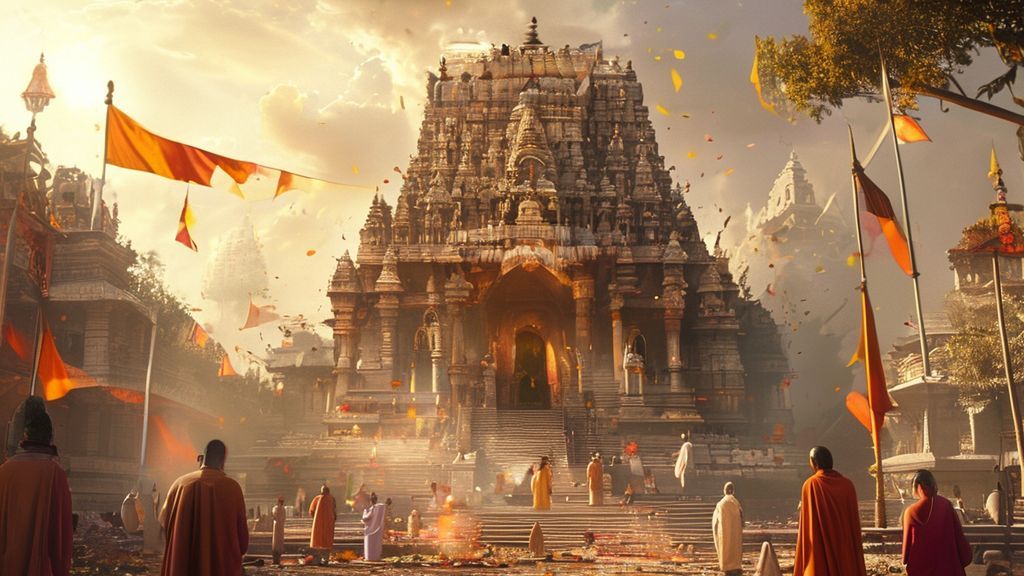
Somnath Temple, the revered first of the twelve Jyotirlingams, is far more than a sacred shrine; it is an eternal testament to Sanatan Dharma’s indestructible spirit. Repeatedly demolished and rebuilt at least 17 times over millennia, it symbolizes the unwavering faith and profound resilience of the Hindu civilization against relentless temporal aggressions, standing as a beacon of divine perseverance.
| Attribute | Details |
|---|---|
| Deity | Bhagwan Shiva (as Someshwara or Somanatha) |
| Location/Origin | Prabhasa Kshetra, Veraval, Saurashtra, Gujarat, India. Originates from Chandra Dev’s penance. |
| Key Festival | Maha Shivaratri, Karthik Purnima, Shravan Maas festivities |
| Scripture Reference | Shiva Purana (Koti Rudra Samhita, Chapter 1), Skanda Purana (Prabhasa Khanda), Mahabharata (Vana Parva) |
| Architectural Style | Chaulukya style (Kailash Mahameru Prasad style) of Nagara architecture |
The Eternal Flame of Sanatan Dharma
The Somnath Temple, nestled on the western coast of Saurashtra, Gujarat, stands as an unparalleled symbol of Hindu faith’s enduring power. More than an architectural marvel or a site of pilgrimage, Somnath embodies the very essence of Sanatan Dharma’s cyclical nature – destruction followed by creation, adversity met with unyielding devotion. Its history is etched in the collective consciousness of Bharatavarsha, representing both the tragic moments of foreign invasions and the glorious triumphs of spiritual resilience. For millennia, this sacred site, mentioned in ancient texts as Prabhasa Kshetra, has drawn millions of devotees seeking the divine blessings of Bhagwan Someshwara, the Lord of the Moon.
The mere mention of Somnath evokes tales of profound faith, brutal invasions, and miraculous resurrections. It is a living proof that true spirituality cannot be annihilated by the sword or fire; it resides in the hearts of devotees and finds its form anew, time and again. The temple’s significance transcends its physical structure, serving as a powerful reminder of our ancestors’ unwavering commitment to preserving their Dharma, an inspiration for every Hindu to uphold their traditions and heritage.
Puranic History and Sacred Legend
The origins of Somnath Temple are deeply embedded in the sacred narratives of our Puranas, predating recorded history. As recounted in the Skanda Purana’s Prabhasa Khanda and the Shiva Purana’s Koti Rudra Samhita, the temple’s genesis is linked to Chandra Dev, the Moon God, also known as Soma. Chandra, having married the twenty-seven daughters of Daksha Prajapati, showed preferential treatment to Rohini, incurring the wrath of his father-in-law. Daksha cursed Chandra to wane and lose his luster.
Distraught, Chandra, along with his wives, sought refuge at Prabhasa Kshetra. Here, he performed intense penance to Bhagwan Shiva. Pleased with his devotion, Shiva appeared and blessed Chandra, relieving him of the curse’s full effect, allowing him to wax for fifteen days each month. In gratitude, Chandra consecrated a Shivalinga at this very spot, and Shiva manifested eternally as Someshwara or Somanatha, the “Protector of the Moon.” This event solidified Somnath’s status as the foremost of the Dwadasa Jyotirlingams.
The Puranas and epics also allude to the temple’s ancient lineage and rebuilding cycles even in mythological times. It is believed that the original temple was constructed by Soma (Chandra) in gold, followed by Ravana in silver, Bhagwan Sri Krishna in wood, and then by King Bhimdev Solanki in stone. This demonstrates an unbroken tradition of reverence and reconstruction that far predates the Islamic invasions.
The cycle of destruction and rebuilding intensified with the arrival of foreign invaders. The temple famously faced its most devastating assault in 1024 CE by Mahmud of Ghazni, who plundered its immense wealth and desecrated the idol. Yet, despite this horrific act, the temple was meticulously rebuilt under the patronage of successive Hindu kings, including the Solankis and Parmars. This pattern of destruction by invaders – including Alaud-din Khilji’s general Ulugh Khan, Muzzafar Shah I, and Aurangzeb – followed by resolute reconstruction by Hindu rulers and communities, is a poignant testament to the unwavering spirit of Sanatan Dharma. Each destruction reinforced the resolve of devotees, culminating in its 17th and most recent rebuilding, initiated by Sardar Vallabhbhai Patel in 1947, and consecrated by Dr. Rajendra Prasad in 1951, embodying the resurrection of national pride.
Architectural and Scientific Marvels
The present Somnath Temple stands as a magnificent example of Chaulukya style (also known as Kailash Mahameru Prasad style) of Nagara architecture, showcasing intricate carvings, grand proportions, and a sublime aesthetic. Built from local Porbandar stone, its soaring *shikhara* (spire) reaches 150 feet, crowned by a majestic *kalasha* (pot-finial) and a *dhwaja* (flagpole). The intricate sculptures adorning its walls depict various deities, celestial beings, and scenes from Hindu mythology, each telling a story of devotion and dharma.
Beyond its aesthetic grandeur, Somnath embodies ancient Bharatan ingenuity. A unique feature is the Baan Stambh (Arrow Pillar), erected on the sea-protection wall. An inscription on this pillar, dating back to 1951, declares: “A Sthambha (pillar) erected on the seashore of Prabhas Patan indicates the presence of a pillar of an arrow, passing through an uninterrupted straight line from this point to the South Pole (Antarctica).” This assertion, without any landmass intervening between Somnath and the South Pole, points to the advanced geographical and astronomical knowledge possessed by ancient Hindu seafarers and sages, a profound testament to their understanding of the globe. This scientific marvel is further elaborated in ancient texts, reflecting a deep connection between our spiritual centers and cosmic understanding. Devotees interested in the deeper nuances of ancient Hindu sciences can find more insights on Hindutva.online.
Rituals and Puja Vidhi at Somnath
Pilgrims visiting Somnath Temple engage in various rituals to seek the blessings of Bhagwan Someshwara. The primary act of worship is Darshan, the sacred viewing of the Jyotirlingam.
Here is a simplified guide to the common rituals:
- Preparation: Devotees typically bathe and wear clean, traditional attire before entering the temple precincts.
- Entry and Darshan: Upon entering, devotees proceed to the main shrine for Darshan of the sacred Jyotirlingam.
- Abhishekam (Consecration Bath): Many devotees opt for an Abhishekam, where the Lingam is ritually bathed with water, milk, yogurt, ghee, honey, and other sacred substances. This is performed by priests on behalf of the devotee.
- Archana: Offering flowers, *Bael Patra* (Bilva leaves), *dhoop* (incense), and *deepa* (lamp) while chanting mantras, seeking specific blessings.
- Aarti: Participating in the elaborate morning and evening *Aarti* ceremonies, where lamps are circled before the deity, accompanied by devotional songs and chants.
- Parikrama: Circumambulating the temple (Parikrama) is also considered meritorious, symbolizing reverence for the divine presence.
Special pujas like Rudra Abhishekam and Maha Mrityunjaya Japa are performed for specific intentions, such as health, prosperity, and spiritual upliftment. These elaborate rituals, conducted by learned priests, involve precise Vedic chants and offerings.
Mantras and Chants for Someshwara
Chanting mantras is a powerful way to connect with the divine energy of Bhagwan Shiva. Devotees visiting Somnath or meditating upon Someshwara can chant the following:
- Basic Shiva Mantra: ॐ नमः शिवाय (Om Namah Shivaya) – The Panchakshari Mantra, the fundamental invocation of Shiva.
- Maha Mrityunjaya Mantra:
ॐ त्र्यम्बकं यजामहे सुगन्धिं पुष्टिवर्धनम्।
उर्वारुकमिव बन्धनान् मृत्योर्मुक्षीय माऽमृतात्॥
(Om Tryambakam Yajamahe Sugandhim Pushtivardhanam |
Urvarukamiva Bandhanan Mrityormukshiya Maamritat ||)
This powerful mantra invokes Shiva for longevity, health, and freedom from the cycle of birth and death.
- Dwadasa Jyotirlinga Stotram (Somnath Verse):
सौराष्ट्रे सोमनाथं च श्रीशैले मल्लिकार्जुनम्।
उज्जयिन्यां महाकालमोङ्कारममलेश्वरम्॥
(Saurashtre Somanatham Cha Shreeshaile Mallikarjunam |
Ujjainyam Mahakalamomkaaramamaleshwaram ||)
This verse specifically glorifies Somnath among the twelve Jyotirlingams.
Dos and Don’ts for Devotees
To ensure a respectful and spiritually enriching visit to Somnath Temple, devotees should observe the following:
- Dos:
- Maintain sanctity and reverence within the temple premises.
- Wear modest, traditional attire.
- Participate in Pujas and Aratis with devotion.
- Offer Bael Patra, Gangajal, and flowers to the Lingam.
- Respect the temple priests and staff.
- Keep the surroundings clean.
- Don’ts:
- Avoid photography inside the Garbhagriha (sanctum sanctorum).
- Refrain from loud conversations or disruptive behavior.
- Do not bring footwear into the main temple area.
- Avoid carrying prohibited items such as leather articles, alcohol, or non-vegetarian food.
- Do not litter or deface temple property.
Frequently Asked Questions About Somnath Temple
Why is Somnath Temple considered so significant in Sanatan Dharma?
Somnath holds immense significance as the foremost of the Dwadasa Jyotirlingams, representing a primordial manifestation of Bhagwan Shiva. Its Puranic origins, linked to Chandra Dev’s penance, and its history of repeated destruction and reconstruction make it a living emblem of Hindu resilience, unwavering faith, and the eternal nature of Dharma. It symbolizes the spiritual victory over temporal aggression.
Who was responsible for the final reconstruction of Somnath Temple?
The monumental task of the present and 17th reconstruction of Somnath Temple was spearheaded by Sardar Vallabhbhai Patel, India’s first Deputy Prime Minister, shortly after India’s independence in 1947. Following his demise, the work was continued by K.M. Munshi, with the support of the Indian government and widespread public donations. The current temple was consecrated by the first President of India, Dr. Rajendra Prasad, in 1951, symbolizing national pride and spiritual resurgence.
What is a Jyotirlingam, and why are there twelve?
A Jyotirlingam (ज्योतिर्लिंगम्) is a devotional representation of Bhagwan Shiva, signifying a “column or pillar of light.” It is believed to be a spot where Shiva appeared as a fiery column of light, penetrating the earth, during an ancient dispute between Brahma and Vishnu. There are twelve such revered shrines across India, each considered extremely holy, where Shiva is worshipped as a radiant reality. These twelve sites are enumerated in the Shiva Purana and are pivotal pilgrimage destinations for Shaivites.
Why This Matters for Every Hindu
The story of Somnath Temple is not merely a chronicle of stone and mortar; it is a sacred saga of Hindu civilization itself. It teaches us that true faith is indomitable, that culture endures beyond physical destruction, and that devotion can rebuild what hate seeks to obliterate. Somnath is a constant reminder of our ancestral strength, resilience, and unwavering commitment to Dharma. It stands as a beacon, guiding us to remember our roots, cherish our heritage, and stand firm in our Sanatani identity. Visiting or simply meditating upon Somnath recharges the spirit, connecting us to a timeless tradition of reverence and courage. It embodies the profound truth that the spirit of Bharatavarsha, like Bhagwan Shiva, is eternal, untouched by the cycles of creation and destruction, always manifesting anew.