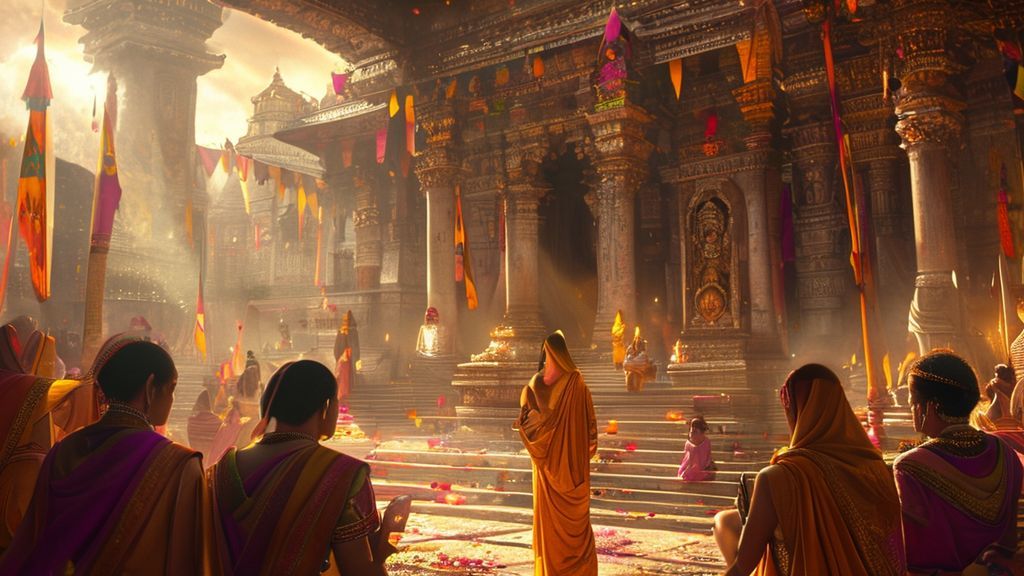
Hindu women and education, under the divine patronage of Devi Saraswati, embody a legacy rooted deeply in Sanatan Dharma, where knowledge (Jnana) has been revered as the paramount path to liberation (Moksha) and societal upliftment since Vedic times. Ancient scriptures consistently highlight women as scholars, philosophers, and revered teachers, integral to the transmission of spiritual and intellectual traditions.
| Attribute | Details |
|---|---|
| Deity of Knowledge | Devi Saraswati, embodying Vak (Speech), arts, wisdom, and learning. |
| Vedic Origin & Legacy | References to learned women (Brahmavadinis) in the Rig Veda, Upanishads, and Itihasas. |
| Key Annual Festival | Vasant Panchami (Saraswati Puja), celebrating the advent of spring and knowledge. |
| Primary Scripture References | Rig Veda (Saraswati Suktas), Brihadaranyaka Upanishad (Gargi, Maitreyi), Devi Bhagavata Purana, Smritis. |
The Eternal Flame of Vidya: Saraswati’s Grace on Hindu Women
In the vast tapestry of Sanatan Dharma, knowledge (Vidya) is not merely a tool for worldly success but a divine pursuit, a beacon guiding humanity towards truth and self-realization. At the heart of this sacred quest stands Devi Saraswati, the embodiment of wisdom, arts, and the purest form of consciousness. Her legacy profoundly underscores the pivotal role of education for all, especially for Hindu women, who historically have been revered as custodians and transmitters of sacred knowledge. From the earliest Vedic hymns to the intricate philosophical debates of the Upanishads, the intellectual and spiritual contributions of women have illuminated the path of Dharma, asserting their inherent right and capacity for profound learning.
The concept of education for women in ancient India was holistic, encompassing spiritual, intellectual, and practical aspects. It was recognized that an educated woman strengthens the entire social fabric, fostering virtuous families and enlightened communities. This profound reverence for female intellect is a cornerstone of our heritage, a testament to the timeless wisdom embedded in Sanatan Dharma.
Glimpses from Itihasa: Matron Sages and Philosophers
The divine inspiration for female education emanates directly from Devi Saraswati herself, who is depicted in the Rig Veda (Mandala 10, Sukta 125, known as the Devi Suktam) not merely as a river goddess, but as Vak Devi, the cosmic principle of articulate speech, thought, and the very essence of Brahma. She is the animating force behind all creation and consciousness, inspiring intellect and eloquence.
Our scriptures are replete with shining examples of women who achieved unparalleled scholarly and spiritual heights. These esteemed women were broadly categorized as Brahmavadinis (female renunciates dedicated to lifelong Vedic study and spiritual pursuits) and Sadyovadhus (women who pursued education until marriage). Their lives exemplify an age when intellectual rigor and spiritual quest were open to all earnest seekers, irrespective of gender:
- Gargi Vachaknavi: One of the most prominent female philosophers, Gargi fearlessly challenged the sage Yajnavalkya in profound philosophical debates, as chronicled in the Brihadaranyaka Upanishad (Chapter 3, Brahmana 6 & 8). Her incisive questions on the nature of reality and the absolute Brahman demonstrated unparalleled intellectual prowess and courage.
- Maitreyi: Another illustrious figure from the Brihadaranyaka Upanishad, Maitreyi was Yajnavalkya’s wife who chose philosophical inquiry and spiritual knowledge over material wealth when offered a share of his possessions. Her dialogue with Yajnavalkya remains a timeless lesson on the pursuit of immortality through knowledge.
- Lopamudra: A revered Rṣiṇī (female Rishi), Lopamudra composed hymns in the Rig Veda (1.179) alongside her husband, Agastya. Her profound insights into spiritual longing and marital harmony are enshrined in these ancient verses.
- Ghosha: Also a Rig Vedic Rṣiṇī, Ghosha is credited with composing two hymns (X.39 and X.40) in the Rig Veda. Her life, marked by perseverance despite a skin ailment, became a testament to spiritual devotion and scholarly contribution.
- Anasuya: Wife of Maharishi Atri, Anasuya’s wisdom, chastity (pativratya), and spiritual power were legendary, earning her reverence from even Devas. Her stories in the Ramayana highlight her role as a spiritual guide and a beacon of Dharma.
- Sulabha: A female ascetic who famously engaged in a deep philosophical debate with King Janaka, as narrated in the Mahabharata (Shanti Parva, Chapter 321). Her intellectual acumen and ascetic discipline earned her immense respect.
These women were not exceptions but representatives of a robust tradition where learning was a cherished pursuit for both men and women, laying the foundation for a vibrant intellectual and spiritual society.
The Edifice of Ancient Education: Women’s Contributions to Vidya
The “architecture” of ancient Indian education was the Gurukula system, a structured and holistic environment where knowledge was transmitted not just through texts but through living example and profound experience. Women actively participated in and even led these institutions, ensuring a comprehensive educational experience for all. This system fostered critical thinking, moral uprightness, and spiritual insight, embodying a scientific approach to self-development and understanding the cosmos.
The curriculum was vast and rigorous, covering not only spiritual texts but also various sciences and arts:
- Vedas and Vedangas: Deep study of the Rig, Yajur, Sama, and Atharva Vedas, complemented by the six Vedangas: Shiksha (phonetics), Kalpa (rituals), Vyakarana (grammar), Nirukta (etymology), Chhandas (meter), and Jyotisha (astronomy/astrology).
- Darshanas (Philosophical Schools): Intensive training in Nyaya (logic), Vaisheshika (atomism), Sankhya (enumeration), Yoga (union), Purva Mimamsa (interpretation of Vedic rituals), and Uttara Mimamsa (Vedanta, on the nature of Brahman).
- Arts and Sciences: Proficiency in Gandharva Veda (music, dance, performing arts), Shilpa Shastra (architecture, sculpture), Ayurveda (medicine), and various mathematical and astronomical disciplines. The legend of Lilavati, the brilliant mathematician after whom Bhaskara II named his seminal treatise, attests to the high regard for women in scientific fields.
The educational process emphasized `Shruti` (hearing the teachings from a Guru), `Manana` (contemplation and critical analysis), and `Nididhyasana` (deep meditation and realization). Women were integral to this entire process, contributing to the development and preservation of these profound streams of knowledge. This robust system ensured that the pursuit of truth was a collective endeavor, enriching `Sanatan Dharma` through diverse perspectives and intellectual contributions.
Honoring Saraswati: A Path to Cultivating Knowledge
Devotion to Devi Saraswati is a continuous process of seeking, learning, and applying wisdom. While Vasant Panchami marks a special day for Saraswati Puja, the true worship lies in the sincere pursuit of knowledge and the cultivation of virtues. The following steps outline a general `Puja Vidhi` to honor Saraswati, symbolizing our commitment to learning:
- Sankalpa (Intention): Begin with a clear intention, resolving to dedicate oneself to the pursuit of knowledge and truth, seeking Devi’s blessings for intellectual clarity.
- Dhyanam (Meditation): Meditate on the radiant form of Devi Saraswati, seated on a white lotus, holding a Veena and books, adorned in white, symbolizing purity and wisdom.
- Avahanam (Invocation): Invoke the presence of Devi Saraswati, inviting her into your sacred space.
- Asanam, Padyam, Arghyam, Snanam: Offer a seat, water for her feet, water for refreshment, and symbolically bathe her (using water or panchamrit).
- Vastram & Abharanam (Garments & Ornaments): Offer new white garments and symbolic ornaments, representing adornment with knowledge.
- Gandha, Pushpam, Dhupam, Deepam (Fragrance, Flowers, Incense, Lamp): Offer fragrant substances like sandalwood paste, white and yellow flowers, incense, and light a lamp (deepam).
- Naivedyam (Food Offering): Offer sattvic foods, especially sweets, fruits, and traditional Indian delicacies like *kheer*, *boondi ladoo*, or *kesar halwa*. Place books and writing instruments near the deity.
- Akshata (Unbroken Rice): Offer unbroken rice grains, symbolizing prosperity and auspiciousness in learning.
- Puja & Archana: Perform `archana` by chanting the Devi’s names or `Moola Mantra` (see below) while offering flowers or grains.
- Aarti & Pradakshina: Conclude with `Aarti`, waving a lamp before the Devi, and perform `Pradakshina` (circumambulation) as a sign of respect.
- Pranama (Prostration): Bow down with reverence, seeking blessings for clarity of mind, wisdom, and success in all intellectual endeavors.
Remember, the highest form of worship is the diligent and virtuous pursuit of knowledge itself.
Invoking Vidya: Powerful Saraswati Mantras
Chanting these sacred mantras dedicated to Devi Saraswati purifies the mind, enhances focus, and sharpens the intellect, opening pathways to profound understanding.
Saraswati Moola Mantra:
ॐ ऐं ह्रीं क्लीं महासरस्वती देव्यै नमः॥
(Om Aim Hreem Kleem Maha Saraswati Devyai Namah)
Saraswati Gayatri Mantra:
ॐ वागीश्वर्यै विद्महे वाग्देवीयै धीमहि तन्नो सरस्वती प्रचोदयात्॥
(Om Vagishvaryai Vidmahe Vagdevyai Dhimahi Tanno Saraswati Prachodayat)
Saraswati Vandana (Prayer to Saraswati):
या कुन्देन्दुतुषारहारधवला या शुभ्रवस्त्रावृता।
या वीणावरदण्डमण्डितकरा या श्वेतपद्मासना॥
या ब्रह्माच्युत शंकरप्रभृतिभिर्देवैः सदा वन्दिता।
सा मां पातु सरस्वती भगवती निःशेषजाड्यापहा॥
(Ya Kundendu Tushara Hara Dhavala, Ya Shubhra Vastravrita.
Ya Veena Vara Danda Mandita Kara, Ya Shveta Padmasana.
Ya Brahmachyuta Shankara Prabhritibhir Devaih Sada Vandita.
Sa Mam Patu Saraswati Bhagawati Nishshesha Jadyapaha.)
(Meaning: May Goddess Saraswati, who is fair like the jasmine-hued moon, whose pure white garland resembles dewdrops, who is draped in pure white attire, whose hands are adorned with the Veena, who is seated on a white lotus, and who is ever revered by Brahma, Vishnu, Shiva, and other Devas, protect me and remove all my dullness and inertia.)
Upholding the Sanctity of Knowledge: Cultural Etiquette
The pursuit of knowledge is a sacred act in Sanatan Dharma, requiring specific conduct to maintain its sanctity and efficacy. Here are some essential guidelines:
- Do: Treat books, educational materials, and musical instruments as manifestations of Devi Saraswati. Keep them clean, organized, and in a respected place.
- Do: Seek blessings from elders, Gurus, and parents before commencing new studies or embarking on important learning endeavors.
- Do: Dedicate a specific, quiet time each day for study, reflection, and contemplation, fostering discipline in learning.
- Do: Share knowledge generously (Vidya Daan) with sincere seekers, as the true value of knowledge increases when shared.
- Don’t: Place feet on books, study tables, or any educational materials, as this is considered a sign of disrespect towards knowledge.
- Don’t: Use knowledge for nefarious purposes, to deceive, or to demean others; knowledge must serve Dharma and truth.
- Don’t: Disrespect teachers (Gurus) or any source of knowledge. The Guru is revered as a manifestation of the Divine.
- Don’t: Procrastinate or approach learning with idleness. Engage with studies with sincerity, humility, and earnestness.
For further insights into Dharmic principles governing education and conduct, visit Hindutva.online.
Can Hindu women still pursue Vedic studies today?
Absolutely. The Shruti (Vedas) and Smriti (Dharma Shastras), when interpreted correctly, never explicitly barred women from Vedic studies. Historical evidence overwhelmingly shows women as active participants. Today, there is a vibrant resurgence, with many contemporary `pathshalas` and `gurukulas` across India and worldwide proudly admitting women, empowering them to delve into the deepest wisdom of our scriptures, thereby reviving this ancient and glorious tradition.
What is the significance of the peacock and swan with Saraswati?
The Swan (Hamsa), often depicted as Saraswati’s vehicle, symbolizes *Viveka* (discrimination or discernment). It represents the ability to separate truth from falsehood, pure from impure, just as a swan is said to be able to separate milk from water. The Peacock (Mayura) is another significant symbol associated with Saraswati. It represents *Jnana* (knowledge) that is vibrant, multifaceted, and aesthetically pleasing. The peacock’s beautiful, intricate patterns symbolize the diverse and profound forms of knowledge, art, and music that Saraswati embodies, often associated with dance, creativity, and the joy of learning.
How can modern education align with Sanatan Dharma principles?
Modern education, while focusing on skills and careers, can profoundly align with Sanatan Dharma by integrating core principles. This includes fostering *Naitik Shiksha* (moral and ethical education), instilling a sense of *Seva* (selfless service) towards society and the environment, and cultivating profound respect for the *Guru-Shishya parampara* (teacher-disciple tradition). By emphasizing holistic development, critical self-reflection, and a deeper understanding of one’s place in the cosmic order, education can transcend mere material acquisition and truly empower individuals to live Dharmic lives, promoting peace, harmony, and righteousness.
The Imperative of Vidya for the Preservation of Sanatan Dharma
The education of Hindu women is far more than a socio-economic endeavor; it is a profound Dharmic imperative, vital for the continuity and flourishing of Sanatan Dharma. When women are empowered with Vidya, they become the primary architects of virtuous households, enlightened communities, and a spiritually resilient nation. As the first teachers of children and the moral compass of the family, their intellectual and spiritual strength ensures that the timeless values, rich cultural heritage, and profound philosophical truths of our ancestors are not only preserved but actively propagated to future generations.
Devi Saraswati’s legacy inspires us to recognize that true Shakti (divine feminine power) is fundamentally rooted in intellectual and spiritual prowess, not just physical might. An educated woman strengthens not only herself but also her family, her community, and ultimately, the entire fabric of Hindu society. Her wisdom serves as a shield against ignorance and `Adharma`, ensuring that the eternal light of Sanatan Dharma continues to shine brightly, guiding humanity towards truth, righteousness, and ultimate liberation. Embracing and promoting the education of Hindu women is thus a sacred duty, essential for the holistic resurgence of Dharma and the prosperity of Bharat. Discover more about our Dharmic heritage at Hindutva.online.