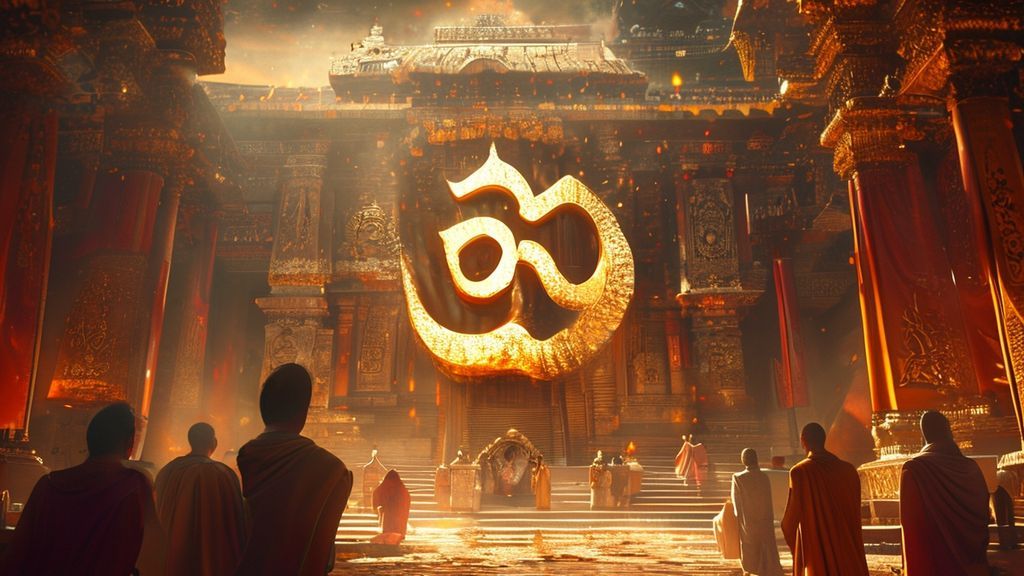
Om Symbol in a dream is a profound spiritual message, signaling a deep connection to the divine consciousness and a call for introspection. It signifies spiritual awakening, inner peace, and the harmonious alignment of one’s being with the cosmic vibration. Such a sacred vision often indicates an auspicious turning point, guiding the devotee towards deeper meditation, self-realization, and a path of enhanced spiritual practice.
| Attribute | Details |
|---|---|
| Symbolic Representation | Praṇava (प्रणव), the primordial sound; union of the three states of consciousness (waking, dreaming, deep sleep) with Turiya (transcendental state). |
| Deity/Concept | Brahman (Saguna and Nirguna), Ishvara, the Universal Self, Cosmic Vibration. |
| Key Significance in Dream | Spiritual awakening, divine guidance, inner peace, an auspicious sign, call to meditation and self-realization, protection. |
| Scripture References | Mandukya Upanishad, Katha Upanishad, Chāndogya Upanishad, Bhagavad Gita (Chapter 8, Verse 13), Yoga Sutras of Patanjali (I.27-29). |
| Associated Practice | Japa (chanting), Dhyana (meditation), Nada Yoga, self-inquiry (Ātma Vichāra). |
The Primordial Echo: Understanding the Om Symbol in a Dream
The syllable Om (ॐ), also known as Praṇava, is the most sacred sound in Sanatan Dharma, revered as the sound of the universe, the essence of all existence, and the ultimate reality, Brahman. To witness the Om symbol in a dream is not a mere subconscious flicker but a profound spiritual communication, a direct message from the cosmic intelligence. It is a moment of deep significance, inviting the dreamer to attune to higher spiritual truths and embrace the path of self-discovery. This divine vision is a testament to an individual’s spiritual readiness and an auspicious omen of profound inner transformation. For those seeking deeper insights into such sacred experiences, Hindutva.online offers extensive resources on Sanatan Dharma.
Puranic History and Vedantic Significance of Om
The origins and profound meaning of Om are deeply embedded in the bedrock of Vedic literature and subsequent philosophical traditions. The Mandukya Upanishad, a concise yet profound text, is entirely dedicated to unraveling the mystery of Om. It declares, “Om ity etad akṣaram idaṁ sarvaṁ” – “The syllable Om is the imperishable; this all is that.” This Upanishad meticulously dissects Om into its three phonetic components (A-U-M) and the silent fourth state, linking them to the four states of consciousness: A for the waking state (Vaiśvānara), U for the dreaming state (Taijasa), M for the deep sleep state (Prājña), and the silent pause, the amātra, representing Turiya, the transcendental, non-dual consciousness beyond all states.
The Katha Upanishad affirms Om as the highest Brahman, stating, “This syllable Om is indeed the lower Brahman and the higher Brahman. Whoever meditates on this syllable, having known its meaning, attains all that he desires.” Lord Krishna Himself declares in the Bhagavad Gita (Chapter 8, Verse 13), “Om ityekākṣaraṁ Brahma vyāharan mām anusmaran yaḥ prayāti tyajan dehaṁ sa yāti paramāṁ gatim” – “Uttering the single syllable Om, the eternal Brahman, and remembering Me, one who departs leaving the body attains the supreme goal.” This unequivocally establishes Om as the direct path to the divine.
In the Yoga Sutras of Patanjali (I.27), Om is referred to as “tasya vācakaḥ praṇavaḥ” – “Its designator (of Ishvara) is the mystic sound Om.” Patanjali further elaborates (I.28), “Its constant repetition and meditation on its meaning leads to the realization of the inner consciousness and the removal of obstacles.” Thus, across Vedas, Upanishads, and Yoga Shastras, Om is consistently presented as the sonic form of the Absolute, the primordial vibration from which the entire cosmos manifested, and the ultimate tool for liberation.
The Cosmic Architecture and Sonic Science of Om
The visual representation of the Om symbol is not arbitrary but a profound architectural diagram of cosmic reality and human consciousness. The three curves, the semi-circle, and the dot each hold specific significance:
- The lower curve represents the waking state (Jagrat), the consciousness active in the external world.
- The middle curve symbolizes the dreaming state (Swapna), where consciousness experiences a subtle inner world.
- The upper curve signifies the deep sleep state (Sushupti), a state of undifferentiated consciousness, devoid of dreams or desires.
- The semi-circle above the curves represents Maya, the veil of illusion that separates the individual consciousness from the absolute. It implies that only by transcending Maya can one reach the highest state.
- The dot, positioned above the semi-circle, symbolizes Turiya, the fourth state of pure consciousness, absolute peace, and non-duality, unconditioned by the other three states and unaffected by Maya. It is the ultimate goal of spiritual realization.
From a scientific perspective, particularly in the realm of Nada Yoga (the yoga of sound), the chanting of Om is recognized for its profound physiological and psychological effects. The vibration of A-U-M resonates through different parts of the body, from the abdomen (A) to the chest (U) and head (M), creating a harmonious internal environment. This sonic architecture helps to align the body’s energy centers (chakras), calm the nervous system, and induce a state of deep meditative peace, fostering mental clarity and emotional balance. The sustained resonance helps in withdrawing the senses (Pratyahara) and concentrating the mind (Dharana), leading towards deeper meditative states (Dhyana).
Rituals and Puja Vidhi Following an Om Dream
Encountering the Om symbol in a dream is a sacred event that calls for a mindful response. It is not an ordinary dream but a powerful spiritual impetus.
- Introspection and Reflection: Upon waking, spend time in quiet contemplation. Reflect on the circumstances of the dream, your feelings, and any accompanying symbols. This introspection helps decipher the personal message the divine is conveying.
- Dedicated Om Japa (Chanting): Begin or intensify your daily practice of chanting Om. Sit in a comfortable meditative posture, close your eyes, and slowly, with full awareness, chant A-U-M. Focus on the vibration, its origin within you, and its expansion into the cosmos. Aim for 108 repetitions (one mala) each morning and evening.
- Deeper Meditation (Dhyana): Integrate the meaning of Om into your meditation. Visualize the symbol, feel its vibration, and contemplate its connection to Brahman and Turiya. Seek to transcend the three states of consciousness and experience the silent fourth.
- Satsang and Scriptural Study: Engage in spiritual company (satsang) and deepen your study of the Upanishads, particularly the Mandukya Upanishad, to further understand the profound meaning of Om.
- Offering Gratitude: Express heartfelt gratitude to the Divine for this auspicious vision. This can be done through silent prayer, a simple offering of flowers or incense, or by dedicating your spiritual practices.
- Seek Guru’s Guidance (if applicable): If you have a spiritual preceptor, share your dream with them. A Guru’s insight can provide deeper understanding and tailored guidance for your spiritual journey.
Mantras and Chants for Contemplation
The most direct mantra is Om itself. However, integrating Om with other sacred chants can deepen its effect.
- Basic Om Chanting:
ॐ (Om)
Chant it slowly, focusing on the distinct sounds A-U-M and the silent resonance.
- Om Shanti Om:
ॐ शान्ति शान्ति शान्तिः (Om Shanti Shanti Shantihi)
A chant for universal peace, peace of mind, peace of speech, and peace of body.
- From the Brihadaranyaka Upanishad (a prayer for truth):
ॐ असतो मा सद्गमय ।
तमसो मा ज्योतिर्गमय ।
मृत्योर्मा अमृतं गमय ॥
ॐ शान्तिः शान्तिः शान्तिः ॥
Om Asato Ma Sadgamaya, Tamaso Ma Jyotirgamaya, Mrtyorma Amritam Gamaya. Om Shanti Shanti Shantihi.
Lead me from the unreal to the real. Lead me from darkness to light. Lead me from death to immortality. Om peace, peace, peace.
- Gayatri Mantra (often prefixed with Om):
ॐ भूर्भुवः स्वः
तत्सवितुर्वरेण्यं
भर्गो देवस्य धीमहि
धियो यो नः प्रचोदयात् ॥
Om Bhur Bhuvah Swah, Tat Savitur Varenyam, Bhargo Devasya Dhimahi, Dhiyo Yo Nah Prachodayat.
We meditate on the glorious splendor of the Vivifier Divine. May He Himself enlighten our minds.
Dos and Don’ts After an Om Dream
- Dos:
- Do engage in regular meditation and Om chanting.
- Do reflect deeply on the dream’s meaning for your personal spiritual path.
- Do maintain purity of thought, word, and deed.
- Do seek guidance from a qualified spiritual teacher if you feel overwhelmed or unsure.
- Do express gratitude for this divine communication.
- Don’ts:
- Don’t dismiss the dream as mere fantasy; treat it with reverence.
- Don’t boast about the dream or seek material gain from it.
- Don’t ignore the spiritual call to deepen your practice.
- Don’t attribute it to superstition or fear; it is a benevolent sign.
- Don’t neglect your regular duties, but integrate this new spiritual energy into your life.
What does “Om” represent in Sanatan Dharma?
Om represents the entire cosmos, the sound of creation, preservation, and dissolution. It is the verbal symbol of Brahman, the ultimate reality, encompassing all states of consciousness (waking, dreaming, deep sleep) and transcending them into the absolute Turiya state. It is the root mantra from which all other mantras emerge.
Is dreaming of Om always auspicious?
Yes, dreaming of the Om symbol is overwhelmingly considered auspicious in Sanatan Dharma. It is a powerful message of spiritual progress, divine blessings, protection, and a clear indication that one is aligning with their higher spiritual purpose. It often signifies inner peace, the overcoming of obstacles, and a call to deepen one’s meditative and spiritual practices.
How can I incorporate Om into my daily life after such a dream?
Beyond formal meditation, you can integrate Om by softly chanting it before starting any task, dedicating moments throughout the day for silent Om japa, using it to begin and end your prayers, or even visualizing the symbol for mental clarity. Carrying a small Om pendant or having the symbol in your puja altar can also serve as a constant reminder of its sacred presence and your spiritual commitment.
What is the difference between AUM and Om?
AUM and Om refer to the exact same sacred sound. AUM explicitly breaks down the three phonetic components (A-kara, U-kara, M-kara) that correspond to the three states of consciousness (waking, dreaming, deep sleep) and the three Gunas (Sattva, Rajas, Tamas). “Om” is the simplified, unified term that implicitly contains these three components, along with the silent fourth state (Turiya) which is beyond all sound and form. Both terms refer to the Praṇava, the primordial vibration.
Embracing Praṇava: Why This Matters for Every Hindu
To dream of the sacred Om is to receive a profound benediction, a direct communication from the anadi (beginningless) and ananta (endless) consciousness that pervades all. This experience is a powerful affirmation of one’s spiritual journey, a gentle yet firm nudge towards deeper self-realization and connection with the Brahman. For every Hindu, understanding and integrating the essence of Om is not merely an intellectual exercise but a living practice that safeguards and perpetuates the eternal wisdom of Sanatan Dharma. It is a reminder that the universe itself is a manifestation of divine sound, and by aligning ourselves with this sound, we align with our true, immortal Self. This sacred vision serves as a beacon, guiding us to transcend the transient and realize the immutable truth within, fortifying our spiritual foundations and ensuring the continuity of our dharma. For further exploration of such profound topics, we encourage devotees to visit Hindutva.online and delve into our extensive collection of scholarly articles.
