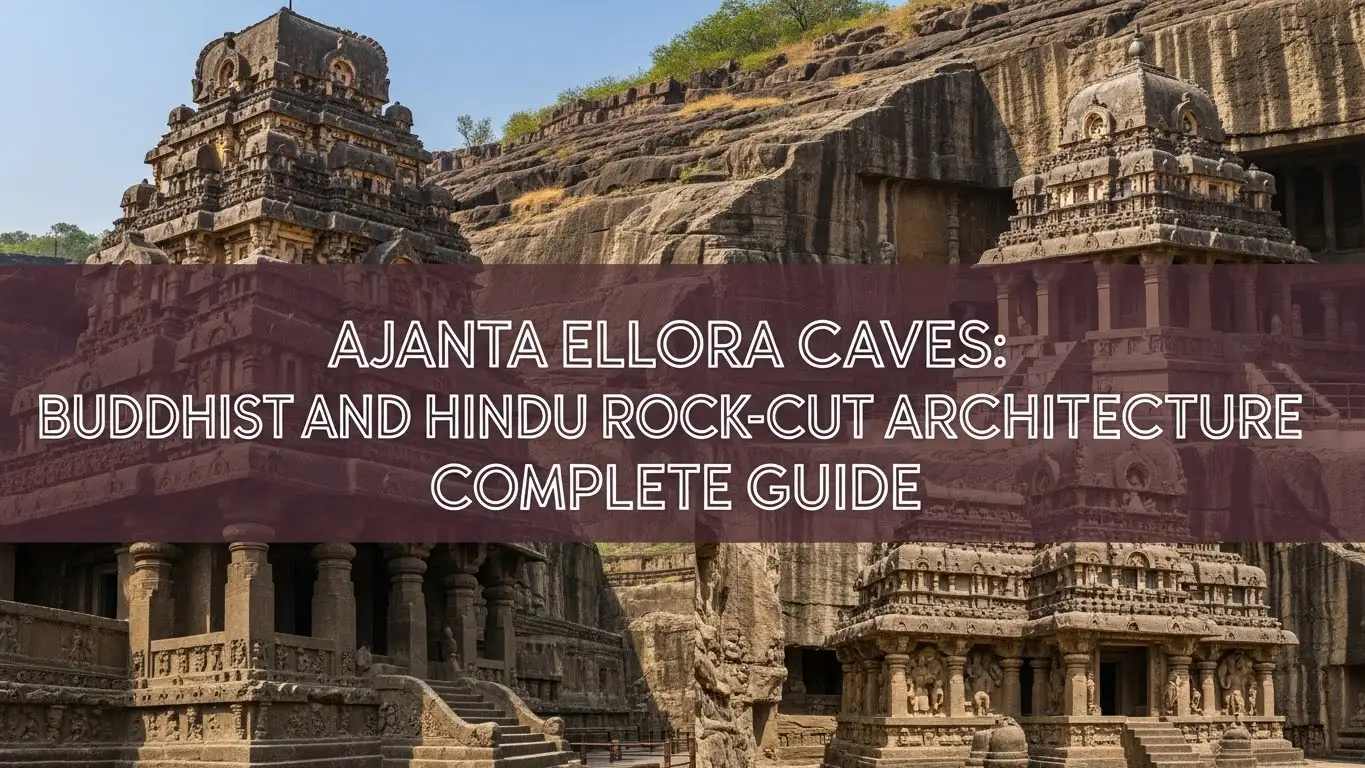
The Ajanta Ellora Caves represent the pinnacle of ancient Indian rock-cut architecture, designated separate UNESCO World Heritage Sites in 1983 for their outstanding universal value as masterpieces of human creative genius and exceptional testimony to vanished civilizations. Located approximately 100 kilometers apart in Maharashtra’s Aurangabad district, these two cave complexes tell distinct yet complementary stories—Ajanta’s 30 Buddhist caves (2nd century BCE to 5th century CE) showcase exquisite murals depicting Jataka tales, while Ellora’s 34 caves (6th to 12th century CE) demonstrate unprecedented religious coexistence with Buddhist, Hindu (Brahmanical), and Jain monuments carved side-by-side.
Ellora’s crowning achievement, the monolithic Kailasa Temple (Cave 16), carved from a single basalt cliff with over 200,000 tonnes of rock removed, stands as “the climax of the rock-cut phase of Indian architecture” and one of the world’s largest monolithic structures.
These caves demonstrate sophisticated subtractive architecture—entire monastery complexes, temples, sculptures, and paintings created by removing rock rather than adding building materials, requiring artisans to visualize finished structures within raw cliff faces before beginning the painstaking carving process. The technical mastery, artistic excellence, and spiritual devotion embodied in these monuments reveal dimensions of ancient Indian civilization that illuminate Hindu philosophy, Buddhist teachings, and Jain principles through stone and pigment rather than text. This comprehensive guide explores both cave complexes’ history, architecture, artistic treasures, and practical visiting information for 2026.
Ajanta Caves: Buddhist Masterpieces and Magnificent Murals
Historical Development: Two Distinct Phases
The Ajanta Caves comprise 30 monuments carved into a horseshoe-shaped cliff along the Waghora River gorge, created in two distinct chronological phases separated by approximately 600 years. This discontinuous development reflects changing Buddhist practices, artistic styles, and patronage patterns across centuries of Indian history.
Phase One (2nd-1st Century BCE): The earliest caves (9, 10, 12, 13, and 15A) were created during the Satavahana Dynasty’s reign, representing early Buddhist Hinayana (Theravada) tradition emphasizing the Buddha’s teachings rather than his worship. These austere caves functioned as viharas (monasteries) and chaitya-grihas (prayer halls) with minimal decoration, focusing on simplicity and meditation conducive to monastic life. The architecture features characteristic apsidal shapes, naves, aisles, and apses reminiscent of cathedral plans developed in Europe many centuries later.
Cave 10, the oldest surviving chaitya hall, contains a row of 23 pillars supporting a vaulted ceiling with a stupa at the apse’s center and circumambulation path around it. The stupa sits on a high cylindrical base, with votaries depicted approaching it on the left wall, suggesting established devotional traditions. This cave’s stark beauty emphasizes architectural form over decorative embellishment, creating contemplative spaces for Buddhist practice.
Phase Two (5th Century CE, Gupta Period): The majority of Ajanta caves (1-8, 11, 14-29) were created during the late 5th century CE, possibly under Vakataka King Harisena’s patronage. These caves represent Mahayana Buddhism, which incorporated deity worship, elaborate rituals, and sophisticated theological developments. This later phase produced the magnificent murals and sculptures for which Ajanta is world-famous, transforming the caves into comprehensive visual encyclopedias of Buddhist philosophy, cosmology, and narrative art.
The cave construction mysteriously ceased around 480 CE, possibly due to political upheaval, Harisena’s death, or shifts in patronage. Despite 7th-century accounts from Chinese pilgrim Xuanzang describing the caves and evidence of medieval-era use through graffiti, the Buddhist community eventually abandoned the site. The caves remained hidden, concealed by dense jungle vegetation, until their dramatic rediscovery in 1819 by British officer John Smith during a tiger hunting expedition.
The Ajanta Murals: Ancient India’s Artistic Treasures
The Ajanta cave paintings rank among the earliest and most significant examples of Indian art, executed using sophisticated fresco techniques on prepared cave walls and ceilings. These murals demonstrate extraordinary artistic achievement in composition, color theory, perspective, emotional expression, and narrative storytelling that rivals contemporary artistic traditions anywhere in the ancient world.
Technical Execution: Artists prepared walls by applying multiple layers—first a rough coat of mud mixed with rock-grit, then finer clay and cow dung, followed by a smooth lime plaster surface. Pigments derived from natural minerals and plants were applied while the plaster remained wet, creating durable bonds that have survived over 1,500 years despite humidity, water seepage, and environmental challenges.
Primary Subjects – Jataka Tales: The predominant subject matter comprises Jataka tales documenting the Buddha’s previous incarnations as animals, humans, and celestial beings across hundreds of lifetimes. These narratives embed ancient moral teachings, cultural lore, and ethical principles found in Hindu and Jain texts as well, demonstrating shared cultural foundations across Indian religious traditions. The stories exemplify the Buddha’s sacrifices and spiritual development across incarnations, illustrating the path toward enlightenment through specific life examples.
Artistic Excellence: The murals demonstrate remarkable ability to express emotions through pose, form, and gesture. Figures display subtle facial expressions, graceful body positions, and dynamic movement that convey psychological states and narrative tension. The artists employed sophisticated compositional techniques including overlapping figures to suggest depth, varied scale to indicate importance, and visual flow directing viewers’ attention through complex narrative scenes.
Notable Cave Paintings:
- Cave 1: Contains spectacular murals including the famous Padmapani (lotus-bearing Bodhisattva) and Vajrapani figures flanking the Buddha
- Cave 2: Features elaborate ceiling decorations with geometric and floral motifs
- Cave 16: Showcases the “Dying Princess” scene depicting profound grief
- Cave 17: Contains the largest and most diverse collection of Jataka tale illustrations
The color palette employed natural pigments: white from lime, black from soot, red and yellow from ochres, blue from lapis lazuli imported via trade networks, green from copper-based minerals. The survival of these vibrant colors across centuries testifies to ancient Indian artists’ sophisticated material knowledge and technical mastery.
Ellora Caves: Multi-Faith Architectural Symphony
Ajanta Ellora Caves Religious Coexistence in Stone
The Ellora complex contains 34 caves extending over 2 kilometers along the Charanandri Hills’ basalt cliff, representing an unprecedented sequence of Buddhist, Hindu (Brahmanical), and Jain religious monuments carved side-by-side. This remarkable proximity demonstrates the spirit of religious tolerance and coexistence that characterized medieval Indian civilization, where competing faiths could flourish simultaneously without violent sectarian conflict.
The caves divide into three groups:
- Caves 1-12: Buddhist (6th-7th century CE)
- Caves 13-29: Hindu/Brahmanical (7th-9th century CE)
- Caves 30-34: Jain (9th-12th century CE)
This chronological and religious sequence spans approximately 600 years of continuous rock-cutting activity from AD 600 to 1200, making Ellora a unique architectural palimpsest documenting evolving religious practices and artistic styles.
Buddhist Caves (1-12): Monastic Complexes
The Buddhist caves primarily consist of viharas (monasteries) designed for monastic residence, study, and meditation. Unlike Ajanta’s predominantly painted caves, Ellora’s Buddhist caves emphasize architectural space and sculptural decoration. Cave 10 (Vishvakarma Cave), the only Buddhist chaitya-griha at Ellora, features a vaulted ceiling, elaborate facade, and multi-story design demonstrating advanced architectural planning.
Cave 12 (Tin Thal), the largest Buddhist excavation, comprises three stories with numerous cells for monks and assembly halls for teaching and ritual. The declining emphasis on painting at Ellora compared to Ajanta reflects shifting Buddhist artistic preferences and possibly the challenges of preserving paintings in Ellora’s more exposed basalt environment.
Hindu Caves (13-29): Mythological Grandeur
The Hindu caves showcase Brahmanical (Hindu) mythology through elaborate sculptural programs depicting Shiva, Vishnu, their various incarnations, consorts, attendants, and narrative episodes from Puranic texts. These caves transform theological concepts into three-dimensional stone narratives accessible to devotees regardless of literacy.
Notable Hindu caves include:
- Cave 14 (Ravana ki Khai): Features Shiva, Vishnu, and Durga with their attendants
- Cave 15 (Dashavatara): Depicts Vishnu’s ten incarnations with elaborate architectural planning
- Cave 21 (Rameshvara): Contains beautiful river goddess sculptures
Kailasa Temple (Cave 16): Monolithic Marvel
The Kailasa Temple stands as Ellora’s—and arguably India’s—most spectacular architectural achievement, carved from a single basalt cliff during the 8th century CE Rashtrakuta Dynasty under King Krishna I. Unlike other cave temples excavated horizontally into cliff faces, Kailasa was carved vertically from top to bottom, requiring removal of over 200,000 tonnes of rock in a “cut-and-carve” technique.
Architectural Specifications:
- Height: 32.6 meters (107 feet) above courtyard level
- Ground Plan: Approximately 50 meters long by 33 meters wide
- Construction Method: Top-down excavation beginning from cliff summit
- Rock Removed: Over 200,000 tonnes through decades of continuous labor
- Structure: Three-story freestanding temple complex carved from living rock
Engineering Process: Artisans first isolated a massive rock block by cutting three deep trenches around its perimeter, then systematically carved downwards using chisels, hammers, and picks. This top-down approach allowed precise planning of the multi-story structure, ensuring roof and upper levels were completed before lower sections. The sequential removal demanded exceptional foresight and coordination, with sculptors visualizing the finished temple within raw stone before beginning work.
Architectural Elements: The temple replicates complex timber and masonry architectural forms—multi-tiered shikhara (spire), intricate column capitals, simulated roof tiles, freestanding Nandi mandapa (pavilion), subsidiary shrines, gateway structures—all carved from bedrock. This fusion of architectural design with sculptural execution represents the pinnacle of Indian rock-carving artistry, creating an entire temple complex including surrounding courtyard from a single geological feature.
Mythological Program: The extensive sculptural decoration depicts Shaivite legends including Ravana shaking Mount Kailasa (Shiva’s Himalayan abode), Shiva and Parvati narratives, and various manifestations of divine power. The audacious conception—recreating the cosmic Mount Kailasa itself in stone—reflects the Rashtrakuta dynasty’s imperial ambitions and the civilization’s capacity for monumental artistic expression.
Construction Timeline: Contrary to popular myths suggesting centuries of work, scholarly consensus indicates the temple was completed in approximately 18 years, not 100 years, though this still represents an extraordinary achievement. The rapid completion required massive coordinated labor forces working simultaneously on different sections.
Jain Caves (30-34): Ascetic Elegance
The Jain caves, though smaller than Buddhist and Hindu counterparts, display refined sculptural work and architectural planning. These caves were excavated during the 9th-12th centuries when Jainism enjoyed royal patronage in the Deccan region.
Important Jain Shrines:
- Cave 30 (Chhota Kailash): Miniature version of the Kailasa Temple
- Cave 32 (Indra Sabha): Most elaborate Jain cave with 13 excavations
- Cave 33 (Jagannath Sabha): Contains beautiful Jain tirthankar sculptures
- Cave 34: Small cave accessed through opening in Cave 33’s left side
The Jain caves emphasize ascetic simplicity balanced with refined artistry, reflecting Jain philosophical principles of non-attachment combined with appreciation for beauty as expression of devotion and respect for tirthankaras (enlightened teachers).
Visiting Information: Timings, Fees, and Practical Details (2026)
Ajanta Caves:
Ellora Caves:
Important Visiting Guidelines:
Photography Restrictions: While photography is generally permitted with paid fees, flash photography is strictly prohibited inside caves to protect delicate murals and paintings from light damage. Some caves may have complete photography bans; respect all signage.
Best Times to Visit:
- Early Morning (6:00-9:00 AM at Ellora): Fewer crowds; excellent natural lighting
- Late Afternoon (3:00-5:00 PM): Golden hour photography opportunities
- Avoid Midday: Intense heat makes exploration uncomfortable; harsh lighting reduces photography quality
Footwear and Dress: Remove shoes before entering certain caves. Wear comfortable walking shoes for extensive exploration. Modest clothing recommended for religious sites.
Physical Considerations: Both sites involve considerable walking, stair climbing, and navigation of uneven surfaces. Carry water, wear comfortable shoes, and pace yourself. The Ajanta caves require a mandatory shuttle bus from parking to the cave entrance due to the gorge location.
Guided Tours Recommended: While self-exploration is possible, hiring licensed guides significantly enhances understanding of artistic, architectural, and historical contexts. Guides provide fascinating stories, point out easily missed details, and explain symbolic meanings that transform visits from sightseeing to genuine cultural education.
Time Allocation:
- Ajanta: Minimum 3-4 hours for meaningful exploration of major caves
- Ellora: Minimum 4-5 hours; full day recommended for comprehensive coverage including Kailasa Temple detailed study
- Both Sites: Ideally allocate 2 days (one for each complex) for unhurried, in-depth experience
How to Reach Ajanta and Ellora from Aurangabad
Aurangabad serves as the base city for visiting both cave complexes, located approximately 100 km from Ajanta and 30 km from Ellora. The city offers excellent accommodation, restaurants, and travel services facilitating multi-day exploration.
Reaching Aurangabad
By Air: Aurangabad Airport (Chikkalthana Airport) connects to major Indian cities including Mumbai, Delhi, Bangalore, and Hyderabad. From the airport:
Hire prepaid taxis or arrange hotel pickups. Booking airport transportation in advance, especially during peak season, ensures smooth transfers.
By Train: Aurangabad Railway Station connects to Mumbai, Hyderabad, Delhi, and other major cities. From the station, Ellora is about 30 km and Ajanta approximately 100 km away.
By Road: Aurangabad enjoys excellent road connectivity:
- Mumbai to Aurangabad: 335 km (6-7 hours)
- Pune to Aurangabad: 230 km (4-5 hours)
- State-run MSRTC and private operators offer regular bus services
Aurangabad to Ajanta Caves
Distance: Approximately 100-107 km
Travel Time: 2-2.5 hours via NH 753F
Transportation Options:
- Private Car/Taxi: ₹1,500-2,500 for round trip including waiting time
- Bus: MSRTC and private buses (₹500-4,500 per person depending on bus type)
- Organized Tours: Many operators offer Ajanta day tours from Aurangabad
The route passes through scenic landscapes, ancient temples, and rural Maharashtra villages, making the journey itself worthwhile.
Aurangabad to Ellora Caves
Distance: 30-31.5 km
Travel Time: 45 minutes to 1 hour
Transportation Options:
- Private Taxi: ₹1,500-1,800 for round trip
- Bus: MSRTC buses available (approximately ₹550 per person)
- Auto-rickshaw: Available for negotiated fares
Recommended Route: Via Aurangabad-Malegaon Road/Aurangabad-Nashik Highway/NH 752H passing by Daulatabad Fort, allowing combined sightseeing. The fort, a magnificent medieval fortification with fascinating history, makes an excellent addition to Ellora visits.
Combined Visiting Strategy
Option 1 – Two Separate Days (Recommended):
- Day 1: Ellora Caves (6:00 AM – 2:00 PM) + Daulatabad Fort (afternoon)
- Day 2: Ajanta Caves (full day, 9:00 AM – 5:00 PM)
Option 2 – Combined Single Day (Rushed):
- Early morning: Ellora Caves (6:00-10:00 AM)
- Afternoon: Travel to and explore Ajanta (12:00-5:00 PM)
- Note: This provides insufficient time for meaningful appreciation; not recommended for art and history enthusiasts
Best Time to Visit (2026)
Winter (October to March) represents the optimal visiting season for both Ajanta and Ellora with pleasant temperatures (15-30°C), clear skies, and comfortable conditions for extensive outdoor exploration. The winter months enable full-day cave visits without heat exhaustion concerns.
Month-by-Month Guide:
October-February (Peak Season):
- Perfect weather for photography and sightseeing
- Clear visibility enhances mural appreciation
- Comfortable temperatures for walking and stair climbing
- Book accommodation well in advance
- Expect larger crowds, especially weekends and holidays
March-May (Summer):
- Very hot (35-45°C); early morning visits essential
- Afternoon heat makes exploration extremely uncomfortable
- Fewer tourists; more peaceful contemplative experience
- Significant discounts on accommodation
- Carry ample water and sun protection
June-September (Monsoon):
- Moderate to heavy rainfall
- Lush green landscapes surround caves beautifully
- Enhanced waterfall activity near cave entrances
- Risk of transportation disruptions
- Humidity may affect comfort levels
- Minimal crowds; intimate exploration opportunities
January 2026 falls within the ideal visiting window, offering excellent conditions for comprehensive exploration of both cave complexes with pleasant weather conducive to photography, detailed mural study, and comfortable multi-hour visits.
Frequently Asked Questions
What is the difference between Ajanta and Ellora?
Ajanta contains 30 exclusively Buddhist caves (2nd century BCE to 5th century CE) famous for exquisite murals depicting Jataka tales. Ellora has 34 caves (6th-12th century CE) representing Buddhist, Hindu, and Jain religions carved side-by-side, emphasizing sculpture over paintings. Ellora’s Kailasa Temple is a monolithic marvel carved top-down from a single cliff. The sites are approximately 100 km apart.
What are the visiting timings and entry fees?
Ajanta opens 9:00 AM – 5:00 PM (closed Mondays) with ₹40 entry for Indians and ₹600 for foreign tourists. Ellora operates 6:00 AM – 6:00 PM (closed Tuesdays) with identical entry fees. Children under 15 enter free. Camera fees are ₹25 for still photography. Guided tours cost ₹1,800 for groups up to 5 people.
How do I reach Ajanta and Ellora from Aurangabad?
Aurangabad serves as the base city. Ellora is 30 km away (45 minutes-1 hour by taxi ₹1,500-1,800 or bus ₹550). Ajanta is 100 km away (2-2.5 hours by taxi ₹1,500-2,500 or bus ₹500-4,500). Taxis, buses, and organized tours are available. Visiting both sites comfortably requires two separate days.
What is special about Kailasa Temple?
Kailasa Temple (Ellora Cave 16) is the world’s largest monolithic structure carved from a single basalt cliff. Built top-down rather than excavated horizontally, it required removing over 200,000 tonnes of rock. The three-story temple rises 32.6 meters (107 feet) and was completed in approximately 18 years during the 8th century Rashtrakuta period. It represents “the climax of the rock-cut phase of Indian architecture”.
Can I see both caves in one day?
While technically possible, visiting both complexes in one day provides insufficient time for meaningful appreciation. Ajanta requires 3-4 hours minimum; Ellora needs 4-5 hours. Combined with travel time (2+ hours each way for Ajanta), a single-day visit becomes rushed and exhausting. Two separate days recommended—one for Ellora (with Daulatabad Fort), another for Ajanta—enabling unhurried exploration and genuine cultural engagement.
Why are the Ajanta murals significant?
The Ajanta murals rank among India’s earliest and finest cave paintings (5th century CE), demonstrating extraordinary artistic mastery in composition, color theory, perspective, and emotional expression. They predominantly depict Jataka tales narrating the Buddha’s previous incarnations. The paintings’ survival for over 1,500 years despite environmental challenges testifies to ancient Indian artists’ sophisticated technical knowledge. They provide invaluable insights into Gupta-period culture, fashion, and daily life.
What should I bring when visiting?
Essential items: comfortable walking shoes, water bottles, sun protection (hat, sunscreen), camera with extra batteries/memory cards, modest clothing, light jacket for early morning Ellora visits. Prohibited: flash photography inside caves, tripods at certain locations, large bags in some caves. Carry minimal belongings as extensive walking and stair climbing required. Hire licensed guides for enhanced understanding (₹1,800 for groups up to 5).
When is the best time to visit?
October to March (winter) offers ideal conditions with pleasant temperatures (15-30°C), clear skies, and comfortable weather for extensive exploration. January 2026 falls within this optimal period. Summer (March-May) is extremely hot; monsoon (June-September) brings rain but lush landscapes. Winter is peak season; book accommodation in advance and expect larger crowds, especially weekends.
Conclusion
The Ajanta and Ellora Caves stand as monumental testimonies to ancient Indian civilization’s artistic genius, architectural innovation, and spiritual depth—rock-cut sanctuaries where Buddhist monks meditated, Hindu devotees worshipped, and Jain ascetics practiced austerities across nearly 1,500 years of continuous religious activity. Ajanta’s magnificent murals preserve Buddhist narratives with artistic sophistication rivaling any contemporary civilization, while Ellora’s unprecedented multi-faith sequence demonstrates the religious tolerance and coexistence that characterized medieval India at its finest.
The Kailasa Temple represents humanity’s audacious ambition to recreate cosmic Mount Kailasa itself through subtractive architecture, removing over 200,000 tonnes of living rock to manifest divine vision in monolithic stone. This engineering and artistic achievement—completing a three-story temple complex carved top-down from a single cliff in approximately 18 years—testifies to the Rashtrakuta dynasty’s resources, organizational capabilities, and the civilization’s commitment to expressing spiritual truths through permanent architectural forms.
These UNESCO World Heritage Sites reward genuine engagement with experiences transcending ordinary tourism—standing before 1,500-year-old murals whose colors remain vibrant, walking through monasteries where Buddhist monks chanted sutras, encountering Shiva sculptures emerging from living rock, and contemplating the collective human effort required to create these sanctuaries across generations. The caves embody Hindu philosophy, Buddhist teachings, and Jain principles not through abstract texts but through accessible visual narratives that speak across centuries to contemporary visitors seeking connections to India’s profound spiritual heritage.
Visiting in 2026 requires straightforward planning—base yourself in Aurangabad, allocate two days (one per complex), hire knowledgeable guides, and approach with curiosity and reverence for the extraordinary civilizations that created these imperishable masterpieces.
About the Author
Aryan Mishra – Cultural Heritage & Temple Architecture Specialist
Aryan Mishra is an accomplished writer and researcher specializing in Hindu festivals, temple architecture, and India’s rich cultural traditions. With a Master’s degree in Indian Art History from Maharaja Sayajirao University, she has extensively documented pilgrimage sites, temple iconography, and folk traditions across India. Her work focuses on making India’s spiritual heritage accessible to contemporary audiences while preserving authentic cultural narratives.