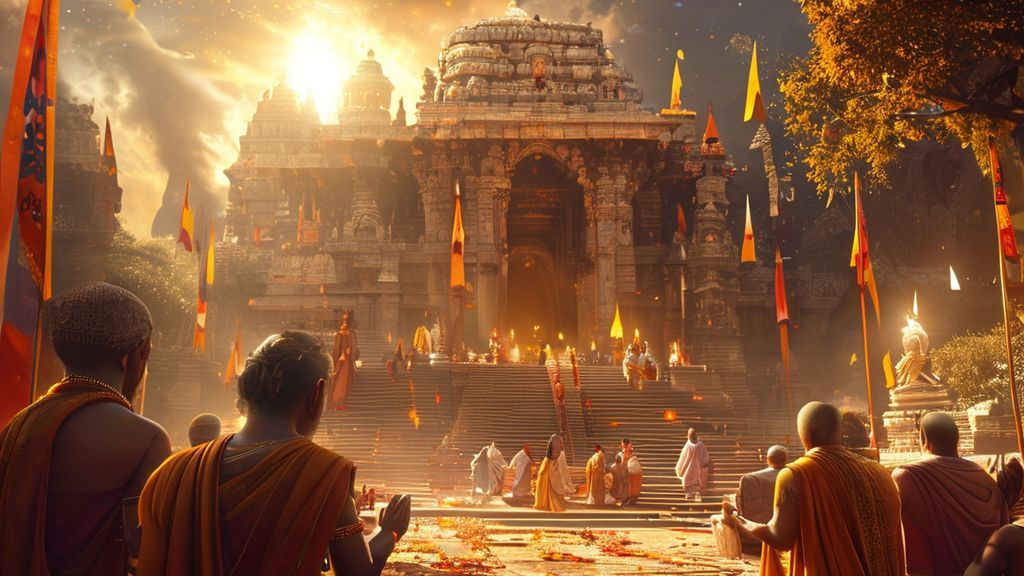
The Bhagavad Gita, often called the “Song of God,” is a profound 700-verse scripture forming a pivotal dialogue between Bhagavan Sri Krishna and Arjuna on the battlefield of Kurukshetra. It encapsulates the essence of Vedic wisdom, meticulously outlining the paths of Karma Yoga, Jnana Yoga, and Bhakti Yoga across its eighteen chapters to guide humanity towards ultimate liberation and righteous living.
| Attribute | Details |
|---|---|
| Deity / Speaker | Bhagavan Sri Krishna (Vishnu’s Avatar) |
| Recipient / Seeker | Arjuna (Pandava Prince) |
| Origin Context | Kurukshetra Battlefield, just before the Mahabharata War |
| Key Festival | Gita Jayanti (Margashirsha Shukla Ekadashi) |
| Scripture Reference | Mahabharata (Bhishma Parva, Chapters 25-42) |
| Core Message | Dharma, Karma Yoga, Jnana Yoga, Bhakti Yoga, Moksha |
The Eternal Song: An Introduction to Bhagavad Gita
The Bhagavad Gita (भगवद् गीता), an integral part of the epic Mahabharata, stands as a timeless beacon of spiritual wisdom, guiding seekers through the complexities of life, duty, and ultimate reality. It is not merely a philosophical treatise but a practical manual for living a righteous and purposeful life, delivered by the Supreme Lord Sri Krishna Himself. On the precipice of the devastating Kurukshetra War, as Arjuna, the mighty warrior, succumbed to despondency, Krishna, his charioteer and divine friend, unveiled profound truths that transcend time and culture. This divine discourse, preserved for millennia, offers solace, clarity, and the ultimate path to liberation (Moksha) for all humanity. For sincere devotees, the Gita is the very breath of Sanatan Dharma, offering unassailable logic and heartfelt devotion.
The Divine Setting: Puranic History & Legend
The narrative of the Bhagavad Gita unfolds dramatically in the Mahabharata, specifically within the Bhishma Parva, just before the commencement of the cataclysmic war between the Pandavas and Kauravas. Arjuna, renowned for his valor, stands aghast at the prospect of fighting his own relatives, gurus, and friends. Overwhelmed by grief and moral dilemma, he expresses his reluctance to fight, questioning the very purpose of such a war that would lead to immense suffering and the destruction of familial bonds (Kuladharma). This moment of profound crisis, described in the first chapter (Arjuna-Vishada Yoga), provides the perfect backdrop for Bhagavan Sri Krishna to deliver His transcendental message. As the Yogeshwara, the Lord of all Yoga, Krishna patiently addresses Arjuna’s doubts, moving from the immortality of the soul to the intricate mechanics of action, devotion, and knowledge, thereby establishing the foundation of all righteous conduct and spiritual realization. This divine dialogue is recounted by Sanjaya to Dhritarashtra, highlighting its universal import beyond the immediate battlefield.
The Bhagavad Gita’s Structural & Philosophical Marvel
The Bhagavad Gita is not an unstructured collection of verses; it is a meticulously organized spiritual masterpiece, a true marvel of literary and philosophical engineering. Its eighteen chapters are traditionally divided into three sections of six chapters each, mirroring the three principal paths to spiritual realization: Karma Yoga (Action), Bhakti Yoga (Devotion), and Jnana Yoga (Knowledge). The first six chapters primarily focus on the discipline of action without attachment, emphasizing the path of Karma Yoga and the nature of the individual soul (Jivatma). The middle six chapters elevate the discourse to the nature of the Supreme Lord (Paramatma), revealing Krishna’s divine opulence and establishing Bhakti Yoga as the most direct path to Him. The final six chapters delve into the intricate aspects of knowledge, discerning the field from the knower, the three modes of nature, and culminating in the supreme secret of surrender and ultimate liberation (Moksha Sanyasa Yoga). This tripartite structure ensures a progressive unfolding of spiritual truths, building from foundational principles to the highest mystical realizations, truly a testament to its profound design as a guide for all seekers on Hindutva.online.
The 18 Chapters: A Summary of Profound Wisdom
Chapter 1: Arjuna-Vishada Yoga (The Distress of Arjuna)
This chapter sets the stage, depicting Arjuna’s deep dejection and moral dilemma on the battlefield of Kurukshetra. Overwhelmed by the prospect of fighting his kinsmen and teachers, he expresses his reluctance to wage war, questioning the purpose and consequences of such a devastating conflict, laying bare his grief and confusion before Lord Krishna.
Chapter 2: Sankhya Yoga (The Yoga of Knowledge)
Krishna begins His divine discourse, asserting the immortality of the soul (Atman) and the ephemeral nature of the body. He introduces the concepts of Karma Yoga (action without attachment to results) and Buddhi Yoga (the yoga of intelligence), emphasizing equanimity in success and failure. This foundational chapter contains the essence of Sankhya philosophy, outlining the distinction between matter and spirit. “Na jayate mriyate va kadachin…” (The soul is never born nor dies).
Chapter 3: Karma Yoga (The Yoga of Action)
Addressing Arjuna’s confusion about action and inaction, Krishna elucidates the principle of selfless action. He declares that one must perform one’s prescribed duties (Svadharma) without attachment to their fruits, for inaction is impossible and performing action is superior to idleness. Action performed as a sacrifice for the greater good purifies the doer and avoids karmic bondage. “Niyatam kuru karma tvam…” (Perform your prescribed duty).
Chapter 4: Jnana-Karma-Sanyasa Yoga (The Yoga of Knowledge, Action, and Renunciation)
Krishna reveals the divine origin of this eternal science of Yoga, tracing its lineage through various sages. He explains the purpose of His periodic descents (Avataras) – to protect the righteous and annihilate the wicked. The importance of knowledge (Jnana) is emphasized, explaining that all actions culminate in true knowledge when performed with devotion and understanding.
Chapter 5: Karma-Sanyasa Yoga (The Yoga of Renunciation in Action)
This chapter reconciles the apparent contradiction between renunciation (Sanyasa) and action (Karma Yoga). Krishna clarifies that true renunciation is not the cessation of action, but the renunciation of the fruits of action. A Karma Yogi, acting without attachment, achieves the same peaceful liberation as a Sanyasi, realizing the oneness of the Self with Brahman.
Chapter 6: Dhyana Yoga (The Yoga of Meditation)
Krishna describes the practical methods for meditation and controlling the mind. He details the posture, environment, and mental discipline required for successful Dhyana Yoga, emphasizing the importance of a steady mind and detachment from all material desires to achieve self-realization and union with the Supreme Self.
Chapter 7: Jnana Vijnana Yoga (The Yoga of Knowledge and Realization)
The Lord reveals His supreme, all-pervading nature and the two energies (Prakriti) through which He sustains the universe – material and spiritual. He declares Himself as the ultimate truth, the source of everything, and describes four types of pious people who worship Him, as well as those who deluded, do not.
Chapter 8: Akshara Brahma Yoga (The Yoga of the Imperishable Brahman)
Arjuna questions Krishna about Brahman, Karma, and devotion at the time of death. Krishna explains the nature of the Supreme Absolute Truth (Akshara Brahman) and the importance of remembering Him at the moment of passing, assuring that one attains whatever state of being one remembers at the end of life. This chapter emphasizes the significance of constant remembrance of God.
Chapter 9: Raja Vidya Raja Guhya Yoga (The Yoga of the Sovereign Science and Secret)
Krishna unveils the most confidential knowledge (Raja Vidya Raja Guhya), describing His transcendental nature as the Supreme controller and the ultimate sustainer of the entire cosmic manifestation, yet remaining detached from it. He explains how devotional service (Bhakti) is the direct path to liberation, accessible to all, irrespective of birth.
Chapter 10: Vibhuti Yoga (The Yoga of Divine Opulences)
To deepen Arjuna’s understanding of His omnipresence, Krishna describes His countless divine opulences (Vibhutis) and manifestations throughout the universe. He states that wherever there is excellence, beauty, or power, it is but a spark of His own splendor, encouraging devotees to perceive Him in all aspects of existence.
Chapter 11: Vishwaroopa Darshana Yoga (The Yoga of the Universal Form)
At Arjuna’s earnest request, Krishna reveals His awe-inspiring universal form (Vishwaroopa) – a spectacular, all-encompassing vision of cosmic creation and destruction. Overwhelmed and terrified, Arjuna begs Krishna to return to His beautiful human form, witnessing the infinite power and majesty of the Supreme Lord.
Chapter 12: Bhakti Yoga (The Yoga of Devotion)
This chapter distinguishes between worshipping the impersonal Brahman and the personal form of God. Krishna declares that devotion to His personal form (Saguna Bhakti) is the most direct, easiest, and highest path to Him, offering relief from material existence. He outlines the twenty-six qualities of a true devotee who is very dear to Him. “Mayy avesya mano ye mam…” (Those who fix their minds upon Me…).
Chapter 13: Kshetra Kshetrajna Vibhaga Yoga (The Yoga of the Field and the Knower of the Field)
Krishna distinguishes between the body (Kshetra, the field of activities) and the soul (Kshetrajna, the knower of the field). He explains the components of the field, the nature of knowledge, and the object of knowledge, emphasizing that true wisdom lies in understanding this fundamental distinction and perceiving the Supreme Lord within all living beings.
Chapter 14: Guna Traya Vibhaga Yoga (The Yoga of the Division of the Three Modes of Material Nature)
This chapter describes the three modes (Gunas) of material nature – Sattva (goodness), Rajas (passion), and Tamas (ignorance) – which bind the embodied soul. Krishna explains how these Gunas influence one’s actions, thoughts, and destiny, and how one can transcend them to attain liberation and realize one’s true, divine nature.
Chapter 15: Purushottama Yoga (The Yoga of the Supreme Person)
Krishna describes the material world as an Ashvattha tree with its roots upwards and branches downwards, symbolizing its fleeting and illusory nature. He then explains the nature of the Supreme Person (Purushottama) who is beyond both the perishable material world and the imperishable individual soul, revealing His ultimate supremacy.
Chapter 16: Daivasura Sampad Vibhaga Yoga (The Yoga of the Divine and Demoniac Natures)
Krishna elaborates on the divine (Daivi Sampad) and demoniac (Asuri Sampad) qualities inherent in human beings. He lists the virtues that lead to liberation (Moksha) and the vices that lead to bondage and degradation, urging Arjuna to cultivate divine qualities and abandon the demoniac tendencies for spiritual progress.
Chapter 17: Shraddha Traya Vibhaga Yoga (The Yoga of the Division of Faith)
This chapter categorizes faith (Shraddha), food (Ahara), sacrifice (Yajna), austerity (Tapas), and charity (Dana) according to the three modes of material nature (Sattva, Rajas, Tamas). Krishna explains how the quality of one’s faith and actions determines one’s spiritual advancement and the purity of one’s consciousness.
Chapter 18: Moksha Sanyasa Yoga (The Yoga of Liberation by Renunciation)
This concluding chapter summarizes the entire Bhagavad Gita, reiterating the essence of renunciation (Sanyasa) and detachment (Tyaga). Krishna advises Arjuna to perform his duty (Kshatriya Dharma) by fighting, and ultimately delivers the Charama Shloka (the ultimate verse) of complete surrender to Him for ultimate liberation from all sinful reactions. “Sarva dharman parityajya mam ekam saranam vraja…” (Abandon all varieties of religion and just surrender unto Me).
Studying the Gita: Rituals & Puja Vidhi
While the Bhagavad Gita is not a deity to be worshipped with traditional Pujas, its study and assimilation are considered the highest form of spiritual practice (Sadhana). The “ritual” associated with the Gita is primarily its daily recitation, contemplation, and application of its teachings. Devotees often observe the following practices:
- Daily Recitation (Patha): Many Hindus recite specific chapters or verses daily, particularly the 15th chapter (Purushottama Yoga) which is highly revered. The entire Gita can also be recited over a period.
- Satsang and Study Circles: Engaging in group study, discussions, and hearing commentaries from enlightened teachers helps deepen understanding.
- Gita Jayanti Celebrations: Annually, on the Shukla Ekadashi of the Margashirsha month, Gita Jayanti is celebrated worldwide, commemorating the day Krishna delivered the Gita. Devotees perform special Pujas, chant the entire Gita, and organize discourses.
- Contemplation (Manana) and Meditation (Dhyana): Reflecting on the profound meanings of the verses and meditating on Krishna’s teachings, especially on the nature of the self and the Supreme.
- Applying Teachings (Vyavahara): The most crucial aspect is to integrate the Gita’s principles, such as Nishkama Karma (action without desire for results) and equanimity, into daily life.
Mantras & Chants from the Gita
The Bhagavad Gita itself is a treasure trove of potent mantras and profound verses. While the entire Gita can be considered a divine chant, some verses are particularly significant for their spiritual power and philosophical depth:
- Gita Dhyana Shlokas: Before commencing Gita study, devotees often recite the Dhyana Shlokas (meditation verses) which invoke the glory of the Gita and Lord Krishna. For example:
Sarvopanishado gavo, dogdha Gopala Nandanah.
Partho vatsah sudhir bhokta, dugdham Gitamritam mahat.(All the Upanishads are cows, the milker is Gopala’s son (Krishna), Partha (Arjuna) is the calf, and the intelligent enjoy the great nectar of the Gita milk.)
- Key Verses for Contemplation:
- Chapter 2, Verse 27: “Jātasya hi dhruvo mṛtyur dhruvaṁ janma mṛtasya ca; tasmād aparihārye ‘rthe na tvaṁ śocitum arhasi.” (For one who has taken birth, death is certain; and for one who is dead, birth is certain. Therefore, in the unavoidable discharge of your duty, you should not lament.) This verse highlights the immortality of the soul.
- Chapter 3, Verse 30: “Mayi sarvāṇi karmāṇi sannyasyādhyātma-cetasā; nirāśīr nirmamo bhūtvā yudhyasva vigata-jvaraḥ.” (Therefore, O Arjuna, surrendering all your actions to Me, with your thoughts resting on the Supreme Self, freed from desires and ego, fight without feverishness.) Emphasizes Nishkama Karma and surrender.
- Chapter 9, Verse 34: “Man-manā bhava mad-bhakto mad-yājī māṁ namaskuru; mām evaiṣyasi satyaṁ te pratijāne priyo ‘si me.” (Always think of Me, become My devotee, worship Me and offer your homage unto Me. Thus you will come to Me without fail. I promise you this because you are My very dear friend.) The essence of Bhakti Yoga.
- Chapter 18, Verse 66 (Charama Shloka): “Sarva-dharmān parityajya mām ekaṁ śaraṇaṁ vraja; ahaṁ tvā sarva-pāpebhyo mokṣayiṣyāmi mā śucaḥ.” (Abandon all varieties of religion and just surrender unto Me. I shall deliver you from all sinful reactions; do not fear.) The ultimate call to surrender.
Dos and Don’ts for Gita Sadhana
To derive maximum benefit from the profound teachings of the Bhagavad Gita, devotees should cultivate certain attitudes and practices:
- DO approach the Gita with reverence and a sincere desire for truth.
- DO strive to understand the Sanskrit terms, even if reading a translation, as direct meaning can be lost.
- DO study it under the guidance of a realized teacher (Guru) to grasp its subtle nuances.
- DO reflect upon the verses and try to apply their wisdom in your daily life.
- DO share its wisdom respectfully with others, as this deepens one’s own understanding.
- DON’T treat the Gita merely as an academic or intellectual exercise; it is a scripture for transformation.
- DON’T interpret the Gita solely through a materialistic or political lens, ignoring its spiritual core.
- DON’T skip chapters or verses that seem difficult; persevere, for clarity comes with consistent effort.
- DON’T use the Gita to justify violence or hatred, as its ultimate message is about righteous action born of Dharma and love.
Frequently Asked Questions About the Bhagavad Gita
What is the core message of the Bhagavad Gita?
The core message of the Bhagavad Gita is to perform one’s prescribed duties (Dharma) with detachment (Nishkama Karma), cultivate devotion (Bhakti) towards the Supreme Lord, seek spiritual knowledge (Jnana), and ultimately surrender to God for liberation (Moksha). It teaches that true peace and happiness come from aligning one’s actions and consciousness with divine will.
Is the Bhagavad Gita only for Hindus?
Absolutely not. While deeply rooted in Sanatan Dharma, the universal principles espoused in the Bhagavad Gita regarding duty, ethics, the nature of the soul, the divine, and the path to inner peace are applicable to all humanity, regardless of religious affiliation. It offers profound insights into existential questions relevant to every sincere seeker.
How can one begin studying the Bhagavad Gita?
Beginners are encouraged to find a reliable translation and commentary, preferably from a traditional lineage. Start by reading it chapter by chapter, reflecting on the meaning. Joining a local Gita study group or seeking guidance from a qualified spiritual teacher can significantly enhance understanding and application of its timeless wisdom. Consistent, devotional study is key.
The Dharmic Significance: Why This Matters for Every Hindu
The Bhagavad Gita is arguably the most influential and revered scripture within Sanatan Dharma, serving as its philosophical backbone and ethical compass. It beautifully synthesizes the various spiritual paths – Karma, Jnana, Dhyana, and Bhakti – into a harmonious whole, making it accessible to individuals of all temperaments and stages of life. For every Hindu, understanding and embodying the Gita’s teachings is paramount for several reasons. It provides clarity on Dharma (righteous duty), guides one through moral dilemmas, illuminates the nature of the Self (Atman) and the Supreme (Brahman), and offers a practical blueprint for achieving both material well-being and spiritual liberation. In an age often marked by confusion and existential angst, the Gita offers an unwavering foundation of truth and a powerful call to live a life of purpose, devotion, and selfless action. It’s the essential guide for navigating the complexities of existence, leading humanity towards the ultimate goal of union with the Divine, preserving the essence of Sanatan Dharma for generations to come, as championed by resources like Hindutva.online.
