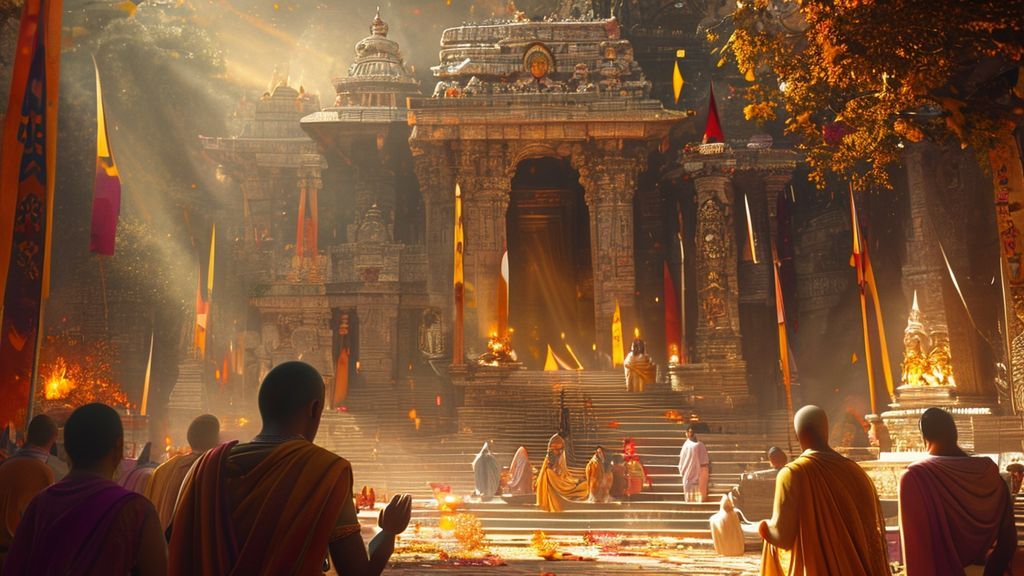
The Vedas are the foundational, revealed scriptures (Shruti) of Sanatan Dharma, encompassing hymns, ritualistic guidelines, and philosophical insights. In contrast, the Upanishads are the concluding philosophical treatises nestled within the Vedas, specifically focusing on the ultimate reality (Brahman) and the individual soul (Atman), representing the pinnacle of Vedic spiritual inquiry known as Vedanta.
| Attribute | Vedas (General) | Upanishads |
|---|---|---|
| Nature | Divinely revealed, Apaurusheya (not man-made) Shruti texts. | Philosophical conclusions of the Vedas, also Shruti. |
| Primary Focus | Karma Kanda: Rituals, hymns (mantras), sacrificial rites, cosmic order (Rta), duties (Dharma). | Jnana Kanda: Metaphysical wisdom, self-realization, nature of Brahman, Atman, Moksha (liberation). |
| Content Types | Samhitas (hymns), Brahmanas (ritual commentaries), Aranyakas (forest treatises). | Philosophical dialogues, meditative insights, allegories, spiritual teachings. |
| Goal | Attainment of worldly prosperity, celestial heavens (Svarga), maintaining cosmic balance. | Transcendental knowledge (Brahma Vidya), Moksha (liberation from cycles of birth and death). |
| Associated Term | Purva Mimamsa (focus on ritual interpretation). | Uttara Mimamsa (Vedanta – focus on philosophical interpretation). |
The Foundations of Sanatan Dharma: Vedas and Upanishads
In the vast ocean of Sanatan Dharma, the Vedas and Upanishads stand as luminous beacons, guiding humanity through the intricacies of existence, cosmic order, and ultimate reality. They are not merely ancient texts but living revelations (Shruti) that have shaped the spiritual, cultural, and ethical fabric of Hindu civilization for millennia. Understanding their distinct yet profoundly interconnected nature is crucial for any sincere seeker, as it reveals the progressive journey of spiritual inquiry within our tradition, from external ritual to internal realization.
The Vedas, meaning “knowledge” (from the root vid – to know), are the very breath of the Divine, meticulously preserved through an unbroken oral tradition spanning thousands of years. They embody a comprehensive vision of the universe, the divine, and human’s place within this grand tapestry. The Upanishads, literally meaning “sitting near devotedly,” represent the esoteric teachings imparted by a Guru to a deserving disciple, delving into the most profound truths that transcend the limitations of sensory perception and intellectual understanding.
The Evolution and Transmission of Vedic Wisdom
The history of the Vedas is not one of human authorship but of divine revelation, heard (shrutam) by ancient Rishis in deep meditative states. This body of knowledge, initially one, was systematized and compiled by the revered Sage Vyasa into four principal Vedas: the Rig Veda, Yajur Veda, Sama Veda, and Atharva Veda, as described in the Mahabharata and various Puranas such as the Vishnu Purana. This division made the immense volume of knowledge more accessible for study and preservation in the Kali Yuga.
Within each Veda, the spiritual wisdom progressively deepens. The Samhitas contain the core hymns and mantras addressed to various deities, embodying the earliest spiritual aspirations. The Brahmanas elaborate on the sacrificial rituals (Yajnas) and their precise performance, offering detailed explanations and theological rationales. The Aranyakas, or “forest treatises,” serve as a bridge, transitioning from the externalized ritualism of the Brahmanas to more introspective and symbolic interpretations, often studied by hermits in secluded forests. It is within the concluding sections of these Aranyakas and Brahmanas that the Upanishads are predominantly found, acting as the philosophical culmination.
The Upanishads are therefore not separate from the Vedas but are their crowning jewels, representing the Vedanta, or “the end of the Veda” – both in their placement and their ultimate purpose. They signify a shift from external religious practices to an intense internal quest for ultimate truth, transcending the temporary fruits of rituals to seek eternal liberation (Moksha).
The Structural Divergence: Karma Kanda vs. Jnana Kanda
To grasp the fundamental difference, one must understand the two primary divisions of Vedic literature: the Karma Kanda and the Jnana Kanda.
The Karma Kanda: The Path of Action and Ritual
The initial portions of the Vedas, primarily the Samhitas and Brahmanas, constitute the Karma Kanda. This section focuses on Dharma (righteous conduct), Artha (material prosperity), and Kama (sensory pleasure) through the meticulous performance of rituals, sacrifices, and duties. The Rig Veda, with its hymns invoking deities like Indra, Agni, and Surya, is central here, praying for prosperity, health, and victory. The Yajur Veda provides the formulas (Yajus) for the sacrificial rites, while the Sama Veda contains melodies for chanting these hymns. The Atharva Veda, while containing some rituals, also includes hymns for protection, healing, and worldly well-being.
The purpose of Karma Kanda is to guide individuals towards a righteous and prosperous life, ensuring cosmic harmony (Rta) and the attainment of higher celestial realms (Svarga) after death. As explained in the Purva Mimamsa Sutras, the emphasis is on the efficacy of ritual action.
The Jnana Kanda: The Path of Knowledge and Wisdom
The Upanishads form the core of the Jnana Kanda, the section dedicated to transcendental knowledge and self-realization. Here, the focus shifts from external actions to internal contemplation, from worldly gains to ultimate liberation. The Upanishads explore profound concepts such as the nature of Brahman (the ultimate reality), Atman (the individual soul), their non-duality, the cycle of rebirth (Samsara), and the means to attain Moksha. They challenge the practitioner to look beyond the transient material world and discover the eternal truth residing within.
Classic Upanishads like the Brihadaranyaka, Chandogya, Kena, Katha, and Mundaka delve into these intricate philosophical questions through dialogues between enlightened sages and earnest disciples, using parables and direct assertions to convey timeless wisdom. For instance, the famous Mahavakya “Tat Tvam Asi” (Thou Art That) from the Chandogya Upanishad encapsulates the essence of non-dual reality, emphasizing the identity of the individual soul with the Absolute.
Rituals and Spiritual Practice: A Unified Approach
While the Vedas provide the framework for external rituals and devotional practices, the Upanishads imbue these with deeper meaning, guiding the practitioner towards internal transformation. A devout Hindu might engage in a daily Sandhyavandanam (Vedic ritual) or perform a Homa (fire sacrifice) as prescribed in the Karma Kanda, seeking blessings and upholding Dharma.
The wisdom of the Upanishads, however, encourages one to see beyond the mere form of the ritual. The fire in the Homa becomes a symbol of the inner purifying fire of knowledge, the offerings represent the surrender of the ego, and the chanting of mantras leads to introspection. The Upanishads advocate for practices like Dhyana (meditation), Pranayama (breath control), and constant self-inquiry as means to realize the Atman-Brahman identity. This synthesis ensures that external adherence to Dharma is complemented by internal spiritual growth, leading to a holistic approach to life.
Mantras for Reflection and Realization
Both the Vedas and Upanishads are rich with powerful mantras that resonate with divine energy. Chanting these with devotion and understanding can elevate the consciousness of a devotee.
From the Vedas (Karma Kanda):
- The Gayatri Mantra (from the Rig Veda 3.62.10):
ॐ भूर्भुवः स्वः तत्सवितुर्वरेण्यं भर्गो देवस्य धीमहि धियो यो नः प्रचोदयात्॥
“Om Bhur Bhuvah Svah, Tat Savitur Varenyam, Bhargo Devasya Dhimahi, Dhiyo Yo Nah Prachodayat.”
This mantra invokes Savitr, the solar deity, for intellectual illumination and spiritual awakening.
From the Upanishads (Jnana Kanda):
- Mahavakyas (Great Sayings):
- Aham Brahmasmi (I am Brahman) – Brihadaranyaka Upanishad 1.4.10
- Tat Tvam Asi (Thou Art That) – Chandogya Upanishad 6.8.7
- Ayam Atma Brahma (This Atman is Brahman) – Mandukya Upanishad 1.2
- Prajananam Brahma (Consciousness is Brahman) – Aitareya Upanishad 3.1.3
- The universal chant:
ॐ शान्तिः शान्तिः शान्तिः॥
“Om Shanti Shanti Shanti.”
(Invoking peace in physical, mental, and spiritual realms, frequently concluding Upanishadic recitations.)
Dos and Don’ts for Approaching Vedic and Upanishadic Study
Approaching these sacred texts requires reverence and a disciplined mindset. One should consult scholarly works and seek guidance from qualified teachers found on platforms like Hindutva.online for deeper understanding.
Dos:
- Approach with reverence (Shraddha): Recognize these as divine revelations, not mere academic literature.
- Seek a Guru: Traditional study is always under the guidance of a knowledgeable teacher who can clarify doubts and impart subtle meanings.
- Practice Self-Discipline: Uphold Yama and Niyama (ethical restraints and observances) to purify the mind for deeper spiritual insights.
- Contemplate and Meditate: The teachings are meant to be lived, not just read. Engage in deep reflection and meditation on the concepts.
Don’ts:
- Treat as mere history or mythology: While containing historical context, their essence is timeless spiritual truth.
- Interpret superficially: Complex philosophical concepts require profound study and contemplation, not quick summaries.
- Disrespect or misuse: Avoid using these sacred texts for personal gain or to diminish others’ beliefs.
- Jump directly to Upanishads without foundation: A foundational understanding of Vedic worldview, Dharma, and basic Sanskrit can be beneficial.
Frequently Asked Questions
Are all Upanishads part of the Vedas?
Yes, all Upanishads are considered integral parts of the Vedas. They are typically found as the concluding sections of the Aranyakas or Brahmanas of the respective Vedic branches, hence their collective name ‘Vedanta’ – the end or culmination of the Vedas.
What is Vedanta?
Vedanta literally means “the end of the Vedas.” It refers to both the Upanishads themselves and the philosophical schools that base their teachings primarily on the Upanishads, the Brahma Sutras, and the Bhagavad Gita. Vedanta focuses on the ultimate nature of reality (Brahman) and the individual soul (Atman) and their relationship.
How many Vedas and Upanishads are there?
There are traditionally four Vedas: Rig Veda, Yajur Veda, Sama Veda, and Atharva Veda. While over 200 Upanishads are known, 108 are widely recognized, and among these, eleven (or sometimes twelve or thirteen) are considered the principal or Mukhya Upanishads, upon which Adi Shankaracharya commented.
Can a beginner study Upanishads directly?
While one can read translations, a deep and meaningful understanding of the Upanishads is challenging for a beginner without proper guidance. It is highly recommended to study them under a qualified Guru or teacher who can explain the complex Sanskrit terms, philosophical nuances, and connect them to the broader Vedic tradition, ensuring the wisdom is assimilated correctly and integrated into one’s spiritual practice.
Dharmic Significance: Preserving the Eternal Wisdom
The Vedas and Upanishads together constitute the unshakeable foundation of Sanatan Dharma, offering a complete spiritual trajectory. The Vedas lay down the principles of righteous living, cosmic order, and the devotional path, providing a framework for Dharma, Artha, and Kama. The Upanishads then elevate the seeker to the highest spiritual pinnacle, revealing the path to Moksha, the ultimate liberation and realization of the Self. This progressive journey within the same body of Shruti underscores the comprehensive nature of Hindu thought, accommodating diverse spiritual temperaments and guiding all towards the same ultimate truth.
By understanding their distinct roles and profound interconnectedness, we not only preserve the pristine wisdom of our Rishis but also empower ourselves to navigate the challenges of modern existence with ancient clarity, ensuring the eternal flame of Sanatan Dharma continues to illuminate the world.
