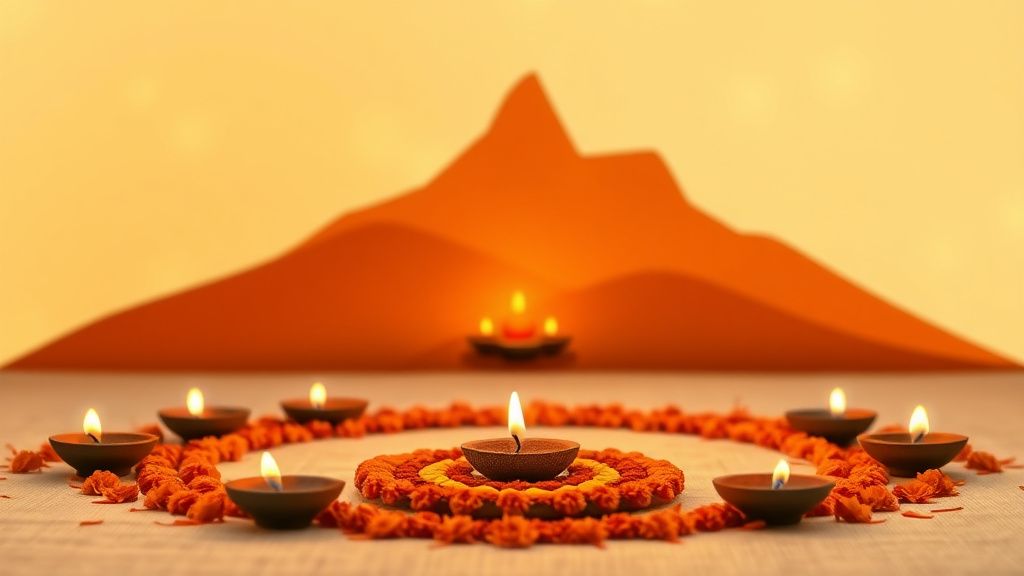
Govardhan Puja, also called Annakut, is observed on the first day after Diwali Amavasya, the Pratipada of the bright half of Kartik. In 2026 the festival falls on Monday, 9 November (the day after Diwali, 8 November). The day commemorates Krishna’s lifting of Mount Govardhan to shelter the village of Vraj from torrential rain sent by Indra; the Bhagavata Purana (Book 10, chapters 24-27) narrates the story. The observance has two principal forms: the Annakut, in which 56 or 108 dishes are arranged before Krishna at temples and homes, and the Govardhan Parikrama, in which devotees circumambulate either an effigy of the hill made of cow dung or, at Govardhan in Mathura district, the actual hill itself.
The Bhagavata story in plain summary
The Bhagavata Purana’s narrative is brief and specific. Krishna, then a child in Vraj, observes the elders of the village preparing the annual yajna for Indra, the rain god. He questions the practice. The cows and the people of Vraj depend, he argues, on Govardhan Hill, which provides grass for the cattle, herbs, water and the forest cover that shapes the local climate; the village should honour Govardhan rather than the distant Indra. The cowherds, moved by Krishna’s argument, redirect the offerings to the hill, with Krishna himself appearing in a vast form on its summit to receive them. Indra, slighted, sends a punishing storm. Krishna lifts Govardhan Hill on the little finger of his left hand and holds it up for seven days as an umbrella; the cattle and the villagers shelter under it. Indra, finally understanding, comes down to bathe Krishna’s feet and acknowledges him as Govardhanadhari, the holder of Govardhan, and Govinda, the protector of cattle.
The Vishnu Purana and the Harivamsa carry shorter versions of the same episode. The Gaudiya Vaishnava commentaries treat the story as the foundational moment of Krishna’s lordship over Vraj and of the bhakti orientation toward direct devotion rather than mediated Vedic ritual.
What “Annakut” actually is
Annakut means “mountain of food”. The day’s signature offering is a literal one: vegetarian dishes piled into a hill-shape before the murti of Krishna. At Krishna temples, especially those of the Pushtimarg and Gaudiya lines, this becomes an elaborate set piece. The classical count is Chappan Bhog, 56 items, derived from the calculation that Krishna ate eight meals a day for the seven days he held up Govardhan; the cowherds offer him those missed 56 meals on this day.
A typical Annakut at a temple includes:
- Six staples: rice, dal, sabzi, puri, kheer, halwa.
- Sweet preparations: peda, barfi, ladoo, jalebi, ghevar, kheer made with rice and with vermicelli, and a milk-based sweet specific to the region.
- Savouries: kachori, samosa, dhokla, khaman, papad, chivda, sev.
- Vegetables of the season: the post-Diwali week falls in the autumn harvest; pumpkin, sweet potato, yam, green leafy vegetables and gourd are typical.
- Fruits: banana, pomegranate, sugarcane, apple, guava, jujube.
- Curd and milk preparations: dahi-rice, raita, rabri, malai-mishti.
The 56 items are then arranged in three tiers in front of the murti, the tallest in the centre, sloping down at the sides, the shape of a hill. After the aarti and recitation, the food is shared as prasad, often in a community meal.
The Govardhan effigy at home
Households that do not travel to a temple build their own Govardhan: a small hill of cow dung in the courtyard or at the entrance of the house, decorated with grass and flowers, with small clay figurines of Krishna, the cowherds, the cattle and the villagers arranged on it. The cow dung is treated as ritually pure in the agrarian Hindu reading and represents both the hill and the cattle that the hill sheltered. The family performs aarti around the effigy and a parikrama (clockwise circumambulation) of it, followed by a Annakut offering in front.
Urban households that do not have access to cow dung substitute clay or even a small earth mound shaped on a tray. The reading is the same; the substance follows availability.
Govardhan in Mathura district
The most concentrated observance is at the actual Govardhan Hill itself, a long low ridge in Mathura district about 22 kilometres west of Mathura town and 26 kilometres from Vrindavan. The hill is treated as a manifestation of Krishna himself in Vaishnava theology; the standard practice is the parikrama, a 21 kilometre circumambulation of the hill on foot, taking most pilgrims six to eight hours. A longer dandavat parikrama, in which the pilgrim measures the circuit one body-length at a time by full prostration, takes several days. The Govardhan Parikrama on this day draws several hundred thousand pilgrims.
The Shri Nathji Temple at Nathdwara in Rajasthan, which holds a murti of Govardhanadhari Krishna (lifting the hill), holds its single largest annual observance on Annakut. The temple’s Annakut here is one of the most photographed in India, with the murti revealed to the public after dusk and the prasad distributed through the night.
Regional variants
- Maharashtra: the same day is observed as Balipratipada, honouring Bali, the asura king to whom Vishnu (as Vamana) granted the boon of returning to earth annually. Wives draw rangoli of Bali at the threshold.
- Gujarat: the day is observed as Bestu Varas, the Gujarati new year (Vikram Samvat) starts the day after Diwali. Annakut and the new-year observance run together at most temples.
- North India broadly: Annakut at temples; cow dung Govardhan at homes; gomata puja (cow worship) during the day.
- Pushtimarg households follow Vallabhacharya’s specific liturgy for Annakut, with the seven days of Krishna holding Govardhan recited; Nathdwara, Kankroli, Surat and Kamvan are the major centres.
- ISKCON temples hold a synchronised Govardhan Puja worldwide; the Annakut is a public function.
What the story means as practice
The theological reading the Bhagavata commentators give is direct: the Govardhan story redirects worship from the distant, transactional deity (Indra, who sends rain and demands sacrifice) to the immediate, sustaining environment (the hill, the cattle, the forest, the river). For what it’s worth, the Annakut practice carries a quieter implication that fits modern environmental and food readings: the right response to abundance is to redistribute it, not to hoard it. Most communities run an open prasadam after the offering for exactly that reason.
Common questions
Is Govardhan Puja always the day after Diwali?
In most years yes; the tithi is Kartik Shukla Pratipada, which falls the day after Diwali Amavasya. In rare years the Pratipada is split across two solar days; in such years some panchangs assign the puja to the day on which the Pratipada sits at sunrise or at mid-day. 2026 is straightforward: Diwali is 8 November, Govardhan Puja is 9 November.
Do I need 56 dishes for the Annakut?
No. The 56 is the classical number for temple Annakut; home Annakut typically does between five and twenty-one dishes depending on the household’s capacity. The practice is to offer one item from each of the seven food categories (sweet, sour, salty, bitter, astringent, pungent, neutral) and to make the offering proportionate to the household; the temple count is aspirational, not required.
Can the parikrama be done at home?
Yes. A home parikrama of the cow dung Govardhan effigy is the standard substitute for those who cannot travel to the actual hill in Mathura district. The procedure is the same: a clockwise circumambulation, ideally seven or eleven rounds (the count corresponds to the seven days Krishna held the hill, with eleven as a stretch number used by some households).
A limitation worth noting
The exact local muhurat for the puja, the Govardhan parikrama gate timings at Mathura, and the Nathdwara temple’s Annakut schedule are revised year by year; this article does not quote those because they shift each Diwali cycle. For background see the Wikipedia entries on Govardhan Puja and Govardhan Hill, and for the canonical narrative the Bhagavata Purana (Book 10, chapters 24-27) in any standard translation.
