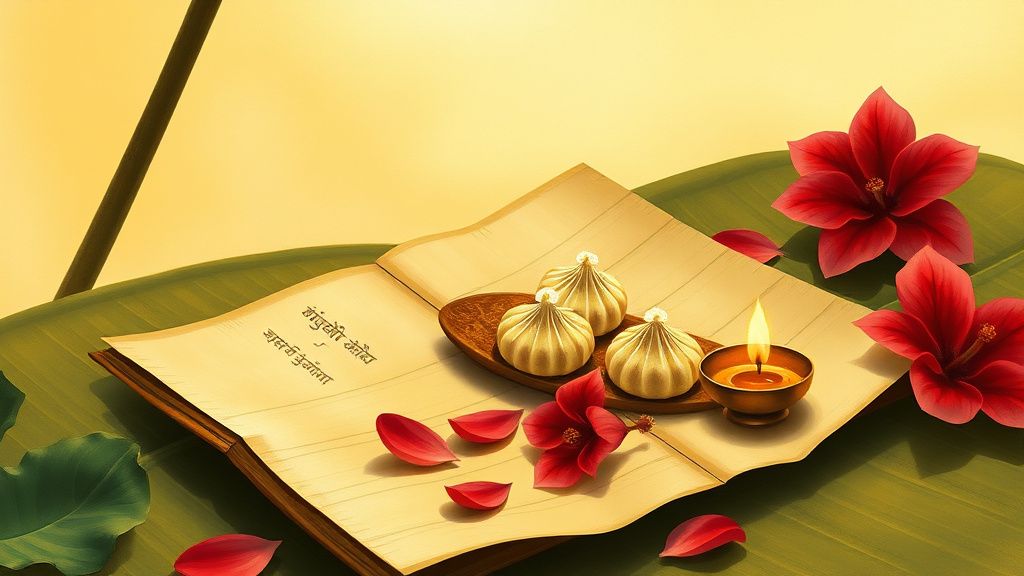
The Ganapati Atharvashirsha (also called the Ganesha Upanishad or Sri Ganapati Atharva Sirsha) is a Sanskrit Upanishadic text of about 29 verses attached to the Atharvaveda. It identifies Ganesha with the Brahman, the absolute reality of the Upanishads, and gives the bija (seed) mantra and the principal procedures for Ganapati upasana (meditative worship). Scholars generally date it to the 16th or 17th century CE, making it one of the later Upanishadic texts. It is one of the most widely recited Sanskrit texts in Maharashtra, particularly during Ganesh Chaturthi and the daily worship at the Ashtavinayak shrines. This article walks through its content, the central verses, and the practical context of its use.
Structure and content
The text is short. It opens with a salutation (shanti mantra), proceeds through the main body of about ten sections that include the upanishadic declaration of Ganesha as Brahman, the bija mantra, the Ganapati Gayatri, the iconographic description of Ganesha, and the closing phala-shruti (the merit of recitation). It is conventionally recited in a single sitting; a fluent reciter can complete it in about ten minutes. The text is in classical Sanskrit, though the orthography varies somewhat across published editions (Gita Press, Sri Ramakrishna Math, Anandashram), with minor differences in the bija mantra section.
The Brahman-identification
The first verse of the Upanishad proper asserts that Ganesha is the Supreme principle, the all-pervading metaphysical absolute called Brahman in Hinduism. Ganesha is identified with Om, with the Atman (the self), and with the Vedic statement “tat tvam asi” (that you are). Verse 6 of the text declares: “You are Brahma, Vishnu, Rudra (Shiva), Indra, Fire, Air, Sun, and Moon.” This identification places Ganesha at the foundation of the cosmos and presents the other major deities as forms or aspects of Ganapati. The move is consistent with the upanishadic genre, which characteristically identifies the chosen deity with the absolute principle.
The bija mantra
Verse 7 contains the phonetic construction of Ganesha’s bija mantra. The procedure: first utter “ga” (the consonant), then “a” (the vowel), add the anusvara (the nasal dot, “m”), and prefix Om. The result is “Om Gam.” This is the Ganapati bija mantra, the seed-syllable on which all subsequent Ganesha mantras are built. The verse also describes the construction phonetically, treating each letter as having a specific cosmic significance: “ga” represents wisdom, “a” represents Brahman, the anusvara represents the binding of the two. The bija mantra is then expanded into the full Ganapati Mantra, “Om Gam Ganapataye Namah.”
The Ganapati Gayatri
The text contains a Gayatri-style mantra for Ganesha: “ekadantaya vidmahe, vakratundaya dhimahi, tanno dantih prachodayat.” We meditate on the one-tusked one, we contemplate the curved-trunked one, may that tusked one impel us. The Ganapati Gayatri is modelled on the original Savitri (Surya) Gayatri of the Rig Veda (3.62.10) and follows the same three-pada structure with the seven-syllable, eight-syllable and ten-syllable padas. It is one of the principal Ganesha mantras recited during the daily sandhya and during Ganesh Chaturthi.
The iconographic description
The text describes Ganesha’s iconographic form: red-coloured, with an elephant face, single tusk, four arms holding noose (pasha) and goad (ankusha) in two hands, and granting fearlessness with the others. The four hands are sometimes interpreted as holding the broken tusk, the modaka, the pasha and the ankusha, with the front hands in varada (boon-granting) and abhaya (fearlessness) mudras. The iconographic description in the Atharvashirsha is one of the principal Sanskrit textual sources for the standard Ganesha murti, though the specific details vary across regional traditions.
The phala-shruti: merits of recitation
The closing verses describe the merits of reciting the Atharvashirsha. The text says that one who studies it becomes fit to realise Brahman, that obstacles are removed from one’s path, that permanent happiness increases in one’s consciousness. Specific procedures are described: recitation in the morning destroys the sins of the night, recitation in the evening destroys the sins of the day, and recitation eight times during the day removes major impediments. The text is conventionally recited 11, 21, or 108 times during specific occasions, with the 108-times recitation called a laghu rudra when combined with appropriate puja procedure.
The text’s place in Ganapatya tradition
The Atharvashirsha is the central scriptural text of the Ganapatya sampradaya, the Hindu tradition that takes Ganesha as the supreme deity. The Ganapatya tradition has its principal seats in Maharashtra (the Ashtavinayak shrines around Pune) and in parts of Karnataka and Tamil Nadu. The text is also recited across all Hindu traditions when invoking Ganesha at the start of any auspicious activity, since Ganesha is the remover of obstacles (vighna-harta) regardless of one’s primary sectarian affiliation. The Ganapati Atharvashirsha is therefore one of the most cross-tradition Sanskrit recitations in current Hindu practice.
Dating and historical questions
The Atharvashirsha is one of the 108 “upanishads” listed in the Muktika Upanishad’s canon, but it is not among the 10 or 12 principal Upanishads commented upon by Shankara, Ramanuja or Madhva. The text is generally dated to the late medieval period, between the 16th and 17th centuries CE. It postdates the major Ganapatya texts and likely systematises an earlier oral tradition. For what it’s worth, the late dating does not affect the text’s practical authority within the Ganapatya tradition; later upanishadic compositions are common across Shaiva, Shakta and Vaishnava traditions, and the Atharvashirsha is treated as canonical regardless of its dating. Its theological compactness and ritual utility have given it a place that older but less practically useful texts have not always retained.
Recitation in practice
- Daily recitation: one round of the full text, usually morning or evening.
- Ganesh Chaturthi: 21 recitations on the day of installation, 11 on subsequent days.
- Sankashti Chaturthi: the fourth day after the full moon each month, on which a single recitation is the standard observance.
- Vighna-nivarana (obstacle removal): 108 recitations with appropriate puja for major obstacles.
- Ashtavinayak yatra: recitation at each of the eight shrines around Pune.
Common questions
Is the Ganapati Atharvashirsha part of the Atharvaveda?
Traditionally yes, as the name “Atharvashirsha” (the head of the Atharvan) suggests. In scholarly terms it is an Upanishad of the Atharvavedic tradition, one of the later Upanishadic texts attached to that Veda. It is not part of the Atharvavedic samhita proper but is classified within the Upanishadic literature of that Veda. The text shares stylistic features with the Atharvavedic tradition, including the use of bija mantras and the systematic phonetic construction of seed syllables.
How is the Atharvashirsha different from the Ganapati Sahasranama?
They are different texts. The Atharvashirsha is a 29-verse upanishadic text that identifies Ganesha with Brahman and contains the bija mantra and gayatri. The Ganapati Sahasranama is a 1,000-name stotra, longer and more devotional in form, listed in the Ganesha Purana. Both are recited during Ganesha worship, but the Atharvashirsha is the metaphysically denser text while the Sahasranama is the more elaborate devotional recitation.
What is the pronunciation guidance?
The text is in standard Vedic-influenced Sanskrit. The bija mantra “Om Gam” requires correct nasalisation of the anusvara, with the final “m” produced as a nasal sound rather than a closed consonant. The Gayatri portion follows the standard Vedic chanting accents (udatta, anudatta, svarita). Most published editions include the accent marks; for first-time recitation, learning the text alongside a recording from a reputable tradition (Gita Press recordings, Anandashram, Sri Ramakrishna Math) is the standard practice.
One limitation worth noting
This article describes the standard published text and the standard practice. Manuscript variants exist, particularly in the bija mantra section and in the closing phala-shruti, with some manuscripts adding or omitting specific verses. Different Ganapatya lineages also use slightly different recitation procedures and different additions (such as the dhyana sloka). The phala-shruti claims of specific worldly and spiritual benefits are statements within the text’s own framework and are not empirical predictions; the recitation is undertaken as devotional practice with whatever expectations the practitioner brings, not as a guaranteed mechanism.
For a textual overview, see Ganapati Atharvashirsha on Wikipedia. The Sanskrit text with English translation is available at the Ganapati Atharvashirsha resource page.
