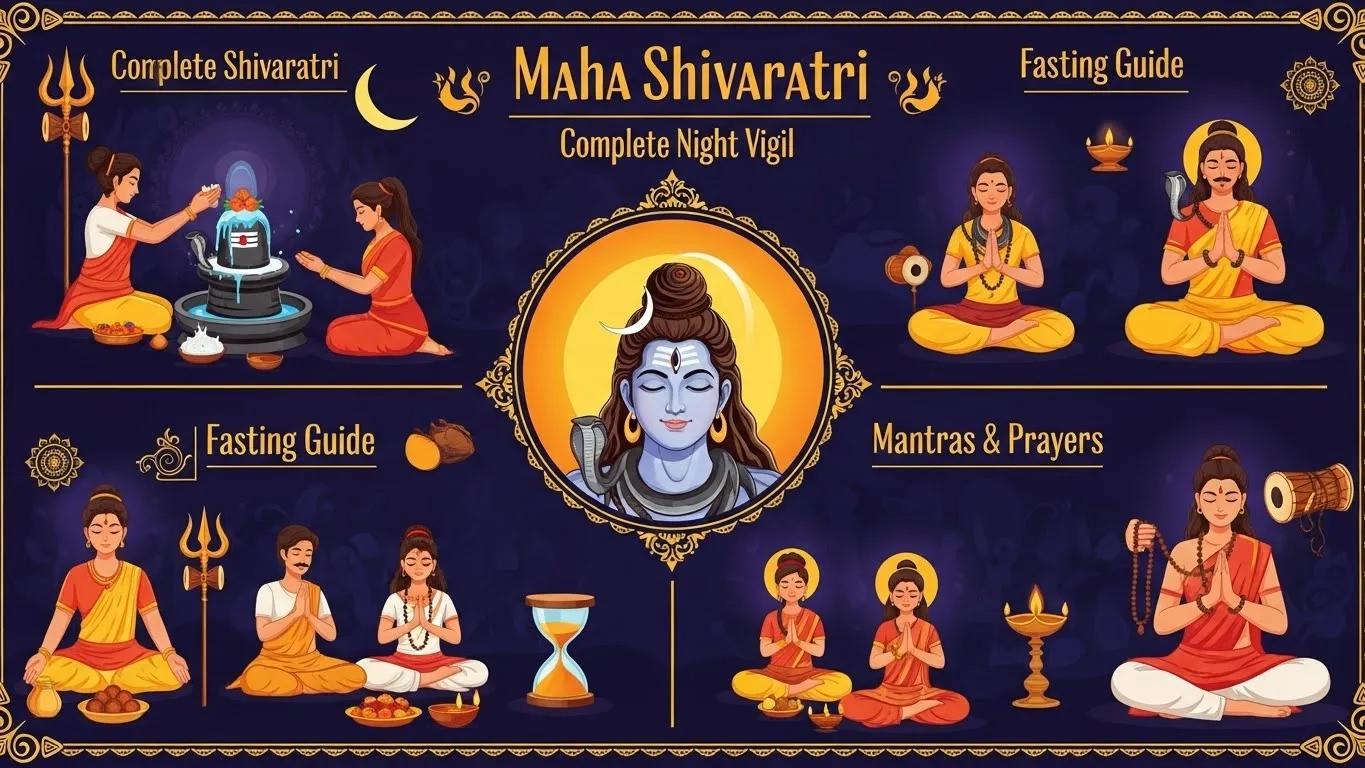
The festival of Maha Shivaratri – from Sanskrit [translate:महाशिवरात्रि] (Maha Shivaratri) where [translate:महा] (Maha) means “great” and [translate:शिवरात्रि] (Shivaratri) means “Shiva’s night” – represents Hinduism’s most spiritually powerful, ascetically rigorous, and devotionally profound festival celebrating the great night when Lord Shiva and Goddess Parvati united in divine marriage, when cosmic energies align creating uniquely favorable conditions for spiritual practices making this the darkest night of lunar month (Amavasya eve) yet paradoxically most illuminating for sincere devotees who observe complete night-long vigil ([translate:जागरण] jaagran) remaining awake from sunset to sunrise engaged in continuous worship, meditation, mantra chanting, and Shiva Linga abhishekam (ritual bathing) performed four times during night’s four prahars (three-hour segments) using sacred substances milk,
honey, yogurt, ghee, and sugar water while offering bilva leaves ([translate:बिल्व पत्र] bel patra) – Lord Shiva’s most beloved offering – accompanied by strict fasting either complete nirjala (waterless) or modified falahar (fruit-based) demonstrating devotion’s intensity through voluntary physical austerity believed to burn accumulated karmic impurities and directly connect consciousness with Shiva Tattva (supreme transcendent principle). Unlike celebratory festivals emphasizing external joy and social gathering, Maha Shivaratri uniquely emphasizes internal spiritual discipline through night-long wakefulness symbolizing soul’s awakening from ignorance’s slumber,
sensory withdrawal enabling deeper meditation, and ego dissolution through sustained devotional focus creating conditions for experiencing [translate:शिव तत्त्व] (Shiva Tattva) – that infinite nothingness, pure consciousness, absolute reality from which all creation emerges and into which all dissolves – accessible through sacred mantra [translate:ॐ नमः शिवाय] (Om Namah Shivaya) whose five syllables represent five elements (earth, water, fire, air, ether) mastered by Shiva making chanting this mantra especially potent on Maha Shivaratri for harmonizing inner elemental balance, quieting restless mind, and experiencing transcendent peace beyond worldly disturbances.
The complete observance encompasses understanding profound spiritual significance rooted in multiple sacred events coinciding on this night – Shiva-Parvati’s divine marriage representing union of consciousness (Purusha) with energy (Prakriti) creating cosmic wholeness, Shiva’s Tandava dance (cosmic dance of creation-preservation-destruction) performed during midnight prahar symbolizing universe’s rhythmic cycles, and Shiva manifesting as infinite pillar of light (Jyotirlinga) revealing supreme formless nature to Brahma and Vishnu teaching humility before absolute reality, detailed night vigil procedure dividing observance into four distinct prahars each requiring fresh abhishekam, specific offerings, continuous chanting, and prescribed meditation
creating structured framework preventing sleep while maintaining spiritual intensity throughout entire night despite physical exhaustion and mental restlessness challenging devotee’s determination, authentic Shiva Linga abhishekam method using specific sequence of sacred substances each carrying symbolic meaning – water purifying sins, milk bestowing prosperity, honey granting sweet speech, yogurt conferring progeny, ghee providing illumination, sugar water attracting divine grace – poured gently while chanting Om Namah Shivaya maintaining continuous flow representing devotion’s unbroken stream, fasting guidelines offering flexibility from complete nirjala fast (no food, no water 24+ hours) for advanced practitioners through modified falahar (fruits, milk, nuts) for those with health constraints to simple sattvic vegetarian meal for beginners recognizing
sincere devotion matters more than rigid external compliance, and contemporary relevance transcending religious sectarianism as millions including non-Hindus drawn to festival’s profound meditation opportunity, yogic practices, and universal message about transcending ego, conquering senses, and experiencing pure consciousness beyond material identification accessible through any sincere spiritual path making Maha Shivaratri truly universal celebration of human spirit’s capacity for transcendence. For devotees in 2025
whether lifelong Shaivites maintaining family traditions through elaborate home puja and temple visits experiencing deep emotional connection with Shiva as beloved deity, spiritual seekers utilizing this astronomically significant night for intensive meditation and yogic practices recognizing unique energetic conditions favorable for breakthrough experiences, first-time observers courageously attempting complete night vigil discovering mental discipline and devotional intensity previously unknown, married couples praying for marital harmony drawing inspiration from Shiva-Parvati’s perfect union embodying complementary energies creating wholeness, health-conscious individuals adapting fasting and vigil requirements to medical needs while maintaining sincere spiritual participation, cultural enthusiasts appreciating India’s rich devotional traditions through music, dance,
temple architecture witnessing Maha Shivaratri’s spectacular celebrations, or simply curious individuals wanting to understand why millions voluntarily stay awake entire night performing repetitive rituals with unwavering devotion, recognizing Maha Shivaratri as sophisticated spiritual technology for consciousness transformation rather than mere religious festival enables approaching this sacred night with complete appreciation transcending superficial observance toward genuine engagement with practices designed to dissolve ego, transcend body-mind identification, and experience infinite consciousness Shiva represents making “great night” truly great through personal spiritual awakening rather than just mechanical ritual completion.
The Profound Significance: Why This Night Is Special
Understanding festival’s deep meaning reveals multidimensional spiritual importance.
When Is Maha Shivaratri Celebrated?
Lunar Calendar Timing:
Month: Phalguna or Maagha (Feb-March)
Tithi: Chaturdashi (14th lunar day) of Krishna Paksha (waning moon phase)
Significance:
Darkest night before new moon (Amavasya) – minimal moonlight, maximum darkness.
2025 Date:
Maha Shivaratri 2025: Wednesday, February 26, 2025
Night Vigil: February 26 evening through February 27 morning
Monthly vs. Maha Shivaratri:
Important Distinction:
- Shivaratri occurs every month (Chaturdashi of Krishna Paksha)
- Maha Shivaratri occurs once yearly (Phalguna month) – THE GREAT Shivaratri
Why This Night?
1. Divine Marriage of Shiva-Parvati
The Sacred Union:
“Maha Shivratri, set for February 26, 2025, is one of the biggest festivals celebrating Lord Shiva. This sacred night marks the divine union of Lord Shiva and Goddess Parvati.”
The Story:
Parvati’s Penance:
Goddess Parvati (Sati reborn) performed intense tapasya (austerities) to win Shiva as husband.
After years of meditation, fasting, yogic practices, Shiva finally accepted her.
The Wedding:
On Maha Shivaratri night, divine marriage ceremony performed.
Cosmic Significance:
Union of Opposites:
- Shiva = Consciousness (Purusha), masculine principle, static awareness
- Parvati/Shakti = Energy (Prakriti), feminine principle, dynamic power
Together: Complete cosmic reality – consciousness energized, energy guided by consciousness
For Devotees:
Married couples worship together praying for harmonious union like Shiva-Parvati.
Unmarried individuals pray for ideal spouse embodying divine qualities.
2. Shiva’s Tandava – The Cosmic Dance
The Dance of Creation-Preservation-Destruction:
“Shiva’s Tandava dance (cosmic dance of creation-preservation-destruction) performed during midnight prahar.”
The Symbolism:
Shiva as Nataraja (King of Dance):
- Dancing creates universe
- Rhythm maintains cosmic order
- Final dance dissolves creation
- Then cycle begins anew
On Maha Shivaratri:
This cosmic dance reaches peak intensity at midnight.
Devotees staying awake witness (spiritually) this divine performance.
3. Manifestation as Infinite Light Pillar
The Jyotirlinga Legend:
The Cosmic Competition:
Brahma (creator) and Vishnu (preserver) argued about supremacy.
Shiva’s Intervention:
Manifested as infinite pillar of blazing light (Jyotirlinga) – no beginning, no end.
The Challenge:
“Find my top or bottom, and you’ll prove superiority.”
The Outcome:
Vishnu (as Varaha) dug downward – found no bottom.
Brahma (as swan) flew upward – found no top.
Both realized Shiva’s formless infinite nature transcending comprehension.
The Teaching:
Humility before Absolute:
Even greatest gods cannot fathom ultimate reality.
Shiva as Supreme:
Represents that transcendent principle beyond creation-preservation.
For Devotees:
Maha Shivaratri celebrates this revelation of formless infinite consciousness.
4. Unique Planetary Alignment
Energetic Significance:
“The night holds special power because of unique planetary alignments.”
The Conditions:
Specific celestial configuration on Maha Shivaratri creates:
- Energetic upward flow in body (naturally rising Kundalini)
- Mind naturally calmer despite darkness
- Meditative states easier to achieve
- Spiritual practices yield amplified results
Yogic Perspective:
If one simply sits upright and aware throughout night, natural energies align facilitating spiritual experiences.
5. Overcoming Darkness with Consciousness
The Darkest Night:
Chaturdashi – 14th lunar day before new moon = Minimal moonlight, maximum physical darkness
The Paradox:
Outer Darkness → Inner Light
Staying awake through darkest night symbolizes:
- Consciousness conquering ignorance
- Awareness transcending sleep (unconsciousness)
- Spirit illuminating material darkness
- Devotion dispelling spiritual blindness
The Practice:
Night vigil becomes metaphor and method for soul awakening.
Who Is Shiva? Understanding Shiva Tattva
Beyond Personal Deity:
“To my astonishment, as I searched more about who this supreme energy was, I realized that Shiva is not a person but is a principle.”
The Cosmic Principle:
“Shiva Tattva, which is an all-pervading consciousness that fills up this nothingness.”
The Scientific Parallel:
“Today, even astronomy tells us that 99.99% of the universe is just empty – nothingness. So, 95% of this is ‘dark matter’ and ‘dark energy’.”
Shiva as That Nothingness:
“Shiva is that nothingness, the dark empty void of space, from which all creation – the stars, planets, galaxies, mountains, oceans, all living beings, etc. – manifests and into which all creation disintegrates.”
The Qualities:
“Shiva means that which is innocent, benevolent, beautiful, transcendental, and absolute.”
Personal and Impersonal:
While Shiva has personal form (Mahadev with third eye, crescent moon, Ganga in hair), ultimate Shiva Tattva is formless infinite consciousness – source and substance of all existence.
Experiencing Shiva:
“Shiva energy permeates through the universe and you will find that it is possible to experience the Shiva Tattva – absolute nothingness – within us.”
Through meditation, especially on Maha Shivaratri.
Complete Fasting Guidelines
The vrat observance demonstrates devotion through voluntary physical discipline.
Types of Fasting
Three Main Options:
1. Complete Nirjala Fast (Most Rigorous)
The Rules:
- No food for entire duration
- No water either
- Complete abstinence from eating and drinking
Duration:
From sunrise on February 26 through sunrise on February 27 (approximately 24-30 hours).
Who Should Attempt:
- Experienced devotees
- Those in good health
- Advanced spiritual practitioners
Spiritual Benefit:
Maximum austerity believed to burn most karmic impurities.
2. Falahar (Fruit-Based Fast)
The Rules:
- No grains, lentils, regular salt
- Fruits allowed
- Milk and milk products allowed
- Nuts and dry fruits allowed
- Rock salt (sendha namak) permitted
- Water allowed freely
Allowed Foods:
- Fresh fruits (bananas, apples, pomegranates, etc.)
- Fruit juices
- Milk, yogurt, buttermilk
- Dry fruits (almonds, cashews, raisins)
- Sabudana (sago/tapioca pearls)
- Potatoes (some traditions)
- Peanuts
- Coconut water
Duration:
Same – sunrise to sunrise
Who Should Choose:
- First-time observers
- Those with moderate health
- Individuals needing energy for night vigil
- Pregnant/nursing women (if fasting at all)
3. Single Sattvic Meal
The Practice:
One simple vegetarian meal during day.
When:
Either before puja begins (evening) or next morning after puja concludes.
What to Eat:
- Simple vegetables
- Chapati or rice
- Dal (lentils)
- Avoid onion, garlic, non-veg
Who Should Choose:
- Beginners
- Elderly
- Those with medical conditions requiring food
- Children participating
Important Fasting Considerations
Health First:
“Remember, these rituals aren’t just yearly events… Each person’s capacity differs, and Lord Shiva accepts all sincere efforts.”
Who Should NOT Fast Completely:
- Diabetics
- Pregnant women
- Nursing mothers
- Chronically ill individuals
- Those on required medications
- Very young children
- Elderly with health issues
The Principle:
Devotion over mechanical compliance.
God values sincere effort and love more than physical suffering endangering health.
Modified Observance:
If complete fasting impossible:
- Reduce to one meal
- Take falahar
- At minimum, avoid non-vegetarian and tamasic foods
- Focus on devotional practices even without fasting
Pre-Fast Preparation
Day Before (February 25):
1. Light Eating:
Don’t overeat thinking it will sustain you.
Eat moderate, easily digestible foods.
2. Hydration:
Drink plenty of water throughout day.
Avoid caffeinated drinks (causes headaches during fast).
3. Mental Preparation:
Mentally commit to observance.
Plan vigil activities (bhajans, readings, meditation).
Last Meal Before Fast (Evening February 25):
Timing:
Consume before sunset ideally.
What to Eat:
- Light vegetables
- Chapati or rice
- Avoid heavy spices
- Avoid overeating (creates discomfort during fast)
Breaking the Fast (February 27 Morning)
After Puja Concludes:
Typically after sunrise (around 6:30-7:00 AM).
First Intake:
- Start with water
- Then light fruit or milk
- Wait 15-20 minutes
Full Meal:
- Light, easily digestible
- Avoid heavy, spicy foods
- Body needs gentle reintroduction to food
Gradual Return:
Normal eating can resume by evening or next day.
The Complete Night Vigil (Jaagran) Guide
The night-long wakefulness forms the core spiritual practice.
Why Stay Awake All Night?
Spiritual Significance:
“Devotees often stay awake through the night, believing this brings them closer to receiving Lord Shiva’s blessings. This practice, known as jagaran, includes meditation, chanting, and prayer.”
The Symbolism:
Awakening from Ignorance:
- Physical sleep = Spiritual ignorance
- Staying awake = Soul consciousness
- Night vigil = Conquering unconsciousness
Energetic Opportunity:
Natural upward energy flow during this night makes meditation easier despite darkness.
Discipline and Devotion:
Voluntary discomfort demonstrates sincere commitment.
The Four Prahars: Dividing the Night
What Is Prahar?
[translate:प्रहर (Prahar)] = A three-hour time division
Traditional Indian Timekeeping:
Day and night each divided into 4 prahars (8 total daily).
Maha Shivaratri’s Four Night Prahars (Approximate Timings):
Note: Exact timings vary by location and sunset/sunrise times. Calculate based on local sunset.
Example for 2025 (adjust for your location):
First Prahar: 6:24 PM – 9:32 PM
Second Prahar: 9:32 PM – 12:39 AM
Third Prahar: 12:39 AM – 3:46 AM (Most powerful – midnight)
Fourth Prahar: 3:46 AM – 6:53 AM
Ritual for Each Prahar
Essential: Perform fresh Shiva Linga abhishekam during each prahar.
First Prahar (Evening) – 6:24 PM – 9:32 PM
Activities:
“Begin with fresh abhishekam. Light new incense sticks. Start your bhajan session. Offer fresh fruits or sweets.”
Detailed Procedure:
1. Fresh Abhishekam:
Bathe Shiva Linga with all sacred substances (detailed below).
2. Bilva Leaves:
Offer fresh bilva leaves (sets of three).
3. Flowers:
White flowers preferred (jasmine, lotus).
4. Incense and Lamp:
Light fresh incense and diya.
5. Bhajan Singing:
Begin devotional songs – group or solo.
Traditional songs like “Om Jai Shiva Omkara.”
6. Offerings:
Fresh fruits, sweets, coconut.
Energy Level:
Still fresh, energetic – easy to maintain focus.
Second Prahar (Late Evening) – 9:32 PM – 12:39 AM
Activities:
“Focus on mantra chanting and use rudraksha mala. Take short meditation breaks. Refresh the oil lamp if needed. Offer milk or water.”
Detailed Procedure:
1. Second Abhishekam:
Repeat full abhishekam sequence.
2. Mantra Chanting:
Om Namah Shivaya – 108 times or more
Use rudraksha mala for counting.
Chant aloud or silently.
3. Meditation:
Sit quietly focusing on Shiva.
Even 10-15 minutes valuable.
4. Reading Sacred Texts:
Shiva Purana passages.
Stories about Shiva’s leelas (divine plays).
Energy Level:
Sleepiness starting – maintain discipline through chanting.
Third Prahar (Midnight) – 12:39 AM – 3:46 AM
THE MOST POWERFUL PERIOD
Activities:
“This is the most powerful period. Deepen your meditation practice. Continue gentle chanting. Keep yourself alert with short walks.”
Why Most Powerful?
- Midnight = Peak cosmic dance (Tandava)
- Energies most aligned
- Mind naturally quieter (world sleeping)
- Maximum spiritual benefit
Detailed Procedure:
1. Third Abhishekam:
Perform with utmost devotion and focus.
2. Deep Meditation:
Longest meditation session of night.
30-60 minutes if possible.
Focus on Shiva Tattva – infinite consciousness.
3. Maha Mrityunjaya Mantra:
[translate:ॐ त्र्यम्बकं यजामहे सुगन्धिं पुष्टिवर्धनम् उर्वारुकमिव बन्धनान्मृत्योर्मुक्षीय माऽमृतात्]
(Om Tryambakam Yajamahe Sugandhim Pushtivardhanam, Urvarukamiva Bandhanan Mrityor Mukshiya Maamritat)
Powerful healing and protection mantra.
4. Staying Alert:
Sleepiness peaks during this period.
Techniques:
- Stand and chant
- Short walks around puja area
- Splash cold water on face
- Deep breathing
- Remember spiritual significance
Energy Level:
Most challenging – maximum tiredness but maximum spiritual reward.
Fourth Prahar (Pre-Dawn) – 3:46 AM – 6:53 AM
Activities:
“Maintain steady devotional activities. Read more spiritual texts. Prepare for morning aarti. Stay focused despite tiredness.”
Detailed Procedure:
1. Fourth and Final Abhishekam:
With gratitude for completing night.
2. Continuous Devotion:
Don’t slack thinking “almost done.”
Maintain intensity till sunrise.
3. Spiritual Reading:
Shiva stories, philosophies.
Keeps mind engaged.
4. Preparing for Conclusion:
Clean puja area of used flowers.
Prepare for final morning aarti.
5. Dawn Aarti:
As sun rises, perform final aarti.
Energy Level:
Second wind often comes – renewed energy seeing dawn approach.
Practical Tips for Staying Awake
Environment:
- Bright lighting – keeps alertness
- Comfortable seating – but not too comfortable (prevents sleep)
- Cool temperature – warmth induces drowsiness
Activities:
- Alternate activities – chanting → reading → meditation → bhajan
- Movement – stand periodically, circumambulate Shiva Linga
- Group vigil – if possible, family/friends help each other stay awake
Avoid:
- Lying down – even briefly (will sleep)
- Heavy food during falahar (causes drowsiness)
- Boring repetition – vary activities
Remember:
“If you feel sleepy, take short walks around your puja area. Remember, the goal isn’t to torture yourself but to maintain awareness through the night.”
Shiva Linga Abhishekam: The Sacred Bathing Ritual
The ceremonial bathing forms the central act of worship.
Setting Up for Abhishekam
What You Need:
The Shiva Linga:
- Stone/marble Shiva Linga (preferred)
- Metal Shiva Linga acceptable
- Picture of Shiva (if physical linga unavailable)
Abhishekam Substances:
Essential Sacred Items:
“Pure water, milk, honey, ghee, and curd for abhishekam.”
- Water – Clean, pure water
- Milk – Fresh cow’s milk
- Honey – Pure honey
- Yogurt/Curd – Fresh, unsweetened
- Ghee – Clarified butter
- Sugar water – Sugar dissolved in water
Optional Additions:
- Panchamrit (mixture of milk, yogurt, ghee, honey, sugar)
- Ganga jal (holy Ganga water)
- Rose water
- Coconut water
Other Essential Items:
- Bilva leaves (sets of 3 leaves together)
- White flowers (jasmine, lotus preferred)
- Rudraksha mala (prayer beads)
- Sandalwood paste
- Incense sticks and dhoop
- Cotton wicks for diya
- Ghee or oil for lamp
- Copper/brass kalash (pot)
- Small bowls for each abhishekam substance
The Abhishekam Procedure
Step-by-Step Sequence:
1. Purification:
“Begin with Dhyana. Sit quietly for a few minutes, focusing on Lord Shiva’s image.”
Calm mind before starting.
2. Kalash Setup:
“Place your kalash (copper or brass pot) filled with water near the Shiva Linga. Add a few coins and mango leaves if available.”
Represents positive energy and abundance.
3. The Abhishekam Sequence:
IMPORTANT: Follow specific order.
“Follow this sequence for abhishekam:”
A. Water:
“Start with clean water.”
Symbolism: Purification of sins
Pour gently over Shiva Linga while chanting: “Om Namah Shivaya”
B. Milk:
“Pour milk slowly.”
Symbolism: Prosperity, nourishment
Continue chanting.
C. Honey:
“Use honey next.”
Symbolism: Sweet speech, devotion’s sweetness
Pour carefully (honey thick, flows slowly).
D. Yogurt/Curd:
“Follow with fresh curd.”
Symbolism: Progeny, fertility
E. Ghee:
“Add ghee carefully.”
Symbolism: Victory, illumination
Very small quantity (ghee expensive, symbolic amount sufficient).
F. Sugar Water:
“End with sugar-mixed water.”
Symbolism: Divine grace, sweetness
Important Techniques:
“Chant ‘Om Namah Shivaya’ or other Shiva Mantras during each offering.”
“Keep your pouring steady and gentle.”
“Clean the Shiva Linga base between offerings to prevent mixing.”
4. After Abhishekam:
Final Water Rinse:
Pour clean water removing all substances.
Wiping:
Gently wipe Linga with clean cloth.
Sandalwood Paste:
Apply tilak (mark) of sandalwood paste.
5. Decoration:
Bilva Leaves:
“Place bilva leaves on the Shiva Linga. Tradition suggests using three leaves together.”
Why Bilva?
Lord Shiva’s most beloved offering.
Three leaves = Three eyes of Shiva
Flowers:
“Add fresh flowers around the base – white flowers work best.”
6. Lighting:
“Light the diya with ghee or oil. Place it slightly to the right. Light incense sticks and let the smoke spread naturally.”
7. Food Offerings:
“Arrange fruits, sweets, and a fresh coconut on a clean plate. Place them in front of the Shiva Linga.”
8. Aarti:
“For aarti, light camphor in a special lamp. Move it clockwise while singing or playing devotional songs.”
Number of Times:
Traditional: Three circles or seven circles
9. Mantra Chanting:
“Chant any Shiva mantras you know. The simple ‘Om Namah Shivaya’ works perfectly.”
10. Silent Meditation:
“End with a few minutes of quiet sitting. Feel the peace and energy around you. Don’t rush to get up.”
Key Principles:
“Remember, these steps are guidelines. What matters most is your sincerity and devotion. If you forget something or make a mistake, don’t worry. Continue with a peaceful mind.”
Om Namah Shivaya: The Sacred Mantra
The powerful chant connects to Shiva’s essence.
Understanding the Mantra
The Components:
[translate:ॐ नमः शिवाय] (Om Namah Shivaya)
Breaking It Down:
Om (ॐ): “The sound of the universe. ‘Om’ means peace and love.”
Namah (नमः): Salutations, bowing, surrender
Shivaya (शिवाय): To Shiva
Combined Meaning:
“I bow to Shiva” or “Salutations to Shiva”
The Five Syllables and Five Elements:
“Na Ma Shi Va Ya – these five syllables indicate the five elements (known as Pancha Bhoota in Sanskrit) – Earth, Water, Fire, Air, and Ether.”
The Correspondence:
- Na = Earth
- Ma = Water
- Shi = Fire
- Va = Air (Vayu)
- Ya = Ether (Akasha/Space)
Why This Matters:
“The five elements are the building blocks of everything in Creation, including the human body, and Lord Shiva is the master of these five elements.”
The Purpose:
“So the ‘Om Namah Shivaya’ chanting is done to harmonize the five elements in the environment.”
The Result:
“When there is peace, love and harmony in all the five elements, then there is bliss and there is joy not just within you, but also around you.”
Benefits of Chanting Om Namah Shivaya
Spiritual Benefits:
1. Mastering Elements:
“Chanting Om Namah Shivaya helps us to master the five elements within us, leading the mind to silence.”
2. Experiencing Shiva Tattva:
“Silence leads to the experience of Shiva Tattva.”
3. Universal Access:
“In this way, everyone can access Shiva through this mantra.”
4. Integration:
“The chanting of this mantra unites the different koshas or layers of our being and elevates the qualities of Shiva within us.”
Mental Benefits:
1. Mind Quieting:
“It has the effect of quieting the mind and so is also a good way to prepare for meditation.”
2. Stability:
“A restless mind becomes stable and peaceful with regular chanting.”
3. Sense Control:
“Om Namah Shivaya helps you to gain control over your senses. This will help you govern your mind eventually.”
4. Direction and Purpose:
“Om Namah Shivaya gives you a sense of direction and purpose in life.”
Energy Benefits:
1. Positive Energy:
“Om Namah Shivaya infuses positive energy and removes negative energy.”
2. Stress Relief:
“It is also a stress-buster, helping you to relax and unwind.”
Astrological Benefits:
“There are nine planets and 27 constellations. Since the Shiva Tattva is the presiding energy and governs the planets as well, chanting Om Namah Shivaya can help nullify the effects of malefic planets to a certain extent.”
How to Chant Om Namah Shivaya
Best Times:
“The best time to chant Om Namah Shivaya is during sunrise and sunset.”
On Maha Shivaratri:
Chant throughout the night during all four prahars.
Method:
“Om Namah Shivaya can be chanted either aloud or in your mind silently.”
Both effective:
- Aloud – creates vibrations, energizes environment
- Silent – deeper internal focus, meditation-like
Recommended Count:
“Chanting Om Namah Shivaya 108 times in succession leads to the best experience.”
Using Rudraksha Mala:
- 108 beads + 1 Meru (summit) bead
- Move one bead per chant
- Don’t cross Meru – reverse direction
Preparation:
“You should chant Om Namah Shivaya ideally after taking a bath in the morning when you offer your prayers.”
Posture:
- Sit comfortably with straight spine
- Face east or north (traditional)
- Close eyes or soft gaze downward
Attitude:
- Chant with devotion, not mechanically
- Feel each syllable’s vibration
- Surrender ego while chanting
Frequently Asked Questions
Can women observe Maha Shivaratri fast and night vigil during menstruation?
Progressive Shaivite tradition generally more inclusive: Unlike some Hindu festivals restricting menstruating women, Maha Shivaratri observance typically permitted as Shiva worship traditionally less restrictive about purity concepts. Temple practice varies – orthodox temples may restrict entry during menses; progressive ones welcome all. Home observance: Completely personal choice – no religious prohibition against menstruating women performing Shiva puja at home.
Practical considerations: Nirjala fast + menstruation = Physically very demanding (dehydration, cramps); modified falahar fast recommended or focus on spiritual practices (meditation, chanting) without fasting. Personal decision based on physical comfort, family tradition, and personal beliefs about menstrual purity. The principle: Shiva as ascetic deity traditionally associated with transcending body-consciousness, ritual purity concerns – sincere devotion matters more than biological states beyond control.
Is it mandatory to stay awake entire night or can I sleep for few hours?
Ideal is complete wakefulness but sincere effort valued: Traditional teaching: Complete night-long vigil from sunset to sunrise considered ideal for maximum spiritual benefit and demonstrating devotion’s intensity. Practical reality: Many people, especially first-timers, elderly, or those with health conditions, cannot maintain full 12-hour wakefulness.
Acceptable modifications: 1. Sleep early evening (6-9 PM), wake for midnight prahar (most powerful 12-3 AM period), continue till morning; 2. Sleep late night (1-4 AM), wake for pre-dawn prahar and morning puja; 3. Doze briefly when exhausted but attempt staying conscious most of night. Remember: “Whether you managed to stay awake all night or dozed off sometimes, don’t feel guilty. Each person’s capacity differs, and Lord Shiva accepts all sincere efforts.” The principle: Sincere attempt with genuine devotion matters more than mechanical perfect execution; progress comes gradually – first Shivaratri partial vigil, subsequent years increase duration as capacity builds.
What if I don’t have Shiva Linga – can I still perform puja?
Multiple acceptable alternatives: Physical Linga: Stone, marble, metal Shiva Linga ideal but not mandatory. Picture/Image: Shiva’s image (Mahadev form, Nataraja, Ardhanarishvara) works perfectly – offer respect, perform abhishekam mentally or with water on frame, place flowers. Shiva Yantra: Geometric representation of Shiva’s energy – can worship this.
Mental worship (Mansik Puja): Most advanced form – visualize Shiva Linga in mind’s eye, perform entire puja mentally offering imagined substances; intention and devotion make it real spiritually. Natural Shiva Linga: Even smooth oval stone can represent Shiva – nature provides many linga-shaped objects. Temple visit: If cannot set up home puja, visit Shiva temple performing worship there. The teaching: While physical representation helpful for focus, Shiva as formless consciousness accessible through pure devotion regardless of external form. “What matters most is your sincerity and devotion.”
Can non-vegetarians eat meat on Maha Shivaratri or days before/after?
Strong vegetarian preference especially on sacred day: Maha Shivaratri day itself: Strictly vegetarian – consuming meat contradicts fasting, purity, spiritual elevation this sacred night represents. Most devotees avoid even onion-garlic (tamasic foods). Days before: Traditional recommendation – at least 3 days prior maintain vegetarianism preparing body-mind for sacred observance. Days after: Can return to normal diet day after, though some maintain vegetarianism through following week.
Reasoning: Sattvic (pure) diet – vegetables, fruits, milk align with spiritual practices, meditation, devotional states; tamasic (inertial) foods – meat increases lethargy, aggression, worldly consciousness counterproductive to spiritual aims. Personal choice: Modern urban devotees may not follow strictly – individual decision. Respectful approach: If attending group celebration, follow collective dietary norms – don’t bring non-veg food to vegetarian gathering. The principle: Temporary vegetarianism shows reverence for sacred occasion aligning diet with spiritual intentions; permanent dietary choices remain personal.
What’s the significance of bilva (bel) leaves specifically for Shiva worship?
Most beloved offering to Lord Shiva with multiple meanings: Mythological: Legend says Goddess Lakshmi resides in bilva tree; offering these leaves pleases both Lakshmi (prosperity) and Shiva simultaneously. Symbolic: Three leaflets together represent: 1. Shiva’s three eyes (two physical, one divine third eye), 2. Trishula (trident) Shiva wields, 3. Three gunas (sattva-rajas-tamas) Shiva transcends, 4. Three debts humans owe (to gods, sages, ancestors) cleared through worship.
Ayurvedic: Bilva leaves medicinal – cooling, digestive, purifying; offering them symbolizes offering health and healing. Scriptural: Shiva Purana specifically mentions bilva as most pleasing offering – simple yet supremely effective surpassing elaborate rituals. Practical: Widely available across India, inexpensive, accessible to all – democratic offering not requiring wealth. If unavailable: Can substitute other leaves or flowers; devotion matters more than specific botanical species – Shiva accepts sincere offerings regardless of leaf type.
Should I chant Om Namah Shivaya exactly 108 times or can it be more/less?
108 traditional but flexibility acceptable: Why 108? Sacred number in Hinduism representing: Cosmic completeness (108 Upanishads, 108 gopis, etc.), astronomical significance (sun’s diameter 108x earth’s, distance relationships), spiritual anatomy (108 marma points, some say 108 energy lines to heart chakra). Mala structure: Rudraksha and other malas contain 108 beads facilitating this count.
Maha Shivaratri: Can chant: 1. Exactly 108 times per session (four sessions = 432 total across four prahars), 2. Multiples: 216, 324, 432, or 1,080 times (advanced practitioners), 3. Continuous chanting without counting – pure devotional flow. Less than 108: If time/capacity limited, even 11, 21, or 51 times beneficial – sincere quality beats mechanical quantity. The principle: “The best time to chant Om Namah Shivaya is during sunrise and sunset. However, even if you miss these times, fret not, this powerful mantra will be beneficial at all prahars of the day.” Number creates structure but genuine devotion transcends numerical requirements.
Can children participate in Maha Shivaratri night vigil and fasting?
Modified age-appropriate participation recommended: Fasting: Young children (under 8): Generally should NOT fast – growing bodies need regular nutrition. Can participate through puja watching, flower offering, simple prayers. Pre-teens (8-12): Partial fasting acceptable – skip dinner or take only falahar (fruits, milk); avoid complete nirjala fast. Teenagers (13+): Can attempt full fast if healthy and willing; still prefer falahar for safety. Night vigil: Young children: Sleep normal hours – forcing wakefulness harmful for development.
Older children/teens: Can attempt partial vigil: 1. Stay awake for one prahar (midnight most meaningful), 2. Participate in evening puja, sleep, wake for morning aarti. Educational approach: Explain significance making it meaningful not just ritual; make it enjoyable through bhajan singing, storytelling, special activities; no pressure – voluntary participation builds genuine interest. The benefit: Early exposure creates lifelong connection to tradition; childhood positive experiences foster adult devotion. The caution: Never force children creating negative associations; balance spiritual education with age-appropriate expectations.
What’s the correct abhishekam sequence if I cannot arrange all six substances?
Flexibility with core essentials maintained: Minimum requirement: Water alone sufficient if nothing else available – “clean pure water” most essential element symbolizing purification. Priority order if limited resources: 1. Water (mandatory), 2. Milk (highly recommended – prosperity, nourishment), 3. Honey (valuable – sweet devotion), 4. Yogurt, Ghee, Sugar water (optional enhancements). Common modifications: Two-substance: Water + Milk. Three-substance: Water + Milk + Honey.
Panchamrit alternative: Can prepare single mixture (Panchamrit) combining all five (milk, yogurt, ghee, honey, sugar) performing abhishekam once with this sacred blend then final water rinse. The sequence if using partial: Always maintain order – don’t skip middle items doing water then ghee; do water → milk → whatever else available → final water rinse. The principle: “Remember, these steps are guidelines. What matters most is your sincerity and devotion.” Elaborate abhishekam with poor devotion inferior to simple water abhishekam with pure love; God sees heart not material offerings.
Can Maha Shivaratri observance bring worldly benefits or only spiritual progress?
Both spiritual and material benefits recognized: Primary purpose: Spiritual evolution – experiencing Shiva Tattva, burning karmic impurities, progressing toward liberation (moksha), developing devotion, discipline, consciousness. Traditional beliefs about worldly benefits: 1. Marriage: Unmarried individuals praying for ideal spouse like Parvati won Shiva. 2. Marital harmony: Couples worshipping together for Shiva-Parvati blessed relationship.
3. Health: Fasting, night vigil purify body-mind; chanting creates positive vibrations. 4. Prosperity: Overcoming obstacles, divine grace in endeavors. 5. Protection: Maha Mrityunjaya mantra especially powerful for removing dangers, illness. 6. Planetary afflictions: Om Namah Shivaya chanting helps “nullify effects of malefic planets.” The teaching: Bhakti yoga (devotional path) traditionally recognizes that sincere devotion brings both spiritual and material fulfillment – not mutually exclusive; however, seeking only worldly gains without spiritual aspiration limits growth. Balanced approach: Pray for legitimate needs (health, harmony, guidance) while maintaining focus on spiritual evolution – let divine wisdom determine what truly benefits you beyond limited ego desires.
Conclusion
The sacred night of Maha Shivaratri represents extraordinary opportunity for consciousness transformation – transcending ordinary festival celebration toward profound spiritual discipline where devotees voluntarily embrace night-long wakefulness conquering sleep’s unconsciousness through sustained meditation, continuous Om Namah Shivaya chanting harmonizing five elements within, rigorous fasting purifying body-mind through abstinence, and repeated Shiva Linga abhishekam demonstrating devotion’s unwavering flow like sacred substances continuously poured creating unbroken stream of worship connecting individual soul with infinite Shiva Tattva – that formless absolute consciousness pervading universe’s apparent nothingness from which all creation manifests and into which all dissolves accessible
through sincere spiritual practice especially potent during unique planetary alignment when cosmic energies naturally facilitate upward movement making darkest physical night paradoxically most illuminating for inner awakening. Understanding complete framework – that profound significance rooted in multiple sacred events (Shiva-Parvati marriage uniting consciousness-energy, Tandava dance creating-sustaining-destroying cosmos, Jyotirlinga manifestation revealing infinite formless nature) creates multilayered meaning transcending single narrative toward comprehensive understanding of Shiva’s cosmic functions and accessible personal connection through devotion, that structured four-prahar night vigil preventing random undisciplined observance through systematic abhishekam, specific offerings, continuous chanting,
prescribed meditation creating framework maintaining spiritual intensity despite physical exhaustion and mental resistance challenging devotee’s determination demonstrating sincere commitment beyond comfortable convenience, that authentic Shiva Linga abhishekam using sacred substances (water, milk, honey, yogurt, ghee, sugar) each carrying symbolic meaning performed with proper sequence and bilva leaf offerings creates tangible ritual expression of abstract devotion giving mind-body concrete engagement supporting sustained focus throughout long night, that flexible fasting options from complete nirjala through modified falahar to simple sattvic meal recognize varying capacity while maintaining core principle that sincere effort within personal limits vastly superior to mechanical perfect compliance lacking genuine devotion or risking health damage,
that Om Namah Shivaya mantra’s five syllables mastering five elements through continuous chanting quieting restless mind, removing negative energies, preparing consciousness for experiencing Shiva Tattva’s silent infinite awareness transcending thought-identification provides accessible yet profoundly effective spiritual technology usable regardless of philosophical sophistication or religious background, and that contemporary relevance extends beyond religious sectarianism as millions including spiritual seekers from diverse traditions drawn to this night’s extraordinary meditation opportunity, yogic practices, and universal message about conquering ego,
transcending senses, experiencing pure consciousness making Maha Shivaratri genuinely universal celebration of human spirit’s capacity for awakening beyond material conditioning – enables approaching sacred night with complete appreciation transcending mechanical ritual toward conscious spiritual engagement transforming “great night of Shiva” into personal awakening experience discovering Shiva’s infinite consciousness within one’s own being.
As you observe Maha Shivaratri in 2025, whether lifelong Shaivite devotee maintaining ancestral traditions through elaborate temple visits and home puja experiencing deep personal relationship with Shiva as beloved deity, meditation practitioner utilizing astronomically significant night for intensive spiritual practice seeking breakthrough consciousness experiences beyond ordinary states, first-time observer courageously attempting complete night vigil discovering mental discipline and devotional capacity previously unknown testing physical-spiritual limits, married couple worshipping together drawing inspiration from Shiva-Parvati’s perfect complementary union praying for harmony transcending individual egos toward partnership wholeness,
health-conscious individual wisely adapting fasting and vigil requirements to medical needs while maintaining sincere spiritual participation demonstrating intelligence balancing devotion with self-care, cultural enthusiast appreciating India’s rich Shaivite devotional traditions through music, dance, temple architecture witnessing spectacular midnight celebrations across subcontinent, or simply curious seeker wanting to understand why millions voluntarily endure night-long wakefulness and daylong fasting with unwavering devotion recognizing sophisticated spiritual technology behind apparent ritualistic repetition, remember that tradition’s ultimate value emerges when ancient practices meet contemporary conscious engagement where understanding night vigil as metaphor and method for soul awakening from ignorance’s slumber,
fasting as voluntary renunciation training detachment from bodily demands, abhishekam as continuous devotional flow dissolving ego boundaries through service, and mantra chanting as vibrational alignment with cosmic consciousness transforms potentially mechanical observance into genuine transformative spiritual experience, that Maha Shivaratri’s teaching about staying awake conquering unconsciousness applies daily life beyond single annual night – maintaining awareness amid life’s sleep-inducing routines, remembering divine reality amid material absorption, sustaining spiritual consciousness amid worldly distractions creating perpetual inner Shivaratri where soul remains eternally awake regardless of external darkness, that Shiva as ultimate reality transcending yet pervading all existence,
destroyer of illusion, master of elements, cosmic dancer, infinite consciousness offers not distant deity requiring fearful propitiation but intimate accessible presence discoverable through sincere seeking within one’s own being where silent spaces between thoughts, peaceful gaps between breaths, infinite awareness behind changing experiences reveals Shiva Tattva always present awaiting recognition through stilled mind and devoted heart, and that whether performing elaborate four-prahar vigil with complete abhishekam rituals, simplified home puja with sincere offerings, temple visit receiving communal darshan amid thousands of fellow devot
About the Author
Anjali Deshmukh – Women’s Spirituality, Goddess Worship, and Devotional Practices Expert
Anjali Deshmukh is a distinguished scholar and practitioner specializing in women’s spiritual practices within Hindu tradition, Goddess worship traditions, feminine aspects of divinity, and the intersection of devotional practices with women’s lived experiences particularly examining how festivals, fasting rituals, and worship procedures create spaces for women’s spiritual expression, community building, and sacred power beyond patriarchal constraints. Drawing from personal practice observing Maha Shivaratri night vigils since adolescence experiencing profound connection with Shiva-Shakti unified principle where Lord Shiva incomplete without Goddess Parvati/Shakti demonstrating divine feminine’s essential role in cosmic reality,
combined with academic research on women’s devotional movements, Shakta-Shaiva synthesis traditions, and feminist theological interpretations of Hindu practices, her work examines how Maha Shivaratri uniquely celebrates divine marriage honoring both masculine consciousness (Shiva) and feminine energy (Shakti/Parvati) as equally essential complementary principles creating wholeness, how women’s Shivaratri observance historically provided legitimate fasting and spiritual discipline opportunities transcending domestic roles enabling direct divine connection and community solidarity among fasting women, and how contemporary women navigate traditional practices adapting night vigils, fasting rules, and puja procedures to modern contexts including menstrual cycle considerations, workplace demands, family responsibilities, and personal health needs while maintaining authentic spiritual engagement.