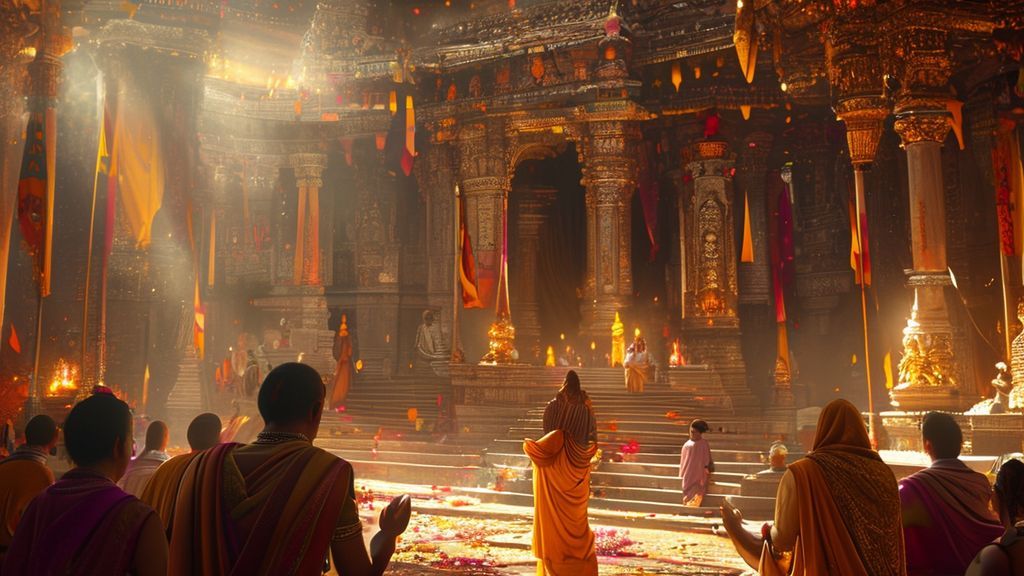
The Natya Shastra, attributed to the venerable Sage Bharata Muni, is the foundational ancient Sanskrit treatise on the performing arts of India. Hailed as the “fifth Veda” (Pañcama Veda), this encyclopedic work meticulously details drama, dance, and music, serving as the scriptural bedrock for classical Indian theatre and artistic expression, guiding devotees toward divine aesthetic experience.
| Attribute | Details |
|---|---|
| Deity/Author | Sage Bharata Muni (divine origin attributed to Brahma) |
| Text Type | Ancient Sanskrit Treatise (śāstra) |
| Core Subject | Performing Arts: Drama (Nāṭya), Dance (Nṛtta, Nṛtya), Music (Gāna), Aesthetics (Rasa theory) |
| Key Concepts | Rasa (aesthetic relish), Bhāva (emotion), Abhinaya (expression), Vācika (vocal), Āṅgika (gestural), Sāttvika (temperamental), Āhārya (costume/make-up) |
| Estimated Period | Between 200 BCE and 200 CE (with earlier oral traditions) |
| Scripture Reference | Primarily the Natya Shastra itself, with references in early Puranas and Epics. |
Introduction: The Cosmic Dance of Sanatan Dharma
In the vast tapestry of Sanatan Dharma, the performing arts are not mere entertainment but a profound pathway to spiritual realization. The Natya Shastra stands as the ultimate testament to this truth, encapsulating the entire spectrum of human emotion and divine expression. It is a sacred text, revered for its unparalleled wisdom, detailing how drama, dance, and music can elevate the consciousness, teach dharma, and connect the mortal with the transcendental. For sincere seekers and practitioners, the Natya Shastra is more than a manual; it is a scripture that reveals the very essence of aesthetic experience, known as Rasa, which is likened to the experience of Brahman itself – Rasovai Saha.
This monumental work, comprising over 6,000 ślokas across 36 chapters, is a complete guide to all aspects of stagecraft, from dramaturgy and musicology to choreography, costume, and audience engagement. It is the cornerstone upon which all classical Indian dance forms (Bharatanatyam, Kathakali, Odissi, Mohiniyattam, Kuchipudi, Manipuri, Sattriya) and classical music traditions (Hindustani and Carnatic) have been meticulously built. Understanding the Natya Shastra is essential for anyone wishing to grasp the depth and spiritual significance of India’s performing arts, which are integral to Hindutva.online‘s mission to preserve and promote Sanatan values.
Puranic History & Legend: The Fifth Veda’s Divine Genesis
The genesis of the Natya Shastra is steeped in divine legend, affirming its sacred status. As recounted within the text itself and alluded to in various Puranas, it is said that during the Treta Yuga, the Devas, led by Indra, approached Lord Brahma. They requested a new form of entertainment and instruction, accessible to all varnas, including the Shudras, who were unable to study the four Vedas directly. Brahma, the creator, recognizing the need for a means to convey ethical lessons (dharma), economic prosperity (artha), worldly pleasure (kama), and liberation (moksha) through a medium that was both pleasing to the senses and uplifting to the soul, decided to create the ‘Fifth Veda’ – the Natya Veda.
Lord Brahma extracted elements from each of the existing Vedas:
- He took words (vāc) from the Rig Veda.
- Melody (gīta) from the Sama Veda.
- Gesture (abhinaya) from the Yajur Veda.
- And the sentiment/aesthetic experience (rasa) from the Atharva Veda.
This composite creation was then imparted to Sage Bharata Muni, along with his hundred sons and twenty-four pupils, to be propagated on Earth. Bharata Muni is credited with codifying this divine knowledge into the comprehensive Natya Shastra. The first play, according to legend, was staged during the festival of Indra Dhvaja and depicted the victory of the Devas over the Asuras (Devasura Sangram), particularly focusing on Brahma’s victory over the Dānavas. This narrative, found in the Natya Shastra’s opening chapters, establishes the art form’s purpose as a vehicle for cosmic order and dharma. The reverence for this origin story underscores the spiritual foundation of all Indian performing arts, making them a form of Yajña, a sacred offering.
Architectural & Scientific Marvels: The Structure of Emotion and Expression
While the Natya Shastra is not a text on physical architecture, its internal structure and systematic exposition of the performing arts are an unparalleled marvel of scientific classification and psychological insight. It is an ‘architectural blueprint’ for human experience, meticulously mapping the subtle interplay of mind, body, and emotion. The text’s brilliance lies in its detailed categorization of:
- Rasa Theory: The most celebrated aspect, defining the eight primary Rasas (later nine with Shanta Rasa): Shringara (erotic), Hasya (comic), Karuna (pathetic), Raudra (furious), Vira (heroic), Bhayanaka (fearful), Bibhatsa (odious), Adbhuta (wondrous). Each Rasa arises from corresponding dominant emotions or Bhavas. This systematic analysis of aesthetic experience is a profound contribution to world aesthetics.
- Abhinaya (Expression): Divided into four types:
- Āṅgika Abhinaya: Expressing meaning through body movements (gestures of hands – *mudras*, head, eyes, neck, feet).
- Vācika Abhinaya: Expression through speech, intonation, poetic delivery, and rhythm.
- Āhārya Abhinaya: Expression through costume, make-up, and stage decor.
- Sāttvika Abhinaya: Expression through involuntary emotional reactions, true inner feeling (e.g., tears, trembling), which is considered the most profound.
- Musicology (Gāndharva): Chapters detail the concept of Svara (musical note), Gramas (scales), Murchhanas (melodic modes), Jatis (prototypes of ragas), Tala (rhythm), and instruments. It lays the groundwork for the highly sophisticated classical music systems of India.
- Dramaturgy (Nāṭya): Comprehensive guidance on playwriting, types of plays (e.g., *Nataka*, *Prakarana*), plot construction, characterization, dramatic metres, and even theatre space design (*mandapa*).
The scientific precision with which Bharata Muni analyzed the human psyche, emotion, and their outward manifestation through art is astonishing. It’s a testament to ancient Indian scholarship’s depth, demonstrating a holistic understanding that seamlessly integrates psychology, philosophy, and performance.
Rituals & Puja Vidhi: The Practice of Sacred Performance
For a sincere practitioner of the performing arts informed by the Natya Shastra, the engagement with the art form itself becomes a profound ritual, a form of spiritual discipline (sādhana). The Natya Shastra itself dedicates chapters to the proper setup of a theatre and the blessings required, indicating the sacred nature of performance.
- Guru Vandana: Before any practice or performance, the first step is always to offer reverence to the Guru (teacher), who embodies the living tradition and transmits knowledge. This is done through prostrations and prayers.
- Invoking Deities: Chanting specific mantras to deities associated with learning and performing arts, primarily Saraswati (Goddess of Knowledge), Nataraja (Lord Shiva as the Cosmic Dancer), and Sage Bharata Muni himself. The space where art is practiced is considered sacred.
- Śuddhi (Purity): Maintaining physical and mental purity is crucial. This includes personal hygiene and a focused, meditative mindset before commencing practice.
- Niyama (Discipline): Regular, dedicated practice (*abhyāsa*) is non-negotiable. This involves daily repetition of *adavus* (basic steps), *mudras* (hand gestures), vocal exercises, and internalization of *bhāvas*.
- Dhyana (Meditation): Before embodying a character or Rasa, an artist often meditates on the emotion or deity associated with it, ensuring the portrayal is authentic and deeply felt, rather than superficial.
- Rasa Anubhava (Experiencing Rasa): The ultimate goal is not just technique but experiencing and conveying Rasa, which requires a profound empathy and spiritual connection to the story or emotion being expressed.
- Samarpanam (Offering): The performance itself is an offering to the Divine, a *yajna*. The artist seeks to transcend the self and become a channel for divine expression.
Mantras & Chants: Evoking Divine Inspiration
For students and performers of the Natya Shastra, specific mantras and ślokas are chanted to invoke blessings, focus the mind, and express reverence for the art and its divine origin.
Saraswati Mantra for Knowledge:
ॐ ऐं ह्रीं क्लीं सरस्वती देव्यै नमः
Om Aim Hrim Klim Saraswati Devyai Namah
(Salutations to Goddess Saraswati, the embodiment of knowledge and arts.)
Nataraja Stuti (Salutation to the Cosmic Dancer):
आचार्याणो वपुर्यत्र नृत्तं यस्य विचेष्टितम्।
तस्मै नमो नमः शम्भोः नाट्यवेदाय विधीयते॥
Ācāryāṇo vapur yatra nṛttaṃ yasya viceṣṭitam.
Tasmai namo namaḥ śambhoḥ nāṭyavedāya vidhīyate.
(Where the body of the teacher is the dance, and the movements are His playful acts, to that Natya Veda of Lord Shiva, salutations again and again.)
A foundational principle from Natya Shastra, often chanted to remember the connection between gaze and gesture:
यतो हस्तस्ततो दृष्टिर्यतो दृष्टिरतो मनः।
यतो मनस्ततो भावो यतो भावस्ततो रसः॥
Yato Hastas Tato Drishti Yato Drishtis Tato Manah.
Yato Manas Tato Bhāvo Yato Bhāvas Tato Rasah.
(Where the hand goes, the eye follows. Where the eye goes, the mind follows. Where the mind goes, emotion (bhava) arises. Where emotion arises, aesthetic relish (rasa) is experienced.)
Dos and Don’ts: Ethical Conduct in Sacred Art
Practicing the arts guided by the Natya Shastra is a spiritual journey. Adherence to certain principles is vital for maintaining the sanctity and effectiveness of the tradition.
- DO: Approach the art form with utmost reverence and humility, recognizing its divine origin and purpose.
- DON’T: Treat the performing arts solely as a means of entertainment or personal gain, divorcing them from their spiritual and ethical foundations.
- DO: Dedicate yourself to rigorous and consistent practice (abhyāsa), understanding that mastery comes through discipline and devotion.
- DON’T: Engage in superficial imitation or distort the classical forms for momentary popularity without deep understanding.
- DO: Show profound respect to your Guru (teacher), who is the living embodiment of the tradition and the channel through which knowledge is imparted.
- DON’T: Disparage other forms of art or artists; instead, foster a spirit of mutual respect and learning.
- DO: Strive to understand the underlying philosophy, symbolism, and spiritual meaning of every gesture, lyric, and melodic phrase.
- DON’T: Compromise on the purity of the technique or the integrity of the storytelling.
Frequently Asked Questions
What are the fundamental elements of the Natya Shastra?
The Natya Shastra is built upon the pillars of Rasa (aesthetic relish), Bhāva (emotions), and Abhinaya (expressions). It meticulously describes how the eight primary Bhāvas lead to the experience of eight Rasas, conveyed through four types of Abhinaya – āṅgika (body), vācika (speech), āhārya (costume/make-up), and sāttvika (temperamental). It also covers music, dramaturgy, and stagecraft extensively.
Who was Sage Bharata Muni, and when did he live?
Bharata Muni is the legendary sage to whom the authorship of the Natya Shastra is attributed. While his historical existence is debated, tradition holds him as the divine recipient and codifier of the Natya Veda from Lord Brahma. Scholars generally date the compilation of the existing text to somewhere between 200 BCE and 200 CE, although its oral traditions are undoubtedly much older, possibly stretching back to the Vedic period.
Is the Natya Shastra relevant for contemporary performing arts?
Absolutely. The Natya Shastra remains profoundly relevant today, serving as the ultimate source text and theoretical framework for almost all classical Indian performing arts. Its principles of Rasa, Bhāva, and Abhinaya are timeless and universal, providing a deep psychological and aesthetic understanding that continues to inspire and guide artists, choreographers, musicians, and dramatists globally, ensuring the continuity of these ancient forms. Its insights on human emotion and communication transcend cultural boundaries.
Is the Natya Shastra only about dance?
No, the Natya Shastra is a comprehensive treatise on all aspects of the performing arts. While it includes extensive sections on dance (*Nṛtta* and *Nṛtya*) and gestural expression, it is equally focused on *Nāṭya* (drama), *Gāna* (music), poetics, prosody, stage design, costume, make-up, and even audience reception. It is an encyclopedic work that considers theatre a holistic art form, integrating various disciplines.
Dharmic Significance: Preserving Sanatan Dharma Through Art
The Natya Shastra is far more than an ancient textbook; it is a spiritual testament, a vibrant conduit for preserving and propagating Sanatan Dharma. By codifying the performing arts, Bharata Muni ensured that the profound philosophical, ethical, and devotional narratives of our Puranas, Itihasas, and Vedas could be experienced not just intellectually, but viscerally, through song, dance, and drama. It allows devotees to witness the exploits of Gods and Goddesses, the dilemmas of dharmic heroes, and the triumph of good over evil, fostering devotion (Bhakti), moral understanding (Dharma), and spiritual upliftment.
The pursuit of Rasa, the aesthetic experience, is equated with the experience of Brahman, making the performance and appreciation of these arts a path to spiritual awakening. In a world increasingly disconnected from its roots, the Natya Shastra reminds us that art is sacred, a powerful tool for cultural transmission and spiritual evolution. It reinforces our identity, connects us to our ancestors, and provides a timeless framework for expressing the beauty and truth of our ancient traditions, which Hindutva.online is dedicated to illuminating for future generations.