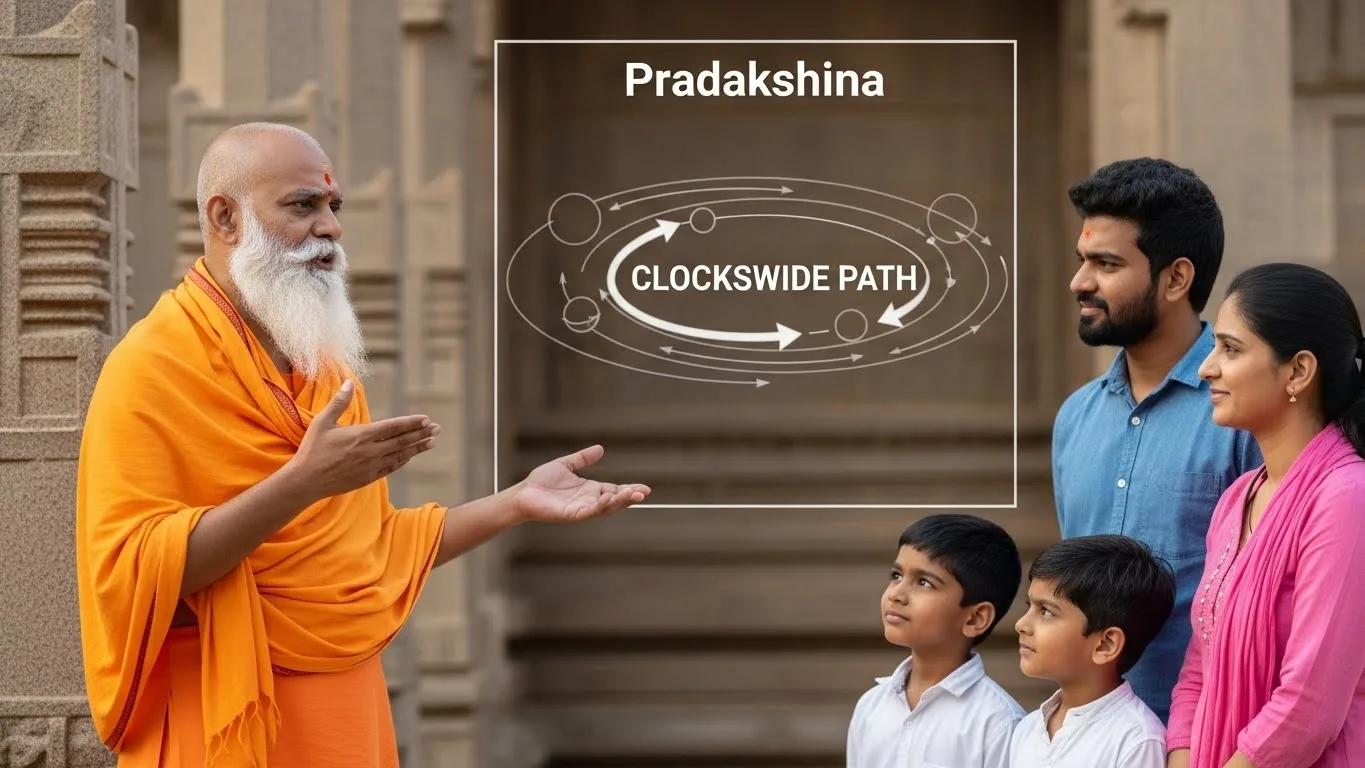
Hindus Circumambulate Temples Clockwise practice of pradakshina – from Sanskrit [translate:प्रदक्षिणा] meaning “to the right” or “moving with the right side toward” – represents one of Hinduism’s most universal yet profoundly significant rituals where devotees walk clockwise around temples, deities, sacred fires, holy trees, and pilgrimage sites keeping the sacred object or space on their right side throughout circular journey, embodying beautiful synthesis of devotional surrender recognizing God as life’s central axis around which everything revolves, cosmic alignment following sun’s apparent clockwise path across sky harmonizing human movement with natural forces governing universe, scientific energy dynamics.
where consecrated spaces function as energetic vortices drawing and emanating spiritual vibrations that devotees absorb more effectively through clockwise circumambulation aligning with Northern Hemisphere’s natural energy flow patterns, and symbolic journey representing soul’s cyclical movement through existence gradually shedding ego, ignorance, and material attachments with each completed circle bringing practitioner closer to divine center ultimately realizing non-separation between individual self and cosmic consciousness.
Unlike arbitrary tradition or mere physical exercise, pradakshina encodes sophisticated understanding of how directional movement affects subtle energy absorption from specially consecrated architectural structures designed as spiritual transmission devices where massive stone temples built through generations following precise Vastu principles and consecrated through elaborate Vedic rituals create powerful energy fields devotees consciously engage through pradakshina’s meditative walking meditation combining physical movement, mental focus through mantra repetition or silent prayer, and devotional emotion ([translate:bhava]) producing integrated experience addressing body (rhythmic walking improving circulation and grounding awareness), mind (focused attention calming mental chatter), and spirit (reverent circumambulation expressing loving surrender to divine presence).
The complete pradakshina practice involves understanding when to perform (typically after puja and darshan before leaving temple, though some devotees perform before entering as purification), how many circles to complete (odd numbers considered auspicious – 1, 3, 5, 7, 11, 21, or 108 depending on tradition and time availability with each repetition amplifying spiritual benefit), proper technique (maintaining deity/temple on right side, moderate steady pace neither rushed nor excessively slow.
folded hands or joined palms expressing reverence, silent mantra repetition or prayers, right shoulder toward center symbolizing offering heart directly to divine), and special exceptions like Shiva temples where complete circumambulation around linga forbidden in most cases due to presence of Nandi (Shiva’s vehicle) blocking full circle requiring instead half-pradakshina or specific modified patterns respecting sanctum’s sacred layout.
For practitioners in 2025 whether regular temple visitors incorporating pradakshina into weekly worship routine, pilgrims undertaking major circumambulations like Kailash parikrama or Govardhan parikrama spanning days or weeks covering dozens of kilometers, home altar devotees practicing miniature pradakshina around puja space maintaining tradition even without physical temple access, or curious seekers wanting to understand familiar practice’s deeper significance beyond mechanical repetition, recognizing pradakshina as sophisticated spiritual technology encoding profound wisdom about consciousness, energy, devotion, and cosmic alignment enables approaching.
this simple yet powerful practice with renewed appreciation transforming routine temple visit into conscious spiritual exercise where each clockwise step represents deliberate choice to organize life around divine center rather than ego, each completed circle affirms commitment to eternal truth beyond temporal concerns, and sustained practice gradually dissolves separate self-sense through repeated symbolic demonstration that we revolve around God rather than imagining ourselves as independent autonomous agents.
The Meaning and Symbolism of Pradakshina
Understanding profound layers of meaning encoded in this deceptively simple practice reveals sophisticated spiritual philosophy.
The Etymology: Breaking Down the Term
Sanskrit Analysis:
[translate:प्रदक्षिणा = प्र + दक्षिण]
- प्र (Pra): Prefix meaning “forward, onward, in front”
- दक्षिण (Dakshina): “Right side, south direction, skillful, auspicious”
Combined Meanings:
1. “To the Right”:
Most literal translation – keeping sacred object on right side while moving
2. “Moving Auspiciously”:
Dakshina implies auspiciousness, blessing – pradakshina means moving in blessed manner
3. “Offering to Divine”:
Dakshina also means offering/donation – pradakshina symbolizes offering oneself
Alternative Names:
- Parikrama (परिक्रमा): Northern India usage, from “pari” (around) + “krama” (step/walk)
- Pradakshina Namaskara: Full formal name emphasizing reverence
- Circumambulation: English equivalent lacking spiritual connotation
Hindus Circumambulate Temples Clockwise The Central Symbolism: God as Life’s Axis
Core Philosophical Teaching:
Pradakshina embodies fundamental truth that God is the center around which everything revolves – not ego, not worldly concerns, not material possessions.
The Circle’s Meaning:
Center = Deity:
- Represents Brahman (ultimate reality)
- Unchanging, eternal, still point
- Source and destination
- That which IS while all else becomes
Circumference = Devotee:
- Represents Jiva (individual soul)
- Moving, changing, evolving
- Orbiting around divine center
- Dependent, while center is independent
The Movement:
Clockwise Rotation:
- Following cosmic order ([translate:Rita])
- Harmony with natural forces
- Solar path alignment
- Positive energy generation
Teaching: Just as planets orbit sun, rivers flow to ocean, electrons circle nucleus – individual souls revolve around divine consciousness. Recognizing this truth (not intellectually but experientially through physical enactment) dissolves ego’s false centrality.
Devotional Surrender:
Each pradakshina step declares: “You are the center, not I”
Ego says: “I am the center of my universe; everything revolves around my needs, desires, opinions”
Pradakshina teaches: “God is the center; I revolve in devotional orbit offering my very movement as worship”
This physical demonstration gradually reprograms consciousness from ego-centered to God-centered existence.
The Shedding Journey: Removing Layers
Each Circle Represents:
Symbolic Removal:
Outer Circles (Initial Pradakshinas):
- Remove gross material attachments
- Money, possessions, status obsession
- Worldly desires and ambitions
- Social masks and pretenses
Middle Circles:
- Remove subtle emotional attachments
- Fear, anger, jealousy, pride
- Relationship dependencies
- Psychological conditioning
Inner Circles (Final Pradakshinas):
- Remove spiritual ignorance ([translate:Avidya])
- False identification with body/mind
- Sense of separate self
- Even attachment to devotion itself
The Ideal:
By pradakshina’s completion, only pure consciousness remains – no longer separate “I” walking around divine “You” but realization of non-duality.
The Cosmic Mirror: Reflecting Universal Patterns
Pradakshina Mirrors:
Astronomical Movements:
- Sun’s apparent path: East to West through South (clockwise in Northern Hemisphere)
- Moon’s orbit: Around Earth
- Planets’ revolutions: Around sun
- Stars’ apparent rotation: Around polar axis
Aligning human movement with cosmic movements creates harmony between microcosm (individual) and macrocosm (universe).
Natural Phenomena:
- Water whirlpools: Clockwise in Northern Hemisphere
- Wind patterns: Cyclones rotate clockwise above equator
- Energy vortices: Natural flow patterns
- DNA helix: Right-handed spiral
Teaching: Humans aren’t separate from nature – our spiritual practices should align with universal patterns, not contradict them.
The Journey of Life:
Birth to Death:
Pradakshina symbolizes complete life cycle:
- Starting point: Birth
- Circular path: Life’s experiences
- Completion: Return to source (death)
- Multiple circles: Reincarnation cycles
Each pradakshina = One lifetime
Multiple pradakshinas = Multiple births working toward liberation
The Path Back to God:
Not Linear but Circular:
Spiritual progress isn’t straight line from ignorance to enlightenment but spiral returning repeatedly to same points with deeper understanding each cycle.
Like circumambulating mountain – pass same landmarks but at higher elevation each round.
The Philosophical Depth:
Advaita (Non-Dual) Interpretation:
Apparent Duality:
- Walker (devotee) separate from center (God)
- Subject circling object
- Seeker seeking sought
Revealed Unity:
- Circle’s circumference has infinite points, all equidistant from center
- All points equally valid, none superior
- The walking itself IS the divine play
- Walker, walking, and walked-around ultimately one consciousness
Bhakti (Devotional) Interpretation:
Eternal Love:
- Circle has no beginning or end
- Devotee’s love for God is eternal
- God’s love for devotee is eternal
- Pradakshina physically manifests this endless love
The Dance:
- Devotee dances around beloved divine
- Like planets dance around sun
- Movement itself is music of devotion
- Joy found in journey, not just destination
This rich symbolic framework transforms simple walking into profound spiritual statement.
Why Clockwise? The Science and Cosmic Alignment
The specific direction proves crucial – not arbitrary preference but based on observable natural phenomena and energy dynamics.
The Northern Hemisphere Phenomenon
Sadhguru explains: “In the northern hemisphere of the planet, this is a natural phenomenon. If you notice closely, many natural phenomenon turn clockwise above the Equator and anticlockwise below it.”
Observable Examples:
Water Drainage:
- Bathwater draining clockwise (Northern Hemisphere)
- Anticlockwise (Southern Hemisphere)
- Coriolis effect from Earth’s rotation
Atmospheric Circulation:
- Cyclones/hurricanes rotate clockwise above equator
- Anticyclones in Southern Hemisphere rotate opposite
- Large-scale weather patterns follow this
Energy Flow:
- “The very energy system functions like this” (Sadhguru)
- Subtle energy (prana) flows clockwise in Northern Hemisphere
- Body’s energy channels align with this pattern
- Chakras spin accordingly
Implication:
Clockwise pradakshina aligns human movement with natural energy flow – swimming with current, not against it.
Cosmic Movements: Following the Sun
Sun’s Apparent Path:
From Earth’s perspective (Northern Hemisphere):
- Sun rises East
- Moves through South (highest point at noon)
- Sets West
- Absent in North (nighttime)
This creates clockwise arc when viewed from above North Pole.
Pradakshina mimics this:
- Devotee faces deity (center)
- Moves East → South → West → North → East
- Keeps deity on right (like sun on right during southward journey)
- Symbolically becomes sun orbiting divine
Other Celestial Bodies:
Moon’s orbit around Earth: Clockwise (from North Pole view)
Planets around Sun: Clockwise orbital direction (with minor exceptions)
Stars’ apparent rotation: Clockwise around polar axis
Teaching: Aligning human ritual with cosmic movements acknowledges we’re part of vast universal choreography, not separate from it.
The Energy Vortex: How Temples Function
Sadhguru clarifies: “Any consecrated space functions like a vortex which means that it reverberates, and it also draws.”
Temple as Energy Device:
Two-Way Flow:
1. Reverberation (Outward):
- Consecrated deity/sanctum emanates energy
- Radiates in specific patterns
- Creates energetic field around temple
- Measurable electromagnetic variations detected
2. Drawing (Inward):
- Simultaneously pulls energy inward
- Creates suction/vacuum effect
- Draws devotees’ consciousness toward center
- Facilitates absorption of sanctified vibrations
The Vortex Pattern:
Like water whirlpool:
- Energy spirals around center
- Clockwise rotation in Northern Hemisphere
- Maximum benefit when moving WITH spiral (clockwise)
- Moving against (counterclockwise) disrupts reception
Optimal Reception: Wet Clothes
Sadhguru’s Scientific Advice:
“If you want to derive benefit from or absorb the energy, you must go clockwise around it. If you want to benefit more, your hair should be wet. If you want to benefit even more, your clothes should also be wet.“
Why Wetness Matters:
Water as Conductor:
- Water conducts energy (electrical, subtle)
- Wet body/clothes more receptive to temple’s energetic field
- Dry body partially insulates
- Moisture creates better energetic interface
Traditional Practice:
Temple Water Bodies:
Every major temple traditionally had:
- Kalyani (water tank)
- Kulam (Tamil Nadu)
- Pushkarni (sacred pond)
Purpose: Devotees take ritual bath before entering, perform pradakshina with wet clothes maximizing energy absorption.
Modern Loss: Many temple tanks now dry or polluted, practice largely discontinued.
Scientific Validation:
Modern Research Shows:
Negative Ionization:
- Wet environments generate negative ions
- Associated with improved mood, mental clarity
- Enhanced energy reception
- Temples near waterfalls, rivers benefit from this
Electromagnetic Conductivity:
- Human body’s electromagnetic field
- Enhanced reception in moisture
- Similar to better radio reception in certain atmospheric conditions
The Magnetic Heart Hypothesis:
Some Theories Suggest:
Rightward Movement:
- Heart positioned left of chest
- Keeping temple on right means heart closer to deity
- Symbolic: Offering heart directly to God
- Possible subtle electromagnetic interaction
Scientific Studies:
Limited peer-reviewed research, but some measurements show:
- Altered brainwave patterns during pradakshina
- Increased alpha waves (relaxation, meditation)
- Heart rate variability improvements
- Stress hormone reduction
Requires further validation, but preliminary data suggests measurable physiological effects beyond placebo.
Why Not Counterclockwise?
Contraindicated Because:
- Against natural energy flow (Northern Hemisphere)
- Disrupts vortex pattern instead of harmonizing
- Symbolically backward – moving away from cosmic order
- Traditionally inauspicious – associated with negative rituals (rare tantric practices, cremation circumambulations)
Exception: Southern Hemisphere temples theoretically should practice counterclockwise, though most Hindu temples in Northern Hemisphere, so clockwise remains standard globally.
How to Perform Pradakshina: Proper Procedure
Understanding correct technique ensures maximum spiritual and energetic benefit.
When to Perform Pradakshina
Standard Temple Visit:
Typical Sequence:
- Enter temple after removing shoes
- Proceed to main sanctum
- Darshan (viewing deity)
- Offer prayers (archana, offering, donation)
- Perform pradakshina (circumambulate sanctum)
- Final prostration
- Exit
Pradakshina positioned AFTER darshan – having received divine grace, devotee circles in gratitude.
Alternative: Some perform pradakshina before entering sanctum as purification preparing consciousness for darshan.
Both valid – depends on tradition.
How Many Times: The Significance of Odd Numbers
Traditional Guidelines:
Odd numbers considered auspicious:
1 Circle:
- Minimum acceptable
- Quick worship
- Symbolic participation
- Better than none
3 Circles:
- Very common
- Represents Trimurti (Brahma-Vishnu-Mahesh)
- Past-Present-Future
- Body-Mind-Spirit
5 Circles:
- Five elements (earth, water, fire, air, ether)
- Pancha Pranas (five life forces)
- More elaborate worship
7 Circles:
- Seven chakras
- Seven days of week
- Complete purification
- Highly meritorious
11 Circles:
- Very auspicious number
- Extended meditation
- Deep devotion demonstration
21 Circles:
- Extremely devout practice
- Significant spiritual commitment
- Special occasions, vows
108 Circles:
- Ultimate devotion
- Sacred number in Hinduism
- Typically reserved for special vow fulfillment
- Entire mala (rosary bead count)
Why Odd Numbers?
Symbolic Completion:
- Even numbers considered incomplete, requiring pairing
- Odd numbers stand complete, whole
- 1 represents divine unity
- Other odd numbers multiples/derivatives of one
Practical:
- Prevents mechanical counting
- Maintains mindfulness
- Traditional preference without rigid rule
Proper Technique
Physical Posture:
Hands:
- Anjali mudra (palms joined) preferred
- Or hands folded over chest
- Some traditions: Right hand raised in blessing mudra
- Maintains reverent attitude
Facing:
- Deity/temple always on RIGHT side
- Devotee faces slightly inward toward center
- Not looking away from sacred space
- Maintains visual connection with deity (when visible)
Pace:
- Moderate, steady – neither rushed nor extremely slow
- Natural walking rhythm
- Some traditions: Measured, meditative slow pace
- Others: Normal comfortable walk
Feet:
- Barefoot traditional (shoes removed before temple entry)
- Grounding connection with earth
- Respectful humility
Mental State:
Consciousness Most Important:
Internal Focus:
- Maintain awareness of deity at center
- Not mechanical walking
- Devotional emotion (bhava)
- Surrender, reverence, love
Mantra Repetition:
Common Practices:
1. Deity’s Name:
- “Om Namah Shivaya” (Shiva)
- “Om Namo Narayanaya” (Vishnu)
- “Om Shri Ganeshaya Namah” (Ganesha)
- Repeat continuously during pradakshina
2. Silent Prayer:
- Personal conversation with deity
- Gratitude expression
- Petition for blessings
- Meditation on divine qualities
3. Pradakshina Mantra:
[translate:यानि कानि च पापानि जन्मान्तर कृतानि च।
तानि तानि विनश्यन्ति प्रदक्षिण पदे पदे॥]
“Whatever sins were committed in past births, they all get destroyed step by step through pradakshina.”
4. Mindful Silence:
- No specific mantra
- Simply aware presence
- Observing breath, footsteps
- Meditation in motion
Starting and Ending Point:
Convention:
- Start from North or East of sanctum (most traditions)
- Complete circle(s) returning to starting point
- Some mark position with small stone, coin
- Or mentally note starting location
Special Case: Shiva Linga Pradakshina Exception
Unique Pattern for Shiva Temples:
The Issue:
Most Shiva sanctums have Nandi (bull vehicle) positioned facing linga blocking complete circumambulation path.
Why Nandi Positioned There:
- Nandi eternally gazes at Shiva
- Devotee shouldn’t cross between Nandi and Shiva (interrupting eternal meditation)
- Sacred geometry of sanctum placement
The Solution: Half-Pradakshina (Ardha-Pradakshina)
Procedure:
- Start from North side (or designated point)
- Walk clockwise halfway around linga
- Stop when reaching Nandi
- Reverse direction (walk counterclockwise back)
- Return to starting point
Alternative: Walk clockwise until Nandi, cross to other side (staying far from linga), complete on opposite side.
Result: Never crossing between Nandi and linga while still circumambulating Shiva.
Why This Exception:
Respecting Sacred Arrangement:
- Nandi’s eternal darshan shouldn’t be interrupted
- Architectural sanctity maintained
- Shows understanding of temple’s deeper symbolism
Not All Shiva Temples:
- Some have Nandi outside allowing full circle
- Others have different layouts
- Follow specific temple’s convention
Frequently Asked Questions
Can we perform pradakshina at home around small altar?
Absolutely yes! Pradakshina perfectly valid for home worship. Approach: Even in small space, can walk around puja altar (if room allows) or perform symbolic mini-circles. Some traditions: Three small clockwise steps in place equals pradakshina when physical circumambulation impossible. Mental pradakshina: Visualize walking around deity – consciousness matters more than physical movement. Benefits same: Devotional surrender, God-centered focus, meditative practice. Adapting tradition: Small apartment? Walk clockwise in room where altar positioned. Every circular movement around sacred object counts.
What if temple built so pradakshina impossible (small sanctum, no corridor)?
Many older temples lack designated pradakshina path – especially small village shrines. Options: 1) Outer pradakshina: Walk around entire temple building from outside, 2) Symbolic: Stand before deity, turn in place clockwise, 3) Mental: Visualize circumambulation, 4) Modified: Whatever circular movement possible in available space. Remember: Tradition emphasizes consciousness over mechanics. Temple architecture varies – some without pradakshina paths still provide full darshan. Devotional flexibility: Adapt respectfully to each temple’s unique configuration.
Should children and elderly perform same number of circles?
Absolutely not mandatory! Pradakshina should be appropriate to individual capacity. Children: Even 1 circle teaches tradition; don’t force exhaustion creating negative association. Elderly/Disabled: One circle or even seated meditation equally valid. Pregnant women: Gentle pradakshina acceptable; listen to body. Sick devotees: Mental pradakshina sufficient. God values sincerity, not athletic performance. Better one reverent circle than 108 mechanical exhausted rotations. The elderly often perform mental pradakshina – visualizing walk while seated near sanctum – considered equally efficacious with proper devotional consciousness.
Can we talk or use phone while doing pradakshina?
Highly discouraged – defeats purpose! Pradakshina is meditative practice requiring focus. Traditional expectation: Silent contemplation, mantra repetition, or prayer. Modern problem: People walk while chatting, checking phones, discussing mundane matters. This transforms sacred practice into mundane exercise – missing spiritual benefit entirely. If must communicate: Step aside, pause pradakshina, complete conversation, then resume. Emergency calls: Understandable exception. Regular practice: Maintain silence and reverence. Teaching children: Pradakshina time is special quiet sacred activity, not playground. Respect others: Even if you’re casual, others may be deeply meditative – your chatter disturbs.
Is pradakshina around sacred trees (tulsi, peepal) same as temple?
Yes, equally valid and traditional! Sacred trees considered divine manifestations. Tulsi (Holy Basil): Worshipped as Lakshmi/Vishnu’s consort; pradakshina around tulsi plant very auspicious. Peepal (Ficus religiosa): Associated with Brahma, Vishnu, Mahesh; circumambulation brings blessings. Banyan: Lord Krishna associated. Procedure identical: Clockwise, odd numbers, devotional consciousness. Some consider more accessible than temples – tulsi plant in home allows daily pradakshina. Environmental benefit: Trees as worship objects promotes conservation. Ancient practice: Predates temples – nature worship foundational to Hinduism.
Why do some pilgrimage pradakshinas take days or weeks?
Major pilgrimage circumambulations (parikrama/parikarma) cover vast distances. Famous Examples: Mount Kailash Parikrama: 52 km, 3 days minimum, extreme altitude. Govardhan Parikrama: 21 km around sacred hill. Arunachala Pradakshina: 14 km around holy mountain. Narmada Parikrama: 2,600+ km along entire river – years! Why so extensive: Greater distance = greater devotion demonstration, purification, merit. Spiritual intensity: Multi-day walking meditation profoundly transformative. Physical challenge: Surrender of comfort, ego dissolution through difficulty. Barefoot tradition: Many pilgrims walk entire distance barefoot, amplifying sacrifice. Life-changing: Devotees report major spiritual breakthroughs.
Can non-Hindus perform pradakshina respectfully?
Most temples welcome respectful participation. Guidelines: 1) Understand significance – not tourist curiosity but sacred practice, 2) Follow protocol – clockwise, shoes off, modest dress, 3) Maintain reverence – silent or prayerful consciousness, 4) Respect restrictions – some temples limit inner sanctum to Hindus but allow outer pradakshina, 5) Ask permission – if uncertain, inquire with priest/guide. Many non-Hindus report profound spiritual experiences from pradakshina. Interfaith appreciation: Understanding enriches rather than appropriates. Universal symbolism: Circumambulation exists across religions (Muslim Hajj around Kaaba, Buddhist stupa circumambulation, Christian labyrinth walking). Hindu inclusivity: Tradition generally welcomes sincere seekers.
Does pradakshina really remove sins/bad karma?
Traditional belief: Yes, scriptural promises cite pradakshina’s purificatory power. Mantra states: “Sins from past births destroyed step by step.” How it works: Not magical erasure but consciousness transformation. Mechanism: 1) Devotional focus alters thought patterns creating positive karma, 2) Symbolic surrender (God as center) dissolves ego generating karmic bondage, 3) Meditative state quiets mind reducing future negative actions, 4) Energy cleansing – temples’ vibrations affect subtle body. Modern perspective: Whether literal karma destruction or psychological/spiritual transformation, sincere pradakshina positively impacts practitioner. Requires genuine devotion – mechanical walking without consciousness ineffective. Best approach: View as spiritual practice supporting overall transformation rather than magical sin-eraser while maintaining materialistic lifestyle unchanged.
Conclusion
The practice of pradakshina represents Hinduism’s beautiful integration of profound spiritual philosophy with accessible physical practice – encoding sophisticated understanding of cosmic alignment, energy dynamics, devotional surrender, and consciousness transformation in simple act of walking clockwise around sacred space, demonstrating that most powerful spiritual technologies need not require complex intellectual comprehension or specialized training but rather sincere devotion expressed through embodied practice literally putting philosophy into motion where each step becomes prayer, each circle affirms divine centrality, and sustained repetition gradually dissolves ego’s false sense of independence revealing eternal truth that individual soul always already revolves around supreme consciousness like planet orbiting sun, wave within ocean, breath within cosmic respiration.
Understanding complete framework – that clockwise direction isn’t arbitrary preference but alignment with Northern Hemisphere’s natural energy flow patterns observable in water drainage, atmospheric circulation, and subtle prana movements making devotee’s movement cooperative with rather than resistant to universal forces, that temples function as energetic vortices simultaneously emanating and drawing vibrations creating measurable fields devotees consciously engage through circumambulation especially effective when body wet (enhanced conductivity) explaining traditional temple water bodies’ significance, that symbolic meanings from God as life’s central axis through shedding attachments with each circle to mirroring astronomical movements harmonizing microcosm with macrocosm reveal multiple simultaneous.
truths operating in different dimensions, and that proper technique from maintaining deity on right through odd number repetitions to internal mantra or prayer creating meditative walking state maximizes both spiritual efficacy and practical benefits including stress reduction, mental clarity, and devotional deepening – enables approaching this universal practice with renewed appreciation,
whether temple regular incorporating pradakshina into weekly worship routine, pilgrim undertaking major circumambulations requiring days or weeks demonstrating extraordinary devotion through physical challenge and sustained meditative focus, or home practitioner maintaining tradition through miniature pradakshina around personal altar or even symbolic turning in place when space limited since tradition emphasizes consciousness over mechanical perfection making sincere devotion with simplified practice superior to elaborate technique lacking genuine surrender.
As you incorporate pradakshina into your 2025 spiritual practice, whether performing three quick circles after temple darshan maintaining basic traditional observance, undertaking 108 pradakshinas during special occasions fulfilling vows or celebrating important life events, walking sacred mountains or pilgrimage routes experiencing transformative multi-day circumambulation dissolving ego through physical challenge and sustained devotional focus, or simply circling home altar or sacred tulsi plant creating daily rhythm organizing household around divine center rather than purely secular concerns, remember that practice’s ultimate purpose transcends physical exercise or mechanical ritual performance toward conscious experiential recognition that God is center around which life revolves
not intellectual concept but embodied understanding demonstrated repeatedly through deliberate choice to place divine at axis while self moves in devotional orbit gradually shedding attachments, ignorance, and ego’s false centrality with each completed circle until eventually boundaries dissolve between devotee and deity, walker and walked-around, individual consciousness and cosmic consciousness revealing fundamental non-separation while paradoxically maintaining loving relationship.
since circle’s very existence requires both center and circumference, unity and diversity, transcendent reality and immanent presence dancing together in eternal sacred choreography we join through simple yet profound act of walking clockwise keeping God on right acknowledging that heart’s deepest truth points always toward divine beloved who remains eternally present awaiting only our conscious return through practices like pradakshina where philosophy becomes poetry, theology becomes dance, and walking becomes worship.
[translate:॥ परिक्रमा समाप्ता। ॐ शान्तिः शान्तिः शान्तिः॥]
(Parikrama is complete. Om peace, peace, peace.)
About the Author
Neha Kulkarni – Festivals, Vratas, and Devotional Practices Expert
Neha Kulkarni is a passionate advocate for Hindu festivals, vrat observances, and devotional practices, specializing in making traditional worship accessible and meaningful for contemporary families navigating modern life’s complexities while seeking authentic spiritual connection.
Drawing from personal experience growing up in traditional Maharashtrian family where temple visits always included reverent pradakshina around sanctum creating cherished memories of walking clockwise with joined palms while grandmother softly chanted mantras, combined with academic study of Hindu devotional literature, temple architecture, and ritual symbolism, her work focuses on explaining traditional practices’ deeper significance beyond mechanical performance while providing practical guidance for sincere observance.
Neha has extensively researched various Hindu devotional practices including pradakshina, aarti, puja procedures, and pilgrimage traditions, demonstrating how embodied rituals like circumambulation address universal human needs for rhythm, meaning, physical engagement with spiritual truths, and tangible methods for expressing abstract devotion through concrete actions anyone can perform regardless of intellectual sophistication or theological knowledge.
She regularly guides families and temple visitors through understanding and properly performing traditional practices like pradakshina, emphasizing that these aren’t arbitrary customs but sophisticated spiritual technologies encoding profound wisdom about consciousness, energy, devotion, and cosmic alignment in accessible physical forms, that sincere devotion with basic correct procedure proves more valuable.
than perfect technique lacking genuine bhava, and that maintaining traditional practices even in simplified modern contexts preserves cultural continuity while providing practically beneficial tools for spiritual development including stress reduction through meditative walking, mental focus through repetitive circular motion, and devotional deepening through symbolic surrender demonstrated physically by placing God at center around which self revolves rather than ego-centered existence treating divine as peripheral convenience.