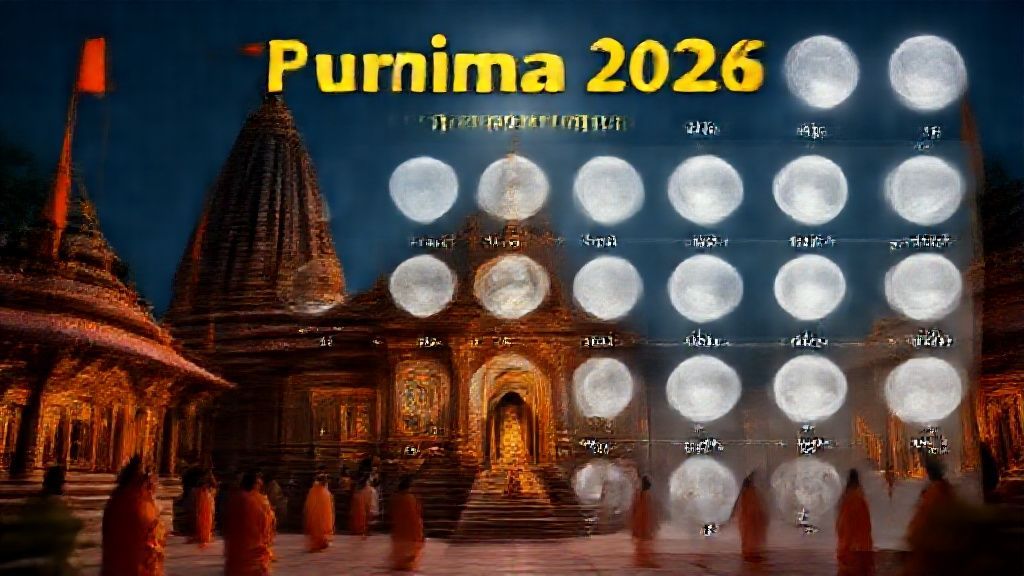
Purnima Dates 2026 mark the sacred full moon days in the Hindu lunar calendar, revered as auspicious times for spiritual practices, vratas, and ceremonies across Sanatan Dharma. Each Purnima, governed by specific astronomical alignments, carries unique religious significance, offering devotees profound opportunities for purification, introspection, and connecting with the Divine.
| Attribute | Details |
|---|---|
| Deity Associated | Chandra Dev (Moon God), Vishnu (especially Satyanarayan Swamy), Shiva, Devi, Krishna, and various specific deities depending on the month’s festival. |
| Significance | Day of ultimate lunar energy, spiritual zenith, ideal for fasting (Vrata), charity (Dana), sacred bathing (Snana), meditation, and performing specific Pujas. |
| Key Festivals | Holi Purnima, Hanuman Jayanti, Buddha Purnima, Guru Purnima, Raksha Bandhan, Sharad Purnima, Kartik Purnima (Dev Deepawali), Dattatreya Jayanti. |
| Scripture Reference | Vedas (Rig Veda mentions Soma/Moon), Puranas (Skanda Purana, Bhavishya Purana detail Purnima vratas), Upanishads (Chāndogya Upaniṣad on lunar cycles and consciousness). |
The Sanctity of Purnima: A Gateway to Divine Grace
In the vast tapestry of Sanatan Dharma, the Purnima Tithi, or the full moon day, holds profound spiritual and cultural significance. It is a moment when the lunar energy is at its peak, profoundly influencing the tides of the oceans and, subtly yet powerfully, the human mind (Manas). Our ancient Rishis, with their deep understanding of cosmic rhythms, designated each Purnima as uniquely sacred, aligning specific vratas (fasts), pujas, and spiritual practices with these celestial events. Far from being mere calendar dates, each Purnima is a spiritual milestone, a sacred portal offering devotees an enhanced opportunity to connect with the Divine, purify the self, and accumulate immense spiritual merit. It is a day of complete light, symbolically representing spiritual illumination and the culmination of positive energies.
Puranic Lore and the Cosmic Dance of Chandra Dev
The significance of Purnima is deeply rooted in our Puranas and Itihasas. Chandra Dev, the Moon God, is revered not merely as a celestial body but as a deity who presides over the mind, emotions, and fertility. As narrated in the Brahma Purana and Skanda Purana, Chandra emerged from the cosmic ocean during the Samudra Manthan, adorned with unparalleled coolness and brilliance. He is often associated with Soma, the divine nectar of immortality mentioned in the Rig Veda, which is believed to infuse life and sustenance into the plant kingdom and, by extension, all beings. The waxing phase (Shukla Paksha) leading up to Purnima is a period of increasing light and auspiciousness, symbolizing growth, prosperity, and spiritual ascension. Purnima itself is the zenith of this energy, a time when the mind is considered most receptive to higher vibrations and divine blessings. Various legends highlight specific Purnimas, such as the birth of Lord Hanuman on Chaitra Purnima, the enlightenment of Buddha on Vaishakha Purnima, and the significance of Guru Purnima, celebrating Vyasa, the compiler of the Vedas, as mentioned in the Bhavishya Purana. These narratives underscore the idea that Purnima is not just a date but a moment charged with sacred history and cosmic power.
Purnima Dates 2026: The Sacred Calendar
For sincere seekers and devotees planning their spiritual observances, understanding the precise Purnima Tithis for 2026 is paramount. Each of these days offers a unique opportunity for devotion and self-realization.
- Tuesday, January 13, 2026: Paush Purnima – Signifies the culmination of the austere Paush month, often associated with spiritual cleansing and the Satyanarayan Puja.
- Thursday, February 11, 2026: Magha Purnima – Particularly sacred for bathing in holy rivers, performing donations, and observing fasts, as extolled in the Padma Purana.
- Friday, March 13, 2026: Phalguna Purnima – Celebrated with immense joy as Holi Purnima, marking the triumph of good over evil through Holika Dahan.
- Sunday, April 12, 2026: Chaitra Purnima – Revered as Hanuman Jayanti, the appearance day of Lord Hanuman, celebrated with fervent devotion.
- Monday, May 11, 2026: Vaishakha Purnima – Also known as Buddha Purnima, commemorating the birth, enlightenment, and Mahaparinirvana of Gautama Buddha, and considered highly auspicious for charity.
- Wednesday, June 10, 2026: Jyeshtha Purnima – Observed by married women as Vat Purnima Vrat for the longevity and well-being of their husbands.
- Thursday, July 9, 2026: Ashadha Purnima – Celebrated as Guru Purnima, honoring our Gurus and spiritual preceptors, a day to express gratitude for their wisdom and guidance.
- Saturday, August 8, 2026: Shravana Purnima – A significant day for Raksha Bandhan, strengthening sibling bonds, and for Yajur Upakarma ceremonies.
- Monday, September 7, 2026: Bhadrapada Purnima – Marks the beginning of Pitru Paksha, a period dedicated to offering respects and rituals to ancestors.
- Tuesday, October 6, 2026: Ashwin Purnima – Known as Sharad Purnima or Kojagiri Purnima, believed to be the night when Devi Lakshmi descends to Earth, offering blessings.
- Thursday, November 5, 2026: Kartik Purnima – A highly auspicious Purnima, celebrated as Dev Deepawali in Kashi, Guru Nanak Jayanti, and for ritual bathing in holy rivers.
- Friday, December 4, 2026: Margashirsha Purnima – Observed as Dattatreya Jayanti, the appearance day of Lord Dattatreya, an incarnation of the Trimurti (Brahma, Vishnu, Shiva).
The Celestial Mechanics: Vedic Astronomy and Purnima
While often perceived through a spiritual lens, the calculation of Purnima Tithi is a testament to the sophisticated astronomical knowledge embedded in Sanatan Dharma. The ancient science of Jyotisha (Vedic Astrology) meticulously tracks the movements of celestial bodies, especially the Moon and Sun. Purnima occurs precisely when the Moon is in opposition to the Sun, signifying a complete illumination of the lunar disk from Earth’s perspective. The accuracy of these calculations, found in Siddhantic texts like the Surya Siddhanta, allowed our ancestors to predict these auspicious moments with incredible precision, many millennia before modern astronomy. This isn’t merely a marvel of engineering but a profound understanding of the cosmos as an interconnected system, where celestial alignments directly impact earthly life and consciousness. The concept of tithi, or lunar day, is a unique contribution of Vedic astronomy, dividing the lunar month into 30 specific segments, each carrying distinct energetic properties, with Purnima being the apex of lunar energy.
Sacred Rituals and Puja Vidhi for Purnima
Observing Purnima Vrata and performing associated pujas are time-honored traditions for seeking blessings and spiritual upliftment. The exact rituals may vary based on the specific Purnima and regional customs, but general guidelines prevail:
- Early Morning Snana: Devotees typically wake before sunrise and perform a sacred bath (Snana), preferably in a holy river or body of water, to cleanse the body and mind.
- Sankalpa: Take a solemn vow (Sankalpa) to observe the Vrata with dedication, articulating the spiritual goal.
- Fasting (Vrata): Many observe a full or partial fast, consuming only water, milk, or fruits. Some keep a strict Nirjala Vrata (without water).
- Satyanarayan Puja: The Satyanarayan Vrata Katha and Puja, dedicated to Lord Vishnu, are highly popular on almost all Purnimas for prosperity, well-being, and overcoming obstacles.
- Offerings: Offer fresh flowers, incense, lamps (Deepam), fruits, and sweets to the chosen deity.
- Chandra Arghyam: In the evening, after moonrise, offer water (Arghyam) to Chandra Dev as a mark of respect and gratitude.
- Charity (Dana): Donate food, clothes, or money to the needy, as acts of selfless giving are highly meritorious on Purnima.
- Meditation & Japa: Engage in meditation, recitation of mantras, or reading of sacred texts throughout the day.
Potent Mantras and Chants for Purnima
Chanting specific mantras on Purnima amplifies spiritual benefits, aligning the devotee’s consciousness with the cosmic energies of the full moon. Here are a few potent chants:
- For Chandra Dev:
ॐ श्रां श्रीं श्रौं सः चंद्रमसे नमः ॥
Om Shram Shrim Shraum Sah Chandramase Namah.
(This mantra invokes the blessings of the Moon God for peace of mind and emotional stability.) - Vishnu Mantra (for Satyanarayan Puja):
ॐ नमो भगवते वासुदेवाय ॥
Om Namo Bhagavate Vasudevaya.
(A universal mantra to invoke Lord Vishnu’s protection and grace.) - Gayatri Mantra:
ॐ भूर्भुवः स्वः तत्सवितुर्वरेण्यं भर्गो देवस्य धीमहि धियो यो नः प्रचोदयात् ॥
Om Bhur Bhuvah Svah, Tat Savitur Varenyam, Bhargo Devasya Dhimahi, Dhiyo Yo Nah Prachodayat.
(The universal prayer for wisdom and enlightenment, highly potent on Purnima.)
Dos and Don’ts on Purnima
To fully harness the spiritual potential of Purnima, devotees should adhere to certain practices and avoid others:
- Do: Observe fasts, perform puja, meditate, chant mantras, visit temples, engage in charity, bathe in holy waters, consume only Sattvic (pure) food.
- Don’t: Engage in materialistic pursuits, gossip, harbor negative thoughts, consume Tamasic (impure) food, cut hair/nails, or engage in violent acts.
Why is Purnima considered so sacred?
Purnima is considered sacred because it represents the zenith of the Moon’s cycle, signifying completeness and the highest expression of lunar energy. In Vedic cosmology, the Moon (Chandra) is directly linked to the mind (Manas), emotions, and fertility. On Purnima, these subtle energies are believed to be at their most potent, making it an ideal time for spiritual practices, introspection, and purification. Our scriptures emphasize that rituals performed on this day yield amplified spiritual benefits, aiding in karma purification and accelerating spiritual growth.
Which deities are primarily worshipped on Purnima?
While Chandra Dev (the Moon God) is universally honored on Purnima, various other deities are worshipped depending on the specific lunar month and associated festivals. Most prominently, Lord Vishnu is revered through the Satyanarayan Puja, performed widely on all Purnimas. Additionally, deities like Lord Hanuman (Chaitra Purnima), Goddess Lakshmi (Sharad Purnima), Lord Shiva, and spiritual teachers (Gurus on Guru Purnima) are worshipped according to the specific Purnima’s significance as detailed in Puranic texts and regional traditions across India.
Is fasting mandatory on Purnima?
Fasting (Vrata) on Purnima is a highly recommended spiritual discipline, but it is not strictly mandatory for all devotees. It is a personal choice and depends on one’s physical health, spiritual capacity, and the guidance of a Guru. Many observe a full fast (Nirjala Vrata), while others opt for a partial fast, consuming fruits, milk, or specific Sattvic foods. The essence lies in devotion, discipline, and sincere intent rather than rigid adherence. The primary purpose of the fast is to purify the body and mind, making them more receptive to divine energies, as explained in scriptures accessible on Hindutva.online.
Embracing Purnima: Preserving Sanatan Dharma and Fostering Spiritual Growth
The observance of Purnima dates, year after year, is far more than a calendrical practice; it is a profound act of preserving the eternal wisdom of Sanatan Dharma. Each Purnima reminds us of our intrinsic connection to the cosmos, the cyclical nature of time, and the ever-present opportunities for spiritual renewal. By honoring these sacred days through sincere devotion, prescribed rituals, and acts of selflessness, we not only accrue individual spiritual merit but also contribute to the collective spiritual well-being of humanity. These observances reinforce dharmic values, foster discipline, and provide regular touchstones for introspection in our otherwise busy lives. Through Purnima, the ancient Rishis bequeathed to us a potent mechanism for aligning with divine energies, ensuring that the flame of Dharma continues to illuminate our paths, guiding us towards peace, prosperity, and ultimate liberation. Let us embrace these auspicious days in 2026 with reverence and devotion, drawing closer to the divine truth that underpins our existence, finding deeper insights into the eternal wisdom available at Hindutva.online.
