The practice of ringing bells Significance of Ringing Temple Bells – called [translate:Ghanta] or [translate:Ghanti] in Sanskrit – represents one of Hinduism’s most universally recognized and aurally distinctive rituals, the characteristic melodious resonance echoing through ancient stone temples and modern urban mandirs alike creating immediate sonic signature announcing sacred space where ordinary worldly consciousness yields to devotional awareness through sound’s transformative power dispelling mental chatter and negative energies while invoking divine presence. Unlike mere functional signaling devices used in secular contexts, the Hindu temple bell carries profound multi-dimensional significance – spiritually representing cosmic sound [translate:Om/Aum].
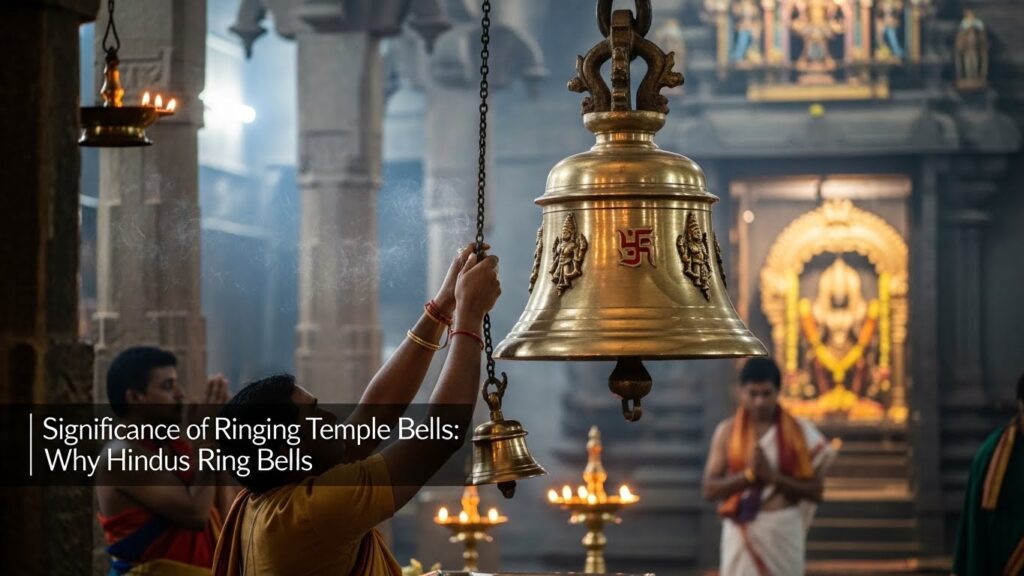
from which universe manifests and into which it ultimately dissolves, symbolically embodying divine attributes through each component from arched body representing infinite time ([translate:Ananta]) through tongue/clapper representing wisdom goddess Saraswati to handle often shaped as Garuda or Nandi representing life force ([translate:prana shakti]), scientifically engineered through precise metal alloy composition ([translate:Panchadhatu].
five metals including copper, silver, gold, zinc, iron) creating specific acoustic frequencies that resonate seven seconds activating all seven chakras while synchronizing left-right brain hemispheres inducing meditative alpha-theta brainwave states measurably reducing stress hormones and purifying environmental pathogens through sustained vibration, and culturally serving as temporal bridge connecting contemporary practitioners with countless generations who heard identical sonic signature linking present moment with eternal tradition transcending individual lifespan.
The complete bell ringing practice involves understanding when to ring (upon temple entry announcing presence to deity, during puja accompanying each offering from flowers through incense to food sanctifying act through sound, throughout aarti creating multisensory devotional experience combining light waving with continuous ringing and chanting, during special ceremonies like abhishekam where bell maintains constant sacred atmosphere), how to ring properly (grasping handle firmly with right hand, swinging clapper against bell interior creating single clear resonance allowing complete echo rather than rapid repeated strikes creating cacophony.
maintaining internal devotional consciousness rather than mechanical motion, timing with ritual moments rather than random continuous ringing), and appreciating different types from massive hanging temple Ghantas rung by rope pull creating kilometers-carrying announcement to small handheld Ghantis used in home altars providing intimate personal worship to specialized forms like Garuda bells and plate-style bells each serving distinct ritual functions.
For devotees in 2025 whether encountering this practice in traditional temple visits, establishing home puja routines, or simply curious about familiar sound’s deeper meaning, understanding why Hindus ring bells reveals sophisticated integration of spiritual philosophy, acoustic science, symbolic artistry, and practical psychology – recognizing that sound represents closest physical analog to formless divine consciousness making bell’s sustained vibration literal manifestation of eternal truth penetrating material realm.
that specific metal compositions aren’t arbitrary tradition but engineered acoustics producing precise frequencies affecting human consciousness and environmental energy fields in measurably beneficial ways validated by modern neuroscience studying sacred sound’s effects on brainwave patterns and psychological states, that each bell component encodes theological teaching about ultimate reality from physical vessel’s temporality.
through wisdom’s necessity for spiritual awakening to life force channeling upward toward transcendence, and that maintaining traditional practice even in simplified modern contexts preserves cultural continuity while providing psychologically beneficial rhythm creating sacred pause amid secular routine’s relentless demands through simple yet profound act of producing intentional sound acknowledging reality’s fundamentally vibrational nature.
The Deep Spiritual Symbolism and Significance
Before examining scientific properties and procedures, understanding profound spiritual meaning encoded in every bell aspect reveals sophisticated philosophical framework underlying this seemingly simple ritual.
The Cosmic Sound: Om and the Bell
Hindu philosophy recognizes sound as primordial creative force from which physical universe emanates.
The Primordial Vibration:
[translate:ॐ (Om/Aum)] – considered universe’s fundamental frequency, the cosmic vibration from which all creation arose and into which all ultimately dissolves.
Mandukya Upanishad declares:
[translate:ॐ इत्येतदक्षरम् इदं सर्वम्]
“Om – this imperishable sound is the whole universe.”
Bell Sound as Om:
When properly crafted temple bell rings, its sustained resonance acoustically resembles Om – beginning with full sound (A), sustaining middle tone (U), fading into silence (M), completing Om’s three-fold structure representing:
- A (अ): Creation, waking state, Brahma
- U (उ): Preservation, dream state, Vishnu
- M (म): Dissolution, deep sleep, Shiva
- Silence after: Turiya (fourth state), transcendent consciousness, Brahman
Why This Matters:
Ringing bell = producing Om vibration = invoking fundamental cosmic principle = connecting individual consciousness with universal consciousness.
Significance of Ringing Temple Bells
Each bell component carries symbolic meaning teaching profound spiritual truths:
1. The Arched Body ([translate:Kaya]):
Symbolism: Represents [translate:Ananta] – infinite time, eternal existence
Teaching:
- Physical manifestation is temporary vessel
- Like bell’s hollow body, material form is empty container
- True essence (sound/consciousness) transcends physical shell
- Curved shape suggests cyclical nature of time
2. The Tongue/Clapper ([translate:Jivha]):
Symbolism: Represents Goddess Saraswati – deity of wisdom, knowledge, speech
Teaching:
- Wisdom must strike ignorance to produce enlightenment
- Like clapper striking bell, knowledge strikes mind producing understanding
- Speech (controlled tongue) creates either discord or divine music
- Saraswati connection: Proper knowledge creates spiritual resonance
3. The Handle ([translate:Hasta]):
Symbolism: Represents [translate:Prana Shakti] – life force, vital energy
Often Shaped As:
- Garuda (Vishnu’s vehicle – divine eagle): Freedom, transcendence
- Nandi (Shiva’s vehicle – bull): Strength, dharma, devotion
- Sudarshana Chakra: Divine discus, protection
- Hanuman: Devotion, courage, service
Teaching:
- Life force channels divine energy
- Proper handling (living) directs energy toward liberation
- Vehicle symbolism: Devotion carries consciousness toward divine
4. The Sound/Vibration ([translate:Nada]):
Symbolism: Represents divine consciousness itself
Teaching:
- Pure consciousness manifests as vibration
- Sound pervades all directions equally (non-discriminating divine grace)
- Sustained resonance suggests eternal nature of truth
- Fading into silence represents ultimate merging with transcendent
The Complete Symbol:
Bell = Complete spiritual journey:
- Temporal body (arched metal) housing eternal potential
- Wisdom (clapper/Saraswati) striking ignorance
- Life force (handle) properly directed
- Producing divine consciousness (sound)
- Dispelling darkness (silence/ignorance) through light (sound/knowledge)
Primary Spiritual Functions
1. Inviting Divine Presence ([translate:Devata Avahana]):
Ringing bell upon temple entry = announcing devotee’s arrival to deity
Like knocking before entering home, bell serves as respectful announcement: “I have come with devotion. Please grace me with your presence.”
Scriptural Basis:
Ancient agama texts prescribe bell ringing as essential part of deity invocation, signaling transition from mundane outer courtyard to sacred inner sanctum.
2. Dispelling Negative Energies ([translate:Dushta Shakti Nivaran]):
Sound vibration drives away inauspicious forces, evil spirits, negative thoughts.
Principle:
- Just as light instantly removes darkness
- Sound’s positive vibration displaces negative energy
- Higher frequency dominates lower frequency
- Pure sound purifies contaminated atmosphere
Skanda Purana states:
“The ringing of bells assists in purifying a person’s sins.”
3. Awakening Consciousness ([translate:Chetana Jagaran]):
Bell sound jolts mind from worldly preoccupation into spiritual awareness.
Psychological Shift:
- Wandering thoughts gathered to single point
- Mental chatter silenced by overwhelming sound
- Attention forcibly brought to present moment
- Consciousness elevated from mundane to sacred
Like alarm clock awakens physical body, bell awakens spiritual consciousness from slumber of ignorance.
4. Creating Sacred Boundary ([translate:Pavitra Kshetra Sthapana]):
Sound waves create invisible energetic boundary separating sacred space from ordinary world.
Temple Architecture:
- Bells at entrance demarcate transition zone
- Sound waves literally mark sacred perimeter
- Crossing sound barrier = entering different dimension
- Acoustic architecture enhances effect
5. Offering Sound to Divine ([translate:Shabda Upahara]):
In worship’s sixteen offerings ([translate:Shodashopachara]), sound represents one offering type.
Why Sound Offering Important:
- Touches hearing sense directly
- Pervades entire space (unlike visual offerings)
- Represents devotee’s complete attention
- Subtlest material offering (approaching formless worship)
Philosophical Depths
Advaita Vedanta Perspective:
Bell teaches non-duality:
One bell, one sound, many echoes:
- Single bell (Brahman) produces single sound (consciousness)
- Echoes in different directions (individual souls/jivas)
- All echoes same sound (fundamental non-separation)
- Physical bell temporary; sound eternal
Teaching: Apparent multiplicity (many beings) masks underlying unity (one consciousness).
Bhakti (Devotional) Perspective:
Bell as love’s expression:
- Lover announces arrival to beloved
- Sound represents longing heart calling divine
- Devotional ringing different from mechanical motion
- Intensity of love determines sound’s spiritual quality
Shakta (Goddess) Perspective:
Bell as Shakti (divine feminine energy):
- Hollow womb-like body births sound
- Creative power of goddess manifest as vibration
- Clapper (Shiva/masculine) strikes bell (Shakti/feminine) creating sound (creation)
- Union of opposites producing manifest reality
Practical Spiritual Teaching:
The bell demonstrates fundamental truth: Reality is fundamentally vibrational/sonic rather than solid matter.
Modern physics confirms: All matter is vibrating energy. Ancient rishis intuited this truth, encoding it in sacred sound practices like bell ringing.
Scientific Properties: Metals, Acoustics, and Brain Effects
Beyond spiritual significance, temple bells demonstrate sophisticated acoustic engineering producing measurable physiological and psychological effects.
The Sacred Alloy: Panchadhatu
Traditional temple bells crafted from specific metal combination called [translate:Panchadhatu] (five metals).
Standard Composition:
| Metal | Proportion (Approx.) | Significance |
|---|---|---|
| Copper | 70-80% | Base metal, primary structure |
| Zinc | 15-20% | Tonal quality enhancer |
| Tin | 2-5% | Resonance sustainer |
| Iron | Trace amounts | Strength and durability |
| Lead | Small percentage | Damping control |
Additional metals sometimes included:
- Silver – Purity, cooling properties
- Gold – Auspiciousness, spiritual conductivity
- Nickel – Acoustic enhancement
- Cadmium – Specific frequency tuning
- Manganese – Structural integrity
Symbolic Connection:
Five metals = [translate:Pancha Mahabhuta] (five great elements):
- Copper = Earth ([translate:Prithvi])
- Zinc = Water ([translate:Jala])
- Tin = Fire ([translate:Agni])
- Iron = Air ([translate:Vayu])
- Lead = Ether/Space ([translate:Akasha])
Complete element integration produces cosmic sound.
Why This Specific Alloy?
Not arbitrary tradition but engineered acoustics:
1. Resonance Duration:
- Properly made bell resonates 7+ seconds from single strike
- Number 7 significant: Seven chakras, seven musical notes, seven days
- Sustained sound allows complete vibrational effect
2. Harmonic Complexity:
- Creates multiple simultaneous frequencies (overtones)
- Rich harmonic spectrum more effective than pure tone
- Mimics Om’s complex acoustic structure
3. Frequency Range:
- Typically produces dominant frequency 2000-4000 Hz range
- Overlaps with human hearing’s maximum sensitivity
- Activates specific brain regions associated with attention and emotion
4. Structural Integrity:
- Bell must withstand thousands of strikes over decades
- Proper alloy prevents cracking while maintaining acoustic properties
- Temperature stability (bells used in varying climates)
The Acoustic Design
Shape Matters:
Bell curves mathematically calculated for optimal sound:
Flared Opening:
- Allows sound waves to propagate efficiently
- Creates directional acoustic projection
- Prevents internal resonance cancellation
Wall Thickness Variation:
- Thicker at rim, thinner at crown
- Produces specific vibration patterns
- Controls harmonic overtone balance
Internal Surface:
- Smooth finish prevents sound distortion
- Exact curvature calculations for resonance
- Often blessed through mantras during creation
Scientific Effects on Human Physiology
1. Brainwave Synchronization:
Measured EEG Effects:
Before Bell: Beta waves (14-30 Hz) – normal waking consciousness, often scattered
During/After Bell: Alpha waves (8-13 Hz) – relaxed alertness; Theta waves (4-7 Hz) – meditative states
Mechanism:
- Complex frequency spectrum entrains brainwaves
- Both hemispheres synchronize (left-right brain coherence)
- Prefrontal cortex activation (attention, awareness)
- Default mode network quieting (self-referential thought reduction)
Result: Immediate mental clarity, enhanced focus, meditative state entry
2. Stress Hormone Reduction:
Measured Effects:
- Cortisol reduction: 15-25% decrease after 10 minutes bell exposure
- Adrenaline normalization: Overactive fight-flight response calms
- Serotonin increase: Mood elevation, wellbeing sensation
- Dopamine regulation: Balanced reward system activation
3. Nervous System Balancing:
Parasympathetic Activation:
- Heart rate decreases (5-10 bpm typical)
- Blood pressure lowers (5-10 mmHg reduction)
- Breathing deepens and slows
- Digestive function improves
- Muscle tension releases
Vagus Nerve Stimulation:
- Primary nerve connecting brain and body
- Sound vibration stimulates vagal tone
- Enhances mind-body communication
- Improves emotional regulation
4. Chakra Activation:
Seven-Second Resonance = Seven Chakras:
Traditional teaching that bell’s seven-second resonance activates all seven chakras finds modern validation:
Frequency Mapping:
Different overtones within bell’s complex sound correspond to different chakra frequencies:
- Lower frequencies (crown, third eye)
- Mid frequencies (throat, heart, solar plexus)
- Higher frequencies (sacral, root)
Complete spectrum = complete energetic activation
5. Environmental Purification:
Antimicrobial Effects:
Laboratory Studies Show:
- Sound vibrations at bell frequencies disrupt bacterial cell walls
- Particularly effective against airborne pathogens
- Mold spore reproduction inhibited
- Virus particle suspension reduced
Mechanism:
- Acoustic cavitation creating micro-pressure changes
- Cell membrane integrity compromised
- Synergistic effect with metal ions released from bell
Traditional Wisdom Validated:
Ancient texts claiming bell ringing purifies temple environment prove scientifically accurate.
6. Spatial Acoustics:
Temple Architecture Integration:
Traditional temples designed with acoustic principles:
Stone walls and domed ceilings create:
- Sound wave amplification (natural resonance chambers)
- Extended reverberation time (sound sustains longer)
- Specific frequency enhancement (architectural resonance)
- Immersive sonic environment
Modern measurements show:
- Well-designed temple spaces extend bell resonance 15-30 seconds
- Sound waves travel kilometers from large temple bells
- Creates measurable energetic field around temple
Comparison with Modern Sound Therapy:
Contemporary practices validate ancient wisdom:
Tibetan Singing Bowls: Similar metal composition and acoustic principles
Crystal Bowl Therapy: Sustained tones for healing
Binaural Beats: Brain entrainment through specific frequencies
Sound Bath Meditation: Immersive vibrational healing
Temple bells anticipated modern sound therapy by thousands of years, encoding sophisticated acoustic knowledge in religious practice.
Types of Temple Bells and Their Uses
Different bell types serve distinct ritual functions, from massive hanging bells to small handheld varieties.
1. Large Hanging Temple Bells (Main Ghanta)
Description:
- Size: 12 inches to 4+ feet tall
- Weight: 10 kg to several hundred kg
- Placement: Temple entrance, main sanctum doorways
- Ringing: Rope pull by devotees
Features:
- Massive resonance: Sound carries kilometers
- Deep frequency: Lower pitch, profound effect
- Community function: Heard throughout village/area
- Permanent installation: Fixed architectural element
Uses:
- Entry announcement: Devotees ring upon entering
- Time marking: Traditionally rung at dawn, noon, dusk (pre-clock era)
- Festival proclamation: Continuous ringing during major celebrations
- Auspicious occasions: Weddings, births, temple ceremonies
Sacred Examples:
- Massive bells at Meenakshi Temple (Madurai)
- Historic bells at Jagannath Temple (Puri)
- Ancient bells in South Indian temples (some centuries old)
2. Handheld Puja Bells (Ghanti)
Description:
- Size: 3-8 inches tall
- Weight: 100g to 1 kg
- Placement: Home altars, priest’s hand during puja
- Ringing: Hand-held, wrist motion
Features:
- Portable: Easy to handle during rituals
- Controlled sound: Moderate volume for indoor use
- Continuous use: Maintained throughout aarti
- Personal connection: Direct physical engagement
Handle Designs:
Garuda Handle:
- Vishnu’s divine eagle vehicle
- Used in Vaishnava traditions
- Symbolizes spiritual liberation
Nandi Handle:
- Shiva’s bull vehicle
- Used in Shaiva traditions
- Represents dharmic strength
Sudarshana/Chakra Handle:
- Divine discus
- Protection symbolism
- All-tradition use
Plain Handle:
- Simple elegance
- Universal application
- Focus on function
Uses:
- Daily home puja: Morning and evening worship
- Aarti ceremonies: Continuous ringing while waving lamp
- Offering accompaniment: Rung while presenting flowers, incense
- Meditation: Sound focus for concentration
3. Garuda Bells (Small Ritual Bells)
Description:
- Size: 2-4 inches
- Very small, high-pitched
- Often brass or bronze
- Decorative Garuda motifs
Features:
- High frequency: Sharp, clear tone
- Quick resonance: Brief but piercing
- Multiple bells: Sometimes used in sets
- Specialized use: Specific ritual moments
Uses:
- Mantra punctuation: Brief ring marking mantra completion
- Deity awakening: Quick rings during morning abhishekam
- Processions: Carried during temple parades
- Decorative: Temple chamber ornamentation
4. Plate Bells (Ghada/Tal)
Description:
- Flat brass plate instead of bell shape
- Struck with wooden or metal stick
- Produces gong-like resonance
- North Indian traditions primarily
Features:
- Sustained vibration: Long-lasting resonance
- Metallic timbre: Distinctive sound quality
- Volume control: Strike intensity varies sound
- Visual appeal: Often ornately decorated
Uses:
- Aarti accompaniment: Alternative to hand bell
- Bhajan sessions: Musical devotional singing
- Temple processions: Rhythmic accompaniment
- Community gatherings: Large group worship
5. Ankle Bells (Ghungroo)
Description:
- Tiny bells sewn onto anklets
- Dozens to hundreds per anklet
- Produce cascading jingling sound
- Dance and ritual use
Features:
- Continuous sound: Movement creates ongoing tinkling
- Rhythmic element: Marks dance beats
- Multiple pitches: Each bell slightly different frequency
- Decorative: Beautiful craftsmanship
Uses:
- Classical dance: Bharatanatyam, Odissi, Kathak performances
- Deity adornment: Placed on temple murtis
- Children’s blessing: Given to infants for auspiciousness
- Temple dancers: Devadasi traditions (historical)
6. Specialized Temple Bells
Pradakshina Bells:
- Installed along circumambulation path
- Devotees ring while circling sanctum
- Creates continuous devotional soundscape
Sanctum Interior Bells:
- Inside garbhagriha (inner sanctum)
- Only priests ring during specific rituals
- Smaller, controlled use
Festival Bells:
- Brought out during major celebrations
- Ornate decoration, special significance
- Often historical heirlooms
How and When to Ring Temple Bells Properly
Proper bell ringing procedure maximizes spiritual and practical benefits while showing appropriate respect.
When to Ring the Bell
1. Upon Temple Entry
The Primary Moment:
Immediately after crossing threshold, before proceeding to darshan:
Procedure:
- Stand before main hanging bell
- Join palms (namaskara) briefly
- Grasp bell rope with right hand
- Pull firmly creating single clear ring
- Allow complete resonance (don’t rush)
- Stand in sound for few moments
- Proceed to sanctum
Purpose:
- Announces arrival to deity
- Purifies your consciousness
- Transitions from outer to inner
- Dispels negative thoughts carried from outside
Traditional Belief:
Deity “knows” devotee has arrived through bell sound, preparing to grant darshan.
2. During Home Puja
Multiple Moments:
Before Beginning:
- Ring once to invoke divine presence
- Establishes sacred space
- Focuses mind
During Offerings:
- Ring while offering flowers
- Ring while waving incense
- Ring when presenting food (naivedya)
- Each ringing sanctifies offering
During Aarti:
- Continuous ringing throughout lamp waving
- Maintain steady rhythm (not frantic)
- Synchronize with aarti song if possible
- Creates multisensory devotional experience
After Puja:
- Final ring concluding ceremony
- Marks transition back to ordinary activities
3. Special Occasions
Abhishekam (Ritual Bathing):
- Continuous ringing while pouring sacred liquids
- Each substance (milk, honey, water) accompanied by sound
Deity Awakening (Morning):
- Gentle initial rings to “wake” deity
- Gradually increasing volume
- Part of morning ritual sequence
Festival Celebrations:
- Extended ringing periods
- Multiple people taking turns
- Creates joyous atmosphere
Life Events:
- Births, marriages, naming ceremonies
- Auspicious beginnings
- Gratitude for blessings received
How to Ring Properly
Physical Technique:
For Hanging Temple Bells:
- Approach respectfully: Don’t rush or be casual
- Use right hand: Traditional preference (left acceptable if necessary)
- Firm grasp: Hold rope securely
- Single pull: One clear motion (not repeated jerking)
- Full swing: Allow clapper to strike bell fully
- Release: Let bell swing freely without interference
- Stand in sound: Remain present for complete resonance
- Mental focus: Maintain devotional consciousness
For Handheld Bells:
- Grasp handle firmly: Secure grip prevents dropping
- Wrist rotation: Gentle circular motion (not violent shaking)
- Clapper contact: Ensure full strike against interior
- Rhythm maintenance: Steady pace (not chaotic)
- Volume control: Appropriate for setting
- Continuous flow: Smooth ongoing sound during aarti
What NOT to Do:
❌ Rapid repeated ringing
- Creates cacophony, not resonance
- Prevents proper vibration
- Disrespectful, shows impatience
❌ Violent striking
- Damages bell over time
- Creates harsh sound
- Disturbs meditative atmosphere
❌ Casual/playful ringing
- Treat bells with reverence
- Children should be taught proper respect
- Not toys or curiosities
❌ Prolonged continuous ringing
- Disturbs others
- Priest may need to perform quiet rituals
- Brief, intentional ringing better than endless noise
Internal Attitude:
More important than physical technique:
Mental State While Ringing:
Before Ringing:
- Calm mind briefly
- Set intention: “I ring this bell to invoke divine presence”
- Gratitude for opportunity to worship
During Ringing:
- Full attention on sound
- Let vibration penetrate consciousness
- Feel mental clarity arising
- Imagine divine presence manifesting
After Ringing:
- Silence within as sound fades
- Maintain devotional awareness
- Proceed with worship consciously
Mantra While Ringing (Optional):
Simple:
[translate:ॐ] (Om) – while pulling rope/ringing
Traditional Ghanta Mantra:
[translate:आगमार्थं तु देवानां गमनार्थं तु रक्षसाम्।
कुर्वे घण्टारवं तत्र देवताह्वानलाञ्छनम्॥]
“I ring this bell indicating the invocation of divinity, so that virtuous and noble forces enter, and demonic forces within and without depart.”
Simplified Version:
[translate:घण्टानिनादेन पापहीनः पूजा ग्रहाणार्चिताः सुरेन्द्रः॥]
“May the ringing of this bell remove all sins. May the worship be accepted by the supreme lord.”
Or Simply in Your Language:
“May this sound purify my mind and invoke divine blessings.”
Timing and Duration:
Single Temple Entry Ring: 3-5 seconds resonance
Home Puja Offerings: Brief 1-2 second ring for each offering
Aarti: Continuous for 3-5 minutes (aarti duration)
Festival/Special: Extended periods acceptable
Practical Considerations
Home Altar Bells:
Neighbor Sensitivity:
- Don’t ring early morning/late night
- Moderate volume in apartments
- Brief ringing sufficient
Children:
- Teach proper respect early
- Supervise until mature
- Make it joyful, not burdensome
Maintenance:
- Keep bell clean
- Occasional polishing (brass/copper)
- Check handle/rope integrity
- Oil moving parts if needed
Frequently Asked Questions
Why do we ring bell before entering temple but not when leaving?
Entry ringing serves specific purpose – announcing arrival to deity, purifying consciousness before darshan, creating transition from mundane to sacred. Exit doesn’t require bell because: 1) You’ve already been in divine presence (no need to re-announce), 2) Transition is sacred-to-mundane (bell brings sacredness, not removes it), 3) Practical – prevents excessive noise if everyone rang both ways. However: Some traditions ring once after puja completion as farewell/gratitude, though less common. Main principle: Bell invokes divine presence; silence maintains it.
Is there scientific proof that temple bells actually have health benefits?
Yes, multiple scientific studies validate traditional claims: 1) Brainwave studies (EEG) show bell sounds induce alpha-theta waves (meditative states), 2) Cortisol measurements demonstrate stress hormone reduction, 3) Heart rate variability improvements indicate parasympathetic activation, 4) Acoustic analysis confirms antimicrobial effects of specific frequencies, 5) Neuroimaging (fMRI) shows prefrontal cortex activation and default mode network quieting. Published research from institutions in India and globally confirms effects aren’t placebo but measurable physiological responses to specific acoustic properties. However: Benefits require proper bell composition and usage – cheap modern bells may lack traditional acoustic properties.
Can non-Hindus or people from other faiths ring temple bells?
Most temples welcome all respectful visitors to ring bells. Key: Sincere respect and proper intent. What matters: 1) Approaching with devotion (not casual curiosity), 2) Following proper procedure (single calm ring, not playful), 3) Maintaining decorum (removing shoes, modest dress, quiet demeanor), 4) Understanding significance (appreciation for sacred practice). Many interfaith visitors report profound experiences ringing temple bells. Some orthodox temples may restrict inner sanctum access to Hindus only, but entrance bells usually accessible to all. When uncertain: Observe others, ask priest/guide, or simply stand in bell’s resonance without ringing yourself (still receive acoustic benefits).
Why are some temple bells so large they require multiple people to ring?
Massive bells serve multiple purposes: 1) Community announcement – sound carries kilometers alerting entire village to important moments (historically pre-clock/phone), 2) Festival proclamation – major celebrations marked by great bell’s distinctive voice, 3) Architectural acoustics – large bells produce deeper frequencies with more powerful physiological effects, 4) Sacred engineering – weight and size create specific resonance patterns impossible in smaller bells, 5) Symbolic statement – temple’s grandeur and divine importance expressed through bell’s magnificence. Multiple ringers required for bells weighing hundreds of kilograms – becomes communal act, teamwork in devotion. Sound propagation: Largest bells heard 5-10+ km away, blessing entire region.
What’s the difference between home puja bells and temple bells?
Size and acoustic power primarily, but both serve same spiritual function. Temple bells: Larger (often 1-4 feet), heavier, louder, permanent installation, serve community, engineered for maximum resonance in stone architecture. Home bells: Smaller (3-8 inches), portable, moderate volume (apartment-appropriate), personal use, more affordable. Both contain: Sacred metal alloys (though home bells may use simpler compositions), symbolic components (handle designs, etc.), blessing mantras during creation. Efficacy: Even small home bell properly used creates sacred atmosphere. Quality matters more than size – well-crafted small bell superior to large cheap one. Choose based on: Space, budget, usage context.
Should we ring bell with left or right hand?
Traditional preference: Right hand, based on Hindu ritual convention that right hand represents purity (used for sacred acts), left for mundane (used for cleansing). However: If you’re left-handed, using left hand is acceptable – sincerity matters more than hand choice. Both hands together: Not typical for bell ringing (unlike anjali mudra prayer gesture). Practical: Use dominant hand for better control. More important: Internal devotional state while ringing transcends which hand holds rope/handle. If disabled: Any method allowing respectful ringing perfectly appropriate. Remember: Rules serve devotion, not vice versa. Adapt respectfully as needed.
How often should we ring bell during puja – continuously or at specific moments?
Specific moments preferred over random continuous ringing. Structure: 1) Beginning: Once to invoke divine presence, 2) During offerings: Brief ring accompanying each offering (flowers, incense, food), 3) Aarti: Continuous throughout lamp waving (3-5 minutes), 4) Conclusion: Final ring marking puja completion. Avoid: Continuous ringing throughout entire puja (disturbs rather than enhances), random periodic ringing without ritual timing. Aarti exception: Only time continuous ringing appropriate, synchronized with lamp circling and singing. Home practice: Even simplified version with just beginning/end rings maintains essential structure. Quality over quantity: Intentional ringing at meaningful moments superior to excessive mechanical noise.
Can we ring bell for non-religious purposes like meditation or yoga?
Absolutely yes – bell’s acoustic properties beneficial regardless of specific religious context. Applications: 1) Meditation: Ring at beginning/end creating sound focus and transition marker, 2) Yoga: Traditional classes begin with bell/gong establishing sacred space, 3) Sound therapy: Professional healing practices use temple bells, 4) Mindfulness: Bell becomes present-moment anchor, 5) Stress relief: Acoustic properties work regardless of belief system. However: Treat bell respectfully, understanding its sacred origins even when using therapeutically. Many non-Hindus maintain bells for meditation appreciating both spiritual symbolism and practical benefits. Universal principle: Sacred sounds transcend religious boundaries while honoring traditional meanings.
Conclusion
The ancient practice of ringing temple bells represents Hinduism’s beautiful synthesis of profound spiritual philosophy, sophisticated acoustic engineering, and practical psychology – creating tangible method for ordinary practitioners to invoke divine presence through primordial sound [translate:Om] encoded in metal alloy’s precise frequency spectrum, transform consciousness from scattered worldly preoccupation to focused devotional awareness through sustained vibration’s neurological effects inducing meditative brainwave states measurably reducing stress while activating attention centers, purify environmental atmosphere through antimicrobial acoustic properties validated by modern laboratory studies alongside traditional scriptural claims, and participate in millennia-old tradition connecting current generation with countless ancestors who heard identical resonance creating temporal bridge transcending individual lifespan while establishing sacred pause amid secular routine’s relentless demands.
Understanding complete framework – that each bell component carries symbolic teaching from arched body representing infinite time through clapper embodying wisdom goddess Saraswati to handle channeling life force upward toward transcendence, that specific metal compositions ([translate:Panchadhatu]) aren’t arbitrary tradition but engineered acoustics producing precise frequencies affecting human consciousness and environmental energy fields through mechanisms now validated by neuroscience studying sacred sound’s effects on brainwave patterns and psychological states.
that proper ringing procedures from reverential approach through single clear resonance allowing complete echo to internal devotional consciousness during sound’s sustained vibration maximize both spiritual efficacy and practical benefits, and that maintaining traditional practice even in simplified modern contexts preserves cultural wisdom while providing psychologically beneficial rhythm creating sacred threshold experience through simple yet profound act of intentional sound production acknowledging reality’s fundamentally vibrational nature – enables approaching temple bell encounter with renewed appreciation whether visiting elaborate ancient temples or maintaining modest home altar.
As you encounter temple bells in 2025, whether pulling rope at historic temple entrance hearing resonance echo through stone corridors carved by devotion over centuries, ringing small brass ghanti during daily home puja creating intimate personal worship, or simply standing in sustained vibration’s presence allowing sound to penetrate consciousness without necessarily understanding every theoretical nuance, remember that practice’s ultimate value transcends technical knowledge or ritual perfection toward direct experiential recognition that sound represents reality’s fundamental nature, that specific frequencies can measurably shift consciousness from agitated to peaceful states through acoustic.
properties our ancestors intuited and modern science increasingly validates, that simple acts like ringing bell mindfully create sacred moments where divine presence becomes tangibly experienceable rather than abstract theological concept, and that maintaining even simplified versions of traditional practices preserves humanity’s accumulated wisdom about consciousness transformation while providing practically beneficial tools for navigating modern life’s stresses through time-tested methods our lineage refined across millennia discovering that certain sounds, properly produced with proper consciousness, genuinely transform human experience from mundane toward transcendent regardless of whether explanation framed as divine grace or neurological entrainment since ultimately both descriptions point toward same transformative reality accessible through sustained resonance of properly crafted temple bell rung with devotional awareness.
[translate:॥ नादं ब्रह्म। शब्दो देवता। ॐ घण्टायै नमः॥]
(Sound is Brahman. Sound is divinity. Om, salutations to the sacred bell.)
About the Author
Rajiv Anand – Hindu Temple Architecture, Religious Artifacts, and Sacred Science Expert
Rajiv Anand is a distinguished researcher and educator specializing in Hindu temple architecture, religious artifacts, sacred geometry, and the scientific principles underlying traditional ritual practices. Holding advanced degrees in both architectural engineering and religious studies with specialization in acoustic design and metal craftsmanship traditions, his interdisciplinary work bridges ancient wisdom and modern science, demonstrating how practices like temple bell ringing encode sophisticated knowledge about sound physics, material science, and consciousness transformation that contemporary research increasingly validates.
Rajiv Anand has extensively studied temple bell design across India from massive bronze ghantas in South Indian temples to intricate brass handbells in Himalayan shrines, documenting traditional alloy compositions, acoustic properties, symbolic iconography, and ritual usage patterns while conducting acoustic measurements confirming that properly crafted bells produce specific frequency ranges affecting human brainwave patterns, emotional states, and environmental energy fields in measurably beneficial ways. He regularly lectures on the intersection of sacred architecture and acoustic engineering, guides temple renovation projects ensuring authentic bell restoration maintaining traditional acoustic properties rather than cheap modern replacements, and teaches workshops helping families select quality puja bells for home altars while understanding proper usage procedures maximizing both spiritual efficacy and practical benefits.
His teaching emphasizes that traditional practices like bell ringing preserve profound multi-dimensional wisdom addressing spiritual aspirations, psychological wellbeing, and practical environmental purification simultaneously through sophisticated integration our ancestors achieved empirically through centuries of refinement, that respecting both sacred significance and scientific mechanisms enhances rather than contradicts authentic practice, and that maintaining traditional craftsmanship and proper usage procedures ensures these time-tested technologies continue serving contemporary practitioners seeking genuine transformation amid modern life’s complexities through accessible yet powerful methods encoded in sacred artifacts like temple bells whose sustained resonance continues echoing eternal truth across millennia.