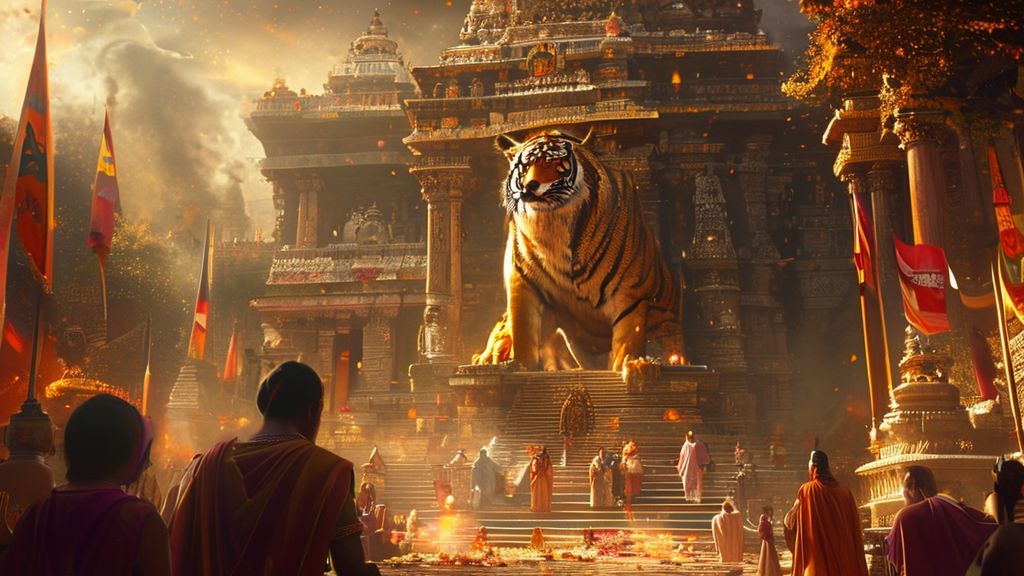
A Tiger Dream in Hinduism, particularly when associated with Durga’s Vahana (mount), the magnificent Vyaghra, symbolizes divine protection, the conquering of negative energies, awakening inner strength, and the imminent arrival of Maa Durga’s benevolent power to overcome life’s challenges, urging the devotee towards steadfast Dharma and righteous action.
| Attribute | Details |
|---|---|
| Deity Associated | Maa Durga (शक्ति, Shakti), the Divine Mother, embodiment of cosmic energy and power. |
| Vahana (Mount) | Vyaghra (व्याघ्र – Tiger) or Simha (सिंह – Lion). Both represent ferocity and primal power. |
| Key Symbolism | Divine Protection, Conquering Evil (inner and outer), Uncontrolled Power under Divine Command, Courage, Dharma, Destruction of Ignorance. |
| Scripture Reference | Devi Mahatmya (part of Markandeya Purana), Kalika Purana, Skanda Purana, Devi Bhagavata Purana. |
| Dream Interpretation | Call to action, spiritual guidance, impending success over obstacles, strengthening of resolve, manifestation of divine grace. |
The Vyaghra: Embodiment of Primal Power and Divine Command
In the vast tapestry of Sanatan Dharma, animals are not mere creatures but profound symbols, often serving as Vahanas (divine mounts) for our revered deities. These Vahanas embody specific attributes of the deity, acting as extensions of their divine power and will. Among these, the Vyaghra (tiger) or Simha (lion) as the mount of Maa Durga holds a singularly powerful significance. It represents unbridled primal force, raw energy, and the ferocity of nature itself, all brought under the benevolent control of the Divine Mother. To dream of this majestic creature, especially in the context of Maa Durga, is not a mere nocturnal fantasy but a profound spiritual communication, a direct message from the cosmic realms, guiding the sincere devotee towards deeper introspection and righteous action.
Such a dream is a powerful reminder of the ever-present divine protection and the dynamic nature of Shakti, the cosmic energy that governs creation, preservation, and dissolution. It signals a moment of spiritual awakening, urging the individual to confront their fears, vanquish inner demons, and embrace the courage required to navigate life’s challenges with unwavering faith in the Divine Mother’s grace. This guide will illuminate the profound scriptural basis, symbolism, and spiritual implications of a tiger dream in Hinduism, particularly when viewed through the lens of Durga’s sacred vahana.
Puranic History & The Legend of Durga’s Vyaghra
The origins of Maa Durga and her formidable mount are beautifully narrated across various Puranas, primarily the Devi Mahatmya, a sacred text embedded within the Markandeya Purana. This scripture details the genesis of Durga from the collective effulgence and wrath of the Devas, who, unable to defeat the formidable Asura Mahishasura, invoked the Supreme Shakti. From their combined energies emerged a radiant goddess, blazing with divine power. Each Deva then offered her their weapons and symbols – Shiva his trident, Vishnu his discus, Vayu his bow and quiver, Agni his spear, and so forth.
Regarding her vahana, the Devi Mahatmya describes Durga manifesting fully armed and mounted, poised for battle. While often depicted with a lion (Simha), many traditions and iconographic representations, especially in Bengal and parts of Eastern India, distinctly portray her with a tiger (Vyaghra). The Kalika Purana and Skanda Purana further elaborate on Durga’s divine attributes and her role as the vanquisher of evil, often emphasizing the ferocious yet controlled power of her mount. The tiger, known for its stealth, strength, and predatory prowess, embodies the very essence of destruction – not for malevolence, but for the annihilation of negativity, ignorance, and ego (अहंकार, Ahankara). It signifies that the primal, untamed aspects of nature and the human psyche are utterly subservient to the Divine Mother’s will. The dream of a tiger in this context is therefore an invocation of this very power, a divine prompt to embody strength and overcome obstacles, much like Durga herself on the battlefield.
The Symbolic Marvel: Durga’s Vyaghra and the Dream State
While not an architectural marvel in the traditional sense, the symbolism of Durga’s Vyaghra is a profound marvel of spiritual engineering, a blueprint for understanding divine power and its manifestation in the universe and within our own consciousness. The tiger, or Vyaghra, is a creature of immense strength, speed, and ferocity. Yet, when Maa Durga rides upon it, she is depicted with serene composure, her multiple arms wielding formidable weapons, effortlessly controlling this untamed beast. This visual paradox is a deep philosophical statement: Durga represents the mastery over primal instincts, the subjugation of raw passion (राजस गुण, Rajas Guna) and ignorance (तामस गुण, Tamas Guna) by pure consciousness (सात्विक गुण, Sattvic Guna).
A Tiger Dream in Hinduism, therefore, is rarely a simple omen of good or bad luck. It is a potent communication from the subconscious, often guided by divine grace. It signifies that Maa Durga is actively involved in your life, preparing you to confront challenges with immense courage and inner strength. The dream might indicate:
- Mastery Over Adversity: Like Durga taming the tiger, you are being empowered to overcome formidable obstacles, both external and internal.
- Awakening of Shakti: It signals the stirring of your own dormant divine energy, your inner strength, and resilience.
- Protection and Guidance: A clear sign that the Divine Mother’s protective gaze is upon you, guiding you through turbulent times.
- Confrontation of Inner Demons: The tiger’s ferocity can represent our own uncontrolled desires, anger, or fears. The dream is a call to tame these aspects under the guidance of spiritual wisdom.
It is a profound spiritual prompt, urging the devotee towards righteous conduct and unwavering faith, echoing the timeless wisdom available on Hindutva.online for spiritual seekers.
Rituals & Puja Vidhi After a Tiger Dream
Upon experiencing a significant dream such as one involving Maa Durga’s Vyaghra, a devotee is encouraged to engage in specific spiritual practices to honor the divine message and strengthen their connection with the Divine Mother. While there isn’t a single prescriptive “Tiger Dream Puja,” these actions are deeply rooted in traditional Durga worship:
- Morning Ablutions & Sankalpa: Rise early, perform a ritual bath (स्नान, Snana) to purify the body. Then, sit in a clean space and take a Sankalpa (संकल्प) – a sacred vow or intention – to perform puja for Maa Durga, acknowledging the dream as a divine sign.
- Offering to Maa Durga: Perform a simple Durga Puja. This can include:
- Dhyana (ध्यान): Meditate on the form of Maa Durga riding her tiger, visualizing her strength and compassion.
- Avahana (आवाहन): Invoke her presence.
- Aasan (आसन): Offer her a symbolic seat.
- Pushpa (पुष्प): Offer fresh flowers, especially red ones like hibiscus.
- Dhupa & Deepa (धूप-दीप): Light incense and a lamp (ghee or oil).
- Naivedya (नैवेद्य): Offer sweets (like halwa, kheer) or fruits.
- Arati (आरती): Conclude with the waving of a lamp.
- Mantra Japa: Chant Mantras dedicated to Maa Durga with utmost devotion. This is a powerful way to absorb and channel the divine energy signified by the dream.
- Reading of Scriptures: Recite verses from the Devi Mahatmya or Devi Suktam.
- Charity & Seva: Perform an act of charity (दान, Dana) or selfless service (सेवा, Seva) in the name of Maa Durga. This amplifies the positive energy and fulfills the karmic aspect of receiving divine guidance.
These actions help consecrate the dream’s message, transforming it into a proactive spiritual endeavor.
Mantras & Chants for Maa Durga and Her Vahana
Chanting sacred Mantras is a direct way to connect with the divine energy of Maa Durga and to invite her protection and blessings. When contemplating a dream of her Vyaghra, these chants can deepen your spiritual experience and harness the strength it represents:
- Navarna Mantra (नवाक्षर मंत्र): The nine-lettered mantra is considered the most powerful for Durga worship.
ॐ ऐं ह्रीं क्लीं चामुण्डायै विच्चे॥
Om Aim Hreem Kleem Chamundaye Vichche.
(This mantra invokes the three primary aspects of the Devi – Mahasaraswati, Mahalakshmi, and Mahakali – for knowledge, wealth, and destruction of negativity.) - Durga Beej Mantra (दुर्गा बीज मंत्र): A potent seed sound for Maa Durga.
ॐ दुं दुर्गायै नमः॥
Om Dum Durgaye Namaha.
(Salutations to Durga, who removes all difficulties.) - Sarva Mangala Mangalye Mantra (सर्व मंगल मांगल्ये):
सर्व मंगल मांगल्ये शिवे सर्वार्थ साधिके। शरण्ये त्र्यम्बके गौरि नारायणि नमोऽस्तु ते॥
Sarva Mangala Mangalye Shive Sarvartha Sadhike. Sharanye Tryambake Gauri Narayani Namoऽstu Te.
(Salutations to Narayani, who is the auspiciousness of all that is auspicious, the benevolent one, the fulfiller of all desires, the refuge, the three-eyed one, the fair-complexioned one.) - Dhyana Sloka for Durga on Vyaghra: While there are many, visualizing her with her mount is key.
सिंहस्था शशिशेखरा मरकतप्रख्या चतुर्भुजा। शंखं चक्रधनुः शरांश्च दधती नेत्रैस्त्रिभिः शोभिता॥
Simhastha Shashishekhara Marakataprakhya Chaturbhuja. Shankham Chakradhanuh Sharamshcha Dadhati Netraistribhih Shobhita.
(Seated on a lion (or tiger), with the moon on her forehead, radiant like an emerald, four-armed, holding a conch, discus, bow, and arrows, adorned with three eyes.)
Dos and Don’ts After Such a Divine Indication
Interpreting a divine dream requires mindful conduct to fully receive and act upon the guidance. Here are some essential Dos and Don’ts:
- Dos:
- Maintain Purity: Keep your body, mind, and surroundings clean.
- Practice Devotion: Increase your daily puja, meditation, and mantra chanting.
- Reflect & Introspect: Consider what challenges you are facing and how the dream might relate.
- Be Fearless Yet Humble: Embrace the courage signified by the tiger, but remain grounded and devoted.
- Engage in Seva: Offer selfless service to others or to temples.
- Seek Guidance: If unclear, consult with a trusted Guru or experienced spiritual elder for interpretation.
- Don’ts:
- Ignore the Message: Do not dismiss the dream as mere coincidence; it holds significance.
- Fear or Panic: The tiger represents divine protection, not harm. Do not let fear overtake you.
- Engage in Negative Actions: Avoid anger, deceit, greed, or harming others. These go against the spirit of Maa Durga.
- Boast or Seek Attention: Keep your spiritual experiences humble and personal.
- Procrastinate: If the dream seems to point to a specific action or change, do not delay.
Frequently Asked Questions About Tiger Dreams
Is a dream of Durga’s tiger always a positive omen?
While generally positive and indicative of divine protection and strength, it is more accurately interpreted as a powerful spiritual prompt. It signifies that you are being called to embody courage, confront obstacles, or awaken your inner strength. It’s an encouragement to actively engage with life’s challenges from a place of spiritual fortitude, rather than a passive promise of “good luck.”
What if the tiger in my dream appears aggressive or frightening?
An aggressive tiger in a dream related to Durga’s vahana often symbolizes the internal or external obstacles that appear formidable. Maa Durga’s presence with her Vyaghra means that even these fierce challenges are under her divine control. The dream might be urging you to confront your fears head-on, assuring you that the divine power is with you to conquer these aggressive forces, be they inner demons or external adversaries. It’s a call to find your own inner ferocity for righteousness, guided by the Mother.
How does Durga’s tiger differ from her lion?
In various Puranic traditions and regional iconography, Maa Durga is depicted riding either a Simha (lion) or a Vyaghra (tiger). Both creatures are apex predators, embodying courage, strength, and ferocity. The distinction is often symbolic or regional. In many Bengali and Eastern Indian traditions, the tiger is her prominent vahana, emphasizing its solitary power, stealth, and untamed nature, which she rides with serene command. The lion is also a widely accepted mount, symbolizing regal power and dominance. Both convey the message that the Divine Mother masters the most powerful and untamed forces of creation, using them for the protection of Dharma.
What is the spiritual significance of seeing the tiger carrying me in a dream?
To be carried by the tiger in a dream can be a profound experience, signifying that Maa Durga herself is guiding and protecting you through a difficult period. It suggests that you are being uplifted and supported by divine grace, empowering you to navigate treacherous paths with confidence. It indicates that you are aligning with the powerful energies of the Divine Mother, allowing her to bear your burdens and lead you towards victory and spiritual advancement.
Why This Matters for Every Hindu
The profound symbolism of a Tiger Dream in Hinduism, especially one featuring Maa Durga’s Vyaghra, transcends mere superstition. It is a vital thread in the fabric of Sanatan Dharma, reminding us that the divine is not distant but intimately involved in our lives, constantly communicating, guiding, and empowering. Such dreams serve as powerful affirmations of faith, encouraging devotees to tap into their innate courage, confront negativity, and uphold righteous living. They reinforce the fundamental teaching that true strength comes from aligning with divine will and surrendering to the Supreme Shakti.
In a world often riddled with doubt and challenges, these divine communications serve as a beacon, illuminating the path of Dharma and reminding every Hindu that the boundless protection and formidable power of the Divine Mother are always accessible. To honor such a dream is to honor one’s own spiritual journey, fortifying one’s resolve and deepening the eternal connection to the universal consciousness, as elucidated through the rich spiritual heritage preserved at Hindutva.online. It is a call to awaken the inner Durga, the unyielding spirit that triumphs over all adversities for the establishment of peace and righteousness.