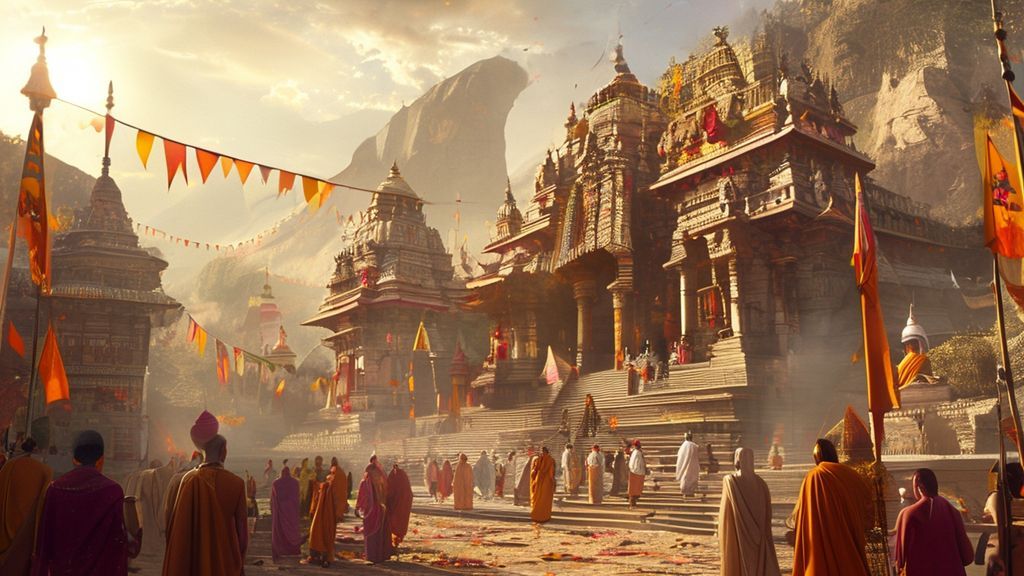
The Char Dham Yatra in Uttarakhand—comprising the sacred abodes of Badrinath, Kedarnath, Gangotri, and Yamunotri—represents a profound spiritual pilgrimage into the Himalayas, while the Haridwar Kumbh Mela, held every twelve years, is a monumental congregation for ritual purification through bathing in the holy Ganga. Both are pillars of Sanatan Dharma’s enduring spiritual heritage.
| Attribute | Details |
|---|---|
| Deities (Char Dham) | Lord Vishnu (Badrinath), Lord Shiva (Kedarnath), Goddess Ganga (Gangotri), Goddess Yamuna (Yamunotri) |
| Location/Origin (Char Dham) | Garhwal Himalayas, Uttarakhand, India. Ancient sites revered since time immemorial, re-established by Adi Shankaracharya. |
| Key Festival (Char Dham) | Akshaya Tritiya (Temple Openings), Diwali (Temple Closures) |
| Scripture Reference (Char Dham) | Skanda Purana (Kedarkhanda mentions these sites), Mahabharata, Puranas. |
| Deity (Kumbh Mela) | River Ganga, associated Devas and Rishis, Sanatan Dharma itself. |
| Location/Origin (Kumbh Mela) | Haridwar, Uttarakhand. One of the four sites where drops of Amrita fell during Samudra Manthan. |
| Key Festival (Kumbh Mela) | Maha Kumbh Mela (every 12 years), Ardha Kumbh Mela (every 6 years), determined by specific astrological conjunctions of Sun, Moon, and Jupiter. |
| Scripture Reference (Kumbh Mela) | Bhagavata Purana, Vishnu Purana, Padma Purana, Skanda Purana (details the Samudra Manthan event). |
Introduction to Uttarakhand: Dev Bhoomi’s Sacred Heart
Uttarakhand, reverently known as Dev Bhoomi (Land of the Gods), is a hallowed realm where the very air hums with spiritual energy. Nestled in the majestic lap of the Himalayas, this sacred state is home to some of Sanatan Dharma’s most venerated sites, chief among them the Char Dham Yatra and the magnificent Haridwar Kumbh Mela. These pilgrimages are not mere journeys; they are transformative odysseys, pathways to purification, self-realization, and ultimately, moksha. For millennia, seekers and sages have braved the challenging terrains to connect with the divine energies enshrined within these ancient temples and confluence points.
The Char Dham, a circuit of four divine abodes, represents a microcosm of the spiritual quest, guiding devotees through the worship of Vishnu, Shiva, Ganga, and Yamuna. Simultaneously, the Kumbh Mela at Haridwar is an unparalleled spectacle of faith, where millions gather for a celestial dip in the Ganga, believing it cleanses sins and grants liberation. Together, these sites embody the living tradition of Hinduism, a profound testament to faith, devotion, and the timeless pursuit of the divine.
Puranic History and Legend: Echoes of the Divine
The Genesis of Char Dham
The origins of the Char Dham temples are steeped in ancient lore, deeply etched in our Itihasas and Puranas, affirming their eternal sanctity.
- Badrinath: The abode of Badri Vishal, Lord Vishnu, where He is said to have performed intense penance for the welfare of humanity. As chronicled in the Skanda Purana’s Kedar Khanda and passages from the Mahabharata, Lord Nara and Narayana (two forms of Vishnu) meditated here. Adi Shankaracharya, in the 8th century CE, is credited with retrieving the idol of Badri Vishal from the Alaknanda River and re-establishing the temple.
- Kedarnath: Dedicated to Lord Shiva, this revered Jyotirlinga is intimately linked with the Pandavas. After the Mahabharata war, seeking absolution for their kinslaying, they were advised by Lord Krishna to worship Shiva. The Kedar Khanda of the Skanda Purana vividly narrates how Shiva, initially disguised as a bull, submerged himself to avoid them, reappearing in different parts, with His hump manifesting at Kedarnath.
- Gangotri: The mythical source of the holy River Ganga, whose celestial descent to earth was brought about by the relentless penance of King Bhagiratha. The Ramayana and Bhagavata Purana detail Bhagiratha’s extraordinary tapasya, performed for thousands of years, to bring the Ganga to purify the ashes of his ancestors. This sacred spot marks the point where Ganga first touched the earth.
- Yamunotri: The origin of the revered River Yamuna, daughter of Surya Dev (Sun God) and sister of Yama (God of Death). According to the Puranas, Sage Asit Muni had his hermitage here and bathed daily in both Ganga and Yamuna. When he became too old to visit Ganga, a stream of Ganga miraculously appeared beside Yamuna for his convenience, signifying the profound devotion that attracts divine grace.
The Eternal Saga of Kumbh Mela
The Kumbh Mela finds its legendary genesis in the timeless Hindu scripture, the Bhagavata Purana, the Vishnu Purana, and the Padma Purana, which describe the momentous Samudra Manthan, the churning of the cosmic ocean. This epic endeavor, undertaken by both Devas (gods) and Asuras (demons), was to extract the pot (Kumbh) of Amrita (elixir of immortality).
During a fierce twelve-day (equivalent to twelve human years) battle for the Amrita, the divine carrier Garuda flew with the pot. It is believed that drops of the Amrita fell at four sacred locations: Haridwar, Prayagraj (Allahabad), Nashik, and Ujjain. These hallowed spots became the rotating venues for the Kumbh Mela, where the celestial energies of immortality are believed to reside during specific astrological configurations. The Haridwar Kumbh Mela specifically occurs when Jupiter is in Aquarius (Kumbha Rashi) and the Sun is in Aries (Mesha Rashi), making the waters of Ganga especially potent for purification.
Architectural & Scientific Marvels of Dev Bhoomi
The spiritual essence of Uttarakhand is powerfully manifested in its temple architecture and the sheer logistical feat of events like the Kumbh Mela.
Architectural Resilience in the Himalayas
The Char Dham temples, though structurally distinct, share a common thread of resilience against harsh Himalayan conditions:
- Badrinath Temple: Located on the banks of the Alaknanda, this temple showcases a unique blend of ancient and regional Himalayan architecture, largely rebuilt after earthquake damages. Its vibrant, colorful facade contrasts with the stark mountain backdrop. The Tapt Kund, a natural thermal spring, demonstrates geothermal activity, a scientific marvel used by pilgrims for centuries.
- Kedarnath Temple: A magnificent stone edifice, standing tall at an altitude of 11,755 feet, is a testament to ancient Indian engineering. Built with massive grey stone slabs, interlocked without mortar, it has withstood countless natural calamities. Its construction, attributed to the Pandavas and later reconstructed by Adi Shankaracharya, showcases a robust Nagara style, adapted for the mountain environment.
- Gangotri and Yamunotri Temples: These temples, situated at the sources of their respective rivers, are simpler, yet profoundly spiritual structures, primarily reflecting the natural beauty and sanctity of their surroundings. Built from local stone and wood, they blend seamlessly with the pristine Himalayan landscape.
The Kumbh Mela: A Grand Human Endeavor
The Kumbh Mela is not merely a religious gathering but an extraordinary display of human organization and faith. The temporary city that springs up for millions of pilgrims, complete with roads, electricity, sanitation, and security, is a modern scientific and logistical marvel. Managing the immense crowds, ensuring safety during the “Shahi Snans,” and providing essential services on an ephemeral infrastructure is a testament to India’s unique capacity for spiritual mobilization. This ancient tradition seamlessly integrates with modern urban planning and crowd management techniques, embodying a harmonious blend of the archaic and the contemporary.
Rituals & Puja Vidhi: The Path to Divine Connection
Engaging with the sacred sites of Uttarakhand involves specific rituals, each designed to deepen the devotee’s spiritual experience.
Performing the Char Dham Yatra
The traditional sequence for the Char Dham Yatra is Yamunotri, Gangotri, Kedarnath, and Badrinath, symbolizing a journey from the west to the east, culminating at the grand abode of Vishnu. At each destination, pilgrims follow prescribed rites:
- Yamunotri: Begin with a purifying bath in the holy waters of the Yamuna, preferably at the Janki Chatti. Offer puja at the main temple, offering prayers to Goddess Yamuna. Many perform Pind Daan (ancestral rites) here.
- Gangotri: Take a sacred dip in the icy waters of the Ganga, especially at the Bhagirathi Shila, believing it cleanses all sins. Offer prayers and perform Ganga Aarti at the temple dedicated to Goddess Ganga.
- Kedarnath: Perform Darshan of the revered Jyotirlinga, offering Bel Patra, milk, and flowers. Circumambulate the temple (Parikrama) and soak in the powerful Shiva energy.
- Badrinath: Bathe in the Tapt Kund (hot springs) before proceeding for Darshan of Lord Badri Vishal. Offer prayers, participate in Aarti, and seek blessings for liberation and spiritual prosperity.
Participating in the Haridwar Kumbh Mela
The Kumbh Mela centers around the sacred bathing rituals:
- Sankalp: Before the dip, pilgrims take a solemn vow (Sankalp) for purification and liberation.
- Shahi Snan (Royal Bath): The most auspicious bathing times, when the various Akhadas (sects of renunciates) lead millions into the Ganga, believing the waters are imbued with divine nectar.
- Kalpavasa: Many devotees observe Kalpavasa, living a temporary ascetic life on the banks of the Ganga, performing daily pujas, meditations, and listening to spiritual discourses.
- Daana and Seva: Offering charity (Daana) and selfless service (Seva) are considered highly meritorious during the Mela.
Mantras & Chants for Divine Connection
Chanting sacred mantras enhances the spiritual potency of these pilgrimages:
- For Badrinath (Lord Vishnu):
ॐ नमो भगवते वासुदेवाय ॥ (Om Namo Bhagavate Vasudevaya)
Meaning: Salutations to the Lord Vasudeva.
- For Kedarnath (Lord Shiva):
ॐ नमः शिवाय ॥ (Om Namah Shivaya)
Meaning: Salutations to Lord Shiva.
महामृत्युञ्जय मंत्र: (Mahamrityunjaya Mantra)
ॐ त्र्यम्बकं यजामहे सुगन्धिं पुष्टिवर्धनम् ।
उर्वारुकमिव बन्धनान्मृत्योर्मुक्षीय माऽमृतात् ॥
- For Gangotri (Goddess Ganga):
ॐ गं गंगायै नमः ॥ (Om Gam Gangayai Namah)
Meaning: Salutations to Goddess Ganga.
- For Yamunotri (Goddess Yamuna):
ॐ यं यमुनायै नमः ॥ (Om Yam Yamunayai Namah)
Meaning: Salutations to Goddess Yamuna.
- For general purification during Kumbh Mela:
गंगे च यमुने चैव गोदावरि सरस्वति । नर्मदे सिन्धु कावेरि जलेऽस्मिन् सन्निधिं कुरु ॥
(Gange cha Yamune chaiva Godavari Sarasvati | Narmade Sindhu Kaveri Jalesmin Sannidhim Kuru ||)
Meaning: O Ganga, Yamuna, Godavari, Saraswati, Narmada, Sindhu, Kaveri, may you all be present in this water.
Dos and Don’ts for Pilgrims
Adhering to certain etiquettes ensures a respectful and spiritually enriching pilgrimage:
- Do: Dress modestly, covering shoulders and knees.
- Do: Maintain cleanliness and sanctity of the holy sites and rivers.
- Do: Respect local customs, traditions, and the sentiments of fellow pilgrims.
- Do: Carry sufficient warm clothing, medicines, and essential supplies, especially for the Char Dham Yatra.
- Do: Hydrate regularly and be mindful of your physical limits due to altitude and challenging terrain.
- Don’t: Litter or defile the sacred environment.
- Don’t: Consume alcohol, tobacco, or non-vegetarian food in the holy premises.
- Don’t: Engage in loud or disruptive behavior.
- Don’t: Bargain excessively with vendors or exploit local communities.
- Don’t: Take photographs inside the sanctum sanctorum of temples where explicitly prohibited.
Frequently Asked Questions
What is the difference between the “Chota Char Dham” and “Bada Char Dham”?
The Char Dham Yatra in Uttarakhand (Yamunotri, Gangotri, Kedarnath, Badrinath) is often referred to as the Chota Char Dham, distinguishing it from the all-India Bada Char Dham circuit established by Adi Shankaracharya, which includes Puri, Rameswaram, Dwarka, and Badrinath. The Uttarakhand circuit focuses on the Himalayan abodes and is a more geographically condensed pilgrimage.
How often is the Kumbh Mela held in Haridwar?
The Maha Kumbh Mela in Haridwar occurs approximately every 12 years, determined by specific astrological positions of the Sun, Moon, and Jupiter. An Ardha Kumbh Mela (half Kumbh) is also held every six years at Haridwar and Prayagraj, offering a similar, albeit smaller, spiritual gathering.
What is the best time to visit the Char Dham sites?
The Char Dham temples are typically open for pilgrims from late April or early May (Akshaya Tritiya) until late October or early November (Diwali). The monsoon months (July-August) can bring heavy rainfall and landslides, making May-June and September-October the most ideal and safest times for the pilgrimage.
What are the spiritual benefits of undertaking these pilgrimages?
Devotees believe that undertaking the Char Dham Yatra grants moksha (liberation from the cycle of rebirth), purifies accumulated sins, and fosters spiritual growth. Similarly, a dip in the Ganga during the Kumbh Mela is believed to cleanse sins, secure merit, and lead to spiritual enlightenment. These journeys connect the individual soul with the universal consciousness, offering profound inner peace and immense spiritual merit.
Preserving Sanatan Dharma: The Enduring Significance
The sacred sites of Uttarakhand—the majestic Char Dham and the monumental Kumbh Mela—are far more than mere tourist destinations; they are the pulsating heart of Sanatan Dharma. They embody centuries of unbroken tradition, faith, and cultural continuity. These pilgrimages are powerful reminders of the profound spiritual heritage passed down through generations, encouraging self-reflection, devotion, and a deep connection with nature, which is revered as divine. By undertaking these journeys, pilgrims not only seek personal salvation but also contribute to the vibrant preservation of our ancient Dharma, ensuring its timeless wisdom continues to inspire and guide humanity. The dedication witnessed at Hindutva.online and similar platforms reinforces the collective effort to safeguard and propagate this invaluable legacy for future generations. These sacred sites serve as living universities of faith, where the ordinary transcends into the extraordinary, reminding us of the enduring power of devotion and the eternal quest for truth, as elucidated in our venerable scriptures and championed by organizations like Hindutva.online.