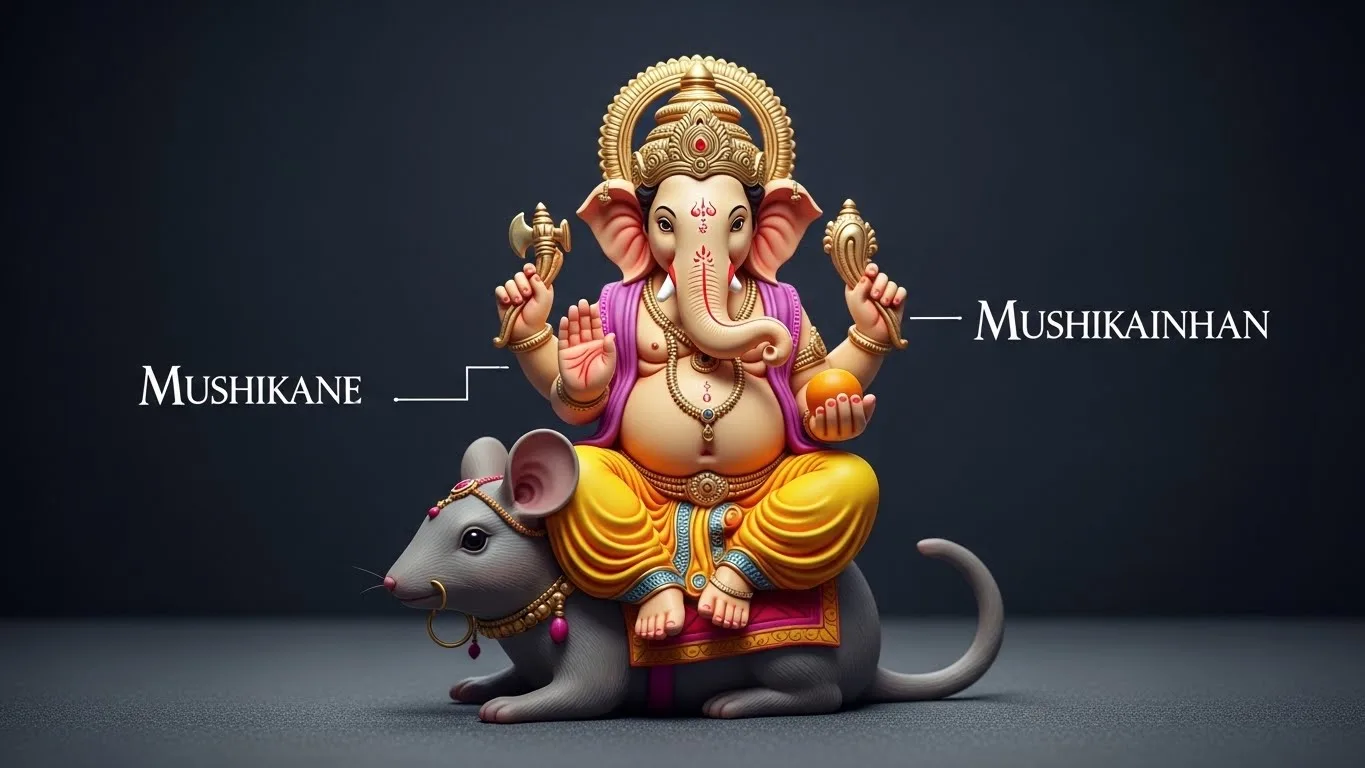
Why Does Lord Ganesha Ride a Mouse Among Hindu iconography’s most charming and philosophically rich paradoxes is Lord Ganesha—the elephant-headed remover of obstacles—riding a tiny mouse, creating a visual juxtaposition that has fascinated devotees, artists, and spiritual seekers for millennia. At first glance, this pairing seems almost comical—an immense deity with a massive elephant head, substantial belly, and divine presence seated atop a creature so small it could fit in a human palm, yet this unlikely combination contains layers of profound spiritual symbolism that address ego, desire, persistence, humility, and the mastery of mind necessary for spiritual liberation.

The mouse, known as Mushika or Mooshaka in Sanskrit, was not always Ganesha’s loyal vehicle but began existence as a celestial musician named Krauncha who fell from grace through arrogance and greed, was cursed to become a giant demon-mouse by Sage Vamadeva, and wreaked havoc across the three worlds destroying crops, disrupting sacred ashrams, and terrorizing sages until Lord Ganesha intervened with compassion rather than violence. When Ganesha subdued the rampaging demon-mouse using his pasha (noose), Mushika realized his errors, begged forgiveness with sincere contrition, and requested eternal service to the lord—a request Ganesha graciously granted, transforming the mouse from destructive demon into devoted vahana (vehicle).
Symbolically, the mouse represents the human mind—restless, constantly gnawing, moving rapidly from desire to desire, capable of penetrating even the smallest openings but also susceptible to greed and destructive tendencies—while Ganesha seated upon the mouse demonstrates complete mastery over these mental fluctuations, teaching that wisdom and divine consciousness must control the scattered mind for spiritual progress to occur.
The size paradox itself carries meaning: how can a tiny mouse carry the massive weight of the elephant-headed god? Because when ego surrenders to divine wisdom, even the smallest creature gains infinite capacity—the mouse didn’t grow larger; Ganesha made himself lighter, teaching that spiritual advancement involves not accumulating power but releasing weight through detachment, humility, and the dissolution of false identifications.
This comprehensive exploration examines the complete story of how Mushika became Ganesha’s vehicle, the multiple interpretations of this symbolism, connections to yogic anatomy and kundalini, the mouse’s role in worship and festivals, and practical spiritual lessons this pairing teaches contemporary seekers.
The Story of Krauncha: From Celestial Musician to Demon Mouse
The origin story of Ganesha’s mouse vahana varies across different Puranic texts, but the most widely accepted narrative comes from the Ganesha Purana and Brahmananda Purana.
Krauncha: The Celestial Musician
In the divine realm of the gods, there lived a Gandharva (celestial musician) named Krauncha who served in Indra’s celestial court. Krauncha was blessed with extraordinary musical talent, enchanting the gods and goddesses with his melodious performances on the veena and through his singing. His music could calm storms, bring peace to troubled minds, and even make flowers bloom out of season.
However, Krauncha possessed a fatal flaw—arrogance about his talents and insatiable greed. His musical abilities led him to believe he was superior to others, and this pride gradually separated him from humility and devotion. He began demanding greater rewards for his performances, accumulating wealth, and looking down upon those he deemed less talented.
The Curse of Transformation
One fateful day, Krauncha was performing in Indra’s court when he accidentally stepped on the foot of the revered Sage Vamadeva, who was seated among the audience. Rather than immediately apologizing with genuine contrition, Krauncha’s arrogance prevented him from showing proper respect. He offered a perfunctory, insincere apology and continued with his performance as if nothing significant had occurred.
Sage Vamadeva, recognizing that Krauncha’s ego had grown so large it prevented him from understanding basic respect and humility, pronounced a curse: “Since you have trampled upon others without awareness or remorse, you shall become a mouse—a creature that others trample upon, that lives in darkness, and that must constantly scurry about seeking food and shelter!”
The curse immediately took effect. Krauncha’s celestial form dissolved, and he transformed into an enormous mouse—not an ordinary rodent but a demon-mouse (Mushikasura) of gigantic proportions, possessing supernatural strength and a voracious appetite that could never be satisfied.
The Alternative Version: Devi’s Curse
Another version of the story involves Goddess Tripurasundari (Parvati). According to this narrative, Krauncha was a devoted worshipper of the Divine Mother. Impressed by his devotion, Devi took him to her celestial abode and blessed him with many boons. However, when he greedily demanded immortality—something he had not spiritually earned—Devi refused.
While the goddess was in deep meditation, Krauncha noticed several divine vessels containing amrita (the nectar of immortality). Unable to control his greed, he transformed himself into a small mouse, climbed one of the vessels, and drank some of the precious nectar. When Devi discovered this theft and betrayal of trust, she cursed him to remain in mouse form but with the mind of a demon—a punishment that combined both animal form and demonic intelligence.
Why Does Lord Ganesha Ride a Mouse Mushikasura’s Reign of Terror
Whether cursed by Vamadeva or Devi (or both in different texts), Krauncha became Mushikasura—a giant demon-mouse that terrorized the three worlds. His size was enormous—larger than elephants in some descriptions—and his appetite was insatiable. He possessed supernatural powers including:
- Invulnerability: Some versions state he had drunk amrita, making him immortal
- Immense Strength: Despite mouse form, he could topple buildings and destroy temples
- Voracious Appetite: He consumed entire granaries, ruined crops, and devoured food offerings meant for gods
- Destructive Nature: He trampled sacred spaces, disrupted yajnas (fire rituals), and destroyed manuscripts
Sage Parashara’s ashram became one of Mushikasura’s primary targets. The demon-mouse would destroy the hermitage’s grain stores, trample the sacred herb gardens, gnaw through important texts written on palm leaves, and generally create chaos that made spiritual practice impossible. The sages tried various methods to stop him—mantras, protective barriers, weapons—but nothing worked against the supernatural mouse.
Ganesha’s Intervention: Compassion Over Violence
When the situation became unbearable, the distressed sages approached Lord Ganesha for help, recognizing that only the remover of obstacles himself could deal with this unprecedented obstacle.
The Divine Confrontation
Lord Ganesha manifested in his Veera Ganapati form—a warrior aspect displaying his divine power. When Mushikasura appeared, causing his usual destruction, Ganesha confronted him directly. The demon-mouse, emboldened by his size and power, challenged the elephant-headed deity.
What followed was not a prolonged battle but a demonstration of divine supremacy. Using his pasha (noose), Ganesha easily captured the giant mouse, binding him and rendering him helpless despite his supernatural strength. The ease with which Ganesha subdued Mushikasura demonstrated that wisdom and divine power transcend brute strength and physical size.
Some versions describe Ganesha placing his foot gently but firmly upon the mouse, a gesture that combined authority with restraint—showing dominance without cruelty, establishing control without violence.
The Transformation Through Surrender
Bound by Ganesha’s noose and pinned beneath his foot, Mushikasura suddenly experienced a profound shift in consciousness. The demon-mouse’s perspective changed from arrogance to humility, from destructiveness to devotion, from rebellion to surrender. He recognized the divine presence before him and understood the futility of ego and desire.
With tears streaming down his face, Mushikasura begged forgiveness from Lord Ganesha: “O Lord! I have been blinded by pride, consumed by greed, and lost in destructive tendencies. I caused suffering to innocent beings and disrupted sacred spaces. Please forgive my transgressions and show me the path to redemption!”
Ganesha, embodying infinite compassion characteristic of the Divine, not only forgave Mushikasura but offered him something even greater—the opportunity for eternal service. Transformation through punishment would be temporary; transformation through devotion would be permanent.
Becoming Mushika: The Eternal Vehicle
Mushikasura made a humble request: “Lord, if you will accept me, I wish to remain by your side forever as your vehicle, serving you eternally and thereby gaining liberation from my karmic burdens.”
Ganesha accepted this request, transforming the demon-mouse into Mushika (or Mooshaka), his loyal vahana. However, there remained a practical problem: Mushikasura’s enormous size made him unwieldy as a vehicle. The giant mouse complained that he couldn’t properly bear Ganesha’s weight, requesting that the lord either reduce the mouse’s burden or make himself lighter.
In response, Ganesha demonstrated a profound spiritual principle—he made himself lighter rather than demanding the mouse become stronger. This act taught that spiritual mastery involves releasing weight (ego, attachments, false identifications) rather than accumulating power. Ganesha reduced his form to a size the mouse could comfortably carry, and from that moment forward, Mushika has served as his faithful vahana, appearing in virtually every representation of Lord Ganesha across temples, homes, and artwork throughout India.
The Symbolism: Multiple Layers of Meaning
The pairing of Ganesha and the mouse carries profound symbolism that operates on multiple levels simultaneously, from psychological to philosophical to yogic.
The Mouse as Mind: Mastering Mental Restlessness
The primary symbolic interpretation is that the mouse represents the human mind in its untamed state:
Constant Motion: Like a mouse that never stays still—always scurrying, investigating, searching—the mind continuously jumps from thought to thought, never resting, perpetually restless.
Gnawing Nature: Mice gnaw constantly, wearing down even the hardest materials through persistent effort. Similarly, the mind gnaws at problems, worries, memories, and plans, wearing away at peace through repetitive thinking patterns.
Desire and Accumulation: Mice hoard food, gathering far more than they need, storing supplies compulsively. This mirrors the mind’s tendency to accumulate desires, always wanting more possessions, experiences, recognition, and security.
Ability to Penetrate: Mice can squeeze through the tiniest openings, finding their way into seemingly secure spaces. The mind similarly penetrates everywhere—invading quiet moments, disrupting meditations, finding ways past our defenses.
Darkness-Dwelling: Mice often prefer darkness and hidden spaces. The untrained mind dwells in ignorance (avidya), hiding from the light of awareness.
Ganesha seated upon the mouse represents buddhi (intellect/wisdom) mastering manas (mind). The mouse gazes up at Ganesha with complete devotion, waiting for direction—just as the disciplined mind should look to higher wisdom for guidance rather than running wild following every desire and impulse.
Ego Transcendence: From Arrogance to Humility
Mushikasura’s transformation from arrogant celestial musician to humble vehicle represents the spiritual journey from ego to surrender:
Pride Before the Fall: Krauncha’s talents led to arrogance—the ego inflating due to abilities, achievements, or status. His curse demonstrates that ego inevitably leads to downfall.
The Humbling Process: Being transformed into a creature others trample upon, living in darkness, constantly scurrying for survival—this represents the humbling that ego must undergo.
Surrender and Grace: Only when Mushikasura completely surrendered his ego to Ganesha did transformation occur. Ego cannot be destroyed by force but dissolves through surrender to the divine.
Service as Liberation: Becoming Ganesha’s vehicle represents the highest purpose—serving the divine—which transforms even the most fallen being into something sacred and honored.
The Size Paradox: True Strength Through Lightness
The apparent impossibility of a tiny mouse carrying an enormous elephant-headed deity teaches several lessons:
Surrender Creates Capacity: When the mouse surrendered completely, it gained the capacity to carry the divine. Complete surrender to God creates infinite capacity within finite beings.
Spiritual Strength vs. Physical Power: The mouse’s ability demonstrates that spiritual strength has nothing to do with physical size or worldly power. The smallest, humblest being can accomplish the greatest spiritual feats.
Releasing Weight: Ganesha made himself lighter rather than demanding more strength from the mouse. Spiritual progress involves releasing attachments, desires, and identifications that weigh us down rather than accumulating more power or abilities.
Mutual Adaptation: Ganesha adapted to the mouse’s capacity while the mouse stretched to accommodate Ganesha. This represents the grace-effort dynamic in spiritual practice—God meets devotees at their level while devotees strive toward the divine.
Desire Control: The Modak Connection
In iconography, the mouse is often depicted looking longingly at the modak (sweet dumpling) that Ganesha holds or sits near a plate of sweets, but restrains himself, waiting for Ganesha’s permission:
Desire Without Compulsion: The mouse desires the sweet (representing sensory pleasures, material objects, worldly achievements) but doesn’t grab it impulsively. This represents the mind that has desires but isn’t controlled by them.
Looking Toward Wisdom: The mouse’s eyes turn toward Ganesha rather than the sweets—seeking higher guidance rather than immediate gratification. True discipline involves redirecting attention from objects of desire toward consciousness itself.
Waiting for Grace: The mouse waits patiently for Ganesha to grant permission, representing the devotee who has learned that fulfillment comes through divine grace rather than grasping.
Persistence and Patience: Gnawing Through Obstacles
While the mouse represents challenges, it also embodies positive qualities:
Persistent Effort: A mouse can gnaw through stone walls given enough time. This represents the power of consistent spiritual practice—daily meditation, mantra repetition, and devotional service that slowly wears away karmic obstacles.
Attention to Detail: Mice are meticulous creatures, noticing tiny details others miss. Spiritual practice requires similar attention to subtle movements of mind and heart.
Resourcefulness: Mice survive in diverse environments through adaptability. The spiritual seeker must be similarly resourceful, finding ways to practice regardless of external circumstances.
Yogic Interpretation: Mooladhara Chakra and Kundalini
From yogic perspective, Ganesha presides over the Mooladhara chakra—the root energy center located at the base of the spine.
Ganesha as Foundation
The Mooladhara represents survival, security, grounding, and the foundation of spiritual energy. Ganesha as its presiding deity removes obstacles that block the awakening and rise of kundalini shakti—the dormant spiritual energy coiled at the spine’s base.
The Mouse Gnawing Through the Brahma Granthi
In kundalini yoga, three psychic knots (granthis) block the upward flow of energy through the central channel (sushumna nadi). The first knot—Brahma Granthi—located at the Mooladhara, represents attachment to physical existence, material security, and survival instincts.
The mouse’s gnawing ability symbolizes the persistent spiritual practice that breaks through this knot, releasing kundalini to rise toward higher chakras. Just as a mouse gnaws patiently through the toughest materials, spiritual practice gradually dissolves energetic blockages, allowing consciousness to expand beyond mere survival concerns toward higher wisdom.
The Journey from Root to Crown
With Ganesha’s blessing at the Mooladhara and the mouse-like persistence in spiritual practice, kundalini energy rises through successive chakras toward the Sahasrara (crown chakra), where the laddoo (sweet ball) represents the bliss of spiritual realization. The entire journey from base to crown mirrors the mouse’s patient gnawing—slow, steady, persistent effort leading to breakthrough and liberation.
The Harmony of Opposites: Snake and Mouse
Another layer of symbolism appears in complete Ganesha iconography—Ganesha wears a snake around his belly while riding a mouse as his vehicle:
Natural Enemies: In nature, snakes are predators and mice are prey—they exist in perpetual conflict and fear of each other.
Harmony Through Divine Presence: In Ganesha’s presence, the snake and mouse coexist peacefully—the snake doesn’t threaten, the mouse doesn’t flee. This represents the transcendence of duality, conflict, and fear that occurs when consciousness rises above instinctual reactions.
Integration of Opposites: The snake represents kundalini energy, spiritual awakening, and transformation. The mouse represents grounded earthly existence, practical concerns, and the lower chakras. Together they show that complete spirituality integrates heaven and earth, transcendence and immanence, meditation and action.
Worship Practices and Festivals
During Ganesh Chaturthi and other festivals celebrating Ganesha, the mouse receives worship alongside the deity.
Mushika in Temple Iconography
Virtually every Ganesha temple features the mouse, usually positioned in one of three ways:
At Ganesha’s Feet: The mouse sits or stands near Ganesha’s feet, gazing upward with devotion, sometimes holding a modak or other food item.
Being Ridden: Ganesha sits upon the mouse, which appears surprisingly stable despite the size difference, sometimes with all four paws planted firmly or standing on hind legs.
Offering Devotion: The mouse performs anjali mudra (prayer gesture) or prostrates before Ganesha, representing complete surrender.
Offerings to Mushika
During worship, devotees make offerings to both Ganesha and his vahana:
Grains and Seeds: Appropriate food for a mouse, symbolizing gratitude for agricultural abundance
Flowers and Incense: Honoring the mouse as sacred vehicle
Prayers for Mind Control: Devotees pray to Mushika asking for help in controlling the restless mind
The Ganesh Chaturthi Story
One beloved story told during Ganesh Chaturthi involves Ganesha and his mouse on the day the moon mocked him. After consuming numerous modaks, Ganesha rode his mouse home. The mouse stumbled upon seeing a snake, causing Ganesha to fall and his belly to burst open, spilling modaks everywhere. The moon witnessed this and laughed mockingly at the sight.
Angered by the moon’s disrespect, Ganesha cursed it to wax and wane, never remaining full. Later, when the moon apologized, Ganesha softened the curse, declaring that seeing the moon on Ganesh Chaturthi would bring false accusations but that the moon would cycle through phases, teaching the impermanence of form.
Contemporary Relevance: Practical Spiritual Lessons
The Ganesha-Mushika pairing offers practical guidance for modern spiritual seekers:
Mastering the Scattered Mind
In our age of constant distraction—smartphones, social media, endless information streams—the mouse-like mind scatters more than ever. Ganesha’s mastery teaches:
Meditation Practice: Regular meditation trains the mind to rest in awareness rather than constantly scattering toward stimuli.
Single-Pointed Focus: Like Ganesha directing the mouse, we must learn to direct attention deliberately rather than letting it wander compulsively.
Witnessing Thoughts: Observing the mind’s movements without identification—watching thoughts arise and pass like watching a mouse scurry without following it.
Transforming Ego Through Humility
Modern culture often encourages ego inflation—celebrating personal achievement, accumulating followers, showcasing success. Mushikasura’s story teaches:
Pride Leads to Fall: Arrogance about talents, achievements, or status inevitably creates suffering and separation.
Grace Through Surrender: Transformation occurs not through self-improvement projects but through surrendering ego to divine wisdom.
Service Over Self-Promotion: The highest purpose is serving something greater than personal aggrandizement.
Small Consistent Actions Create Great Results
The mouse’s ability to gnaw through walls offers hope to practitioners discouraged by slow progress:
Daily Practice Matters: Even small amounts of daily meditation, mantra repetition, or spiritual study accumulate to create breakthrough.
Patience with Process: Spiritual transformation happens gradually through persistent effort rather than dramatic sudden shifts.
Trust the Process: Like the mouse gnawing without seeing the other side of the wall, practitioners must trust that consistent practice leads to liberation even when immediate results aren’t visible.
Frequently Asked Questions
Why does Ganesha ride a mouse?
Ganesha rides a mouse because it symbolizes his complete mastery over the restless, desire-driven mind. The mouse (Mushika) represents mental restlessness, ego, desires, and the scattered attention that creates obstacles to spiritual growth. Ganesha seated upon the mouse demonstrates that wisdom and divine consciousness must control the mind for spiritual progress. The mouse was originally a celestial musician named Krauncha cursed to become a demon-mouse due to arrogance and greed. After Ganesha subdued him, Mushika surrendered and requested to serve eternally as Ganesha’s vehicle, transforming destructive tendencies into devoted service. This teaches that even the most problematic aspects of personality can be transformed through surrender to divine wisdom.
How did Mushika become Ganesha’s vehicle?
Mushika became Ganesha’s vehicle through a transformation story. Originally a celestial musician named Krauncha, he was cursed by Sage Vamadeva to become a giant demon-mouse due to arrogance and disrespect. As Mushikasura, he terrorized the three worlds, destroying crops, disrupting ashrams, and creating chaos. When sages approached Ganesha for help, the lord subdued the demon-mouse using his noose (pasha) and placed his foot upon him. Mushikasura suddenly experienced a profound shift from arrogance to humility, begged forgiveness, and requested to serve Ganesha eternally as his vehicle. Moved by this sincere surrender, Ganesha accepted, transforming the demon into his loyal vahana by reducing his own weight so the mouse could carry him comfortably.
What does the mouse symbolize in Ganesha iconography?
The mouse symbolizes multiple interconnected meanings: the restless human mind that constantly scatters from thought to thought; ego and desires that gnaw away at spiritual peace; the ability to penetrate even the smallest openings, representing persistent spiritual practice breaking through obstacles; greed and accumulation, as mice hoard food compulsively; and humble service after ego surrender. In yogic terms, the mouse represents breaking through the Brahma Granthi at the Mooladhara chakra, allowing kundalini energy to rise toward higher consciousness. The mouse gazing at modaks but restraining itself represents desire controlled by wisdom. Overall, Ganesha riding the mouse teaches that intellectual wisdom (buddhi) must master the scattered mind (manas) for spiritual liberation to occur.
How can a tiny mouse carry the heavy elephant-headed Ganesha?
This apparent paradox carries profound spiritual teaching. The mouse can carry Ganesha not because it grew stronger but because Ganesha made himself lighter—teaching that spiritual progress involves releasing weight (ego, attachments, false identifications) rather than accumulating power. When the demon-mouse complained he couldn’t bear Ganesha’s weight, the compassionate lord reduced his form to a size the mouse could comfortably carry. This demonstrates that when ego completely surrenders to divine wisdom, even the smallest being gains infinite capacity for spiritual work. The pairing also teaches that true spiritual strength has nothing to do with physical power or worldly status—the humblest creature can accomplish the greatest spiritual feats through devotion and surrender.
What is the story of Krauncha curse?
Krauncha was a talented Gandharva (celestial musician) in Indra’s court whose musical abilities led to arrogance and greed. One day, he accidentally stepped on Sage Vamadeva’s foot during a performance but offered only an insincere apology, revealing his pride. The sage cursed him: “Since you trampled others without awareness, you shall become a mouse—a creature others trample upon!” Krauncha transformed into a giant demon-mouse (Mushikasura) who terrorized the three worlds. In an alternative version, Krauncha served Goddess Tripurasundari but greedily stole amrita (immortality nectar) from her vessels, leading to her curse. Both versions emphasize the same lesson: arrogance and greed lead to downfall, humility and surrender lead to redemption.
What is the significance of the mouse looking at modak?
In Ganesha iconography, the mouse is often depicted gazing longingly at modaks (sweet dumplings) but restraining itself, waiting for Ganesha’s permission. This symbolizes desire controlled by wisdom rather than compulsion. The modak represents sensory pleasures, material objects, and worldly achievements that the mind naturally desires. The mouse looking toward the sweet but not grabbing it impulsively represents the disciplined mind that has desires but isn’t controlled by them. Its eyes turning toward Ganesha rather than fixating on the object of desire represents seeking higher wisdom’s guidance rather than immediate gratification. The mouse waiting patiently for permission teaches that true fulfillment comes through divine grace and wisdom rather than grasping and accumulating.
What is the yogic meaning of Ganesha’s mouse?
In yogic philosophy, Ganesha presides over the Mooladhara chakra (root energy center) at the spine’s base. The mouse represents the persistent spiritual practice that breaks through the Brahma Granthi—the first psychic knot blocking kundalini energy’s upward flow through the sushumna nadi (central channel). Just as a mouse gnaws patiently through tough materials, spiritual practice gradually dissolves energetic blockages. The mouse’s gnawing symbolizes consistent meditation, mantra repetition, and yogic discipline that slowly penetrates obstacles preventing spiritual awakening. The reward at the crown chakra (Sahasrara) is represented by the laddoo (sweet ball) Ganesha holds—the bliss of realization. The entire journey from Mooladhara to Sahasrara requires mouse-like patience and persistence.
Why do snake and mouse coexist peacefully with Ganesha?
In complete Ganesha iconography, a snake wraps around his belly while a mouse serves as his vehicle—natural predator and prey existing harmoniously. This represents the transcendence of duality, conflict, and fear that occurs when consciousness rises above instinctual reactions. The snake symbolizes kundalini energy, spiritual awakening, and transformation (higher chakras), while the mouse represents grounded earthly existence, practical concerns, and the root chakra. Together they show that complete spirituality integrates opposites: heaven and earth, transcendence and immanence, meditation and action, spiritual aspiration and practical living. In Ganesha’s divine presence, all conflicts dissolve, teaching that ultimate reality transcends and includes all apparent oppositions in perfect harmony.
About the Author
Dr. Aryan Mishra – PhD in Vedic Studies and Ancient Indian History
Dr. Aryan Mishra is a distinguished scholar specializing in ancient Indian history, Vedic traditions, and Hindu cultural practices. With over 15 years of research experience focused on decolonizing historical narratives, he has published extensively on Hindu iconography, Puranic literature, Ganesha worship traditions, vahana symbolism, yogic philosophy, chakra systems, and the intersection of mythology with practical spirituality. His work bridges academic rigor with devotional accessibility, making complex symbolic and philosophical concepts understandable to contemporary audiences seeking authentic knowledge about Hindu wisdom traditions and their transformative potential for daily spiritual practice and psychological well-being.