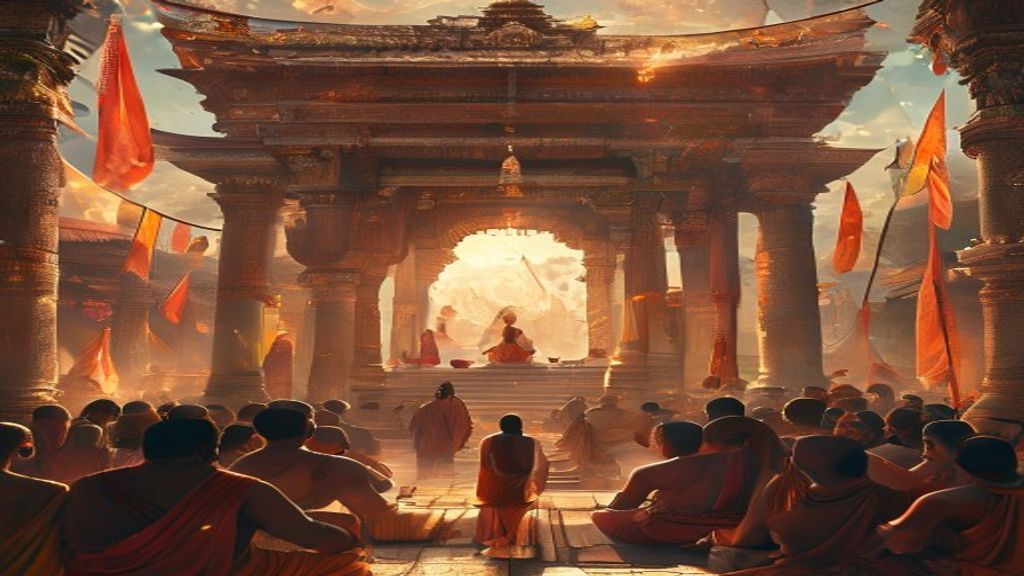
Hinduism, or more accurately Sanatan Dharma, does not proselytize because its foundational philosophy recognizes the inherent divinity within every being and respects the myriad paths to ultimate truth. This ancient wisdom, rooted in Vedic principles, emphasizes individual spiritual evolution (*moksha*) rather than external conversion, viewing faith as a personal journey of self-realization.
| Attribute | Details |
|---|---|
| Core Principle | Ekam Sat Viprah Bahudha Vadanti (Truth is One, Sages Call It by Many Names) |
| Philosophical Basis | Sarva Dharma Sambhava (Equality of all Dharmas/Religions), Universalism, Individual Spiritual Sovereignty |
| Key Concepts | Atman (Soul), Brahman (Ultimate Reality), Karma (Action & Consequence), Moksha (Liberation), Svadharma (One’s Own Path) |
| Scriptural Foundation | Vedas (Rig Veda), Upanishads, Bhagavad Gita, Puranas |
The Inherent Universalism of Sanatan Dharma
Sanatan Dharma, often referred to as Hinduism, stands distinct among global spiritual traditions for its inherent lack of a proselytizing impulse. This isn’t a modern strategic choice, but a deeply ingrained philosophical principle, a direct emanation from its core tenets. Unlike many faith systems that view themselves as the sole path to salvation and actively seek to convert others, Sanatan Dharma embraces a pluralistic worldview. It recognizes that the Divine, Brahman, is infinite and multifaceted, and consequently, the ways to approach and realize this Ultimate Reality are equally diverse. This profound acceptance fosters an ethos where the external form of worship or belief system is less significant than the internal spiritual journey and adherence to Dharma, righteousness.
The absence of a conversion imperative stems from a fundamental understanding of Atman, the individual soul, as intrinsically connected to Brahman. Every being is considered a spark of the Divine. The spiritual path is thus an unfolding, a realization of this pre-existing truth within oneself, rather than an adoption of an external creed. This perspective views all genuine spiritual paths as valid expressions of humanity’s quest for truth, each suited to different temperaments and stages of evolution. This is the cornerstone of Sanatan Dharma’s enduring wisdom and its unique position in the world’s spiritual landscape, offering a profound lesson in religious harmony and individual spiritual freedom.
The Puranic & Vedic Tapestry: A History of Non-Conversion
The ancient scriptures of Sanatan Dharma consistently articulate a worldview that precludes the necessity, or even the possibility, of forced conversion. The Rig Veda, in its profound utterance, “Ekam Sat Viprah Bahudha Vadanti” (Truth is One, the Sages call it by Many Names), lays the philosophical groundwork for religious pluralism. This isn’t mere tolerance; it’s a recognition of the inherent validity of diverse expressions of the Divine. The Upanishads further elaborate on the nature of Brahman as pervasive and immanent, residing within all creation. If God is everywhere, and within everyone (Atman is Brahman), then there is no external entity or belief system that one must be ‘converted’ to join. The journey is internal, a realization of what already is.
The Itihasas and Puranas, while replete with stories of great kings, sages, and divine incarnations, never depict instances of forceful conversion to “Hinduism.” Instead, they emphasize adherence to Dharma, righteous conduct, and the performance of one’s own duties (Svadharma). For instance, the teachings of Lord Krishna in the Bhagavad Gita (Chapter 3, Verse 35) explicitly state: “श्रेयान् स्वधर्मो विगुणः परधर्मात् स्वनुष्ठितात् । स्वधर्मे निधनं श्रेयः परधर्मो भयावहः ॥” (It is far better to discharge one’s prescribed duties, even though faultily, than to perform another’s duties perfectly. Destruction in the course of performing one’s own duty is better than engaging in another’s duties, for to follow another’s path is dangerous.) This verse profoundly illustrates the emphasis on individual spiritual path and the dangers of abandoning one’s inherent nature or inherited spiritual framework for another’s.
The Puranas recount interactions with various spiritual traditions and peoples, often through dialogue and philosophical debate, but never through conquest for conversion. The emphasis was always on the universal principles of truth, compassion, and righteousness, which transcend sectarian labels. The very concept of Sanatan Dharma, meaning “Eternal Dharma,” suggests a timeless, universal truth that is not bounded by a specific historical founder, doctrine, or conversion ritual, but is instead an underlying cosmic law applicable to all beings.
The Philosophical Architecture of Sanatan Dharma
While Sanatan Dharma lacks temple architecture specifically designed for proselytization, its entire philosophical framework is structured to support individual spiritual exploration, which inherently negates the need for conversion. The six orthodox schools of Hindu philosophy (Darshanas) – Nyaya, Vaisheshika, Sankhya, Yoga, Mimamsa, and Vedanta – all offer distinct yet complementary paths to understanding reality and achieving liberation (Moksha). Each school provides a comprehensive methodology, allowing individuals to choose a path that resonates with their intellect and temperament, a concept utterly foreign to a proselytizing religion.
Consider the emphasis on Karma and Reincarnation. One’s current life circumstances and spiritual inclinations are seen as a result of past actions and accumulated impressions (samskaras). This framework posits that each soul is on a unique journey of evolution, and forcing a change in one’s spiritual expression would be a superficial act, failing to address the deeper karmic trajectory. The focus is on purifying one’s own heart and actions, rather than altering another’s external religious affiliation. The concept of Ishta Devata, choosing one’s personal deity, further underscores this individual spiritual autonomy. A devotee is free to worship any form of the Divine that inspires them most, recognizing all forms as manifestations of the one Brahman. This internal flexibility is the very “architecture” that fosters spiritual growth without coercion.
Rituals & Puja Vidhi: Personal Sadhana, Not Public Proclamation
The rich tapestry of Hindu rituals, or Puja Vidhi, is designed for personal spiritual upliftment and communal harmony, not for converting adherents. Every ritual, from the daily Sandhyavandanam to elaborate temple ceremonies, is an act of self-purification, devotion, and a means to connect with the Divine. The emphasis is on the internal transformation of the practitioner (sadhaka) through disciplined practice (sadhana), not on attracting new members through public display or persuasion.
- Sankalpa (Intention): All rituals begin with a solemn resolve, a Sankalpa, stating the purpose of the worship, typically for the well-being of the individual, family, or the world, never for converting others.
- Archana (Offerings): Devotees offer flowers, fruits, water, and incense to the chosen deity, expressing love and surrender. This is a personal act of devotion, fostering a direct relationship with the Divine.
- Dhyana (Meditation): Many rituals include periods of meditation and contemplation on the deity’s form and attributes, focusing on inner stillness and connection.
- Aarti (Light Offering): The waving of lamps is a symbolic act of dispelling darkness and inviting divine light, a collective prayer for knowledge and purity.
- Prasada (Sacred Food): Food offered to the deity is consecrated and then shared, symbolizing divine grace and unity among devotees. This reinforces community but does not seek to expand it through conversion.
Each step is a mindful engagement with the spiritual, designed to cultivate inner peace, devotion, and wisdom. These practices are intrinsically self-focused in their aim for spiritual progress, without any mandate for outreach or proselytization. Learn more about diverse spiritual practices on Hindutva.online.
Mantras & Chants: Echoes of Universal Truth
Hindu mantras and chants are powerful vibrations intended to purify the mind, invoke divine energies, and aid in meditation. Their purpose is not to evangelize but to facilitate an individual’s spiritual experience and connect them to universal consciousness. Many significant mantras encapsulate the pluralistic and non-proselytizing nature of Sanatan Dharma:
- “Om Sarve Bhavantu Sukhinah, Sarve Santu Niramayah, Sarve Bhadrani Pashyantu, Ma Kaschit Dukha Bhag Bhavet.”
(May all be happy. May all be free from illness. May all see what is auspicious. May no one suffer.)This universal prayer for the well-being of all beings, irrespective of their faith or background, perfectly illustrates the inclusive spirit.
- “Loka Samastah Sukhino Bhavantu.”
(May all beings in all worlds be happy.)A concise mantra expressing expansive compassion and wishes for global harmony.
- “Aham Brahmasmi.”
(I am Brahman.) – From the Brihadaranyaka UpanishadThis Mahavakya (Great Utterance) affirms the intrinsic divinity of the individual soul, rendering external conversion superfluous.
- “Tat Tvam Asi.”
(Thou art That.) – From the Chandogya UpanishadAnother profound Mahavakya, directly instructing the seeker on their identity with the Ultimate Reality, emphasizing self-realization.
These chants are tools for inner awakening and expressing a universal ethos, not for recruiting followers. Their power lies in their ability to transform the individual consciousness, aligning it with the cosmic order.
Dos and Don’ts for the Devotee in a Pluralistic World
Adhering to Sanatan Dharma’s principles in a world of diverse faiths involves specific attitudes and practices:
- DO: Respect All Paths (Sarva Dharma Sambhava). Acknowledge the sincerity and validity of other spiritual traditions.
- DO: Focus on Svadharma. Concentrate on your own righteous conduct, duties, and spiritual growth.
- DO: Engage in Seva (Selfless Service). Serve humanity and all beings without discrimination, recognizing the Divine in everyone.
- DO: Seek Knowledge. Continuously study scriptures, engage in philosophical inquiry, and reflect on deeper truths.
- DO: Live by Dharmic Principles. Practice truthfulness (Satya), non-violence (Ahimsa), compassion (Karuna), and purity (Shaucha).
- DON’T: Criticize or Denigrate Other Faiths. Avoid judging or belittling the beliefs or practices of others.
- DON’T: Force Beliefs on Others. Never attempt to coerce or manipulate individuals into adopting Hindu practices or philosophies.
- DON’T: Engage in Aggressive Outreach or Recruitment. The spirit of Sanatan Dharma is to attract by example, not by active proselytization.
- DON’T: Claim Exclusivity of Truth. Avoid asserting that Sanatan Dharma is the “only” path to the Divine.
Isn’t it a weakness not to convert others?
From the Dharmic perspective, the absence of proselytization is not a weakness but a strength, reflecting deep philosophical maturity and confidence in the universal nature of truth. It stems from the understanding that truth does not need to be ‘sold’ or ‘imposed’; it reveals itself to those who earnestly seek it. This approach fosters genuine spiritual inquiry and respect for individual autonomy.
Does this mean all religions are the same?
No, it does not mean all religions are identical in their doctrines, practices, or historical trajectories. Rather, it signifies that while the paths and expressions may differ, the ultimate goal of spiritual realization and the underlying divine truth are universally accessible. Sanatan Dharma respects the diversity of paths while affirming the singularity of the ultimate reality, as captured in the phrase “Ekam Sat Viprah Bahudha Vadanti.”
What about Reconversion (Ghar Wapsi)?
The concept of Ghar Wapsi (“return home”) in the Hindu context is generally understood as the voluntary re-embrace of one’s ancestral Sanatan Dharma by individuals or communities who had previously converted to other faiths, often under duress or socio-economic pressure. It is framed not as a conversion, but a homecoming to one’s original spiritual and cultural roots, aligning with the idea of svadharma. While sometimes controversial in practice, its philosophical basis differs fundamentally from proselytization, as it seeks to restore rather than acquire new adherents.
How does one become a Hindu then?
Traditionally, one is born into Sanatan Dharma, inheriting a cultural and spiritual lineage. However, given its universal principles, individuals who sincerely resonate with its philosophy and wish to adopt its way of life are welcomed. There is no formal, universal conversion ceremony akin to baptism. Often, a personal commitment, adoption of Dharmic practices, study of scriptures, and sometimes a symbolic ritual (like a shuddhi or purification ceremony, or simply beginning daily puja and connecting with a guru or community) are considered sufficient. The focus is on embracing the lifestyle and philosophy, not on a mandatory membership rite. Many sincere seekers globally have seamlessly integrated into Dharmic traditions and found their spiritual home, enriching the tradition with their devotion, as highlighted on Hindutva.online.
Dharmic Significance: Preserving Sanatan Dharma and Universal Harmony
The non-proselytizing nature of Sanatan Dharma is not a passive stance, but an active principle that underpins its resilience and relevance. By not seeking to convert, Hinduism preserves the sanctity of individual spiritual choice and promotes an atmosphere of genuine religious harmony. It teaches that the journey to truth is deeply personal and multifaceted, recognizing the inherent divinity in all beings irrespective of their external religious label. This approach has allowed Sanatan Dharma to absorb, adapt, and coexist with myriad traditions for millennia, making it a living testament to universal acceptance. In an increasingly interconnected world, this ancient wisdom offers a powerful paradigm for mutual respect, peace, and the celebration of spiritual diversity, ensuring the continued preservation and flourishing of its eternal values.
