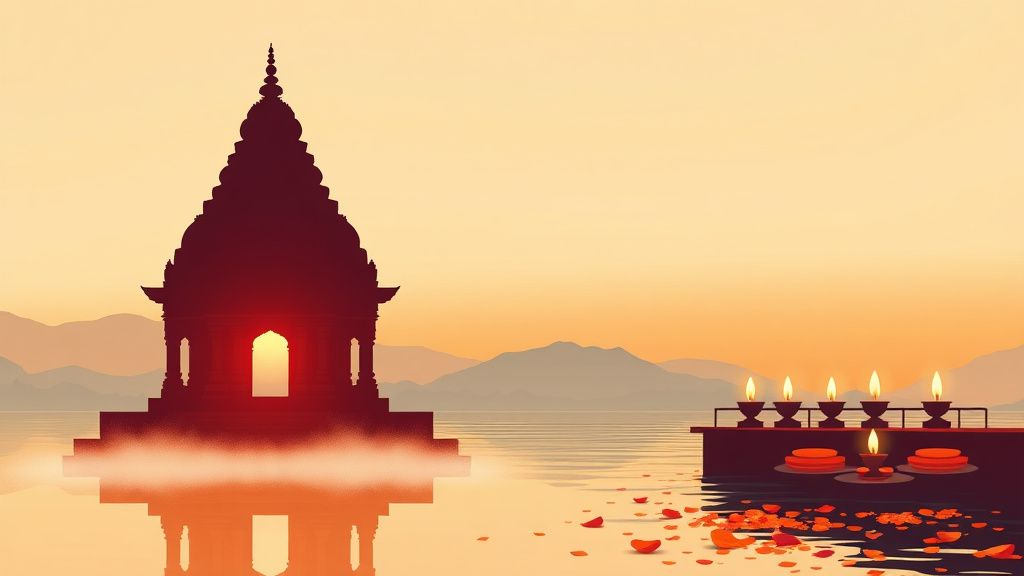
Haridwar sits on the right bank of the Ganga at the point where the river leaves the Shivalik foothills and enters the plains, at an elevation of about 314 metres in Uttarakhand’s Haridwar district. The town is roughly 220 km from Delhi and 35 km from Dehradun’s Jolly Grant Airport, and is one of the seven sapta puri (ancient sacred cities) of Hinduism. Its central religious focus is Har ki Pauri ghat, where the evening Ganga Aarti is performed daily, typically around 6:00 PM in winter and 6:30–7:00 PM in summer. This article covers Har ki Pauri, the three hilltop temples that ring the town, the Kumbh Mela cycle, and reaching Haridwar from Delhi and the chota char dham route.
Har ki Pauri and the evening aarti
Har ki Pauri (“steps of the Lord”) is the principal bathing ghat. A footprint set in stone here is traditionally identified with Vishnu, and the present masonry was rebuilt under various dynasties; the Brahma Kund at the centre is the spot most pilgrims try to reach for the dip. The evening aarti is performed by the Ganga Sabha priests, lasts about 45 minutes, and is preceded by the floating of diya leaf-boats on the river. Plan to arrive 30–45 minutes early on weekends and during Sawan; the central platform fills first.
- Winter evening aarti: around 5:45–6:15 PM
- Summer evening aarti: around 6:45–7:15 PM
- Morning aarti: around 5:30 AM year-round, lower attendance
- Dress code: no enforced rule but modest dress is expected; many pilgrims change into wet clothes for the bath
The three hilltop temples
Three principal temples sit on hills around Haridwar and together are sometimes called the Siddh Peeth triangle. Each is reachable by foot and by ropeway (udan khatola).
- Mansa Devi: on Bilwa Parvat, southwest of Har ki Pauri. The deity is a wish-granting form of Shakti. Ropeway from Upper Road; foot path of about 1.5 km.
- Chandi Devi: on Neel Parvat across the river. Built in 1929 by Suchat Singh of Kashmir, though the shrine itself is older. Ropeway from Nai Basti; foot path of about 3 km via Chandi Ghat.
- Maya Devi: the patron-goddess temple, an 11th-century structure within town. Considered one of the 51 Shakti Pithas, where Sati’s heart and navel are said to have fallen.
For what it’s worth, the ropeway combo ticket sold at the Mansa Devi base station covers both Mansa Devi and Chandi Devi and is the simpler option for a half-day visit; the queue at Mansa Devi alone on a Sunday afternoon can absorb three hours on foot.
Kumbh and Ardh Kumbh at Haridwar
Haridwar is one of the four cities (with Prayagraj, Nashik and Ujjain) that hosts the Kumbh Mela. The Haridwar Kumbh runs on a 12-year cycle, with an Ardh Kumbh (“half Kumbh”) at the six-year midpoint. The astrological trigger is Jupiter entering Aquarius (Kumbh rashi) while the Sun is in Aries. The most recent full Kumbh at Haridwar was in 2021 (held in a curtailed COVID format); the next is expected in 2033. The Ardh Kumbh in 2027 is the closer-term major surge.
Daksheshwar Mahadev and other shrines
Daksheshwar Mahadev temple at Kankhal, about 4 km south of Har ki Pauri, marks the site of the Daksha Yajna of the Sati legend (Vayu Purana 1.30, Bhagavata Purana 4.4). Bharat Mata Mandir at Sapt Sarovar is a 20th-century multi-storey shrine to Mother India. Pawan Dham, Sapt Rishi Ashram and the Patanjali Yogpeeth complex on the Delhi-Haridwar road round out the standard tourist circuit.
Reaching Haridwar
- By rail: Haridwar Junction (HW) is on the main Delhi-Dehradun line; the Shatabdi from New Delhi takes about 4.5 hours.
- By road: Delhi to Haridwar is roughly 220 km via NH-334 and the Delhi-Dehradun Expressway. Driving time is typically 4–5 hours.
- By air: Jolly Grant Airport, Dehradun, is 35 km north; taxi or shared cab to Haridwar takes about an hour.
- To Rishikesh: 25 km north on NH-58. Shared autos and frequent UTC buses run through the day.
- To Char Dham routes: Haridwar is the canonical starting point for the Yamunotri-Gangotri-Kedarnath-Badrinath circuit. Most yatra buses leave from Rishikesh, 25 km onward.
Common questions
Is the Ganga at Haridwar safe to bathe in?
Bacteriological water quality at Har ki Pauri is monitored by the Uttarakhand State Pollution Control Board and is variable. The Brahma Kund is fed by a channel rather than the main flow and tends to be calmer. Most pilgrims take a quick immersion rather than a swim. Strong undercurrents downstream of the kund have caused drownings; chains are provided at the bathing steps and are meant to be used.
Where to stay?
Haridwar has a wide range of dharamshalas, ashrams (Shantikunj at the Patanjali side, several around Bhimgoda) and private hotels along Railway Road and Upper Road. Rishikesh, 25 km away, has more guesthouse and yoga ashram options and tends to be quieter outside the rafting season.
When is the best time to visit?
October to March is the cool-dry stretch and is the most comfortable for the ghat and the hilltop temples. Sawan (July-August) is the largest Shiva-pilgrimage surge, with kanwariyas walking in from across north India; the town is densely crowded and accommodation rates spike. April-June is hot and dry in the plains; the hill temples are still comfortable.
One limitation worth noting
Aarti timings and ropeway operating hours shift seasonally and around festival days, and the Kumbh-period schedule departs significantly from normal operations. The figures above are typical for a non-festival visit; for an exact-day plan check the Uttarakhand tourism portal or the temple operator’s notices.
For background on the town and the Ganga Sabha, see Haridwar on Wikipedia and the Uttarakhand Tourism portal.