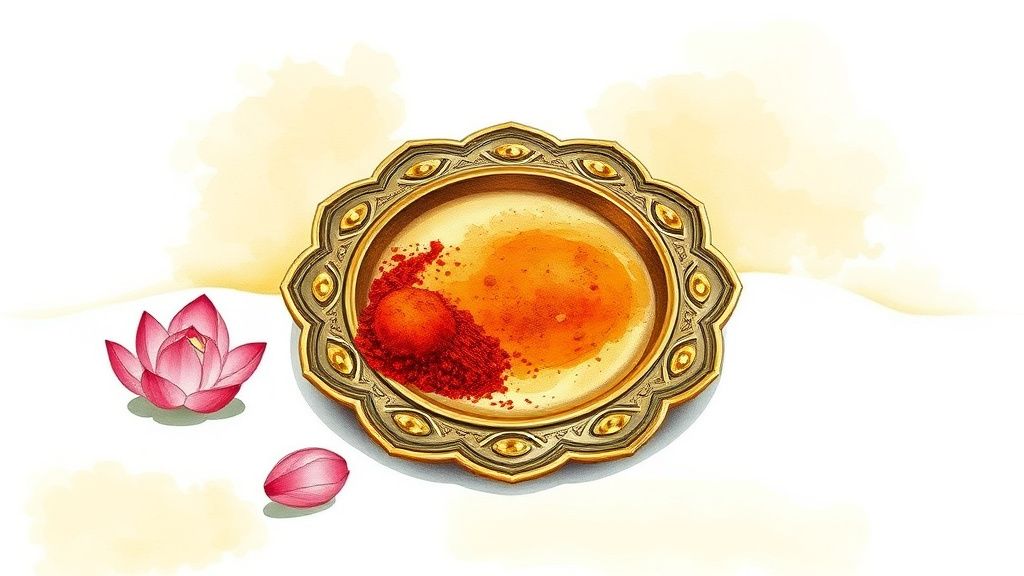
The tilak and the bindi are both forehead markings used in Hindu religious and cultural practice, but they are not the same thing. The tilak is a sectarian and ritual mark applied with a paste of sandalwood, ash, kumkum or other substances, often by male priests and devotees, identifying the wearer’s sampradaya (Vaishnava, Shaiva, Shakta, Smarta). The bindi is a small dot or design on the centre of the forehead worn primarily by women, decorative as well as religious, and not tied to a specific sect. Both sit at the location of the ajna chakra (the sixth chakra of yogic tradition, said to be the seat of intuition) between and slightly above the eyebrows. This article distinguishes the two clearly, walks through the main types of tilak, and explains how the bindi diverges from the tilak in materials, gender association and meaning.
The basic difference
- Tilak: a religious mark with a specific shape signalling the wearer’s tradition. Applied with chandan (sandalwood), vibhuti (ash), kumkum, gopichandan (a clay from Dwarka) or kasturi (musk paste). Worn by both men and women, more visibly by men. Applied for puja, temple visits, and major samskaras including weddings.
- Bindi: a small mark on the centre of the forehead, traditionally a dot. Worn predominantly by women. Materials range from kumkum (the traditional form) to felt stickers and bindi jewellery (the modern forms). The bindi can be religious, decorative, or both, and is not sect-specific.
The Sanskrit roots are distinct: tilaka from til, “sesame seed”, referring originally to the small seed-sized mark; bindu, “point” or “drop”, from which “bindi” derives. The tilak word is older in Hindu texts, attested in the Vishnu Purana and the Padma Purana (early medieval, roughly 4th-10th century CE). The bindi word is used in the Tantric texts but the simple round forehead dot as women’s decoration becomes prominent in later medieval Hindu practice.
The main types of tilak
Tilak shapes carry community information; a trained eye reads the wearer’s sampradaya from the shape alone:
- Urdhva pundra (Vaishnava): two vertical lines from the eyebrows to the hairline with an elongated U at the bottom, made with white gopichandan or chandan, with a red vertical line (Lakshmi mark) in the centre. Sri Vaishnava (Iyengar) tilak. Madhva Vaishnava tilak omits the red line; Pushti Marga and other Krishna-centred sampradayas use variations.
- Tripundra (Shaiva): three horizontal lines of vibhuti (white sacred ash) across the forehead, often with a red kumkum dot in the centre. The three lines are said to represent Shiva’s icchashakti (will), jnanashakti (knowledge) and kriyashakti (action).
- Shakta tilak: a red kumkum dot or vertical line, sometimes with three small dots above. Worn by Devi-tradition devotees.
- Smarta tilak: a tripundra of vibhuti with a kumkum dot in the centre, used by followers of the Smarta sampradaya (which honours Shiva, Vishnu, Devi, Surya and Ganesha equally).
- Bhakti / pan-Hindu tilak: a single vertical or curved chandan line with a kumkum dot at the top, the most common form seen in mixed religious gatherings.
Materials used and their meanings
- Chandan (sandalwood paste): ground from Santalum album wood; cooling on the skin, associated with sattvic (calm) qualities. The standard material for Vaishnava and pan-Hindu tilaks.
- Vibhuti (sacred ash): ash from a yajna fire or from burnt cow-dung, applied dry or mixed with water. Worn by Shaivas; the impermanence of the ash is read as a reminder of the body’s mortality.
- Kumkum: a red powder made from turmeric and slaked lime. Used both as a forehead dot for women and as the red component of many tilaks.
- Gopichandan: a yellowish-white clay sourced from a specific lake near Dwarka, Gujarat. Used by Sri Vaishnava and some Madhva communities for the urdhva pundra shape.
- Kasturi (musk): a darker paste, used in some Vaishnava traditions, attributed historically to Krishna’s mark; the synthetic substitute is now standard since natural musk is restricted.
The choice of material is governed by sampradaya, not by personal preference. A Vaishnava using vibhuti, or a Shaiva using only chandan in the urdhva pundra shape, would be visibly out of place.
Bindi: how it differs
The bindi originated as the simplest of forehead marks: a single round kumkum dot at the centre of the forehead. Three layers of meaning are commonly given:
- The ajna chakra: in yogic and Tantric texts, the spot between the eyebrows is the seat of the sixth chakra. The bindi marks this point.
- The third eye: a related but distinct concept; the bindi is said to symbolise inner vision and discernment.
- Marital status: in much of North India a red bindi is worn by married women and a coloured or black bindi by unmarried girls. In South India this distinction is less rigid; unmarried women, married women and widows alike wear bindis.
The modern sticker bindi (developed in the 1980s) is made of felt or thin plastic with adhesive backing. It is widely worn for fashion as well as religious or marital reasons, and has been adopted as a decorative item globally. For what it’s worth, the most useful distinction for someone learning about these traditions is that the tilak is a sectarian marker and the bindi is a culturally Hindu but largely non-sectarian marker; the two should not be conflated in description even where they appear in the same physical location.
Common questions
Can men wear a bindi?
The bindi as a women’s marker is recent (medieval and later). Earlier and in many contemporary religious contexts, men wear a tilak with a red kumkum dot at the top, which is structurally close to a bindi. Calling that dot a “bindi” is uncommon in conventional Hindu speech; it is called a kumkum dot or part of the tilak. Some male yogis and devotees wear a small red dot alone; this would typically be read as a Shakta or Bhakti mark rather than a bindi in the women’s-fashion sense.
What does the colour of the bindi mean?
Red is the traditional colour, associated with Lakshmi, Shakti and the rising sun. In North Indian custom a red bindi specifically signals married status. Other colours have entered modern usage without strict meaning: black bindis are popular among unmarried women in some regions, and coloured or jewelled bindis are worn for fashion. South Indian women wear kumkum (red) regardless of marital status, with the additional kumkum-in-the-parting (sindoor) reserved for married women specifically.
Is the tilak ever worn by non-Hindus?
The tilak is a sectarian Hindu marker and is not appropriate for casual non-Hindu wear. However, the small kumkum or chandan dot given as prasad at a temple is regularly received and worn by non-Hindu guests as a sign of respect to the temple’s hospitality; this is uncontroversial. The full tilak with sect-identifying shape is reserved for Hindu sampradaya members.
Why do some sadhus have a very elaborate tilak?
Renunciate orders (Vaishnava akharas, Naga sadhus, Dashanami sannyasis) wear elaborate tilaks that extend across the forehead and sometimes down the nose and arms. The shape and material identify the akhara and the lineage of initiation. The Kumbh Mela gatherings are when these distinctive forms are most visible. The elaborate tilak is part of the sadhu’s external religious identity, not an everyday or casual marking.
A limitation worth noting
The sub-tradition variations within Vaishnava, Shaiva and Shakta lineages are extensive and not all summarised here. Each sampradaya (Sri Vaishnava with Vadakalai and Thenkalai sub-branches, Madhva, Pushti Marga, Gaudiya, the major Shaiva schools, the Shakta Sri Vidya tradition) carries distinct tilak shapes, materials and application customs. The dating of when each shape stabilised is debated; the figures used here represent cautious mainstream views drawn from the Puranic literature, not a definitive scholarly consensus. For a particular sampradaya’s exact shape and application, the family priest or a senior community member remains the right source.
For broader background see the Wikipedia overviews of tilaka and bindi.
