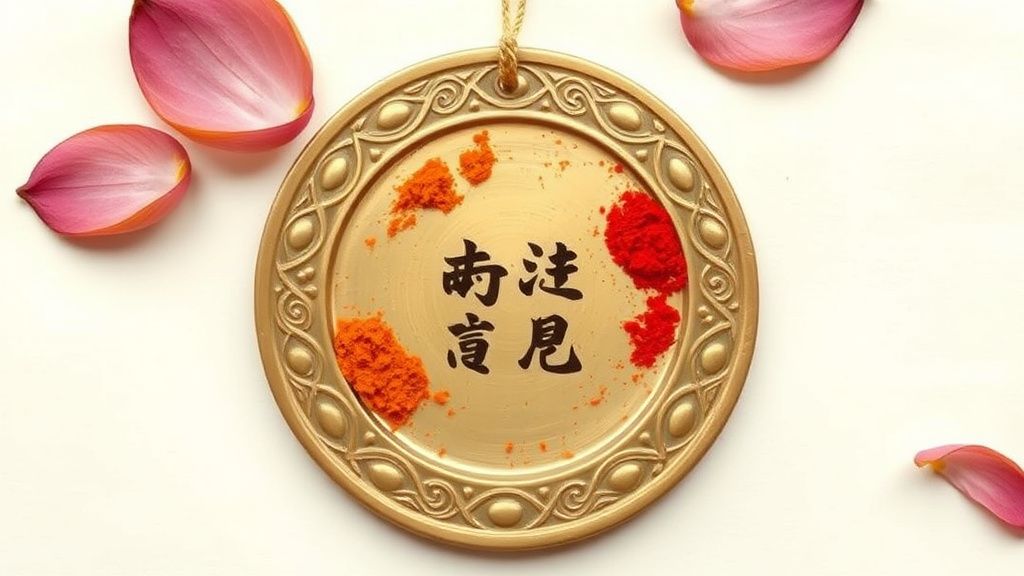
Sindoor is the red or orange-red powder applied by a Hindu woman along the parting of her hair (the maang) after marriage. The first application happens at the wedding itself, in a ritual called Sindoor Daan performed by the groom after the saptapadi. The pigment is traditionally a mix of turmeric and slaked lime; the alkaline lime reacts with curcumin in turmeric to give the bright red colour. Commercial mineral-based pigments sold under the same name have repeatedly tested positive for lead and should be avoided. Sindoor is most associated with North Indian, Bengali, Odia and Maharashtrian practice; in Tamil, Telugu, Kannada and Malayali traditions the marker takes the form of a kumkum dot on the forehead, not in the parting.
Composition: the safe version and the unsafe version
The traditional recipe is straightforward:
- Turmeric powder (Curcuma longa): the yellow base, rich in curcumin.
- Slaked lime (calcium hydroxide): the alkaline activator. A small quantity, around 5–10% of the mix, converts the yellow turmeric into the red sindoor colour.
- Optional alum (potash alum): a fixative that helps the colour bind to skin.
- Optional aromatic oils: sandalwood or rose, added in some household recipes.
Commercial sindoor sold in markets and grocery stores often substitutes synthetic dye, lead tetroxide (red lead, Pb3O4), or mercury-based vermilion (HgS) for the turmeric-lime preparation. The US FDA recalled multiple sindoor batches in 2008 and again in 2016 for lead contamination. A 2017 study by researchers at Rutgers University tested 95 sindoor samples from US and Indian shops; more than a third contained lead above the FDA threshold of 20 ppm, with some samples above 30,000 ppm. The contaminated sindoor poses a documented neurotoxic risk, especially for daily users. Buyers should check the ingredients label; turmeric and lime are safe, red lead and mercury sulphide are not.
When the practice is first attested
Sindoor is not mentioned in the Vedas or in the Grihya Sutras of Asvalayana, Paraskara or Apastamba. The earliest clear scriptural reference linking red parting-powder to married women appears in the Brahmanda Purana (5th–10th century CE). Female figurines from the Indus Valley sites (c. 2500 BCE) show traces of red pigment in the hair area, but the religious or marital reading of this is conjectural; the figures are not labelled. For what it’s worth, the most defensible historical reading is that sindoor was a regional folk practice that gradually acquired pan-Hindu marital meaning during the early medieval period, not a Vedic tradition with continuous attestation.
The Sindoor Daan ritual
Within the wedding, Sindoor Daan happens after the saptapadi and (in southern weddings) after the Mangalya Dharanam. The standard sequence:
- The priest hands the groom a small box (sindoor daani) or a small mound of sindoor on a silver coin or leaf.
- The bride sits or stands with her head covered by a thin cloth or the saree pallu, exposing the parting.
- The groom dips his right thumb (or in some traditions, a small applicator stick) into the sindoor and draws a line from the centre of the forehead back along the parting.
- The line is traditionally drawn three times in some North Indian communities, once in Bengali practice. The groom takes care that the sindoor falls inside the parting and not on the bride’s face or forehead.
- The bride uncovers her head; close family members may then touch her feet with their hands, and the elders bless her with rice grains.
In Bengali Hindu weddings the Sindoor Daan takes place at the groom’s home after the bride’s arrival, not at the bride’s mandap. The bride may hold a betel leaf or a copper plate over her face during the application.
Daily application: the rules
After the wedding, the bride is expected to reapply sindoor daily as part of her morning routine. The conventions:
- Length of the line: in Bihar and parts of UP a long line extending well back along the parting is traditional; in Maharashtra a smaller dot or short line at the front of the parting is preferred; in Bengal a short stripe near the hairline.
- Time of day: applied in the morning after bathing, before food or work. Removed before sleeping in some households, retained continuously in others.
- During menstruation: conventions vary; some households suspend sindoor during the period, others do not. There is no scriptural rule on this.
- During religious fasts (Karva Chauth, Teej): a fresh, deliberately bright application is part of the fast-day appearance.
- Travel: small portable sindoor compacts (modern packaging) are sold for daily reapplication.
Sindoor and the widowhood question
Historically, a widow’s sindoor was wiped off at the funeral rites; the same applied to the mangalsutra and the red bangles. The convention is rooted in Smriti-period (early medieval) social codes, not in the older Vedic texts, and has been openly contested by Hindu reform movements since the 19th century. Bengali widow Tagore-era reform writing was particularly explicit about it. Today the choice to retain or remove sindoor after widowhood is a personal one, with no statutory or universal religious mandate either way. Many widowed women retain a small daily application; others prefer to stop.
Common questions
Is sindoor the same as kumkum?
The pigments overlap but the use is distinct. Sindoor is applied in the parting and is reserved for married women. Kumkum is applied as a forehead dot and is worn by women of any marital status; it is also offered as prasad at temples and applied by male devotees in some traditions. South Indian Hindus generally use kumkum on the forehead and do not use the parting application; North Indian and Bengali Hindus generally use sindoor in the parting and may also wear kumkum on the forehead.
Why is sindoor red and not another colour?
Red is read as auspicious in Hindu thought, tied to Lakshmi, Shakti and the rising sun. The colour’s chemistry happens to be accessible: turmeric plus lime gives a bright red, and the natural minerals available in the Indian subcontinent (cinnabar, red ochre) provide the same range. The convergence of the colour’s symbolic value with its practical availability fixed the convention.
Can a non-Hindu wear sindoor?
Sindoor in the parting is a Hindu marital marker. Non-Hindu women may wear kumkum as a decorative or guest courtesy dot when visiting a temple, but the parting application carries a specific religious and marital meaning. Several South Asian Christian and Muslim communities have adopted bindis and decorative forehead dots without the marital reading attached.
How do you remove dried sindoor stains from clothing?
Traditional turmeric-and-lime sindoor washes out with a paste of curd and salt, applied to the stain and rinsed in cold water. Synthetic red-dye sindoor is harder to remove; lemon juice plus salt sometimes works, and a fabric-safe oxidising stain remover otherwise. The wedding-day sindoor often falls on the bride’s saree at application; brides usually choose a red saree precisely so the stain doesn’t show.
A limitation worth noting
Sub-community variations in sindoor application length, frequency, and convention during menstruation or other periods are extensive and not all summarised here. The dating of when sindoor became a pan-Hindu marital marker is debated; the figures given draw on textual attestations rather than archaeological certainty. The health figures on lead-contaminated commercial sindoor are accurate as of the studies cited but the testing landscape changes; readers should consult current FDA and CDSCO advisories for the latest sample-by-sample results.
For broader background see the Wikipedia entry on sindoor and the larger ritual sequence at the Hindu wedding entry.
