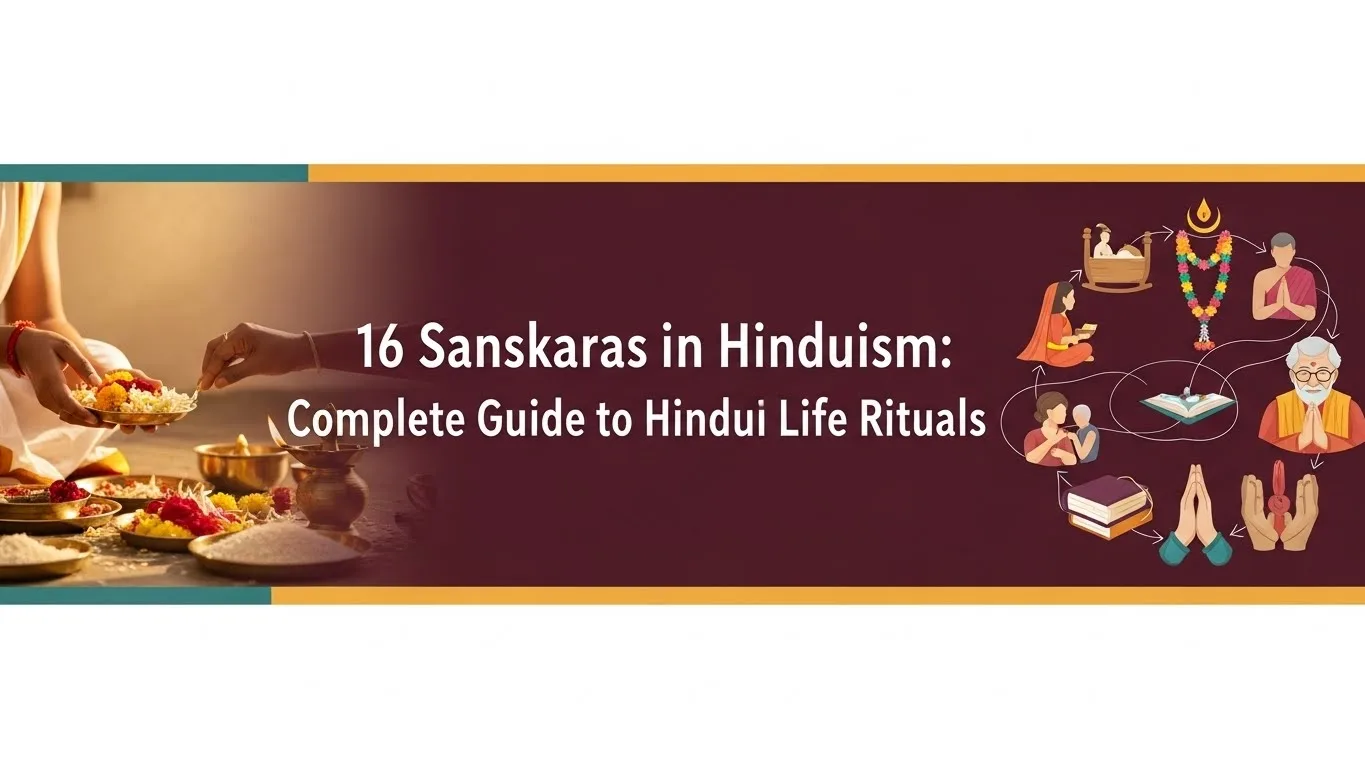
The 16 sanskaras in Hinduism – collectively known as Shodasha Samskaras from Sanskrit shodasha (sixteen) and samskara (sacrament/refinement) – represent one of the world’s most sophisticated systems of sacred rites of passage marking and sanctifying human development from before conception through death and beyond, creating comprehensive spiritual framework that recognizes life’s journey not as random sequence of biological events but as purposeful progression through defined stages each requiring divine blessings, community recognition, and conscious preparation for evolving responsibilities within family, society, and cosmic order.
Unlike secular modern cultures treating birth, education, marriage, and death as mere administrative formalities documented through certificates and legal paperwork, Hindu tradition understands these transitions as spiritually significant thresholds where individual consciousness interfaces with eternal divine patterns, requiring formal rituals (vidhi) that purify accumulated negative impressions (samskaras in psychological sense), invoke protective deities, align personal trajectory with dharmic purpose, and create positive mental imprints guiding character development throughout life.
The Sanskrit root sam-kri literally means “to make perfect” or “to refine completely,” revealing these ceremonies’ essential function: progressive refinement of raw human potential into realized spiritual capacity, analogous to goldsmith’s systematic processes transforming crude ore through multiple purification stages into pure, radiant gold capable of reflecting divine light without distortion. For Hindu families in 2025, understanding complete samskara system proves essential even when contemporary circumstances prevent observing all sixteen with traditional elaboration – knowing the framework reveals.
Hinduism’s profound psychological sophistication recognizing that human development requires systematic intervention at critical junctures, that community participation in individual transitions strengthens collective bonds while providing support networks, that sacred ceremonies create meaningful markers preventing life from blurring into undifferentiated monotony lacking purposeful direction, and that spiritual consciousness doesn’t develop accidentally but demands deliberate cultivation through prescribed practices at age-appropriate developmental stages from infancy through adulthood to death, each samskara building upon previous foundations while preparing ground for subsequent evolution in never-ending spiral of increasing refinement culminating ultimately in liberation (moksha) from cyclical rebirth itself.
Understanding Samskara: The Concept and Purpose
Before examining individual ceremonies, grasping the fundamental theological and psychological principles underlying the samskara system transforms these rituals from quaint cultural customs into profound spiritual technology addressing universal human developmental needs.
The Etymology and Meaning:
The word samskara carries multiple interconnected meanings revealing its conceptual richness:
1. Refining Process: Sam (complete) + kri (to do/make) = to make complete, to perfect, to refine thoroughly
2. Sacred Impression: Deep psychological imprint created by significant experiences, shaping character and tendencies
3. Purifying Ritual: Ceremonial procedure removing impurities and consecrating for higher purpose
The Dual Significance:
Hinduism recognizes two types of samskaras, though using same word:
External Samskaras (Rituals): The sixteen formal ceremonies marking life stages – what this article primarily discusses
Internal Samskaras (Psychological Impressions): Mental imprints formed by experiences, thoughts, and actions that create personality patterns and karmic tendencies
The beautiful connection: external ritual samskaras create positive internal psychological samskaras, systematically imprinting consciousness with values, behaviors, and spiritual orientations that shape character development throughout life.
The Scriptural Foundation:
While Vedic literature references numerous samskaras (some texts identify 40+), the tradition eventually standardized around sixteen primary ones (Shodasha Samskaras) as most essential:
Grihya Sutras: Ancient household ritual manuals (Paraskara, Ashvalayana, Gobhila Grihya Sutras) provide detailed procedures for each samskara
Dharma Shastras: Law codes (Manu Smriti, Yajnavalkya Smriti) discuss samskaras’ social and spiritual obligations
Puranas: Devotional texts contextualize samskaras within bhakti framework
The Multi-Dimensional Purpose:
Samskaras serve simultaneously on multiple levels:
1. Spiritual Purification:
- Removes negative karmic impressions from previous births
- Invokes divine blessings for soul’s journey
- Creates sacred protection around vulnerable life transitions
- Aligns individual destiny with cosmic purpose
2. Psychological Development:
- Marks clear life stages providing developmental structure
- Creates positive identity formation at each transition
- Establishes healthy boundaries and role expectations
- Builds confidence through community recognition and support
3. Social Integration:
- Formally introduces individual to community at each stage
- Creates mutual responsibilities between individual and society
- Transmits cultural values across generations
- Strengthens collective bonds through shared ceremonial participation
4. Educational Function:
- Teaches dharmic values through ritual symbolism
- Introduces sacred texts, mantras, and traditions
- Prepares for upcoming life stage’s responsibilities
- Creates teachable moments for spiritual instruction
The Life-Cycle Framework:
The sixteen samskaras divide into natural life categories:
| Category | Samskaras | Life Phase | Primary Purpose |
|---|---|---|---|
| Prenatal | 1-3 | Before birth | Preparing ideal vessel for incoming soul |
| Childhood | 4-9 | Birth to age 5-7 | Physical care, identity formation, social introduction |
| Educational | 10-14 | Age 8-20s | Intellectual development, spiritual initiation, maturity |
| Adult | 15 | Marriage age | Fulfilling householder duties, creating family |
| Final | 16 | Death | Ensuring peaceful transition to next realm |
The Modern Relevance:
Even when full traditional practice proves impractical in contemporary urban contexts:
Psychological Benefits: Clear life stage markers prevent developmental ambiguity, providing structure and meaning during transitions
Community Bonds: Shared celebrations strengthen extended family networks increasingly fragmented by modern mobility
Cultural Transmission: Rituals tangibly connect younger generations to ancestral wisdom and spiritual heritage
Mindfulness Practice: Sacred ceremonies create intentional pauses in rushed modern life for reflection and spiritual reconnection
Identity Formation: Participating in ancient traditions provides stable cultural identity amid globalization’s homogenizing forces
Understanding this framework, let’s explore each samskara in detail.
Prenatal Samskaras (1-3): Preparing for Sacred Birth
Hindu tradition uniquely recognizes that spiritual development begins before physical birth, understanding that creating ideal conditions for incoming soul requires conscious preparation starting from conception itself.
1. Garbhadhana Samskara (Conception Ceremony)
Timing: Before or immediately after conception
Literal Meaning: Garbha (womb) + dhana (wealth/bestowing) = Bestowing wealth into the womb
Purpose and Significance:
This first samskara recognizes conception as sacred act rather than mere biological function, emphasizing:
- Conscious intention in creating new life
- Spiritual preparation of parents for sacred responsibility
- Invoking ideal soul to incarnate in family
- Purifying parents’ consciousness for noble procreation
Traditional Practice:
Historically performed on auspicious nights calculated according to wife’s fertile period, lunar phases, and favorable nakshatras (lunar mansions). Couples would:
- Observe vrata (fast) and spiritual preparation days prior
- Perform evening puja invoking Prajapati (lord of procreation) and other deities
- Recite specific Vedic mantras requesting pure, healthy offspring
- Maintain sattvic consciousness and devotional mood
Modern Context:
While few contemporary couples perform formal Garbhadhana, the underlying principles remain relevant:
- Conscious family planning rather than accidental conception
- Preparing mentally, emotionally, and spiritually for parenthood
- Creating healthy, loving environment for pregnancy
- Recognizing procreation’s sacred dimension beyond physical act
2. Pumsavana Samskara (Male/Child Protection Ceremony)
Timing: Third month of pregnancy (after quickening detected)
Literal Meaning: Pumsa (male/child) + vana (generation) = Generating/protecting the child
Purpose and Significance:
Despite name’s male implication (reflecting ancient preference for sons), Pumsavana actually seeks protection and healthy development for fetus regardless of gender:
- Ensuring proper physical formation
- Protecting from miscarriage and complications
- Invoking divine blessings for strong, healthy baby
- Maternal health and wellbeing
Traditional Practice:
Around third month when pregnancy becomes visible:
- Priest performs homa (fire ceremony) with specific herbs
- Mother given blessed prasad and herbal preparations
- Vedic mantras chanted for child’s healthy development
- Protective prayers against pregnancy complications
Ayurvedic Connection:
Pumsavana significantly connects with Ayurvedic prenatal care:
- Specific herbs administered support fetal development
- Dietary recommendations ensure proper nutrition
- Lifestyle guidance prevents complications
- Mind-body practices maintain mother’s equilibrium
Modern Adaptation:
Contemporary practice often merges Pumsavana with Simantonnayana (next samskara), combining protective prayers with baby shower celebration. Core elements remain:
- Medical prenatal care ensuring healthy pregnancy
- Spiritual practices for mother’s peace of mind
- Family support and celebration of upcoming birth
- Conscious attention to fetal wellbeing
3. Simantonnayana/Seemantonnayana Samskara (Hair-Parting Ceremony)
Timing: Fifth, seventh, or ninth month of pregnancy (typically seventh)
Literal Meaning: Simanta (parting of hair) = Hair-parting ceremony
Purpose and Significance:
This beautiful samskara serves multiple purposes:
- Psychological: Celebrating pregnancy, reducing maternal anxiety
- Social: Community gathering supporting expectant mother
- Spiritual: Blessings for safe delivery and healthy child
- Practical: Ensuring mother receives proper care and rest
Traditional Practice:
Elaborate ceremony involving:
- Hair Parting: Husband ceremonially parts wife’s hair upward using symbolic items (porcupine quill traditionally, now comb)
- Adorning: Mother receives flowers, ornaments, new clothes from family
- Blessings: Elders and married women bless with protective mantras
- Gifts: Family members gift items for baby and mother
- Feast: Celebratory meal with auspicious foods for mother’s health
Mantra Example:
भूर्भुवः स्वः तत्सवितुर्वरेण्यं भर्गो देवस्य धीमहि।
धियो यो नः प्रचोदयात्॥
The Gayatri Mantra often chanted for divine protection.
Modern Baby Shower Connection:
Contemporary “God Bharai” (North India) or “Seemantham” (South India) essentially maintains this samskara:
- Family gathers to celebrate and support pregnant woman
- Gifts for baby and mother exchanged
- Blessings from elders invoking safe delivery
- Creating joyful, stress-free environment for mother
Psychological Wisdom:
Ancient texts understood that mother’s mental state affects fetal development – thus creating positive, supportive, stress-free environment during pregnancy through this ceremony serves both spiritual and practical purposes validated by modern prenatal psychology.
Childhood Samskaras (4-9): Early Formation Years
The six childhood samskaras address critical developmental needs from birth through early childhood, establishing foundation for healthy physical, psychological, and spiritual growth.
4. Jatakarma Samskara (Birth Ceremony)
Timing: Immediately after birth, before cutting umbilical cord
Literal Meaning: Jata (born) + karma (action) = Birth rites
Purpose: Welcoming soul into physical world with sacred blessings
Traditional Practice:
Father performs brief ceremony:
- Touching Baby’s Lips: With gold ring or spoon, father places honey and ghee on newborn’s tongue
- Whispering: Sacred mantras whispered into baby’s right ear
- First Sound: Om or deity name as baby’s first conscious sound
- Blessing: Prayers for intelligence, longevity, strength
Symbolism:
- Honey: Sweetness of life, pleasant speech
- Ghee: Nourishment, purity, sacred offerings
- Gold: Prosperity, purity
- Mantras: Spiritual protection and awakening
Modern Practice:
While immediate post-birth ritual increasingly rare in hospitals, families adapt by:
- Performing ceremony within first few hours/days
- Creating sacred atmosphere in hospital room if possible
- Playing recorded mantras for newborn
- Conscious blessing by parents even without formal priest
5. Namakarana Samskara (Naming Ceremony)
Timing: 10th, 11th, 12th, or 21st day after birth (varies by tradition)
Purpose: Establishing child’s individual identity and social existence
Significance:
Names in Hindu tradition carry profound meaning:
- Reflect family’s hopes and blessings
- Connect to deities, virtues, or auspicious qualities
- Astrologically calculated for favorable vibrations
- Create child’s first social identity
Traditional Procedure:
- Preparation: Puja to Ganesha and family deities
- Astrological Consultation: Name selected based on birth nakshatra (lunar mansion)
- Whispering: Father whispers chosen name four times in baby’s right ear
- Announcement: Name formally declared to assembled family
- Blessings: Elders bless baby using the new name
- Feast: Celebration with sweets and festive meal
Naming Methodologies:
Nakshatra-Based: Each nakshatra has specific syllables; name begins with auspicious syllable
Deity-Based: Names of gods/goddesses (Krishna, Lakshmi, etc.)
Virtue-Based: Qualities hoped for child (Prakash = light, Shanti = peace)
Family Tradition: Naming after grandparents or ancestors
Modern Practice:
Contemporary families balance tradition with modern sensibilities:
- Consulting astrologers while considering practical name usability
- Multiple names (official/legal, spiritual/astrological, nickname)
- Formal ceremony with priest or simple family gathering
- Online tools for nakshatra-based name suggestion
6. Nishkramana Samskara (First Outing)
Timing: Fourth month after birth
Purpose: Baby’s first formal introduction to outside world beyond home
16 Sanskaras in Hinduism
Traditional Practice:
- Parents take baby to temple or sacred place
- Baby shown sun and moon for first time
- Prayers for protection from external elements
- Beginning of baby’s sensory engagement with wider world
Significance:
Recognizes controlled, sacred introduction to external environment rather than casual, early exposure. Creates first memories and impressions in developing consciousness.
Modern Adaptation:
While not always formally marked, families often remember baby’s “first temple visit” or similar milestone, maintaining essence of conscious first outing.
7. Annaprashan Samskara (First Solid Food)
Timing: Sixth month (when teeth appear) or seventh month
Purpose: Initiating baby’s transition from milk to solid food
Traditional Procedure:
Elaborate ceremony where:
- Baby dressed in new clothes
- Puja performed invoking Goddess Annapurna (food deity)
- Sweet rice (kheer) prepared as first food
- Elder (often maternal uncle) feeds first bite
- Symbolic objects placed before baby (book, money, soil, etc.)
- Baby’s choice supposedly indicates future inclination
Modern Relevance:
This samskara perfectly aligns with modern pediatric recommendations (solid foods at 6 months), showing ancient wisdom’s practical grounding. Contemporary families maintain this as baby’s “first rice eating ceremony” with varying elaboration.
(See our detailed article on Annaprashan for complete procedures)
8. Chudakarana/Mundan Samskara (First Haircut)
Timing: First, third, or fifth year (varies by tradition)
Purpose: Ritual shaving representing purification and renewal
Traditional Practice:
- Complete head shaving at temple or home
- Hair offered to deity or sacred river
- Prayers for healthy hair growth and removal of birth impurities
Symbolism:
Birth hair considered to carry womb’s impurities; removing it symbolizes:
- Fresh beginning
- Cleansing
- Preparing for next life stage
Modern Variations:
Some families do partial shave, some skip entirely. South Indian traditions particularly maintain this (especially at Tirupati temple).
9. Karnavedha Samskara (Ear Piercing)
Timing: Sixth month to fifth year (varies widely)
Purpose: Health benefits and cultural tradition
Scientific Basis:
- Acupressure points in earlobes linked to health benefits
- Ayurvedic texts cite immunity and cognitive benefits
- Modern research suggests some neurological connections
Traditional Practice:
- Auspicious day selected
- Professional or family elder pierces earlobes
- Gold studs traditionally used
- Both boys and girls pierced historically (now mostly girls)
Modern Context:
Widely practiced for girls, less common for boys in contemporary times. Many families maintain this tradition with medical professionals performing piercing hygienically.
Educational Samskaras (10-14): Knowledge and Maturity
These five samskaras mark intellectual and spiritual awakening, traditionally occurring during brahmacharya (student) stage of life.
10. Vidyarambha Samskara (Beginning of Learning)
Timing: Age 5 (when formal education begins)
Purpose: Initiating child into knowledge acquisition
Traditional Practice:
- Worship of Goddess Saraswati (learning deity)
- Child writes first letters in rice or sand
- Guru introduces alphabet
- Symbolic beginning of educational journey
Modern Adaptation:
School admission ceremonies, kindergarten first day, or home-based ritual marking educational commencement.
11. Upanayana Samskara (Sacred Thread Ceremony)
Timing: Ages 8-16 (varies by caste/tradition)
Purpose: Spiritual initiation and “second birth”
Significance:
Most important childhood samskara, marking:
- Qualification to study Vedas
- Beginning of spiritual responsibilities
- Formal entry into dharmic life
- Receiving sacred thread (yajnopavita)
Traditional Elaborate Procedure:
Multi-day ceremony involving:
- Preparation and preliminary rituals
- Thread investiture by guru/father
- Teaching of Gayatri Mantra
- Symbolic alms collection (bhiksha)
- Feast and community celebration
Sacred Thread Symbolism:
Three strands represent:
- Physical, mental, spiritual purity
- Debt to gods, sages, ancestors
- Past, present, future
Modern Practice:
Maintained primarily by Brahmin communities, though increasingly others also observe. Some families include girls in adapted ceremonies.
12. Vedarambha Samskara (Beginning Vedic Study)
Timing: After Upanayana
Purpose: Formal initiation into Vedic learning
Traditional Context:
Boy begins studying specific Veda assigned to his family lineage under guru’s guidance in gurukul system.
Modern Relevance:
Rarely practiced separately from Upanayana in contemporary context, though some traditional families maintain Vedic study traditions.
13. Keshanta/Ritusuddhi Samskara (Coming of Age)
Timing: Age 16 (when secondary sexual characteristics appear)
Purpose: Marking transition to physical maturity
For Boys (Keshanta):
- First beard shaving
- Recognition of manhood
- Increased responsibilities
For Girls (Ritusuddhi):
- First menstruation ceremony
- Recognition of womanhood
- Preparation for future marriage
Modern Adaptations:
While formal ceremonies less common, many families still mark these milestones through family gatherings and blessings.
14. Samavartana Samskara (Graduation)
Timing: Completion of education
Purpose: Returning home from guru’s ashram as educated adult
Traditional Context:
Student completes Vedic education, receives guru’s blessings, returns home ready for householder life.
Modern Equivalents:
University graduation ceremonies essentially fulfill this samskara’s purpose – marking educational completion and transition to professional life.
Adult and Final Samskaras (15-16)
15. Vivaha Samskara (Marriage)
Timing: Appropriate marriage age (varies by era and individual)
Purpose: Sacred union for dharma, progeny, and mutual spiritual growth
Significance:
Most elaborate of all samskaras, recognizing marriage as:
- Sacred partnership transcending individual existence
- Foundation for next generation
- Context for fulfilling householder duties
- Spiritual journey toward liberation through family life
Key Rituals:
Multi-day ceremony including:
- Kanyadaan (giving away bride)
- Panigrahana (groom taking bride’s hand)
- Saptapadi (seven steps around fire with seven vows)
- Sindoor application, mangalsutra wearing
- Elaborate community celebration
Modern Hindu Weddings:
While specific rituals vary by region, most maintain core elements creating spiritual bond between couple.
16. Antyeshti Samskara (Funeral Rites)
Timing: After death
Purpose: Ensuring departed soul’s peaceful transition
Significance:
Final samskara recognizing death not as end but as transition in soul’s eternal journey.
Key Components:
- Ritual preparation of body
- Cremation with specific mantras
- Post-cremation ceremonies (10-13 days)
- Shraddha (ancestor offerings)
Purpose:
- Release soul from earthly attachments
- Provide spiritual support for transition
- Comfort grieving family
- Fulfill final duties to deceased
Frequently Asked Questions
Are all 16 sanskaras mandatory for every Hindu?
No, not mandatory in strict sense. Historically, practice varied by caste, region, and family tradition. Today, most families observe select sanskaras: Namakarana (naming), Annaprashan (first solid food), Upanayana (sacred thread – primarily upper castes), Vivaha (marriage), and Antyeshti (funeral). Observing what’s feasible with sincere understanding proves more valuable than mechanical completion of all sixteen without proper consciousness.
Can girls undergo Upanayana (sacred thread ceremony)?
Historically, ancient Vedic period allowed girls’ Upanayana, but practice discontinued centuries ago due to changing social norms. Modern revival movement advocates restoring girls’ right to Upanayana, with some progressive families performing ceremony for daughters. Traditional orthodox families still restrict to boys only. The debate continues between preserving historical practice versus returning to earlier Vedic inclusivity.
What if we missed sanskaras during childhood – can they be performed later?
Some sanskaras can be performed later if missed at traditional age, though ideally they follow prescribed timing. Upanayana particularly can be done in adulthood if missed in childhood – some converts to traditional Hinduism undergo this. However, prenatal and early childhood sanskaras obviously can’t be retroactively performed. Missing sanskaras doesn’t invalidate one’s Hindu identity; sincere spiritual practice matters more than mechanical ritual completion.
Do sanskaras apply to Hindu converts or only birth Hindus?
Hindu conversion (formal or informal) traditionally involves adapted sanskaras appropriate to adult entry into tradition. Most commonly: Upanayana (sacred thread for spiritual initiation) and sometimes Namakarana (taking Hindu name). No universal authority mandates specific requirements – different lineages and gurus handle differently. Sincere adoption of Hindu philosophy and practice generally considered more essential than ritual formalities.
How do sanskaras differ across Hindu denominations and regions?
Significant variation exists. By tradition: Vaishnavas, Shaivas, Shaktas emphasize different deities during ceremonies while maintaining basic structure. By region: South Indian practices differ from North Indian; Bengali customs differ from Gujarati. By caste: Some sanskaras traditionally caste-specific (Upanayana particularly). Core framework remains consistent; specific procedures, mantras, and elaboration vary considerably.
Are sanskaras relevant for Hindus living abroad?
Yes, definitely! Many Hindu diaspora communities maintain sanskara traditions as cultural identity anchor and spiritual practice. Challenges include finding qualified priests, accessing ritual materials, and balancing with mainstream cultural participation. Families adapt by: simplifying ceremonies, combining sanskaras with local celebrations (baby showers, graduations), using online resources for guidance, creating diaspora community support networks for ritual observance.
What’s the minimum requirement to make a samskara valid?
Sincere intention and basic ritual structure suffice for validity. Ideally includes: invoking appropriate deity, chanting relevant mantras (even simplified versions), performing core symbolic actions, gathering family/community witnesses. Elaborate multi-day ceremonies with professional priests represent ideal; simpler home ceremonies with sincere devotion prove acceptable when resources limited. Spiritual consciousness matters more than external elaboration.
How do sanskaras relate to modern psychological development theories?
Fascinating correlation! Sanskaras align remarkably with developmental psychology’s life-stage models. Erik Erikson’s psychosocial stages, for instance, parallel sanskara framework: trust formation (infant ceremonies), identity development (childhood/educational sanskaras), intimacy (marriage), generativity (householder duties), ego integrity (approaching death). Ancient Hindu psychology recognized developmental needs modern science rediscovered, providing spiritual dimension contemporary theories often lack.
Conclusion
The sixteen sanskaras represent Hinduism’s systematic blueprint for conscious human development, recognizing that transformation from biological organism to spiritually realized being requires deliberate intervention through sacred ceremonies at critical life junctures rather than happening accidentally through mere passage of time. This sophisticated framework demonstrates profound psychological wisdom understanding that human consciousness develops through clear stages, each requiring specific preparation, community support, and spiritual blessing to successfully navigate the transition from dependence to autonomy, from ignorance to knowledge, from individual identity to cosmic consciousness.
Whether contemporary Hindu families observe all sixteen sanskaras with traditional elaboration or selectively maintain handful of ceremonies adapted to modern urban constraints, understanding the complete system reveals Hinduism’s holistic vision integrating physical, psychological, social, and spiritual dimensions of human existence into unified developmental journey where material and transcendent purposes complement rather than contradict each other.
As you consider sanskaras for your family in 2025, remember that these ancient rituals serve not as burdensome obligations creating guilt when imperfectly performed but as gifts of wisdom offering structured pathways for conscious growth, meaningful celebration of life’s transitions, tangible connection to thousands of years of spiritual tradition, and practical methods for creating positive psychological impressions (samskaras) that shape character toward virtue, knowledge, and ultimately liberation.
Even simplified observance with proper understanding proves more valuable than elaborate ceremonies performed mechanically without comprehending their purpose – the divine responds to sincere devotion and conscious intention more than external ritual perfection, making these transformative practices accessible to all regardless of resources, making modern adaptations fully valid when maintaining essential spiritual core, and ensuring this profound tradition continues nurturing human development from conception through death and beyond across changing circumstances and evolving times.
॥ सर्वं ज्ञानप्लवेनैव वृजिनं सन्तरिष्यसि॥
(Through knowledge alone shall you cross over all impurities – Bhagavad Gita 4.36)
About the Author
Neha Kulkarni – Home Rituals and Practical Hindu Living Expert
Neha Kulkarni is a respected teacher specializing in home-based Hindu practices, daily worship procedures, practical application of religious traditions in contemporary family life, and making ancient ritual wisdom accessible for modern households. With personal experience maintaining traditional observances while navigating professional career and raising children in urban environment, her work focuses on helping families integrate meaningful spiritual practices into busy modern lives without overwhelming complexity or guilt about imperfect observance. Neha has guided hundreds of families through life-cycle ceremonies including naming ceremonies, first solid food rituals, sacred thread ceremonies, and marriage preparations, providing practical step-by-step procedures, simplified adaptations for resource constraints, and clear explanations of symbolic significance helping participants understand what they’re doing beyond mechanical ritual performance.
She regularly publishes on topics including establishing home puja routines, seasonal festival observances, children’s religious education, maintaining traditions in diaspora contexts, and balancing authentic practice with modern practical realities. Her teaching emphasizes that Hindu tradition offers flexible frameworks rather than rigid requirements, that sincere devotion and conscious understanding matter more than perfect external conformity, and that adapting ceremonies to contemporary circumstances while maintaining spiritual core proves entirely legitimate and necessary for tradition’s living continuity across generations and changing cultural contexts.