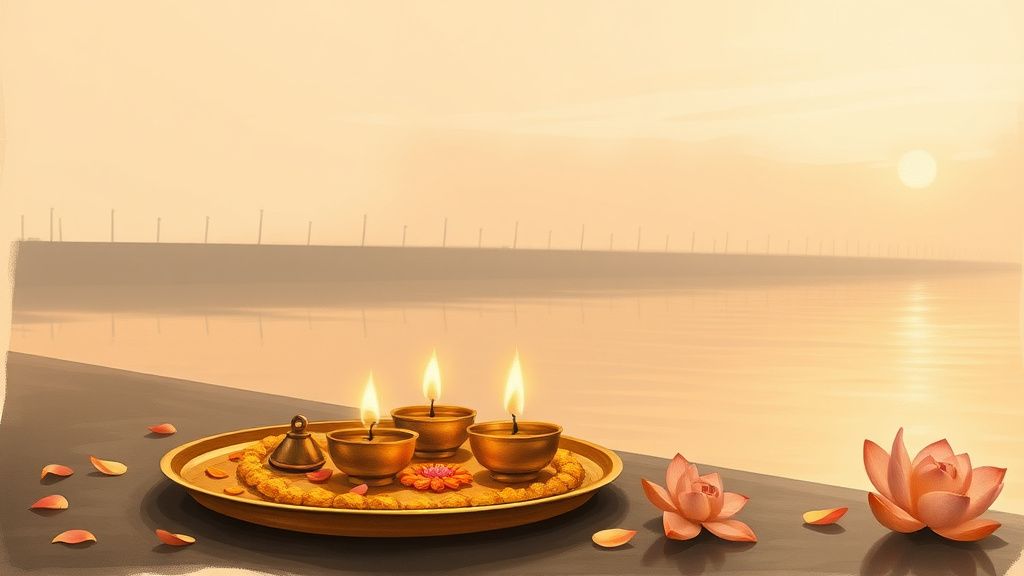
The evening Ganga Aarti at Dashashwamedh Ghat in Varanasi is the most attended of the daily river-aarti performances on the Ganga. It is run by the Gangotri Seva Samiti, with a parallel ceremony at the adjacent Rajendra Prasad Ghat. The aarti takes place daily at sunset, around 6:45 PM in summer and 6:00 PM in winter, and lasts about 45 minutes. Seven priests on raised platforms perform the synchronised lamp ritual to the Ganga. This article covers the timings, the ritual sequence, what to expect at the ghat, the boat-side viewing alternative, and how Dashashwamedh fits in the Varanasi ghat sequence.
Daily timings and what to expect
- Winter aarti: approximately 6:00 PM to 6:45 PM (November to February)
- Summer aarti: approximately 6:45 PM to 7:30 PM (March to October)
- Morning aarti (Subah-e-Banaras): around 5:00 AM at the adjacent ghat, smaller in scale
- Frequency: daily, no rest day; special expanded aartis on Dev Deepavali, Ganga Dussehra and Makar Sankranti
The ghat fills early. By 5:30 PM in winter and 6:15 PM in summer, the seven raised platforms have been set up with the panchmukhi (five-flame) lamps, conch, incense holders, peacock-feather fans (morpankhi) and chamara (yak-tail) whisks. Pilgrims gather on the steps below and on boats moored along the river. The boat-side view is the most photographed angle and is the easier seat on a crowded evening.
The ritual sequence
The aarti runs in eight movements, each item passed from priest to priest along the line so that all seven move in synchrony:
- Opening conch (shankh) blow: announcement of the aarti, three blasts.
- Dhoop (incense): sandal and resin incense circled before the river.
- Karpur deepak (camphor lamp): the smaller camphor flame.
- Panchmukhi deepak: the principal five-flame brass lamp, the visual signature of the aarti.
- Peacock-feather fan (morpankhi): waved in dedication.
- Chamara whisk: traditionally used to fan a royal deity, here offered to the river.
- Flower (pushpa): petals offered.
- Pradakshina with bells: the priests circle in place with hand bells; the chant of “Har Har Gange” rises through this section.
The musical accompaniment is a fixed set of bhajans, with the Ganga Stotra by Adi Shankara (“Devi sureshvari bhagavati gange”) and Tulsidas’s Ramcharitmanas verses prominent in the playlist. The whole ceremony from first conch to the closing aarti song is just under 45 minutes.
Origin of the organised aarti
The current organised, choreographed form of the Dashashwamedh aarti was institutionalised by the Gangotri Seva Samiti from 1991 onwards. Earlier, an evening lamp offering to the river had taken place informally at this and other ghats for centuries; the Gangotri Seva Samiti gave it the seven-priest, fixed-sequence format that is now the model copied at Haridwar, Rishikesh, Prayagraj and other riverfront aartis.
Dashashwamedh itself takes its name from a legendary ten-horse sacrifice (dasha-ashvamedha) performed by Brahma to welcome Shiva back to Kashi. The present ghat masonry dates from the mid-18th century, with reconstruction by Ahilyabai Holkar in 1774.
Watching from a boat
The river-side view is the most popular. Wooden rowboats and motorboats moor in rows in front of the seven platforms; shared rowboats are typically Rs 100-200 per head for an hour-long evening trip that includes the aarti, while a private boat for four to six runs Rs 600-1500 depending on season and bargaining. Diesel motorboats are restricted on certain days under NGT orders to reduce river pollution.
For what it’s worth, the second row of boats out from shore is the sweet spot; you sit slightly above the steps view line, get the priests fully framed against the ghat, and avoid the press of the front-row boats whose passengers obscure each other’s shots.
Dashashwamedh in the ghat sequence
Varanasi has 88 ghats running for about 6.5 km along the western bank of the Ganga, from Assi Ghat in the south to Raj Ghat in the north. Dashashwamedh is the central ghat and the closest to the Kashi Vishwanath temple complex, about 800 metres inland. The 88-ghat walk is the standard pilgrim circuit, with bathing concentrated at five principal ghats: Assi, Dashashwamedh, Manikarnika (the principal cremation ghat), Panchganga and Adi Keshava.
Common questions
Is the aarti free?
Yes, viewing from the ghat steps is free. Reserved seating on the upper terraces is operated by some local outfits during peak season for a small fee (Rs 100-300), but it is not necessary. The boat fare is separate and is the main paid component for most visitors.
Photography rules?
Photography from the ghat steps and from boats is permitted. Tripods are sometimes blocked at the front of the ghat on crowded evenings. Flash is discouraged; the aarti is well-lit and most modern cameras handle the scene without flash. The Manikarnima cremation ghat downstream prohibits photography by long-standing convention.
Best time to visit?
October to March is cool and the aarti starts earlier with sunset around 5:30 PM. November’s Dev Deepavali (the full moon of Kartik) is the biggest single-night spectacle, with all 88 ghats lit by oil lamps; the crowd is enormous and accommodation books out weeks in advance. April-June is hot and dusty; July-September is the monsoon and the river runs high.
One limitation worth noting
Sunset times shift by about an hour through the year and the aarti start follows sunset closely, so the exact clock time differs across months. Boat operators’ rates fluctuate. The figures above are typical for the regular daily aarti; for a Dev Deepavali or Ganga Dussehra visit, expect a different schedule and a much larger crowd.
For background see Dashashwamedh Ghat on Wikipedia and the Uttar Pradesh Tourism portal.
