Difference Between Lakshmi and Mahalakshmi In Hindu theology’s intricate divine taxonomy where single deities manifest in multiple forms reflecting different cosmic functions and theological perspectives, the distinction between Lakshmi and Mahalakshmi represents one of the most philosophically significant yet often confused relationships—not merely a semantic difference in naming but a fundamental theological distinction between Lakshmi as the benevolent goddess of wealth, prosperity, and material abundance who serves as Lord Vishnu’s
eternal consort seated beside him on lotus thrones, versus Mahalakshmi as the Supreme Mother Goddess (Adi Parashakti) representing primordial cosmic energy (Prakriti), the source from which the Trimurti itself emerges, manifesting as the fierce warrior deity riding a lion who destroys demons and restores cosmic balance independently without requiring male divine partnership.
According to Shakta traditions, particularly the Devi Mahatmya (Durga Saptashati), Mahalakshmi is one of three primary manifestations of Adi Shakti alongside Mahakali (representing tamas/destruction) and Mahasaraswati (representing sattva/creation), with Mahalakshmi specifically embodying rajas (sustaining dynamic energy) that maintains cosmic order and battles against forces threatening dharma—a far cry from the peaceful, lotus-holding, golden-complexioned Lakshmi who bestows financial prosperity, domestic harmony, and material blessings upon devoted householders seeking worldly success.
While mainstream Vaishnavism emphasizes Lakshmi as Vishnu’s consort and the goddess of wealth whose mythology centers on emerging from the cosmic ocean during Samudra Manthan to choose Vishnu as her husband, Shakta traditions assert Mahalakshmi as an independent supreme divinity who transcends the Trinity, creates Brahma-Vishnu-Shiva from her own cosmic energy, distributes Saraswati to Brahma, Parvati to Shiva, and Lakshmi (a limited manifestation of herself) to Vishnu as consorts enabling their cosmic functions.
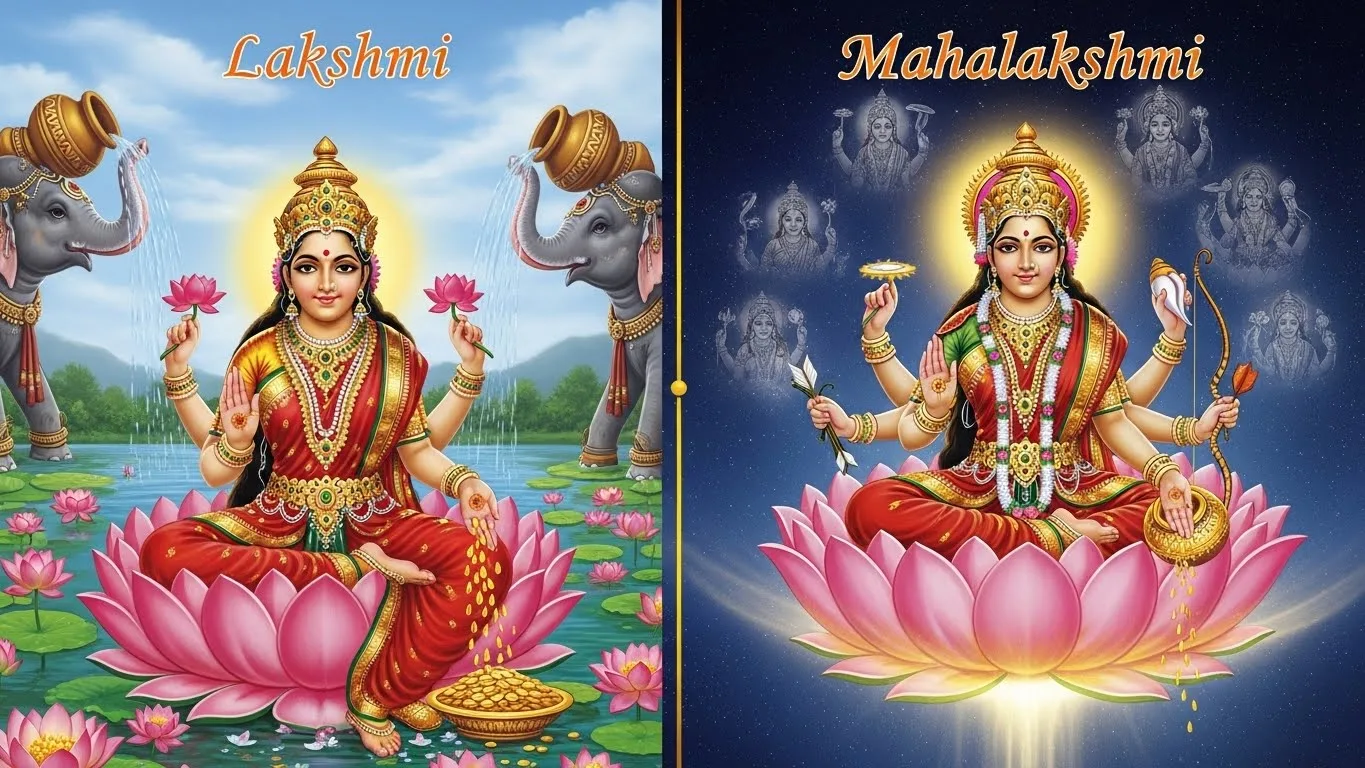
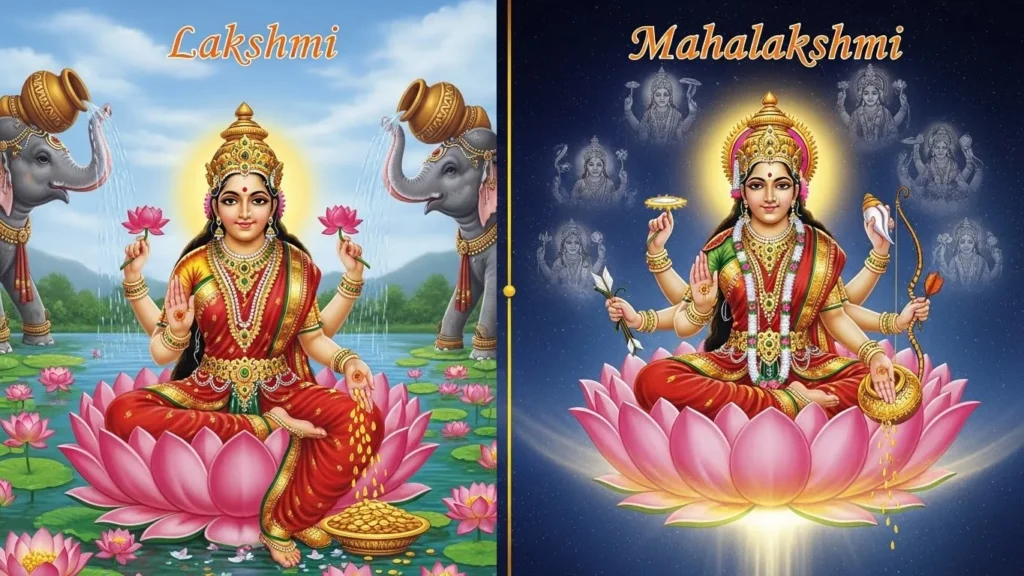
This distinction manifests visually in iconography: Lakshmi appears serene, golden-skinned, seated on pink lotus, holding lotuses and gold coins, flanked by elephants performing abhisheka, while Mahalakshmi is depicted as a fierce warrior goddess with eighteen arms holding weapons, riding a lion (not standing beside elephants), wearing red battle attire, and destroying demons—most prominently worshipped at Kolhapur’s Mahalakshmi Temple in Maharashtra where the lion vahana clearly establishes her as a form of Durga rather than the peaceful prosperity goddess.
The theological complexity deepens with Garuda Purana identifying Lakshmi as Prakriti (Mahalakshmi) manifesting in three forms—Sri (sattvic goodness), Bhu (rajasic activity), and Durga (tamasic power)—suggesting layers of identity where Mahalakshmi represents the abstract cosmic principle while Lakshmi represents specific accessible manifestations devotees can worship for particular purposes. The Lakshmi Sahasranama (thousand names of Lakshmi) includes “Mahalakshmi” as one name, suggesting unity, yet Shakta texts maintain clear hierarchy: Mahalakshmi is the impossible-to-comprehend Supreme Mother whose complete form transcends human imagination, while Lakshmi is an amsha avatar (partial manifestation) specifically designed for Kali Yuga devotees to worship and approach.
The practical implications are profound: worshippers seeking material wealth, business success, domestic prosperity, and financial stability invoke Lakshmi through traditional Lakshmi Puja, especially during Diwali, while those seeking spiritual liberation (moksha), cosmic power, destruction of evil forces, universal balance, and transcendent realization worship Mahalakshmi through Durga Saptashati recitation and Navaratri celebrations.
Understanding the difference between Lakshmi and Mahalakshmi reveals fundamental Hindu philosophical principles about the relationship between absolute and manifest divinity, the distinction between anthropomorphic accessibility and transcendent incomprehensibility, regional variations in goddess theology (Maharashtra’s fierce Mahalakshmi versus pan-Indian gentle Lakshmi), and the integration of Vedic prosperity goddesses with Tantric supreme Shakti concepts creating complex theological layers requiring contextual interpretation rather than simplistic equations.
This comprehensive exploration examines the theological foundations distinguishing these forms, their different roles and functions, iconographic differences, scriptural sources, worship practices, regional variations, the Devi Mahatmya’s Mahalakshmi, and contemporary devotional implications.
Theological Foundations: Consort Versus Supreme
The most fundamental distinction lies in their theological status and relationship to other deities.
Lakshmi: Vishnu’s Consort and Wealth Goddess
In mainstream Hindu tradition, especially Vaishnavism, Lakshmi is understood as Lord Vishnu’s eternal consort (Vishnu Patni), inseparably connected to the preserver deity who maintains cosmic order. This relationship defines her primary identity and function.
Dependent Relationship: Lakshmi’s mythology consistently connects her to Vishnu—she emerges from the ocean and immediately chooses him as her husband, she accompanies him in his avatars (as Sita with Rama, Rukmini with Krishna), and she sits or stands beside him in temple iconography.
Limited Domain: Her primary function focuses on bestowing wealth, prosperity, fortune, beauty, and material abundance to devotees—a crucial but limited aspect of cosmic management compared to creation, preservation, or destruction.
Accessible Form: Lakshmi represents an approachable, benevolent goddess who responds to prayers for worldly success, financial stability, and domestic harmony—qualities making her one of Hinduism’s most popularly worshipped deities.
Mahalakshmi: Supreme Mother Goddess
In Shakta traditions, particularly texts like Devi Mahatmya and Devi Bhagavata Purana, Mahalakshmi represents the Supreme Mother Goddess (Adi Parashakti) from whom all creation emerges.
Independent Divinity: Mahalakshmi is not defined by relationship to male deities but exists as an autonomous Supreme Being who transcends and precedes the Trinity of Brahma-Vishnu-Shiva.
Universal Domain: Her cosmic function encompasses creation, preservation, and destruction—she is Prakriti (primordial nature), the active principle enabling all cosmic processes.
Transcendent Nature: The complete form of Mahalakshmi is impossible to comprehend or imagine—she manifests in accessible forms (including Lakshmi) so devotees can approach and worship her.
The Hierarchy Question
Some traditions maintain that Lakshmi is an amsha avatar (partial manifestation) of Mahalakshmi—the supreme goddess takes a limited, specific form as Vishnu’s consort to fulfill particular cosmic functions related to sustaining prosperity and material abundance.
According to this framework, worshipping Lakshmi addresses immediate material needs but results in continuous rebirth driven by desires, while only Mahalakshmi’s blessings can grant moksha (spiritual liberation) by transcending the cycle of material attachment.
Scriptural Sources and Traditions
Different sacred texts present varying perspectives on these divine forms.
Vedic and Puranic Lakshmi
Rigveda: Early references to Sri (fortune/prosperity) as an abstract principle later personified as Lakshmi
Vishnu Purana: Describes Lakshmi as Bhrigu’s daughter who resides in Swarga but due to Durvasa’s curse leaves and enters the ocean, emerging during Samudra Manthan
Garuda Purana: Identifies Lakshmi as Prakriti (Mahalakshmi) manifesting in three forms—Sri (sattvic), Bhu (rajasic), Durga (tamasic)—suggesting layered identity
Lakshmi Sahasranama: Contains thousand names of Lakshmi, including “Mahalakshmi,” suggesting unified divine identity with multiple aspects
Shakta Texts: Mahalakshmi as Supreme
Devi Mahatmya (Durga Saptashati): The foundational Shakta text describes three primary manifestations of Adi Shakti:
- Mahakali (tamasic/destructive principle)
- Mahalakshmi (rajasic/sustaining principle)
- Mahasaraswati (sattvic/creative principle)
In the Devi Mahatmya’s middle episode (Madhyama Charitra), Mahalakshmi manifests to destroy the buffalo demon Mahishasura, demonstrating her warrior aspect.
Devi Bhagavata Purana: Presents Mahalakshmi as the Supreme Goddess who transcends the Trinity, described as the source of all creation, preservation, and destruction.
Tantric Texts: Emphasize Mahalakshmi as independent supreme divinity (Swatantra Devi) manifesting various goddess forms.
Regional Variations
North India: Predominantly worships Lakshmi as Vishnu’s consort, focusing on wealth and prosperity
Maharashtra: Strong tradition of Mahalakshmi worship as independent warrior goddess, centered at Kolhapur temple
Bengal: During Durga Puja, acknowledges the Mahalakshmi-Durga connection as fierce protective mother
South India: Complex integration where temple traditions include both forms with context-specific worship
Iconographic Differences: Visual Theology
The two forms display dramatically different visual representations revealing their distinct natures.
Lakshmi’s Iconography
Appearance:
- Golden or yellow-hued radiant complexion
- Serene, peaceful, benevolent facial expression
- Four arms (occasionally two when with Vishnu)
- Seated or standing on pink/red lotus
Attributes:
- Upper hands hold lotus flowers (purity, enlightenment)
- Lower right hand displays abhaya mudra (protection)
- Lower left hand shows varada mudra with cascading gold coins (blessings)
Attire:
- Red or pink sari with gold embroidery
- Abundant gold jewelry, crown, ornaments
- Feminine, graceful, attractive appearance
Vahana (Vehicle):
- White elephant (Gaja Lakshmi form) or
- Owl (uluka) representing wisdom and vigilance
Symbolism: Beauty, grace, fertility, abundance, material prosperity, domestic harmony
Mahalakshmi’s Iconography
Appearance:
- Fierce, powerful, warrior-like expression
- Often red or dark complexion
- Eight, ten, or eighteen arms holding weapons
- Standing or seated on lion
Attributes:
- Multiple arms holding various weapons: discus (chakra), sword (khadga), shield, trident, conch, bow and arrows, mace, noose
- Some hands display mudras of blessing and protection
- Warrior goddess prepared for cosmic battle
Attire:
- Red battle dress or armor
- Martial appearance rather than ornamental beauty
- Crown with Shivalinga (at Kolhapur temple)
Vahana (Vehicle):
- Lion (simha)—the definitive marker distinguishing her from peaceful Lakshmi
- The lion firmly establishes her as goddess of power, war, and royalty
Symbolism: Cosmic power, warrior energy, demon destruction, protection, universal balance, dharma restoration
The Decisive Visual Marker
Devdutt Pattanaik notes the iconographic test: “If the vahana is elephant, then the deity is Lakshmi; if it is the lion, the deity is Durga/Mahalakshmi”—at Kolhapur’s Mahalakshmi temple, the lion presence conclusively identifies her as the warrior goddess of power rather than the prosperity goddess.
Roles and Functions: Prosperity Versus Power
The two forms serve dramatically different cosmic and devotional functions.
Lakshmi’s Functions
Material Prosperity: Primary role involves bestowing wealth, financial success, business prosperity, agricultural abundance
Domestic Harmony: Grants marital happiness, family wellbeing, household peace, and auspiciousness
Beauty and Grace: Represents aesthetic refinement, physical beauty, artistic excellence
Worldly Success: Blesses devotees with career achievement, social status, comfort, luxury
Fertility: Associated with progeny, continuation of lineage, generational prosperity
Mahalakshmi’s Functions
Cosmic Maintenance: Embodies the rajasic (dynamic) energy that sustains the universe between creation and dissolution
Demon Destruction: Manifests as warrior goddess to destroy demons threatening cosmic order—particularly Mahishasura in Devi Mahatmya
Dharma Protection: Fights to restore righteousness when evil forces threaten universal balance
Liberation Granting: Only Mahalakshmi can bestow moksha (spiritual liberation) from the cycle of rebirth
Trinity Empowerment: Provides the Shakti (power) enabling Brahma to create, Vishnu to preserve, Shiva to destroy
The Devi Mahatmya’s Three Goddesses
The Devi Mahatmya (Durga Saptashati) presents Mahalakshmi as one of three cosmic manifestations of Adi Shakti, each representing different gunas (qualities).
The Tridevi Structure
The text divides into three sections (charitas), each featuring one primary goddess:
Prathama Charitra (Chapters 1-4): Features Mahakali, representing tamas (inertia, destruction)
- Awakens Vishnu from yogic sleep
- Destroys demons Madhu and Kaitabha
- Embodies destructive energy clearing space for new creation
Madhyama Charitra (Chapters 5-10): Features Mahalakshmi, representing rajas (activity, passion)
- Emerges to destroy buffalo demon Mahishasura
- Battles numerous demons threatening devas
- Embodies dynamic sustaining energy maintaining cosmic balance
Uttara Charitra (Chapters 11-13): Features Mahasaraswati, representing sattva (purity, harmony)
- Destroys demons Shumbha and Nishumbha
- Embodies creative intelligence organizing existence
Mahalakshmi’s Distinctive Role
In this framework, Mahalakshmi specifically represents the sustaining, maintaining, active energy that battles to preserve dharma and cosmic order—closely paralleling Vishnu’s preservation function but as an independent supreme power rather than his consort.
These three forms—Mahakali, Mahalakshmi, Mahasaraswati—transcend the regular pantheon of Parvati-Lakshmi-Saraswati as consorts, representing instead the primordial Shakti’s threefold manifestation through the gunas.
Worship Practices and Rituals
The two forms receive different types of worship reflecting their distinct natures.
Lakshmi Worship
Diwali/Deepavali: The primary festival for Lakshmi worship, especially on Lakshmi Puja night
- Homes are cleaned and decorated
- Diyas (oil lamps) are lit to invite her
- Prayers for prosperity, wealth, business success
- Gold coins, new account books, offerings of sweets
Friday Worship: Lakshmi is traditionally worshipped on Fridays
Offerings: Lotus flowers, sweets, fruits, rice, turmeric, kumkum
Mantras: Lakshmi mantras focus on wealth, prosperity, abundance
Tone: Gentle, devotional, requesting material blessings
Context: Household worship, business establishments, temples with Vishnu
Mahalakshmi Worship
Navaratri: Primary festival for Mahalakshmi worship as part of the nine-night Durga celebration
- Worshipped alongside Mahakali and Mahasaraswati
- Focus on cosmic power, demon destruction, protection
Durga Saptashati Recitation: Chanting the 700 verses specifically invokes Mahalakshmi’s power
Offerings: Red flowers, animal sacrifice in some traditions (particularly Maharashtra), martial offerings
Mantras: Powerful Shakta mantras invoking cosmic energy, liberation, demon destruction
Tone: Intense, transformative, seeking spiritual power and liberation
Context: Independent goddess temples (Kolhapur), Shakta traditions, tantric practices
Regional Variations: Maharashtra’s Warrior Goddess
The Mahalakshmi worship tradition reaches its apex in Maharashtra, particularly at the famous Kolhapur temple.
Kolhapur Mahalakshmi Temple
Located in Kolhapur, Maharashtra, this ancient Shakti Peetha houses a unique Mahalakshmi idol:
Unique Features:
- Black stone idol, 3 feet tall, weighing 40 kg
- Lion carved near the goddess’s feet—definitively establishing warrior identity
- Shivalinga on the crown symbolizing universal origin
- Snake fangs behind the Shivalinga representing time
Worship Practices:
- During Navaratri and Dussehra, local Maratha clans sacrifice goats to the fierce, hot goddess
- Recognized as goddess of power, war, and royalty
- Warriors traditionally sought her blessings before battle
Theological Identity:
The idol is called Ambabai (mother), and debate exists whether she represents Lakshmi or Parvati/Durga—the lion vahana strongly indicates Durga identification despite the temple name using “Mahalakshmi.”
Maharashtra Tradition
In Maharashtra, Mahalakshmi worship emphasizes her warrior, protective, fierce aspects—she is visualized as a virginal warrior goddess riding a lion, much like Durga, rather than as Vishnu’s beautiful consort.
This regional variation demonstrates that “Mahalakshmi” can refer to the supreme mother goddess independent of Vishnu, reflecting Shakta theology’s emphasis on feminine divine supremacy.
Prakriti and Cosmic Function
Both Garuda Purana and Shakta texts identify Mahalakshmi with Prakriti (primordial nature), but with different emphases.
Mahalakshmi as Prakriti
Prakriti represents the active, manifest, creative cosmic principle that complements Purusha (pure consciousness). Mahalakshmi as Prakriti embodies:
Universal Nature: The fundamental substance and energy of material existence
Creative Power: The dynamic force enabling all cosmic processes
Guna Source: The origin of the three gunas (sattva, rajas, tamas) structuring existence
Trinity Enabler: Provides the Shakti allowing Brahma-Vishnu-Shiva to perform their functions
Lakshmi as Prakriti Aspect
When Lakshmi is identified with Prakriti, it typically refers to her specific role in the preservation and prosperity dimension—not the totality of cosmic energy but the aspect focused on sustaining, nourishing, and enriching existence.
Contemporary Devotional Implications
Understanding these distinctions helps devotees approach worship appropriately.
When to Worship Lakshmi
Devotees seeking material prosperity, business success, financial stability, domestic harmony, beauty, comfort, worldly achievement worship Lakshmi through:
- Diwali Lakshmi Puja
- Friday observances
- Lakshmi mantras and stotras
- Household shrines with Lakshmi-Vishnu
When to Worship Mahalakshmi
Devotees seeking spiritual liberation (moksha), cosmic power, protection from evil, destruction of obstacles, universal balance, transformation, transcendent realization worship Mahalakshmi through:
- Navaratri celebrations
- Durga Saptashati recitation
- Shakta tantric practices
- Pilgrimage to Kolhapur and other Shakti Peethas
Integration in Practice
Many devotees don’t strictly separate these forms, recognizing Mahalakshmi as the supreme essence and Lakshmi as an accessible manifestation—worshipping both according to their specific needs and spiritual development levels.
Frequently Asked Questions
What is the main difference between Lakshmi and Mahalakshmi?
The main difference is theological status and function. Lakshmi is the benevolent goddess of wealth, prosperity, and material abundance who serves as Lord Vishnu’s eternal consort, focusing on bestowing financial success, domestic harmony, and worldly blessings. Mahalakshmi is the Supreme Mother Goddess (Adi Parashakti) representing primordial cosmic energy from which the Trimurti emerges, manifesting as an independent warrior deity riding a lion who destroys demons and restores cosmic balance.
In Shakta traditions, Mahalakshmi transcends the Trinity as autonomous supreme divinity, while Lakshmi is understood as a limited, accessible manifestation of Mahalakshmi specifically designed for devotees to worship for material needs. Mahalakshmi bestows spiritual liberation (moksha), while Lakshmi worship results in material prosperity but continued rebirth.
How does iconography differ between Lakshmi and Mahalakshmi?
Lakshmi appears serene with golden complexion, seated on pink lotus, holding lotus flowers and gold coins, displaying blessing gestures, wearing red/pink sari with gold jewelry, flanked by elephants or riding an owl—representing beauty, grace, and prosperity. Mahalakshmi appears as a fierce warrior with red or dark complexion, riding a lion (not elephant), holding weapons in eight to eighteen arms including discus, sword, shield, trident, conch, bow and arrows, wearing red battle dress, and displaying martial energy—representing cosmic power and demon destruction.
The definitive visual marker is the vahana: elephant indicates Lakshmi; lion indicates Durga/Mahalakshmi. At Kolhapur’s Mahalakshmi temple, the lion presence conclusively identifies her as the warrior goddess of power rather than the gentle prosperity deity.
What does the Devi Mahatmya say about Mahalakshmi?
The Devi Mahatmya (Durga Saptashati) presents Mahalakshmi as one of three primary manifestations of Adi Shakti alongside Mahakali (tamasic/destructive) and Mahasaraswati (sattvic/creative). In the text’s middle section (Madhyama Charitra), Mahalakshmi specifically represents rajas (dynamic sustaining energy) and manifests to destroy the buffalo demon Mahishasura and other demons threatening cosmic order.
These three forms—Mahakali, Mahalakshmi, Mahasaraswati—transcend the regular pantheon of Parvati, Lakshmi, and Saraswati as consorts, representing instead the primordial Shakti’s threefold manifestation through the three gunas (qualities of nature). Mahalakshmi embodies the active, maintaining force that battles to preserve dharma and universal balance, paralleling Vishnu’s preservation function but as an independent supreme power rather than his consort.
Is Mahalakshmi the same as Durga?
In Shakta traditions, particularly in Maharashtra, Mahalakshmi and Durga are closely identified or considered the same supreme goddess. The Kolhapur Mahalakshmi temple features a lion vahana and martial attributes clearly establishing her as Durga’s form rather than the peaceful Lakshmi. During Navaratri, Mahalakshmi is worshipped as part of the Durga celebration alongside Mahakali and Mahasaraswati as three aspects of Adi Shakti.
The Devi Mahatmya presents Mahalakshmi destroying Mahishasura—the same demon famously killed by Durga. However, in Vaishnava traditions, Lakshmi remains distinct from Durga as Vishnu’s consort. The relationship is complex: some texts identify Mahalakshmi as supreme cosmic energy manifesting as both peaceful Lakshmi (when associated with Vishnu) and fierce Durga (when battling demons), while others maintain they are separate goddesses entirely.
Why does Maharashtra worship Mahalakshmi differently?
Maharashtra has a strong tradition of worshipping Mahalakshmi as an independent warrior goddess rather than Vishnu’s gentle consort, centered at the famous Kolhapur Mahalakshmi temple. This temple features a unique black stone idol with a lion carved near her feet (definitively establishing warrior identity) and a Shivalinga on her crown. During Navaratri and Dussehra, local Maratha clans sacrifice goats to this fierce goddess recognized as deity of power, war, and royalty.
This regional variation reflects Shakta theology’s emphasis on feminine divine supremacy and Maharashtra’s historical martial culture. The goddess is called Ambabai (mother) and visualized as a virginal warrior riding a lion, much like Durga, rather than as the beautiful lotus-seated prosperity goddess. This demonstrates that “Mahalakshmi” in Maharashtra refers to the supreme mother goddess independent of Vishnu.
Can worshipping Lakshmi lead to moksha?
According to Shakta teachings, particularly those distinguishing Lakshmi from Mahalakshmi, worshipping Lakshmi alone results in material prosperity and worldly blessings but causes continuous rebirth because it perpetuates desires rather than transcending them. Only Mahalakshmi’s blessings can grant moksha (spiritual liberation) from the cycle of rebirth. Living beings in Kali Yuga, filled with ignorance, have downgraded Mahalakshmi (supreme cosmic energy) to Lakshmi (merely wealth), focusing on material abundance rather than spiritual transcendence.
Lakshmi worshippers will take countless births, always tormented by desires. However, other traditions maintain that sincere worship of any divine form with devotion (bhakti) can lead to liberation, and that Lakshmi and Mahalakshmi are ultimately the same divine energy approached through different names and forms according to devotees’ spiritual development levels and specific needs.
What scriptures discuss the Lakshmi-Mahalakshmi distinction?
The Devi Mahatmya (Durga Saptashati) presents Mahalakshmi as one of three supreme manifestations of Adi Shakti distinct from consort goddesses. The Devi Bhagavata Purana presents Mahalakshmi as the Supreme Goddess transcending the Trinity. Tantric texts emphasize Mahalakshmi as independent supreme divinity manifesting various goddess forms. The Garuda Purana identifies Lakshmi as Prakriti manifesting in three forms—Sri (sattvic), Bhu (rajasic), Durga (tamasic)—suggesting layered identity. The Vishnu Purana describes Lakshmi’s emergence from the ocean and relationship with Vishnu.
The Lakshmi Sahasranama includes “Mahalakshmi” among her thousand names, suggesting unified identity with multiple aspects. These texts reflect different theological perspectives—Vaishnava scriptures emphasize Lakshmi as Vishnu’s consort, while Shakta texts assert Mahalakshmi as supreme independent goddess with Lakshmi being a limited manifestation.
How should devotees approach worshipping these forms?
Devotees seeking material prosperity, business success, financial stability, domestic harmony, beauty, and worldly achievement should worship Lakshmi through Diwali Lakshmi Puja, Friday observances, Lakshmi mantras, and household shrines with Lakshmi-Vishnu images, offering lotus flowers, sweets, and prayers for abundance. Devotees seeking spiritual liberation (moksha), cosmic power, protection from evil, destruction of obstacles, universal balance, transformation, and transcendent realization should worship Mahalakshmi through Navaratri celebrations, Durga Saptashati recitation, Shakta tantric practices, and pilgrimage to temples like Kolhapur.
Many devotees integrate both approaches, recognizing Mahalakshmi as supreme essence and Lakshmi as accessible manifestation, worshipping according to specific needs and spiritual development levels. Understanding these distinctions allows approaching worship with clarity, aligning prayers with deepest needs and aspirations—whether immediate material success or ultimate spiritual enlightenment.
About the Author
Neha Kulkarni – PhD in Vedic Studies and Ancient Indian History
Neha Kulkarni is a distinguished scholar specializing in ancient Indian history, Vedic traditions, and Hindu cultural practices. With over 15 years of research experience focused on decolonizing historical narratives, he has published extensively on Hindu goddess theology, Shakta-Vaishnava theological distinctions, Devi Mahatmya studies, iconographic analysis, regional goddess worship variations, Puranic literature, and the complex relationships between consort goddesses and supreme Shakti manifestations. His work bridges academic rigor with devotional accessibility, making complex theological distinctions understandable to contemporary audiences seeking authentic knowledge about Hindu wisdom traditions and their transformative potential for both material prosperity and spiritual liberation.
