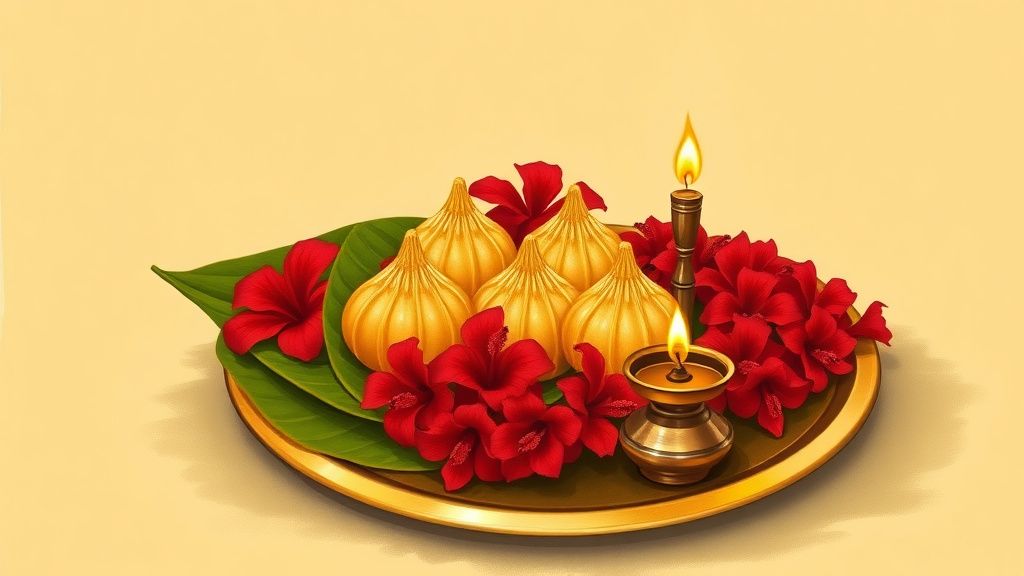
The laddu is the standard sweet prasad for two deities in particular: Ganesha and Hanuman. The modak-shaped or round laddu sits on Ganesha’s iconographic right palm in many depictions, and the boondi laddu is the staple offering at Hanuman temples across India. The most-distributed laddu in India is the Tirumala laddu, a sealed-tin laddu carrying a Geographical Indication tag and an official Tirumala Tirupati Devasthanams shelf life of 15 days. Home laddu preparation is straightforward but technique-sensitive: the sugar syrup must reach the right consistency, the boondi must be uniform, and the binding must happen while everything is still warm enough to fuse into a ball.
Two laddu types and their associations
- Boondi laddu: made from small fried droplets (boondi) of besan (chickpea flour) batter, bound with sugar syrup. The standard offering at most Hanuman temples and at major North Indian festivals.
- Besan laddu: made from roasted besan, ghee, and powdered sugar, formed into balls. Easier than boondi laddu; doesn’t require the small-droplet frying step.
- Rava laddu: semolina-based, often with grated coconut, easier to prepare at home.
- Motichoor laddu: a finer version of boondi laddu with smaller, denser droplets. The Tirumala laddu and the Banarasi laddu are motichoor variants.
- Coconut laddu: grated coconut bound with condensed milk or sugar syrup; quick recipe used in Krishna offerings.
Ganesha is associated with the round laddu and the steamed modak. Hanuman is associated specifically with the boondi laddu and with chickpea-based prasad more broadly (chana laddu, chana prasad). The associations are firmly established in temple practice across India.
A home besan laddu (the easiest version) for Ganesha
For roughly 15-20 medium laddus:
- In a heavy-bottomed pan, heat 1 cup of ghee. Add 2 cups of coarse besan (chickpea flour).
- Roast on low-to-medium heat, stirring continuously, for 15-20 minutes until the besan turns golden brown and the kitchen fills with a nutty aroma. The colour change is the indicator; under-roasted besan tastes raw.
- Turn off the heat. Add 1/4 cup of fine semolina (optional, for texture).
- Stir on the residual heat for another 2 minutes.
- Let the mixture cool until just warm to the touch (10-15 minutes).
- Add 1 cup of fine powdered sugar (boora or castor sugar), 1 teaspoon of cardamom powder, and 1/4 cup of chopped cashew or almond.
- Mix thoroughly with a wooden spoon, then with hands.
- Take small portions and roll into round balls between the palms. If too crumbly, add a teaspoon of warm ghee.
- Place on a clean plate to set. The laddus firm up over 1-2 hours.
- Offer to the deity in a clean small bowl, with a single laddu separated as the principal offering.
The boondi laddu for Hanuman (more technique)
The boondi laddu requires a perforated ladle (boondi ladle) and more careful sugar syrup work. For 12-15 laddus:
- Boondi batter: mix 1 cup besan with 3/4 cup water and a pinch of baking soda to form a smooth pancake-like batter. Add a small pinch of yellow food colour or saffron for the yellow tinge.
- Frying: heat ghee or oil in a deep pan to medium-hot (about 175 C). Hold a perforated ladle over the hot oil and pour batter through it; the small droplets fall into the oil and fry briefly. Skim out within 30 seconds; the boondi should be lightly golden, not crisp.
- Drain: place fried boondi on absorbent paper.
- Sugar syrup: mix 1.5 cups sugar with 1 cup water and a pinch of cardamom. Boil to a one-thread consistency (a small drop between thumb and finger forms a single thread when pulled).
- Combine: while the syrup is still warm, add the boondi. Mix gently. Add chopped cashew, raisin, and a few drops of edible camphor or kewra essence.
- Form: while the mix is still warm (not hot), take portions in cupped palms and press into round balls. The warmth is essential; cold boondi will not bind.
- Set: place laddus on a clean tray. They firm up over 1-2 hours.
For what it’s worth, the boondi laddu is one of the more technical home preparations and is forgiving only if you have already fried the boondi correctly. First-time cooks often produce uneven boondi and resulting unbound laddus. The besan laddu and the rava laddu are easier first projects.
The Tirumala laddu in particular
The Tirumala laddu deserves its own note. The Tirumala Tirupati Devasthanams’ potu kitchen produces over 300,000 laddus daily. The laddu is roughly 100 grams, composed of besan, sugar, ghee, cashew, raisin, cardamom and edible camphor. Two grades exist: the larger kalyanam laddu for special pujas, and the standard proktam laddu for everyday distribution. The recipe is closely guarded; the laddu is the only food in India with a Geographical Indication tag specifically restricted to the issuing temple. The official shelf life is 15 days at ambient temperature in the sealed tin.
Offering protocol
- Place 3 to 11 laddus in a clean small bowl or plate in front of the deity. The count varies by intention: 3 for the household, 5 for a small gathering, 11 or 21 for a vow-fulfilment.
- For Ganesha, place a fresh durva (a specific grass) on top, or a tulsi leaf if durva is unavailable.
- For Hanuman, place a betel leaf or a fresh red flower on top.
- Recite the offering mantra: Om Gam Ganapataye Namaha for Ganesha; Om Hanumate Namaha for Hanuman.
- After 5-10 minutes, remove the bowl and distribute the laddus to family and visitors.
Common questions
Why are laddus the specific prasad for Ganesha?
The Skanda Purana and the Ganesha Purana mention modak and sweet offerings in connection with Ganesha; the round laddu evolved as a variant of the round modak. The modak is shown in Ganesha’s right palm in many iconographic representations, and the laddu is the related sweet that became the everyday offering. Ganesha’s reputation as the “remover of obstacles” and the deity who is invoked at the start of any auspicious activity made his prasad the most-distributed sweet at Hindu beginnings.
Why boondi laddu for Hanuman?
The boondi laddu’s chickpea base aligns with chickpeas (chana) being the standard Hanuman offering. The bright orange-yellow colour of the laddu echoes the red sindoor that is applied to Hanuman’s image, and the laddu’s round form matches the iconographic representations of Hanuman in mid-flight. The pan-Indian convention of boondi laddu as the Hanuman temple prasad consolidated over the medieval period in the major Hanuman temples (Mehandipur, Sankat Mochan Varanasi, Salasar).
How long do home-made laddus keep?
Besan laddus stored in an airtight container at ambient temperature keep 7-10 days; boondi laddus keep 5-7 days. Refrigeration extends this to 2-3 weeks, but the laddus should be brought to room temperature before eating. The home version does not match the Tirumala laddu’s published 15-day shelf life because home preparation conditions are less controlled than the temple’s specialised potu kitchen.
Can the same laddu be offered to multiple deities?
Yes. A single home batch of laddus is commonly offered to the Ganesha image first (standard opening of any puja), then to the main deity of the day, then distributed to family. The single batch serves multiple offerings without ritual problem. The convention is that the offering blesses the prasad once; subsequent presentations to other deities are acceptable.
A limitation worth noting
This article covers home preparation of two common laddu types and the offering protocol. The specific Tirumala laddu recipe is closely guarded by the temple and is not reproducible at home in its exact form. The various regional laddus (Mysore pak which is not strictly a laddu, gond laddu of Rajasthan, pinni of Punjab, motichoor of Banaras) each have their own techniques and traditions that go beyond the besan and boondi covered here. For specific community traditions, the family elders and the temple’s prasad maker are the authoritative source.
See the Wikipedia entry on laddu and the entry on the Tirupati laddu.