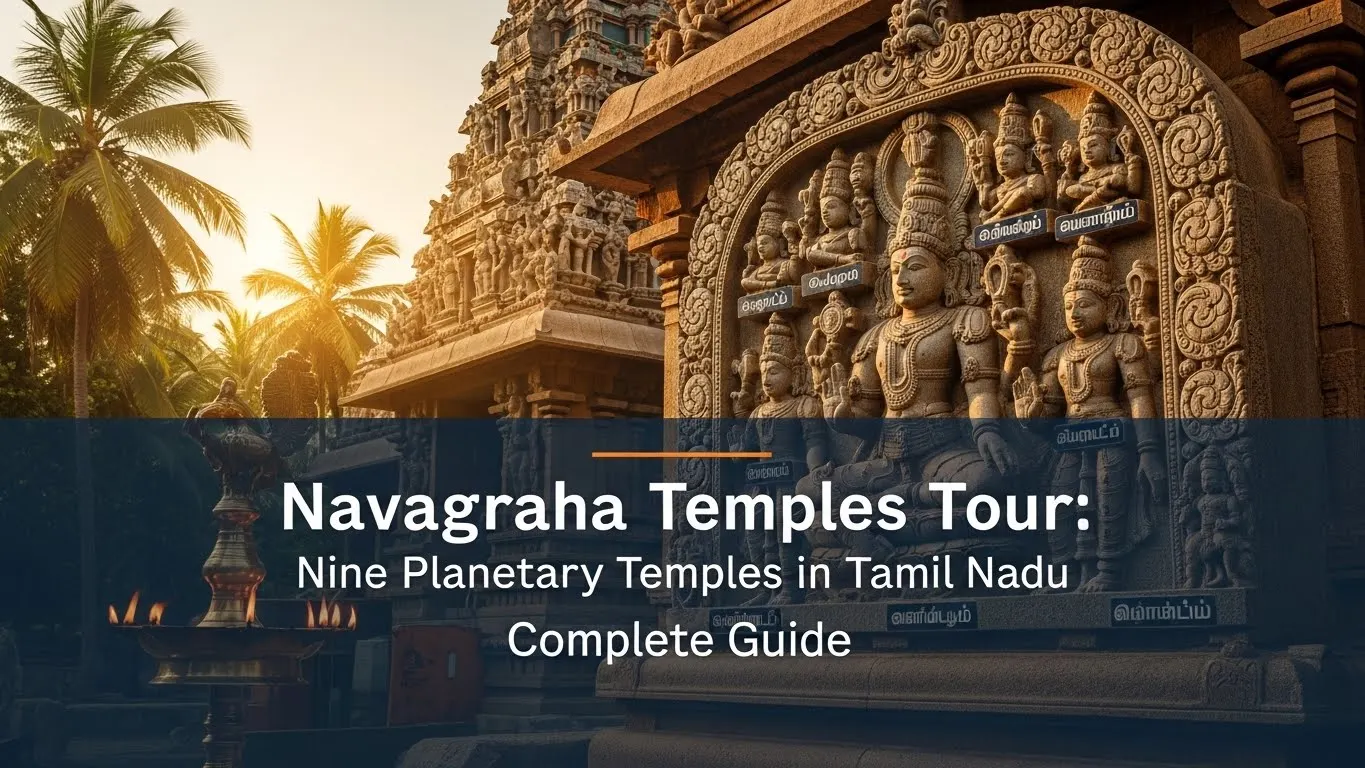
The Navagraha Temples Tour are a sacred circuit of nine ancient Hindu temples dedicated to the nine celestial bodies (grahas) of Vedic astrology, all located within a compact radius around Kumbakonam in Thanjavur district of Tamil Nadu, making them accessible for pilgrims seeking astrological remedies and spiritual blessings. These nine temples honor Surya (Sun), Chandra (Moon), Mangala/Angaraka (Mars), Budha (Mercury), Guru/Brihaspati (Jupiter), Shukra (Venus), Shani (Saturn), Rahu (north lunar node), and Ketu (south lunar node), with each temple believed to possess unique powers to alleviate adverse planetary effects (doshas) in individuals’ horoscopes through specific rituals called pariharam.

The Suryanar Kovil (also called Suryanar Temple) near Aduthurai stands as the only temple where Lord Surya is worshipped as the principal deity, with all remaining eight grahas also having their own shrines within this temple, making it the spiritual center and starting point for most Navagraha tours.
Visiting the Navagraha temples is believed to fix major life problems related to planetary afflictions including marriage difficulties (Mangal/Kuja dosha at Vaitheeswaran Koil), mental disturbances and emotional issues (Chandra dosha at Thingalur), career obstacles (Shani dosha at Tirunallar), health concerns, financial troubles, and relationship challenges. The complete tour can be accomplished in 1-2 days covering approximately 200-250 kilometers, with pilgrims typically staying in Kumbakonam or Thanjavur and following either an astrological sequence or a route-based itinerary that minimizes travel distance.
The temples follow traditional Dravidian architectural style with thousand-year-old structures, each featuring the presiding Shiva lingam along with dedicated shrines for the specific planetary deity (graha), special sacred tanks (theerthams), and prescribed rituals including abhishekams, flower offerings, archanas, and homams to remedy doshas and invoke planetary blessings. This comprehensive guide explores the nine Navagraha temples with their locations and specific planetary significance, astrological remedies (pariharam) performed at each temple, detailed tour routes and itineraries for 2026 pilgrims, the spiritual and Vedic astronomy foundations, practical visiting information including timings and accommodations, and what this sacred circuit reveals about Hindu philosophy‘s integration of cosmic forces and earthly well-being.
The Nine Navagraha Temples: Complete List
1. Surya (Sun) – Suryanar Kovil
Location: Near Aduthurai, Thanjavur District
Temple Name: Suryanar Kovil (also called Suryanar Temple or Suryanarayana Temple)
Presiding Deity: Suriyanar (Sun God) with consorts Ushadevi and Pratyusha Devi
Unique Feature: “The only temple where Lord Surya is worshipped as the principal deity”. All remaining eight grahas also have their own shrines here
Significance:
- Remedies Surya dosha (afflictions related to Sun in horoscope)
- Grants health, vitality, authority, and success
- Ideal starting point for Navagraha temple circuit
Distance from Kumbakonam: Approximately 15-20 km
2. Chandra (Moon) – Thingalur
Location: Thingalur, Thanjavur District
Temple Name: Kailasanathar Temple (Sri Chandran Sthalam)
Presiding Deity: Lord Shiva as Kailasanathar; Moon God (Chandran) has separate shrine
Special Feature: “Moon’s rays fall directly on the presiding deity during Puratasi (September-October) and Panguni (March-April) months”
- “Chandra rules one’s mind and is mainly associated with emotions”
- Remedies mental disturbances, emotional instability, and Chandra dosha
- “Those born in Kadaga Rasi (Cancer) will overcome all problems” if they worship here
- Cures ailments related to mind and psyche
Offerings: White arali flowers, white clothes, rice mixed with jaggery
Distance from Kumbakonam: Approximately 32 km
3. Angaraka/Mangala (Mars) – Vaitheeswaran Koil
Location: Vaitheeswaran Koil (also spelled Vaitheeswarankoil), Mayiladuthurai District
Temple Name: Vaitheeswaran Temple (Vaidyanathaswamy Temple)
Presiding Deity: Lord Shiva as Vaidyanathaswamy (Divine Physician); Mars (Angaraka) shrine at entrance
Special Feature: Known as the “Divine Healing Temple” where Lord Shiva cured Mars of leprosy
- Remedies Mangal Dosha (Kuja Dosha) – malefic effects of Mars
- Particularly important for marriage prospects and marital harmony
- Healing of diseases and physical ailments
- Sacred waters (Siddhamritha Teerth, Jatayukundam) have purifying properties
- Thiruchandu Urundai (medicinal elixir) given as prasadam
Offerings: Red cloth, Bengal gram (kadalai paruppu), red flowers
Distance from Kumbakonam: Approximately 27 km
4. Budha (Mercury) – Thiruvenkadu
Location: Thiruvenkadu, Thanjavur District
Temple Name: Swetharanyeswarar Temple
Presiding Deity: Lord Shiva as Swetharanyeswarar; Mercury (Budha) has dedicated shrine
Significance:
- Remedies Budha dosha (Mercury afflictions)
- Grants intelligence, communication skills, business success
- Helps in education and academic pursuits
Distance from Kumbakonam: Approximately 18 km
5. Guru/Brihaspati (Jupiter) – Alangudi
Location: Alangudi (also spelled Apatsahayesvarar), Thanjavur District
Temple Name: Apatsahayesvarar Temple (also called Guru Sthalam)
Presiding Deity: Lord Shiva as Apatsahayesvarar (Savior from Dangers); Jupiter (Guru) shrine
Significance:
- Remedies Guru dosha (Jupiter afflictions)
- Grants wisdom, progeny, prosperity, and spiritual knowledge
- Removes obstacles in childbirth and grants children
- Bestows good fortune and protection
Distance from Kumbakonam: Approximately 20 km
6. Shukra (Venus) – Kanjanoor
Location: Kanjanur (also spelled Kanjanoor), Thanjavur District
Temple Name: Agniswarar Temple
Presiding Deity: Lord Shiva as Agniswarar; Venus (Shukra) has dedicated shrine
Significance:
- Remedies Shukra dosha (Venus afflictions)
- Grants marital bliss, luxury, artistic talents, beauty
- Success in creative pursuits and relationships
- Financial prosperity and comforts
Distance from Kumbakonam: Approximately 15 km
7. Shani (Saturn) – Thirunallar (Tirunallar)
Location: Thirunallar, Karaikal (Puducherry Union Territory)
Temple Name: Dharbaranyeswarar Temple (also called Shani Sthalam)
Presiding Deity: Lord Shiva as Dharbaranyeswarar; Saturn (Shani) shrine
Special Feature: Most crowded of all Navagraha temples due to widespread fear of Shani (Saturn) effects
Significance:
- Remedies Shani dosha and Sade Sati (7.5 year Saturn period)
- Removes obstacles, debts, chronic diseases
- Grants longevity and patience
- Liberation from karmic burdens
Ritual: Gingelly oil (sesame oil) abhishekam to Shani
Best Day: Saturdays
Distance from Kumbakonam: Approximately 90 km (farthest temple)
8. Rahu (North Lunar Node) – Thirunageswaram
Location: Thirunageswaram, Thanjavur District
Temple Name: Naganathar Temple
Presiding Deity: Lord Shiva as Naganathar; Rahu has dedicated shrine
Special Feature: Milk abhishekam to Rahu idol during solar/lunar eclipses
Significance:
- Remedies Rahu dosha (afflictions from north lunar node)
- Removes serpent curses (sarpa dosha)
- Grants success against enemies and hidden obstacles
- Protection from accidents and sudden calamities
Distance from Kumbakonam: Approximately 6 km (closest to Kumbakonam)
9. Ketu (South Lunar Node) – Keezhaperumpallam
Location: Keezhaperumpallam (also spelled Keezhperumpallam), Thanjavur District
Temple Name: Nagannathaswamy Temple
Presiding Deity: Lord Shiva as Nagannathaswamy; Ketu shrine
Significance:
- Remedies Ketu dosha (south lunar node afflictions)
- Grants spiritual enlightenment and moksha
- Removes ancestral curses
- Helps in meditation and spiritual practices
Distance from Kumbakonam: Approximately 65 km
Astrological Significance and Pariharam (Remedies)
Understanding Navagraha Doshas
Planetary afflictions (doshas) in one’s horoscope are believed to cause various life challenges:
Common Doshas:
- Surya Dosha: Problems with authority figures, government issues, health problems
- Chandra Dosha: Mental instability, emotional disturbances, mother-related issues
- Mangal/Kuja Dosha: Marriage delays, marital discord, accidents, aggression
- Budha Dosha: Communication problems, business failures, education obstacles
- Guru Dosha: Lack of wisdom, childlessness, financial problems
- Shukra Dosha: Relationship issues, infertility, loss of comforts
- Shani Dosha: Sade Sati suffering, chronic diseases, poverty, obstacles
- Rahu Dosha: Confusion, addiction, legal troubles, sudden losses
- Ketu Dosha: Spiritual crisis, detachment issues, accidents
Pariharam Rituals at Navagraha Temples
Each temple offers specific remedial rituals:
Common Pariharams:
- Abhishekam: Sacred bathing of the planetary deity with specific liquids
- Archana: Chanting of the planetary deity’s 108 names
- Homam/Havan: Fire ritual with specific offerings
- Pradakshina: Circumambulation (walking around) the shrine
- Donation: Giving specific items related to the planet
- Mantra Chanting: Reciting planetary mantras (Gayatri mantras)
Specific Remedies for Major Doshas:
Navagraha Temples Tour Surya Dosha Pariharam
- “Worshiping Lord Surya regularly at Suryanar Kovil”
- “Reciting the Surya Gayatri Mantra”
- Offering red flowers, wheat, and jaggery
- Sunday visits
Chandra Dosha Pariharam
- “Worshiping Lord Chandra at Thingalur”
- “Reciting the Chandra Gayatri Mantra”
- Offering white flowers, rice, and milk
- Monday visits during waxing moon
Mangal Dosha Pariharam
- “Worshiping Lord Hanuman” (Hanuman is ruling deity of Mars)
- “Reciting the Hanuman Chalisa”
- Visiting Vaitheeswaran Koil on Tuesdays
- Offering red cloth and Bengal gram
- Bathing in sacred temple tanks
- Consuming Thiruchandu Urundai prasadam
- Astrologers recommend checking if the 9th house lord has favorable aspect from Jupiter
- The five purities (suddhis) enhance effectiveness: Mana suddhi (mental purity), Mantra Uchharana suddhi (correct mantra pronunciation), Dravya suddhi (material purity), Kriya suddhi (ritual purity), and Deha suddhi (bodily purity)
- Sincerity matters more than elaborate rituals
When to Visit Navagraha Temples
Auspicious Times:
- Specific planetary days: Sunday (Sun), Monday (Moon), Tuesday (Mars), Wednesday (Mercury), Thursday (Jupiter), Friday (Venus), Saturday (Saturn)
- Transit periods: When planets move into new zodiac signs
- Dasha/Bhukti periods: During one’s planetary periods in Vedic astrology
- Eclipses: Especially for Rahu and Ketu temples
- Birth star days: Particularly beneficial to visit on one’s nakshatra day
- Personal consultations: Many visit after consulting Nadi astrologers in nearby Vaitheeswaran Koil
Tour Routes and Itineraries
Option 1: Two-Day Tour from Kumbakonam
Base: Kumbakonam
Route: Kumbakonam → Thirunageswaram (Rahu) → Alangudi (Guru) → Thingalur (Chandra) → Suryanar Kovil (Surya) → Kanjanur (Shukra) → Stay in Thanjavur
Distance: Approximately 120 km
Temples Covered: 5 temples (Rahu, Guru, Chandra, Surya, Shukra)
Base: Thanjavur or return to Kumbakonam
Route: Thanjavur/Kumbakonam → Thirunallar (Shani) → Keezhaperumpallam (Ketu) → Thiruvenkadu (Budha) → Vaitheeswaran Koil (Mangala/Mars) → Return
Distance: Approximately 249 km
Temples Covered: 4 temples (Shani, Ketu, Budha, Mangala)
- “We are suggesting that the Shani temple be visited first as it is the most crowded of the temples in cluster 2”
- Complete Thirunallar early to avoid crowds, then proceed to others
Option 2: Astrological Sequence
- Surya (Sun) – Suryanar Kovil
- Chandra (Moon) – Thingalur
- Angaraka (Mars) – Vaitheeswaran Koil
- Budha (Mercury) – Thiruvenkadu
- Guru (Jupiter) – Alangudi
- Shukra (Venus) – Kanjanur
- Shani (Saturn) – Thirunallar
- Rahu – Thirunageswaram
- Ketu – Keezhaperumpallam
Note: This sequence follows astrological importance but may not be distance-efficient
Option 3: One-Day Intensive Tour
For time-constrained pilgrims:
Direction 1: Suryanar Kovil → Kanjanur → Vaitheeswaran Koil → Thiruvenkadu → Keezhaperumpallam → Thirunallar
Direction 2: Thirunageswaram → Alangudi → Thingalur
Feasibility: Very tight schedule requiring early start (5-6 AM) and disciplined timing at each temple
Getting to Kumbakonam Region
- Route: Bangalore → Salem → Vriddhachalam → Kumbakonam → Thanjavur
- Distance: 445 km
- Time: 7-8 hours drive
- Route: Chennai → Villupuram → Kumbakonam → Thanjavur
- Distance: 333 km
- Time: 5-6 hours drive
By Train:
- Kumbakonam Railway Station: Well connected to major cities
- Thanjavur Railway Station: Another convenient base
By Air:
- Nearest airports: Trichy (Tiruchirappalli) ~90 km, Chennai ~270 km
Accommodation Options
Kumbakonam:
- Most convenient base for temple circuit
- Range of hotels from budget to mid-range
- Temple town atmosphere with vegetarian restaurants
Thanjavur:
- Alternative base with more amenities
- Opportunity to visit UNESCO World Heritage Brihadeeshwara Temple
- Better hotel options and tourist infrastructure
Recommendation:
“We strongly recommend keeping another day to explore Brihadeeshwara temple – A UNESCO World Heritage site – Thanjavur and other Chola temples, the palace in Thanjavur”
Practical Visiting Information
Temple Timings
General Schedule (varies slightly by temple):
- Morning: 6:00 AM – 12:00 PM
- Afternoon Break: 12:00 PM – 4:00 PM
- Evening: 4:00 PM – 8:00 PM
Recommended Timing: Early morning (6-9 AM) for peaceful darshan and completing more temples
Dress Code and Temple Etiquette
Men: Traditional dhoti or pants with shirt; remove shirts at some temples
Women: Sarees, churidars, or traditional attire covering shoulders and knees
All Visitors:
- Remove footwear before entering temples
- No leather items inside temple premises
- Maintain silence and reverence
- Photography restrictions vary by temple
Special Services Available
Archanai (Prayers): ₹10-50 depending on temple
Abhishekam: ₹100-500 depending on elaborateness
Homam: ₹500-2000 depending on ritual complexity
Prasadam: Distributed after rituals
Tour Operators
TNSTC (Tamil Nadu State Transport Corporation):
- Operates package tours from Kumbakonam covering all Navagraha temples
- Comfortable buses with fixed schedules
- Economical option for groups
Private Tour Operators:
- Customizable itineraries
- Car/van rentals with drivers familiar with routes
- Can accommodate specific timings and ritual requirements
Astrologer Consultations:
- Vaitheeswaran Koil famous for Nadi astrology
- Many pilgrims combine temple tour with astrological consultation
- Can provide personalized pariharam recommendations
Budget Estimate (2026)
Transportation:
- Self-drive/rental car: ₹2000-3500 for 2 days
- Private car with driver: ₹3500-5000 for 2 days
- TNSTC package tour: ₹500-800 per person
Accommodation:
- Budget hotels: ₹800-1500 per night
- Mid-range hotels: ₹2000-4000 per night
Temple Expenses:
- Basic darshan: Free
- Archanai/prayers: ₹10-50 per temple
- Special poojas: ₹100-500 per temple
- Total for basic tour: ₹500-1000
Food: ₹300-600 per person per day (vegetarian meals)
Total Estimated Cost: ₹5000-10,000 for 2-day complete tour (per person, moderate budget)
Spiritual and Astronomical Foundations
Navagrahas in Vedic Astrology
The nine grahas (celestial influencers) in Hindu astronomy:
Luminaries:
- Surya (Sun): Soul, vitality, authority, father
- Chandra (Moon): Mind, emotions, mother
Planets:
- Mangala (Mars): Energy, courage, siblings, property
- Budha (Mercury): Intelligence, communication, commerce
- Guru (Jupiter): Wisdom, children, wealth, spirituality
- Shukra (Venus): Love, luxury, spouse, arts
Malefics:
- Shani (Saturn): Karma, discipline, longevity, obstacles
Shadow Planets (Lunar Nodes):
- Rahu (North Node): Desire, illusion, foreign elements
- Ketu (South Node): Liberation, spirituality, detachment
Cosmic Influence on Human Life
Vedic astrology posits:
- Planetary positions at birth determine life patterns
- Unfavorable placements create doshas (afflictions)
- Transit of planets activates different life periods
- Remedial worship can mitigate negative influences
Sacred Geometry of Temple Circuit
The nine temples form a geometric pattern:
- Clustered within manageable radius
- Strategic placement reflecting cosmic order
- Pilgrimage circuit as spiritual journey through cosmic forces
- Completing the circuit balances all planetary influences
Frequently Asked Questions
What are the nine Navagraha temples in Tamil Nadu?
The nine Navagraha temples are: 1) Suryanar Kovil (Sun) near Aduthurai, 2) Thingalur (Moon) Kailasanathar Temple, 3) Vaitheeswaran Koil (Mars), 4) Thiruvenkadu (Mercury) Swetharanyeswarar Temple, 5) Alangudi (Jupiter) Apatsahayesvarar Temple, 6) Kanjanur (Venus) Agniswarar Temple, 7) Thirunallar (Saturn) Dharbaranyeswarar Temple, 8) Thirunageswaram (Rahu) Naganathar Temple, and 9) Keezhaperumpallam (Ketu) Nagannathaswamy Temple. All temples are located within the Kumbakonam-Thanjavur-Mayiladuthurai region, covering approximately 200-250 km total circuit distance.
Which temple should I visit first in the Navagraha circuit?
Suryanar Kovil dedicated to Lord Surya (Sun) is traditionally the starting point as it’s the only temple where Surya is the principal deity, and all other eight grahas also have shrines there. However, for route efficiency, many pilgrims start with Thirunageswaram (Rahu) which is closest to Kumbakonam at just 6 km. The astrological purist sequence begins with Sun, followed by Moon, Mars, Mercury, Jupiter, Venus, Saturn, Rahu, and Ketu.
How many days needed to visit all Navagraha temples?
The complete Navagraha temple circuit can be covered in 1-2 days depending on pace and ritual participation. A comfortable two-day tour allows proper darshan and pariharam rituals at each temple: Day 1 covering 5 temples (Rahu, Guru, Chandra, Surya, Shukra) ~120 km, and Day 2 covering 4 temples (Shani, Ketu, Budha, Mangala) ~249 km. An intensive one-day tour is possible but very tight, requiring early start and minimal time at each temple. Adding an extra day to explore Thanjavur’s Brihadeeshwara Temple (UNESCO site) is highly recommended.
What is pariharam and why visit Navagraha temples?
Pariharam means astrological remedy performed to mitigate adverse planetary effects (doshas) in one’s horoscope. Visiting Navagraha temples is believed to fix major life problems related to planetary afflictions including marriage difficulties (Mangal/Kuja dosha), mental disturbances (Chandra dosha), career obstacles (Shani dosha), health concerns, financial troubles, and relationship challenges. Each temple offers specific remedial rituals including abhishekam (sacred bathing), archana (108-name chanting), homam (fire ritual), mantra recitation, and prescribed offerings to invoke planetary blessings and balance karmic energies.
Which Navagraha temple remedies Mangal Dosha for marriage?
Vaitheeswaran Koil (Vaitheeswarankoil) dedicated to Mars (Angaraka/Mangala) specifically remedies Mangal Dosha (Kuja Dosha) affecting marriage prospects and marital harmony. This temple where Lord Shiva as Vaidyanathaswamy cured Mars of leprosy is particularly important for individuals with unfavorable Mars positioning in their charts. Remedies include offering red cloth and Bengal gram (kadalai paruppu) on Tuesdays, bathing in sacred waters (Siddhamritha Teerth, Jatayukundam), and consuming Thiruchandu Urundai medicinal prasadam. Worshiping Lord Hanuman and reciting Hanuman Chalisa also helps.
What is special about Thingalur Moon temple?
Thingalur Kailasanathar Temple dedicated to Chandra (Moon) has the unique feature that moon rays fall directly on the presiding deity during Puratasi (September-October) and Panguni (March-April) months. The temple specifically helps those “born in Kadaga Rasi (Cancer) overcome all problems” and remedies mental disturbances, emotional instability, and mind-related issues since “Chandra rules one’s mind and is associated with emotions”. Offerings include white arali flowers, white clothes, and rice mixed with jaggery. The temple has historical significance related to devotee Appoothi Adikal and saint Thirunavukkarasar.
Which is the most crowded Navagraha temple?
Thirunallar Dharbaranyeswarar Temple dedicated to Shani (Saturn) is the most crowded of all Navagraha temples due to widespread concern about Shani dosha and Sade Sati (7.5 year Saturn period). Tour guides specifically recommend “visiting Shani temple first as it is the most crowded” to avoid long waits. The temple is located in Thirunallar, Karaikal (Puducherry) about 90 km from Kumbakonam—the farthest temple in the circuit. Saturdays see maximum crowds. The temple offers gingelly oil (sesame oil) abhishekam to Shani for remedying Saturn afflictions.
Can I visit Navagraha temples in one day?
Yes, an intensive one-day tour is possible but very tight, requiring an early start (5-6 AM) and disciplined timing at each temple. The route can be split into two directions: Direction 1 covering Suryanar Kovil, Kanjanur, Vaitheeswaran Koil, Thiruvenkadu, Keezhaperumpallam, and Thirunallar; Direction 2 covering Thirunageswaram, Alangudi, and Thingalur. However, a comfortable two-day tour is recommended allowing proper darshan, participation in pariharam rituals, peaceful temple experience, and flexibility for ritual timing. The total circuit covers 200-250 km with good road conditions throughout the region.
Conclusion
The Navagraha temple circuit represents one of Tamil Nadu’s most spiritually significant pilgrimage routes—a sacred journey through nine ancient Dravidian temples that integrates Vedic astrology’s cosmic vision with Shaivite devotion, offering millions of pilgrims practical remedies for planetary afflictions while creating a profound experience of Hindu cosmology’s living presence in temple architecture and ritual practice. The compact geographic clustering within the Kumbakonam-Thanjavur region makes this elaborate spiritual circuit remarkably accessible, allowing devoted seekers to traverse the entire cosmic spectrum from Sun to shadow planets within just 1-2 days of focused pilgrimage, visiting thousand-year-old sanctuaries where each planetary deity receives specialized worship designed to balance that graha’s influence in human consciousness and destiny.
The temples’ dual nature—each functioning as a Shiva temple with the presiding Shaivite deity while also housing dedicated planetary shrines—demonstrates Hindu philosophy‘s characteristic integration of diverse spiritual dimensions, recognizing that cosmic forces (grahas) operate within the supreme divine consciousness (Shiva), that astrological influences represent particular facets of ultimate reality, and that remedying planetary doshas through devotional worship aligns individual karma with cosmic order.
The specific pariharams performed at each temple—from Vaitheeswaran Koil’s red cloth offerings and Thiruchandu Urundai prasadam curing Mangal dosha to Thingalur’s white flower offerings balancing Chandra’s emotional influences, and Thirunallar’s gingelly oil abhishekam mitigating Shani’s karmic restrictions—preserve sophisticated astrological psychology encoded in ritual form, where material offerings, sacred bathing, mantra vibrations, and devotional consciousness work synergistically to transform subtle energy patterns affecting life outcomes.
Whether one approaches these temples as a believing Hindu seeking genuine astrological remedies, a cultural tourist exploring Tamil Nadu’s architectural heritage, or a scholar studying Vedic astronomy’s practical applications, the Navagraha circuit offers a unique window into how traditional Hindu society integrated cosmic awareness with daily spiritual practice, created specialized sacred spaces addressing specific human concerns, and maintained living traditions that continue serving contemporary devotees seeking planetary harmony,
life problem resolution, and the blessings that flow when earthly pilgrimage aligns consciousness with celestial rhythms—a journey that, regardless of one’s astrological chart, provides the undeniable benefits of sacred travel, devotional focus, ancient temple beauty, and the peace that comes from surrendering personal struggles to divine grace manifested through Surya’s life-giving vitality, Chandra’s emotional balance, Mangala’s protective courage, and all the cosmic forces that these nine temples honor, appease, and celebrate through centuries of continuous worship in the heart of Tamil Nadu’s spiritual landscape.
About the Author
Rajiv Anand – Cultural Heritage & Temple Architecture Specialist
Rajiv Anand is an accomplished writer and researcher specializing in Hindu festivals, temple architecture, and India’s rich cultural traditions. With a Master’s degree in Indian Art History from Maharaja Sayajirao University, she has extensively documented pilgrimage sites, temple iconography, and folk traditions across India. Her work focuses on making India’s spiritual heritage accessible to contemporary audiences while preserving authentic cultural narratives.