Reciting the Hanuman Chalisa correctly is more about regularity than ritual elaborateness. The standard rules across north Indian Vaishnava households are: a bath before the recitation, a clean seat, a fixed time (early morning or evening), facing east or north, and uninterrupted reading from the opening doha through the closing one. Tuesdays and Saturdays are the conventional weekdays of Hanuman worship. A single recitation takes around 8 to 10 minutes at a moderate pace. This article covers pronunciation pointers for Awadhi, the ritual frame of a session, the common count commitments, and the bestowed times.
The ritual frame before the recitation
The standard preparation steps in a household setting:
- Snana: a full bath in the morning, or hand-foot-face washing in the evening. Clean clothes, ideally not the same clothes slept in.
- Asana: a cotton or wool mat to sit on. Tradition discourages sitting directly on the bare floor or on a bed for the recitation.
- Direction: facing east for morning recitation, west or north for evening. The seat is fixed for the duration of the session.
- The booklet or print copy: a printed Chalisa or memorized text. The recitation is uninterrupted; the reader does not pause mid-verse for unrelated activity.
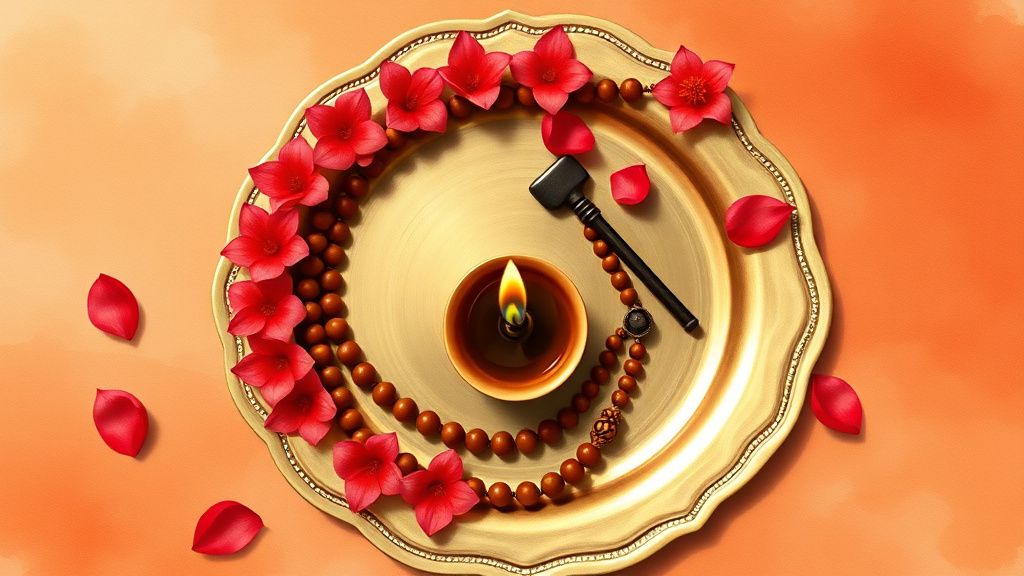
- The lamp: a small oil lamp or ghee lamp is lit before the Hanuman image, if a household shrine is present. A few flowers, a stick of incense, and red sindoor or red cloth are the conventional offerings.
Hanuman is conventionally offered red flowers (hibiscus is the traditional choice), sindoor (red vermilion paste, often mixed with oil and applied to the image), and ladoos (sweet flour balls, especially boondi ladoo). The offerings precede the recitation; the recitation closes with a brief aarti.
Pronunciation pointers for the Awadhi text
The text is in Awadhi, not Sanskrit, and Hindi speakers handle it naturally. A few specific notes for those reading from transliteration:
- The opening dohas: Shri Guru charan saroj raj, nij man mukur sudhari / Baranau Raghubar bimal jasu, jo dayak phal chari // Buddhi-hin tanu janike, sumirau pavan-kumar / Bal buddhi vidya dehu mohi, harahu kalesh vikar. The nij in nij man is a short, clean i; not extended.
- “Jai” pronunciations: the standard opening of chaupais like Jai Hanuman gyan gun sagar / Jai Kapis tihu lok ujagar uses jai with a short final glide, not “jay-ee”.
- Retroflex vs. dental: the Awadhi retroflex consonants (ṭ, ḍ, ṇ) are softer than Sanskrit retroflexes but still distinct from dentals. Krishna in the text is Kṛṣṇa; Lakshman is Lakṣmaṇa.
- The Awadhi nasalization: Saugandh Ram ki dilavain and other lines use Awadhi nasal endings; these are softer than the Sanskrit anusvara but distinct from a non-nasal close.
- Speed: the conventional pace is a flowing but unhurried recitation, roughly 4-5 chaupais per minute. Speed-reading the text undermines the rhythm Tulsidas built into the meter.
Best times to chant
- Brahma muhurta: the 90-minute window before sunrise. The pre-dawn hour is the standard preferred time for any devotional recitation.
- Evening: just before or just after sunset, after the household lamp has been lit. This is the most commonly observed Hanuman Chalisa hour in family settings.
- Tuesdays and Saturdays: the conventional Hanuman vrata days. Many practitioners maintain a baseline daily recitation and increase the count to 7 or 11 on these two days.
- Hanuman Jayanti: Chaitra Purnima (March-April), the birth anniversary. Major Hanuman temples in north India hold continuous Akhand Path Chalisa recitations across 24 hours.
- Before sleep: a single recitation before sleep is a widespread household practice, especially in homes with children, since the text is considered protective against fear at night.
Common recitation commitments
- 1 daily: the entry-level commitment, takes around 10 minutes. Suitable for daily practice across years.
- 3 daily: often undertaken during a period of difficulty (illness, court case, examination). 30 minutes.
- 7 daily on Tuesdays and Saturdays: a stepped commitment for the vrata days, alongside the baseline daily 1.
- 11 daily: the strong protective vow, often for 11, 21 or 40 consecutive days as a sustained observance.
- 21 or 40 daily for 21 or 40 days: the deeper vow forms, undertaken with a specific intention named at the start.
For what it’s worth, the most useful initial commitment is one Chalisa recitation per day at the same hour, sustained without break for 40 days. Forty days is the standard length of a mandala observance in north Indian devotional practice. The pattern, repeated across years, is what the lineage tradition describes as the bedrock practice; larger counts on specific days come on top of this baseline.
Common questions
Can the Chalisa be recited mentally?
Yes, although the text is conventionally recited aloud or whispered. Audible recitation has the additional effect of carrying the chaupai rhythm; mental recitation tends to lose the meter. The traditional preference for Awadhi devotional texts is vaikhari (aloud) recitation, with mental japa reserved more for shorter Sanskrit mantras.
What if the recitation is interrupted mid-verse?
The standard rule is to complete the recitation in a single uninterrupted reading. If interrupted by an urgent practical matter, the conventional practice is to restart from the opening doha rather than picking up mid-verse. Phone calls, conversations or any non-recitation activity break the continuity of the chaupai sequence.
Are there days to avoid?
No, the Chalisa has no traditionally prohibited days. Some practitioners reduce or skip recitation during a household death observance period (the 13 days of sutaka) as part of broader ritual restraint, but this is a household custom rather than a rule of the text. Women in menstruation in some households suspend the formal seated recitation; this is observed in some lineages and not in others.
One thing this article does not claim
Pronunciation videos and recordings on the internet vary widely in their fidelity to the Awadhi. The article describes the conventional pronunciation features but cannot serve as a substitute for hearing the recitation done by a trained singer or reciter. Practitioners serious about pronunciation should listen to a recording by a known and respected reciter; the recordings of Sri Hari Om Sharan and of Anup Jalota are widely circulated and serve as conventional reference, though the article does not formally endorse any particular recording.
For the standard textual treatment, see the entry on the Hanuman Chalisa at Wikipedia. The principal Hanuman temple founded by Tulsidas himself is documented at Sankat Mochan Hanuman Temple.