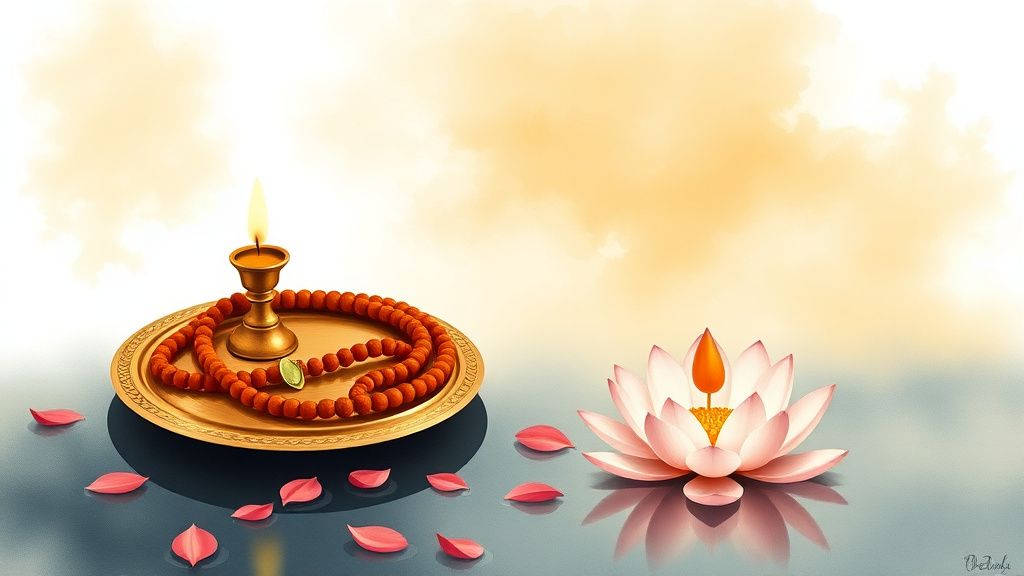
Japa is the meditative repetition of a mantra or a divine name. The Sanskrit root jap- means “to utter in a low voice, repeat internally, mutter”. The classical reference is Patanjali’s Yoga Sutras 1.27-28, which name praṇava (Om) as the verbal form of Ishvara and prescribe tajjapaḥ tadarthabhāvanam, “the repetition of that and the contemplation of its meaning”. A standard japa session uses a 108-bead mala to count repetitions, and the practice is graded by traditional texts into three forms by volume of utterance: spoken aloud, whispered, and mental. This article unpacks the textual sources, the three forms, the role of the mala, and the typical structure of a daily session.
What japa means
The Sanskrit term derives from the root jap- in the sense of soft repeated utterance. In Vedic and post-Vedic literature, the term is used for the recitation of a mantra fixed in mind, repeated across a counted number of cycles. Folk etymology, recorded in several Tantric handbooks, reads the two syllables as ja (“destroys birth”) and pa (“destroys sin”), though this is a devotional gloss rather than a Sanskrit etymology.
Japa is one of the standard limbs of bhakti and yogic discipline. The Bhagavad Gita at 10.25 has Krishna say yajñānāṃ japayajño ‘smi (“of sacrifices, I am the sacrifice of japa”), placing it above the ritual offerings of fire and oblation. In Patanjali’s eightfold Yoga, japa sits in the niyama stage as svādhyāya, the discipline of self-study which includes mantra recitation.
The three forms by volume
Tantric and yogic handbooks consistently classify japa into three grades, differing in the level of audible sound:
- Vaikhari japa: spoken aloud, at conversational or soft volume. The lips move, the syllables are heard. Considered the entry-level form, suitable for beginners and for use in group recitation.
- Upamshu japa: whispered, the lips and tongue moving but the sound barely audible. Traditional texts grade this form as more potent than spoken japa by a factor often given as 100. The Linga Purana and several Tantric manuals make this claim.
- Manasika japa: mental, no movement of lips, no breath modulation, the syllables arising in the mind alone. Traditionally rated as the most potent form, sometimes by a factor of 1,000 over upamshu. The endpoint is ajapā japa, “the japa that does not need to be done”, in which the mantra repeats itself in the consciousness without conscious initiation.
A fourth, less commonly listed form is likhita japa, in which the practitioner writes out the mantra by hand, line after line, often in a dedicated notebook. The visual and tactile attention reinforces the verbal repetition.
The mala and the count of 108
The standard japa mala has 108 beads plus a separate larger head bead, the meru or sumeru. The practitioner advances one bead per repetition of the mantra, beginning from the bead next to the meru and returning to it after 108. The meru bead is not counted; the practitioner does not pass over it but instead reverses the direction of the mala, beginning the next cycle from the same bead.
The number 108 has several traditional readings: 27 lunar mansions multiplied by 4 quarters; the number of upanishadic verses claimed in some lists; the product 1 x 2² x 3³, used in numerological writings. The most consistent traditional defense is simply that 108 is the established count, taught by the lineage and treated as fixed.
Mala materials vary by deity and practice: rudraksha beads for Shiva and most general practice, tulsi wood for Vaishnava japa, sandalwood for Devi practice, crystal for Saraswati and learning-related mantras. A small cloth bag (gaumukhi) is often used to hold the mala during recitation so the beads are not visible.
A typical japa session
A standard household japa session, performed in the morning after bathing or in the evening before the lamp at the home shrine, runs roughly:
- Asana: a comfortable seated posture, typically on a cloth or kusha-grass mat. Padmasana or sukhasana is standard.
- Sankalpa: a brief statement of intention naming the date, the place, the practitioner and the mantra to be recited.
- Pranayama: a short cycle of anuloma viloma or simply three deep breaths to settle the body.
- Mala counting: beginning the mantra, advancing one bead per repetition, completing one full round (108) or more.
- Closing: a brief offering of the merit to the deity or to all beings, and a short period of silence before rising.
A common daily commitment is one mala (108 repetitions) at the same hour each day. Longer commitments are usually framed as anushthana, a fixed undertaking of so many repetitions to be completed within so many days. The Gayatri purascharana, for example, is 2.4 million repetitions; the Om Namah Shivaya purascharana is 550,000.
Choosing a mantra
For what it’s worth, the most stable advice across the bhakti and yoga traditions is that the choice of mantra matters less than the consistency of the practice. A single mantra received from a teacher, or one of the public mantras (Gayatri, Om Namah Shivaya, Hare Krishna, Om Mani Padme Hum in the Buddhist tradition), repeated daily across years, is the standard frame. Switching between mantras in search of the right one tends to undercut the practice. The traditional language is that mantra is a seed: it requires a fixed soil and time.
Common questions
Does japa require initiation from a guru?
Tantric mantras with specific bija seed-syllables traditionally do require diksha (initiation) from a qualified teacher. The public mantras of the Vedic and devotional traditions, including the Gayatri after the 19th-century reform period, Om Namah Shivaya, and the Hare Krishna mahamantra in the Gaudiya tradition, are widely chanted without formal initiation. The line between the two categories is drawn differently by different lineages.
What hand position is used for the mala?
The mala is held in the right hand, draped over the middle finger, advanced bead by bead with the thumb. The index finger is conventionally not used, since it is associated with the ego in tantric anatomy. Some Vaishnava and Buddhist traditions allow other configurations; the right-hand-with-thumb-and-middle-finger is the most widespread default.
Is the count strict?
For formal anushthana with a fixed completion target, yes; missed days or interrupted counts may require restart according to lineage rules. For daily devotional japa without a fixed count, the discipline is regularity rather than exactness. Most teachers prefer that a practitioner do a smaller count daily over years than a large count irregularly.
One thing this article does not claim
Specific health outcomes (lowered blood pressure, reduced anxiety, improved sleep) are sometimes cited for japa in modern wellness writing. Some of these have small published studies behind them; many do not. The article restricts itself to the traditional textual and ritual frame, in which japa is described as a contemplative discipline aimed at cittavṛtti-nirodha (settling of mental fluctuations), moksha, or bhakti. The clinical claims are a separate body of work that the article does not stand in for.
For broader textual background, the entry on Japa at Wikipedia collects the cross-tradition citations. Patanjali’s brief but pivotal treatment of japa is at sutras 1.27-28 of the Yoga Sutras.
