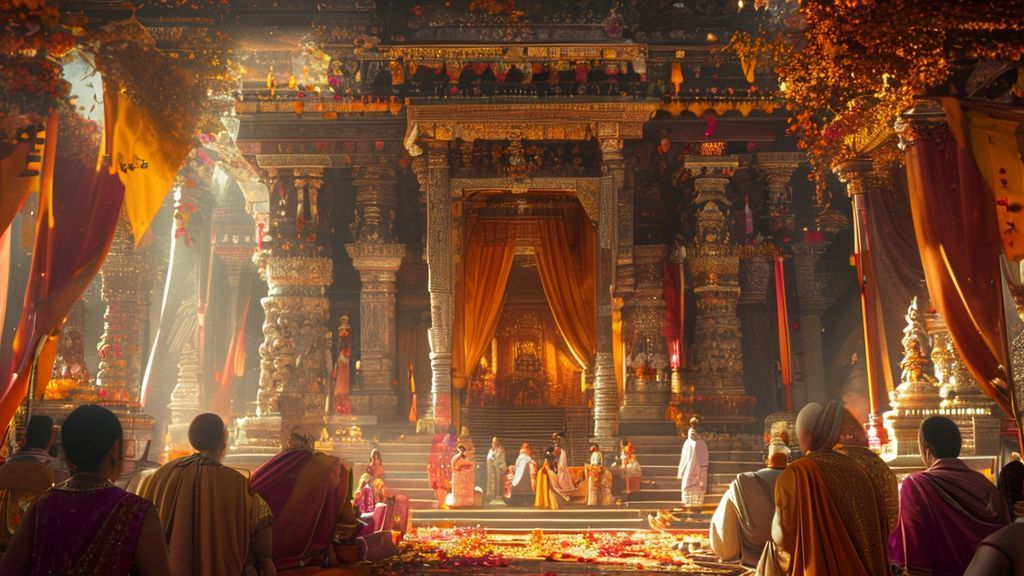
The **Hindu Wedding Mandap** is the sacred, temporary four-pillared structure under which the Vedic wedding ceremony, or Vivaha Sanskar, takes place, symbolizing the marital home, the four Vedas, and the cosmic canopy protecting the union. It is the consecrated space where divine presence is invoked to bless the couple, forming the spiritual epicentre of their union.
| Attribute | Details |
|---|---|
| Primary Purpose | To serve as the consecrated space for the Vivaha Sanskar (Hindu wedding rituals). |
| Core Structure | Typically four pillars, supporting a canopy, often adorned with traditional elements. |
| Key Elements | Homa Kund (sacred fire pit), sacred water vessels (Kalasha), images of deities, flowers, fabrics, and traditional decorations. |
| Central Deity | Agni Devata (Fire God), invoked as the divine witness to the marriage vows. |
| Symbolism of Pillars | Represents Dharma (righteousness), Artha (prosperity), Kama (desire), Moksha (liberation); also the four parents or four Vedas. |
| Scriptural Reference | Rooted in Vedic Grihya Sutras (e.g., Ashvalayana, Gobhila) and Dharma Shastras (e.g., Manusmriti) for sacred ritual spaces. |
The Sacred Canopy: Unveiling the Hindu Wedding Mandap
In the profound tapestry of Sanatan Dharma, the Vivaha Sanskar, or Hindu wedding, stands as one of the most sacred and transformative rites of passage. At its very core lies the Mandap, not merely a decorative structure, but a consecrated microcosm of the universe, a temporary temple where two souls unite under divine auspices. This sacred space is where the most significant vows are exchanged, the divine Agni (fire) is invoked as a witness, and the blessings of ancestors and deities are sought. The Mandap embodies the spiritual gravity and cultural richness of Hindu matrimony, serving as the fulcrum for the journey from individuality to shared destiny. For those seeking a deeper understanding of these eternal traditions, further insights are available on Hindutva.online.
Its spiritual significance transcends mere aesthetics; it is designed to encapsulate the couple and their families in an aura of piety and protection, establishing a sanctified environment where the divine presence is palpable. Every element within and around the Mandap is meticulously chosen to resonate with Vedic wisdom and auspicious symbolism, making the wedding ceremony a powerful spiritual experience.
Vedic Roots: The Puranic & Scriptural Origins of the Sacred Space
While a specific “Puranic story” of the Mandap’s creation is not found, its conceptual genesis is deeply embedded in the ancient Vedic tradition of establishing sacred spaces for performing Yajnas (sacrifices) and Sanskars (rites of passage). The Vedas, particularly the Grihya Sutras like the Ashvalayana Grihya Sutra and Gobhila Grihya Sutra, meticulously describe the rituals for marriage and the preparation of the sacred fire altar (Homa Kund), which is always central to the Mandap. These texts lay down the foundation for creating a purified, protected area for these pivotal ceremonies.
The concept of a temporary, consecrated enclosure for important rituals dates back to Vedic times, where Rishis (sages) would erect simple shelters or “yajnavedi” (sacrificial altars) for their spiritual practices. The Mandap, in its modern elaborate form, evolved from these basic structures, adapting to societal changes while retaining its core function as the ultimate sacred precinct for the Vivaha Yajna. It symbolizes the couple’s future home, established with divine blessings, much like a Grihastha (householder) establishes their home around the sacred fire. The four pillars can be seen as representing the four corners of the universe, or the four directions, signifying the cosmic reach of the union, guarded and blessed by the divine. The canopy above functions as a celestial dome, sheltering the union under the watchful eyes of the Gods and the infinite sky.
Architectural Splendor & Symbolic Elements of the Mandap
The Mandap is a masterpiece of symbolic architecture, designed not just for beauty but to embody profound Vedic principles. Its structure, typically a four-pillared canopy, is rich with meaning:
- The Four Pillars (Stambha): These are perhaps the most iconic feature, traditionally representing the four parents (two from each side), who support and guide the couple. Deeper spiritual interpretations link them to the four Vedas (Rig, Sama, Yajur, Atharva), the four Ashramas (Brahmacharya, Grihastha, Vanaprastha, Sanyasa), or the four aims of human life: Dharma (righteousness), Artha (prosperity), Kama (fulfillment of desires), and Moksha (liberation). They signify the strong foundations upon which the marital life is built.
- The Canopy (Vitana): The roof or canopy covering the pillars symbolizes the celestial dome, protection, and the expansive sky under which the union is blessed. It acts as a divine umbrella, signifying shelter, comfort, and the blessings from the cosmos.
- The Homa Kund (Sacred Fire Pit): Placed at the very centre of the Mandap, the Homa Kund is indispensable. The sacred fire, Agni, is invoked as the divine witness (Agni Devata) to the vows. Offerings made into this fire purify the atmosphere, invoke divine grace, and solidify the promises made. The smoke carries the prayers to the heavens.
- The Altar (Vedi): Surrounding the Homa Kund, the Vedi is where many smaller ritual items are placed, such as rice, ghee, sacred herbs, and water pots (Kalashas). The Kalasha, often adorned with mango leaves and a coconut, symbolizes creation, abundance, and fertility, invoking the presence of Lakshmi and other deities.
- Directional Alignment: Traditionally, the Mandap is oriented to face East, the direction of the rising sun, symbolizing new beginnings, light, and enlightenment. The couple often faces East during key rituals.
- Decorations: Adornments like fresh flowers (especially marigolds, roses, and jasmine), vibrant fabrics, intricate designs (Rangoli), mango leaves, and images of benevolent deities (like Ganesha and Lakshmi) further enhance the sanctity and beauty of the space. These elements not only create an aesthetically pleasing environment but also carry specific auspicious meanings, inviting positive energies and blessings.
Rituals & Puja Vidhi Within the Mandap
The Mandap serves as the stage for a multitude of sacred rituals, each imbued with profound significance. While regional variations exist, the core Vivaha Sanskar rituals generally include:
- Vara Satkar (Welcoming the Groom): The groom and his family are formally welcomed at the entrance of the Mandap by the bride’s parents, often with an Aarti and presentation of sweets.
- Kanya Agaman (Arrival of the Bride): The bride makes her grand entrance, often escorted by her maternal uncle, symbolizing the family’s support and love as she steps into her new life.
- Kanya Daan (Giving Away the Bride): The most emotionally poignant ritual where the bride’s parents symbolically offer their daughter to the groom, signifying their trust and the relinquishment of their parental responsibility to the groom.
- Hasta Melap (Joining of Hands): The hands of the bride and groom are formally joined, often with a sacred thread, symbolizing their inseparable union.
- Vivaha Homa (Invoking the Sacred Fire): The Agni Devata is invoked, and offerings (Aahutis) of ghee, grains, and herbs are made into the Homa Kund by the couple, guided by the priest.
- Pani Grahan (Taking the Bride’s Hand): The groom formally takes the bride’s hand, vowing to accept her as his wife and lifetime companion.
- Mangal Phera / Saptapadi (Circumambulations and Seven Vows): The couple circumambulates the sacred fire four or seven times (Mangal Phera), each round representing a vow and a promise for their married life. The Saptapadi, or Seven Steps, are the most crucial, where each step signifies a specific vow for their shared future, including promises of mutual respect, prosperity, health, and progeny.
- Ashirwad (Blessings): The ceremony concludes with blessings from the priest, parents, and elders, showering the couple with good wishes for a harmonious and prosperous life together.
Sacred Mantras & Chants for Marital Harmony
Within the Mandap, a continuous stream of Vedic mantras, slokas, and chants sanctifies the atmosphere and invokes divine blessings. Some key mantras include:
- Agni Invocation:
ॐ अग्निं दूतं पुरो दधे हव्यवाहमुपब्रुवे। देवाँ आ सादयादिह॥
Om Agnim Dhootam Puro Dadhe Havyavāhamupabruve. Devāṁ ā Sādayādihā.
(Meaning: I place Agni, the messenger, in front; I call upon the carrier of oblations, may he bring the gods here.) This mantra invokes Agni as the divine messenger and witness. - Saptapadi Vows (Examples): Each step of the Saptapadi is accompanied by a specific mantra, reflecting the vow. For instance, for the first step, the groom often says:
एष एकपदी भव सा मा अनुव्रता भव। पुत्रान् विन्दावहै बहून् ते सन्तु जरदष्टयः॥
Eṣa ekapadī bhava sā mā anuvratā bhava. Putrān vindāvahai bahūn te santu jaradaṣṭayaḥ.
(Meaning: Take the first step, may you be devoted to me. May we have many sons, who may live to a full age.) These mantras solidify the seven vows the couple takes. - General Prosperity & Blessing Mantras: Priests also chant various shanti (peace) and svasti (well-being) mantras to ensure the couple’s long and fulfilling life together.
Dos and Don’ts for Respectful Participation
Participating in a Hindu wedding ceremony within the Mandap requires reverence and adherence to certain cultural norms:
- Do:
- Maintain sanctity: Treat the Mandap as a sacred space, comparable to a temple.
- Dress appropriately: Wear traditional or formal attire that is modest and respectful.
- Participate with devotion: Be present and respectful during the rituals.
- Offer blessings: Greet the couple with genuine well-wishes.
- Observe silence: Especially during key mantra recitations.
- Don’t:
- Wear shoes inside the Mandap area.
- Engage in loud conversations or disruptive behaviour.
- Turn your back to the Homa Kund or the deities.
- Consume non-vegetarian food or alcohol within the premises of the wedding venue, especially if traditional customs are observed.
- Disrespect any ritual or custom, even if you do not fully understand it.
Frequently Asked Questions About the Mandap
Why are there always four pillars in a Mandap?
The four pillars of the Mandap symbolize various foundational aspects of life and marriage, including the four parents (representing the union of two families), the four Vedas (Rig, Sama, Yajur, Atharva) as sources of spiritual knowledge, and the four Purusharthas (Dharma, Artha, Kama, Moksha) – the righteous goals of human existence. They represent the strong, unwavering support system for the couple’s new journey.
What is the significance of the Homa Kund (sacred fire) in the Mandap?
The Homa Kund, with its sacred fire (Agni), is the most crucial element. Agni is revered as a divine messenger (Agni Devata) and a pure witness to the vows exchanged. Offerings into the fire purify the atmosphere, invoke blessings from deities, and solidify the sacred promises made by the couple. It signifies the light of knowledge, the power of purification, and the eternal nature of the divine presence.
Is the Mandap essential for every Hindu wedding?
Yes, for a traditional Vedic Hindu wedding, the Mandap is considered essential. It is the consecrated space where the Vivaha Sanskar rituals, particularly those involving the Homa Kund and Saptapadi, are performed. Without this sacred enclosure, the authenticity and spiritual efficacy of the Vedic marriage ceremony are considered incomplete.
How are Mandaps typically decorated, and do the decorations have meaning?
Mandaps are decorated with fresh flowers, vibrant fabrics, traditional rangoli patterns, sacred plants like mango leaves and banana trees, and images of benevolent deities (like Ganesha and Lakshmi). These decorations are not merely aesthetic; they carry deep symbolic meaning. Flowers symbolize joy, purity, and fertility; colours represent auspiciousness and emotional states; and divine images invite blessings, creating a spiritually charged and beautiful environment for the sacred union.
Preserving Sanatan Dharma: The Enduring Significance of the Mandap
The Hindu Wedding Mandap is far more than a temporary structure; it is a profound embodiment of Sanatan Dharma’s eternal values. It represents the sanctity of marriage as a spiritual union, not just a social contract. By creating this sacred space, we reiterate our commitment to Vedic traditions, ensuring that new generations understand the depth and reverence required for such a pivotal life event. The rituals performed within the Mandap infuse the marital journey with divine blessings, guiding the couple towards a life of Dharma, Artha, Kama, and Moksha. It is a powerful reminder that every Hindu home, at its foundation, is consecrated by divine principles, fostering harmony, spiritual growth, and the continuity of our rich cultural heritage. Through the Mandap, we honour our ancestors, connect with the divine, and lay the foundation for a righteous and blissful future, truly living the ideals found on Hindutva.online.
