Vishnu is conventionally depicted with four arms holding four attributes: the Sudarshana Chakra (discus), the Panchajanya (conch, also called shankha), the Kaumodaki (mace, also called gada), and the Padma (lotus). The first three are the “weapons” in the strict sense; the lotus is a non-weapon attribute that completes the iconographic set. The standard iconographic order is given in the Vishnu Purana and the Agni Purana, with twenty-four named configurations depending on which hand holds which attribute. Each configuration corresponds to one of Vishnu’s twenty-four murti-forms (Keshava, Narayana, Madhava, Govinda, and so on). This article describes the three weapons in turn, their puranic origin stories, their symbolic meaning, and their role in the major narratives where Vishnu (or his avatars Rama and Krishna) wield them.
The Sudarshana Chakra
The Sudarshana Chakra (“good vision discus”) is Vishnu’s most distinctive weapon. The name combines su (auspicious) with darshana (sight, vision). In standard iconography it appears in Vishnu’s upper right hand, depicted as a spinning disc with serrated edges and flame-like rays. The principal puranic origin story comes from the Vishnu Purana and the Markandeya Purana: the divine architect Vishvakarma forged the chakra from the brilliance of the sun, which had been pared down at the request of his daughter Sanjna who was unable to bear her husband Surya’s full intensity. The three objects fashioned from the discarded brilliance are the Pushpaka Vimana (used by Kubera and later by Ravana), the Trishula of Shiva, and the Sudarshana Chakra of Vishnu.
Key narratives in which the chakra appears:
- The beheading of Shishupala (Mahabharata, Sabha Parva): Krishna beheads his cousin Shishupala at Yudhishthira’s Rajasuya yajna after Shishupala exceeds the promised one hundred insults. The chakra returns to Krishna’s hand after the act.
- The death of Jayadratha (Mahabharata, Drona Parva): Krishna obscures the sun with the chakra to deceive Jayadratha into emerging from cover, enabling Arjuna to kill him within the day’s deadline.
- The Samudra Manthana (Vishnu Purana): the chakra cuts Mount Mandara during the churning of the ocean.
- The beheading of Rahu: Vishnu severs Rahu’s head with the chakra after Rahu drinks the amrita disguised as a deva.
In Vaishnava theology the chakra is treated as a personification, Chakraperumal or Sudarshana Murti, with his own iconographic form (eight or sixteen arms, flaming aspect). Dedicated shrines to Sudarshana exist within several major Vaishnava temples, including the Srirangam complex in Tamil Nadu and the Sri Varadaraja Perumal temple at Kanchipuram. Standalone Sudarshana temples are rare.
The Panchajanya conch
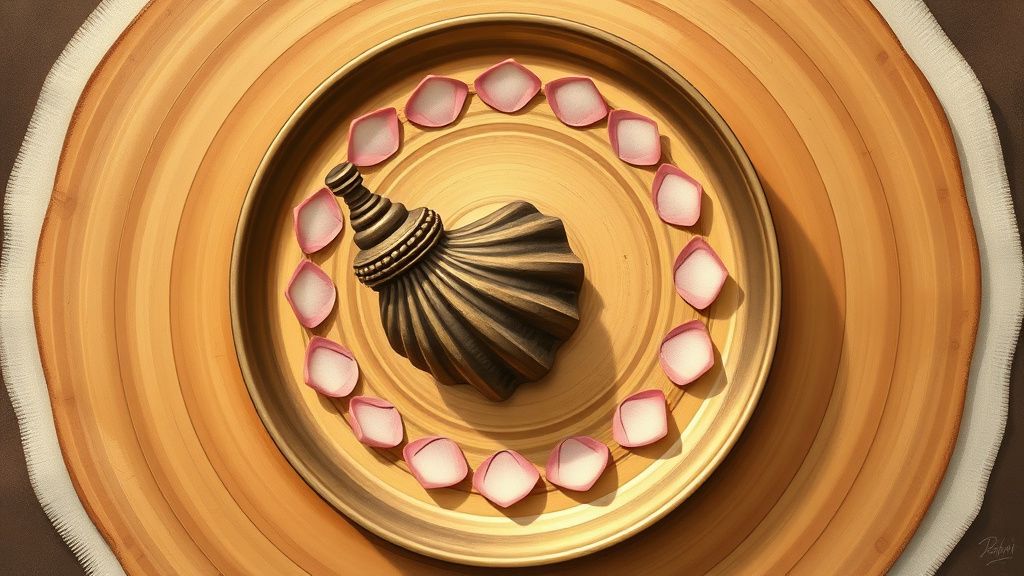
The Panchajanya is Vishnu’s conch shell, the source of the cosmic sound that announces auspicious beginnings. The Mahabharata gives the origin story (Adi Parva): Vishnu killed a daitya named Panchajana who lived in the form of a conch on Mount Chakravan in the ocean, and took the conch shell that Panchajana had inhabited. The Skanda Purana offers a variant: Krishna’s guru Sandipani’s son was swallowed by a sea-dwelling daitya named Panchajana; Krishna killed Panchajana, recovered the boy, and kept the conch.
The Panchajanya appears most prominently in the opening of the Bhagavad Gita (Mahabharata, Bhishma Parva, 1.15-1.18). At the start of the Kurukshetra war, Krishna sounds the Panchajanya alongside Arjuna’s conch Devadatta, Yudhishthira’s Anantavijaya, Bhima’s Paundra, Nakula’s Sughosha, and Sahadeva’s Manipushpaka. The sound is described as filling earth and sky and shaking the hearts of the Kaurava army. Iconographically the Panchajanya is depicted as a right-spiralling (dakshinavarti) conch in Vishnu’s upper left hand, often with a serpentine ornament around the base.
The Kaumodaki mace
The Kaumodaki is Vishnu’s mace, depicted in his lower right or lower left hand depending on the murti-form. The name appears first in the Mahabharata (Adi Parva), where the mace is given to Krishna by Varuna, the god of the seas, alongside the discus Sudarshana given to Vishnu and the bow Gandiva given to Arjuna. The gift is connected with the burning of the Khandava forest by Agni; the divine weapons are bestowed to assist Agni’s task.
Symbolically, the mace is associated in the Vaishnava commentarial tradition with the intellect (buddhi), the power of knowledge (jnana-shakti), and the principle of time (kala). Later iconography sometimes personifies the mace as Gadadevi, a female form holding ornamental marks of the weapon, who appears as one of the attendants of Vishnu in temple sculpture. The earliest sculptural form of the Kaumodaki is a simple rod, visible in Kushan-period Vishnu images (1st-3rd century CE); medieval forms develop the elaborate fluted and segmented mace familiar from south Indian Pallava and Chola sculpture.
The twenty-four murti-form scheme
The four-armed Vishnu icon admits twenty-four configurations depending on the order in which the four attributes are held. The Agni Purana (chapter 49) and the Padma Purana codify the standard list. The twenty-four murti-names follow the cycle of the chakra-shankha-gada-padma order through every permutation:
- Keshava: lower right padma, upper right shankha, upper left chakra, lower left gada.
- Narayana: lower right shankha, upper right padma, upper left gada, lower left chakra.
- Madhava: lower right gada, upper right chakra, upper left padma, lower left shankha.
- Govinda, Vishnu, Madhusudana, Trivikrama: and through seventeen further forms to complete the cycle.
The twenty-four names are recited as the Vishnu Sahasranama’s nucleus and appear in the daily sandhya-vandana of orthodox Vaishnavas. The naming convention provides a precise system for identifying a Vishnu image in temple sculpture or in a household icon.
A note on the symbolic readings
For what it’s worth, the symbolic readings attached to each attribute (chakra as the wheel of time, conch as the primordial sound, mace as the intellect, lotus as the unfolding cosmos) are most reliably found in the commentarial tradition (the Vaishnava acharyas Ramanuja and Madhva, and later Vedanta Desika), not in the puranic source texts themselves. The puranas tell the origin stories and describe the narrative use of the weapons; the symbolic-allegorical reading is a later interpretive layer. Both layers are part of the living tradition and both repay attention, but a careful reader keeps them distinguished.
Common questions
Why does Vishnu have four arms?
The four arms are an iconographic convention shared with several major Hindu deities, representing the four cardinal directions, the four Vedas, the four varnas, or simply divine plenitude in a way the two-armed human body cannot. Vishnu’s four arms specifically hold the four attributes that identify him; without the chakra and shankha in particular, the image would be visually ambiguous.
Do Vishnu’s avatars use the same weapons?
The major avatars use a different weapon set appropriate to their narrative. Rama wields a bow (typically the Kodanda); Krishna uses both the Sudarshana Chakra and the Panchajanya in the Mahabharata; Parashurama uses an axe; Narasimha uses claws. The four standard attributes are specifically Vishnu’s, not the avatars’.
What is the right-spiral significance of the Panchajanya?
A dakshinavarti (right-spiralling) shankha is one whose internal spiral, viewed from the open end, turns clockwise. This direction is rare in nature (most conches spiral the other way) and is considered exceptionally auspicious in temple ritual. The Panchajanya is described in the puranic literature as dakshinavarti, which is part of why the conch itself, beyond its function as a sound-producing object, is treated as sacred.
Is the Sudarshana Chakra ever physical?
In temple ritual, a metal Sudarshana Chakra icon is processed in some Vaishnava traditions, particularly at Srirangam. The chakra-yantra (a geometric diagram with the chakra at its centre) is used in tantric practice associated with the Vaishnava goddess traditions. The “physical” chakra in ritual is symbolic, not a recovered relic.
One limitation worth noting
The puranic accounts of the weapons are not uniform across the corpus. The Vishnu Purana, the Markandeya Purana, the Bhagavata Purana, and the Skanda Purana each have variant versions of the origin stories, and the Vaishnava sectarian texts (Pancharatra Agamas, Vaikhanasa Agamas) introduce additional details specific to their traditions. The article above takes the most widely attested versions; readers tracking a specific temple’s iconographic programme should consult the local sthala-purana or the relevant Agama.
For background see the Sudarshana Chakra Wikipedia entry and the Panchajanya Wikipedia entry.