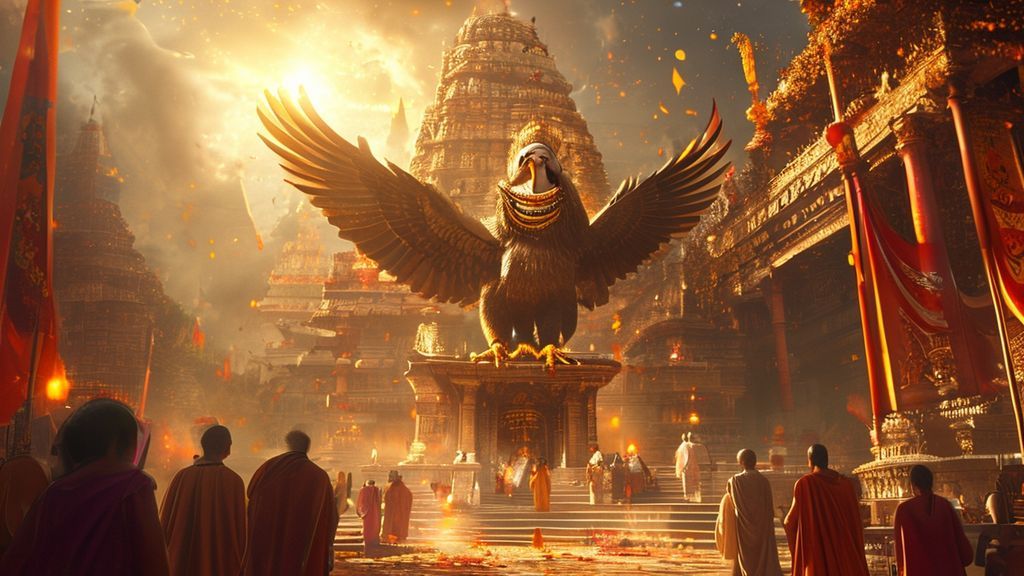
Eagle Dream: Garuda Symbolism in Hinduism centers on Garuda, the divine Vahana of Lord Vishnu, representing unparalleled strength, cosmic speed, and unwavering devotion. Revered as the king of birds, he embodies Vedic knowledge, fearlessness, and the triumph of divine wisdom over ignorance, protecting devotees and upholding Dharma.
| Attribute | Details |
|---|---|
| Deity / Form | Garuda (गरुड़), the Divine Eagle, Vahana of Lord Vishnu |
| Parentage / Origin | Son of Sage Kashyapa and Vinata; born from a golden egg. His sibling is Aruna, charioteer of Surya Dev. |
| Key Symbolism | Strength, speed, courage, devotion, liberation, Vedic knowledge, protector against venom and negativity, destroyer of evil. |
| Key Festival | Garuda Panchami (श्रावण शुक्ल पञ्चमी), observed during Shravana month. |
| Scripture References | Mahabharata (Adi Parva), Vishnu Purana, Bhagavata Purana, Garuda Purana, Skanda Purana. |
| Iconography | Golden-bodied, white face, red wings, eagle’s beak, human-like torso, four arms (often carrying conch, discus, mace, lotus), adorned with jewels and a crown. |
The Mighty Garuda: A Pillar of Sanatan Dharma
In the vast cosmology of Sanatan Dharma, certain divine beings transcend their literal forms to embody profound philosophical truths. Among these, Garuda, the majestic king of birds, stands supreme. More than just the mount of Lord Vishnu, Garuda is a dynamic symbol of courage, unwavering devotion, liberation, and the formidable power of Vedic knowledge. His very presence in iconography and narratives inspires devotees to overcome challenges, rise above ignorance, and strive for spiritual freedom. The symbolism of Garuda pervades our temples, scriptures, and daily lives, serving as a constant reminder of divine protection and the ultimate triumph of Dharma.
Garuda, often referred to as Garutman, Suparna, or Vinatāputra (son of Vinata), is an archetype of resolute action against injustice and a beacon of hope for those seeking protection from adversarial forces. His story is not merely a tale of a mythical creature, but a profound teaching on filial piety, self-sacrifice, and the attainment of immortality through righteous endeavor.
Puranic History and Legend: The Birth of a Divine Champion
The epic saga of Garuda’s origin and valor is extensively narrated in various Puranas and Itihasas, most notably the Adi Parva of the Mahabharata, the Vishnu Purana, and the Bhagavata Purana. He is born to the great Rishi Kashyapa and his wife Vinata. Vinata’s sister, Kadru, mother of the Nagas (serpents), was a source of constant rivalry. Through a deceitful wager concerning the color of the divine horse Uchchaishravas, Kadru enslaved Vinata and, consequently, Garuda.
Driven by intense filial love and a burning desire to liberate his mother, Garuda sought counsel from his enslaved mother. The Nagas, mocking, demanded the celestial nectar of immortality, Amrita, as the price for Vinata’s freedom. This seemingly impossible task became Garuda’s divine mission. His legendary journey to Svarga (heaven) to retrieve the Amrita is a testament to his unparalleled strength and determination.
He battled and defeated countless celestial beings, including Indra and the Devas, demonstrating his invincible prowess. Ultimately, through a combination of strategic brilliance and immense power, Garuda acquired the pot of Amrita. Before he could deliver it to the Nagas, Lord Vishnu appeared, impressed by Garuda’s devotion and strength. Vishnu offered Garuda immortality without consuming the Amrita and the boon of becoming his eternal Vahana (mount), with the condition that Garuda would remain humble. In return, Garuda pledged eternal service and sought the boon of being superior to the Nagas, who had enslaved his mother.
As prophesied by Vishnu, Garuda tricked the Nagas. He placed the Amrita on the Kusha grass, instructing them to purify themselves before partaking. While the Nagas were bathing, Indra swiftly reclaimed the Amrita. Thus, Vinata was freed, the Nagas were deprived of immortality, and their tongues were split while licking the sharp Kusha grass in vain. This incident established Garuda’s eternal enmity with the serpents, symbolizing the triumph of Dharma over deceit and the subjugation of base desires (represented by the Nagas) by divine knowledge and courage.
Symbolic Representations in Art & Iconography
Garuda’s magnificent form is a central feature in Hindu temple architecture and iconography, particularly in Vaishnava traditions. He is typically depicted with a golden body, a white face, and powerful red wings, an eagle’s beak, and often a human torso and limbs. In his more elaborate forms, he may possess four arms, holding Vishnu’s attributes: the Shankha (conch), Chakra (discus), Gada (mace), and Padma (lotus). He is frequently shown kneeling in devotion before Lord Vishnu, with palms joined in Anjali Mudra.
His presence is paramount in Vishnu temples, where a separate shrine or a towering Garudastambha (Garuda pillar) often stands directly opposite the main deity, facing the sanctum. This placement signifies his perpetual readiness to serve the Lord and his role as a protector of the temple and its devotees. In South Indian Dravidian architecture, particularly on the towering Gopurams (temple gateways), Garuda is sculpted with intricate detail, often positioned high above, appearing to guard the celestial path to the temple’s inner sanctum.
The Garudadhwaja, the flag bearing Garuda’s emblem, is hoisted during temple festivals and processions, signifying the presence and protection of Lord Vishnu. This flag is a powerful visual symbol of victorious Dharma, dispelling all negativity and ensuring the auspiciousness of any endeavor. The symbolic richness of Garuda extends to even the smallest household shrines, where his image reminds devotees of courage, devotion, and divine grace, often found on sacred vessels and amulets as well. Discover more about such profound symbols at Hindutva.online.
Rituals & Puja Vidhi for Garuda Devotees
While Garuda is primarily revered as an extension of Lord Vishnu’s glory, specific rituals and prayers are dedicated to him, particularly for protection, courage, and relief from afflictions. The most significant day for his worship is Garuda Panchami, observed on the fifth day of the bright fortnight in the Hindu month of Shravana. This day commemorates his power over serpents and is invoked for protection against snake bites, venom, and all forms of negativity and fear.
Devotees seeking his blessings often perform a simple puja:
- Sankalpa: Begin with a clear intention, invoking Garuda for desired protection or strength.
- Avahana: Invoke Lord Garuda, mentally visualizing his powerful form.
- Asana: Offer a seat to the deity.
- Snana: Offer sacred water for bathing.
- Vastra & Upachara: Present sacred clothing (symbolically), flowers, incense (dhoop), lamp (deep), and camphor (karpura).
- Naivedyam: Offer fruits, milk, or sweets as prasada.
- Mantra Japa: Chant Garuda Mantras (see below) with devotion.
- Aarti: Conclude with the waving of a lamp, singing his glories.
- Pranama: Offer prostrations and seek blessings.
Regular worship of Garuda, especially for those who travel frequently or face particular fears, is believed to bestow fearlessness, immense strength, and the ability to overcome obstacles, much like Garuda himself. He is the ultimate protector against spiritual and physical poisons.
Mantras & Chants for Garuda
Chanting Garuda Mantras invokes his protective energies, grants courage, and helps in overcoming fear and obstacles. The most potent and commonly recited mantra is the Garuda Gayatri Mantra:
ॐ पक्षि राजाय विद्महे, सुवर्ण पक्षाय धीमहि, तन्नो गरुड़: प्रचोदयात्॥
Om Pakshi Rajaya Vidmahe, Suvarna Pakshaya Dhimahi, Tanno Garudah Prachodayat.
(Meaning: “May we know the King of Birds, may we meditate on the Golden-winged One, may that Garuda inspire us.”)
Another powerful mantra for protection is:
गरुड़ाय नमः ॥
Garudaya Namah.
(Meaning: “Salutations to Garuda.”)
Devotees can also chant Vishnu Sahasranama, where Garuda is implicitly praised through the glorification of Lord Vishnu, his supreme master. Reciting these mantras with unwavering faith is believed to grant the devotee the mental fortitude to face challenges and dispel all forms of fear and negative influences.
Dos and Don’ts in Garuda Worship
- Do’s:
- Maintain purity of mind and body during worship.
- Show immense reverence for eagles and all birds, recognizing them as sacred.
- Meditate on Garuda’s qualities: devotion, courage, speed, and wisdom.
- Offer prayers with genuine sincerity, seeking protection and strength.
- Remember his eternal connection and subservience to Lord Vishnu.
- Don’ts:
- Disrespect or harm any bird, particularly eagles, as they are symbols of Garuda.
- Engage in frivolous or impure thoughts while performing Garuda puja or chanting mantras.
- Forget the philosophical message: Garuda represents the triumph of knowledge over ignorance, not mere physical power.
- Use his symbolism for malicious intent or to harm others.
Why is Garuda considered the sworn enemy of serpents in Hinduism?
Garuda’s eternal animosity towards serpents (Nagas) stems from the deceitful wager between his mother, Vinata, and her sister, Kadru (mother of the Nagas). Kadru tricked Vinata into slavery, which extended to Garuda. To free his mother, Garuda had to procure Amrita from the heavens for the Nagas. Though he succeeded, he cleverly outwitted them, preventing them from achieving immortality while freeing his mother. This historic event, detailed in the Mahabharata, solidified his role as the vanquisher of serpents, symbolizing the overcoming of base desires and earthly attachments.
What spiritual lessons can devotees learn from Garuda’s symbolism?
Garuda embodies profound spiritual lessons. His unwavering devotion to Lord Vishnu teaches us the paramount importance of Bhakti (devotion). His arduous journey to acquire Amrita for his mother highlights selfless service and filial piety (Dharma). His victory over the Devas and Nagas represents the triumph of truth and righteousness over deceit and illusion. Ultimately, Garuda symbolizes the ability of the discerning intellect (Vedic knowledge) to overcome all obstacles, temptations, and negative forces, leading to liberation and spiritual freedom, an ideal central to Hindutva.online‘s mission.
Is Garuda worshipped independently, or only as Vishnu’s Vahana?
While Garuda is inextricably linked to Lord Vishnu and is primarily revered as His divine Vahana, he also receives independent worship, particularly on specific occasions like Garuda Panchami. Devotees may invoke him for protection against venomous creatures, for courage, speed, and to dispel fear and negative energies. Many Vishnu temples have separate shrines for Garuda, where devotees offer prayers directly to him, acknowledging his unique powers and significance as a protector and a symbol of pure devotion.
Why This Matters for Every Hindu
The symbolism of Garuda is not merely a mythological narrative; it is a living principle guiding every sincere seeker of Sanatan Dharma. Garuda represents the quintessential devotee – powerful, yet humble; swift, yet unwavering in his purpose; a protector of Dharma and a servant of the Divine. His story instills faith in the ultimate victory of good over evil, reminds us of the power of selfless action, and teaches us to cultivate unwavering devotion. To understand Garuda is to understand a fundamental pillar of Vaishnava theology and the broader Hindu ethos of striving for excellence, protecting righteousness, and surrendering to the Supreme Lord. His golden wings continue to carry the aspirations of countless devotees towards liberation and eternal truth.